Learning Path through the Matheo Study Series#
#AuditTheMath campaign takes off.An early, untested draft — anchored to MMv5
This is an early-draft learning path that has not been tested. It is specific to the MMv5 release of the Matheo Study Series — the citable public floor. Where a study exists in MMv5, each step gives a triplet of links: the MMv5 page first, its PDF second, and the original HELL development file last (for context). Some development-only artifacts (adversarial reviews, foundation tests) exist only in HELL and are linked there directly.
How to Use This Page#
The Matheo Study Series consists of eleven studies (b11–b21) — thirty-two individual papers in all, counting each study’s formal paper plus its companion versions for different audiences. The series builds a cumulative argument from formal axioms to a call to action, running to well over 200,000 words.
Note
The detailed reading routes below were first built for the b11–b18 core and have not yet been extended to the three later studies (b19 SGIR, b20 WorkLogic, b21 AI co-authorship). Treat the routes as covering the backbone; all eleven studies are listed in the Matheo Study Series map.
This page offers structured reading paths matched to your background and available time. Each path lists documents in dependency order, with estimated reading times and exit ramps so you can stop at any point with a coherent understanding of what you have read so far.
Reading time estimates assume ~250 words per minute for general reading and ~200 words per minute for formal/mathematical content. Actual times will vary by background and reading style.
Series at a Glance#
Code |
Title |
What It Does |
Prereqs |
|---|---|---|---|
b11 |
PET: Formal Panentheism |
14 axioms in mereology + S5 modal logic formalizing “all is in God, but God exceeds all.” Six-tradition scriptural convergence. |
None |
b12 |
e7Day: Self-Correcting Construction |
20 axioms + 7 theorems defining the BABL/ZION/OSCR framework for self-correcting systems. Five audience-specific companion papers. |
b11 |
b13 |
e7He: Anti-BABL Inoculation |
7-stage Hero Journey as BABL inoculation. Supervillain theorem. Commitment trichotomy. Hero Journey Quartet card game. |
b12, b14 |
b14 |
JUB: Innovation Theodicy |
11 axioms (ax15–ax25) + 7 theorems (th5–th11). The Jubilee System as self-stabilizing economics and innovation theodicy. |
b11, b12 |
b15 |
Structural Deadlock |
Formal proof that Divine Simplicity (ax11b) generates structural deadlock with PET’s relational axioms (ax8–ax10). |
b11 |
b16 |
RiskyMAD: Existential Risk |
Stochastic forecast: nuclear winter is certain under MAD over infinite horizons. MAD → MAP transition framework. |
b12, b14 |
b17 |
h* Theorem: Experimental Test |
Causal concentration theorem. 8 transparency criteria for testing the h* hypothesis. Falsification protocol. |
b11, b13, b14 |
b18 |
Call to Action: MAD → MAP |
Integrates all b11–b17 into a call to action for averting accidental nuclear winter. Candidacy and eschatological analysis. |
All |
Dependency Graph#
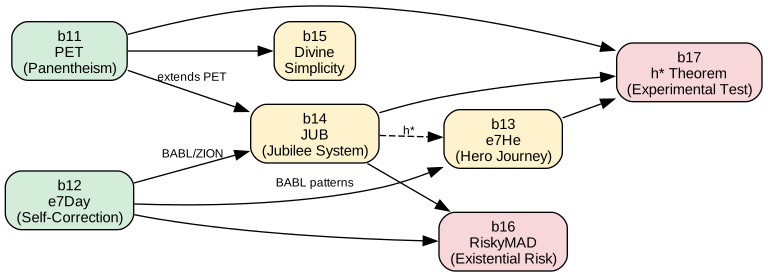
Textual summary:
b11 (PET) ────────────────────────→ b14 (JUB, extends PET)
                                         ↑
b12 (e7Day, independent) ───────────────┘ (BABL/ZION framework)
     ↓
b13 (e7He, uses e7Day BABL patterns + JUB h*)

b15 (Structural Deadlock) ← b11

b16 (RiskyMAD) ← b12, b14

b17 (h* Candidacy) ← b11, b13, b14

b18 (Call to Action) ← ALL (b11--b17)
A GraphViz source file for the full dependency graph (including
sub-papers) is available at
source/matheology/heaven/study/learning-path-matheo-graph.dot.
Document Inventory#
All reading times are estimates. “Intro” papers are written for general readers (age 12+). “Math” papers contain formal axioms and proofs. Companion papers (theophil, econ, polsci, syseng, socpsy) are written for specific disciplinary audiences.
b11 — PET (Matheo-1)#
b12 — e7Day (Matheo-2)#
Document |
Description |
Est. Time |
|---|---|---|
20 axioms + 7 theorems + 1 conjecture. BABL/ZION/OSCR. |
~60 min |
|
General reader introduction. OK vs NOT OK framing. |
~14 min |
|
b12-theophil · MMv5 PDF · HELL |
Theological-philosophical companion. |
~36 min |
b12-syseng · MMv5 PDF · HELL |
Systems engineering companion. |
~31 min |
b12-socpsy · MMv5 PDF · HELL |
Social psychology companion. |
~23 min |
b13 — e7He (Matheo-3)#
Document |
Description |
Est. Time |
|---|---|---|
7-stage Hero Journey as BABL inoculation. Supervillain theorem. |
~34 min |
|
General reader introduction. Bullying opening, card game. |
~14 min |
|
b13-theophil · MMv5 PDF · HELL |
“Born Again Again in the Second Exodus.” Cross-traditional. |
~23 min |
b14 — JUB (Matheo-4)#
Document |
Description |
Est. Time |
|---|---|---|
11 axioms (ax15–ax25) + 7 theorems (th5–th11). Innovation theodicy. |
~44 min |
|
General reader introduction. Why the Jubilee System matters. |
~17 min |
|
Economic and game-theoretic companion. Ostrom, Peters, Piketty. |
~30 min |
|
b14-theophil · MMv5 PDF · HELL |
Theological-philosophical companion. Plantinga, Hick, process. |
~36 min |
b14-polsci · MMv5 PDF · HELL |
Political science. Acemoglu/Robinson, Scheidel, Gene Sharp. |
~40 min |
b15 — Structural Deadlock (Matheo-5)#
b16 — RiskyMAD (Matheo-6)#
b17 — h* Theorem (Matheo-7)#
b18 — Call to Action (Matheo-8)#
Document |
Description |
Est. Time |
|---|---|---|
From MAD to MAP. Patton 8-function structure + candidacy. |
~20 min |
|
General reader introduction. Phase 1 standalone, age 12+. |
~12 min |
|
b18 appendix · MMv5 PDF · HELL |
“Nobody’s Job.” Standalone Phase 2 candidacy. |
~13 min |
Eschatological recognition analysis. For everyone age 12+. |
~7 min |
|
Eschatological recognition. For teachers and preachers. |
~14 min |
|
Eschatological recognition. For scholars and theologians. |
~26 min |
Reader Profiles and Reading Paths#
Profile 1: General Reader#
“I want to understand the core argument without formal mathematics.”
Background assumed: None. These paths use only the general-reader introductions, which are written for age 12+.
Express Path (~1.5 hours)#
Step |
Document |
What You Gain |
Time |
|---|---|---|---|
1 |
What the axiom system claims: 14 axioms, six traditions agree. |
~22 min |
|
2 |
How BABL and ZION work: self-correcting vs self-destroying systems. |
~14 min |
|
3 |
Why the Jubilee System matters: innovation theodicy. |
~17 min |
|
4 |
Why this is urgent: stochastic certainty of nuclear catastrophe. |
~14 min |
|
5 |
The experiment: how to test if the framework works. |
~17 min |
|
6 |
What you can do about it: from MAD to MAP. |
~12 min |
Standard Path (~4 hours)#
The Express Path above, plus:
Step |
Document |
What You Gain |
Time |
|---|---|---|---|
7 |
Hero Journey as BABL inoculation. The card game. |
~14 min |
|
8 |
Why Divine Simplicity creates structural deadlock. |
~15 min |
|
9 |
Full call to action with candidacy. |
~20 min |
|
10 |
Eschatological recognition overview (7 traditions). |
~7 min |
|
11 |
b18 appendix · MMv5 PDF · HELL |
“Nobody’s Job” — the candidacy in full. |
~13 min |
Deep Path (~12 hours)#
The Standard Path above, plus all eight main papers, the teen companion, the eschatological analysis (producer or expert version), and the b11 ax14 case study. Read in paper order: b11 paper, b12-math, b13 paper, b14-math, b15-math, b16 paper, b17 paper, b18-esc expert.
Profile 2: Mathematician / Logician#
“I want the formal system: axioms, theorems, proofs.”
Background assumed: Familiarity with first-order logic, mereology, and modal logic (S5). Some exposure to game theory is helpful for b14+.
Express Path (~1.5 hours)#
Step |
Document |
What You Gain |
Time |
|---|---|---|---|
1 |
Axiom system overview without notation. Six traditions converge. |
~22 min |
|
2 |
BABL/ZION framework overview. What the 20 axioms formalize. |
~14 min |
|
3 |
Jubilee System axioms overview. Innovation theodicy claim. |
~17 min |
|
4 |
h* theorem claim and transparency criteria. |
~17 min |
|
5 |
Where the formal system leads. The testable predictions. |
~12 min |
Standard Path (~5 hours)#
The Express Path above, plus the formal papers:
Step |
Document |
What You Gain |
Time |
|---|---|---|---|
6 |
Full 14 axioms with proofs (mereology + S5 modal logic). |
~33 min |
|
7 |
20 axioms + 7 theorems + 1 conjecture. Full derivations. |
~60 min |
|
8 |
11 axioms (ax15–ax25) + 7 theorems (th5–th11). Full proofs. |
~44 min |
|
9 |
Structural deadlock formal argument. Extensionality analysis. |
~39 min |
|
10 |
h* theorem with CausalInfluence, sub-axiom decomposition. |
~39 min |
Deep Path (~20+ hours)#
The Standard Path above, plus: all adversarial reviews (especially Panel 1 formal logic, Panel 3 game theory), all foundation tests (ZF, DTT, HoTT, summary), the b14 math review (13 reviewers), all author replies and revision llogs, the b16 paper, and the b18 paper.
Profile 3: Theologian / Philosopher#
“I want the theological implications: what does this mean for my tradition?”
Background assumed: Familiarity with classical theism, process theology, or analytic philosophy of religion. Some exposure to cross-traditional dialogue.
Express Path (~1.5 hours)#
Step |
Document |
What You Gain |
Time |
|---|---|---|---|
1 |
Six-tradition axiom convergence. Why this matters theologically. |
~22 min |
|
2 |
Hero Journey as BABL inoculation. “Born Again Again.” |
~14 min |
|
3 |
Innovation theodicy. Why suffering is a system design problem. |
~17 min |
|
4 |
Why Divine Simplicity creates a structural deadlock. |
~15 min |
|
5 |
The call to action: what theology demands. |
~12 min |
Standard Path (~5.5 hours)#
The Express Path above, plus:
Step |
Document |
What You Gain |
Time |
|---|---|---|---|
6 |
b12-theophil · MMv5 PDF · HELL |
e7Day theological-philosophical companion. |
~36 min |
7 |
b13-theophil · MMv5 PDF · HELL |
“Born Again Again in the Second Exodus.” Cross-traditional. |
~23 min |
8 |
b14-theophil · MMv5 PDF · HELL |
Jubilee theodicy: Plantinga, Hick, process theology, Islam/Judaism/Hinduism. |
~36 min |
9 |
Full formal argument. al-Ghazali, 99 Names, Incarnation. |
~39 min |
|
10 |
Full call to action with candidacy and Patton structure. |
~20 min |
|
11 |
Eschatological recognition: 7 traditions. |
~7 min |
Deep Path (~20+ hours)#
The Standard Path above, plus: b18-esc expert · MMv5 PDF · HELL (26 min), b11 paper · MMv5 PDF · HELL (33 min), b11 scriptural review, b11 ax14 case study, the b14 theophil review (14 reviewers), Panel 2 (cult expert), Panel 4 (philosophy), the b18 candidacy brief, and the b18 appendix · MMv5 PDF · HELL.
Profile 4: Political Scientist / Economist#
“I want the governance framework and the policy implications.”
Background assumed: Familiarity with institutional economics, game theory, or political science. Exposure to Ostrom, Acemoglu/Robinson, or nuclear deterrence theory is helpful but not required.
Express Path (~1.5 hours)#
Step |
Document |
What You Gain |
Time |
|---|---|---|---|
1 |
BABL/ZION framework: what makes systems self-destroy or self-correct. |
~14 min |
|
2 |
The Jubilee System: why cyclical resets stabilize economies. |
~17 min |
|
3 |
RiskyMAD: the stochastic certainty argument. |
~14 min |
|
4 |
h* theorem: coordination problem, first-mover, free-rider. |
~17 min |
|
5 |
MAD → MAP: the concrete transition proposal. |
~12 min |
Standard Path (~5 hours)#
The Express Path above, plus:
Step |
Document |
What You Gain |
Time |
|---|---|---|---|
6 |
Economic analysis: Ostrom, Peters, Piketty, mechanism design. |
~30 min |
|
7 |
b14-polsci · MMv5 PDF · HELL |
Political science: Acemoglu/Robinson, Scheidel, Gene Sharp. |
~40 min |
8 |
Full stochastic model. COOP from Mt. 24. |
~25 min |
|
9 |
Full h* theorem: coordination mechanisms, falsification. |
~39 min |
|
10 |
Full call to action: Patton structure + candidacy. |
~20 min |
Deep Path (~20+ hours)#
The Standard Path above, plus: 153 review and alternatives, Panel 3 game theory review, Panel 3 author reply, the b14 econ review (8 reviewers), the b14 polsci review (8 reviewers), all revision llogs, the b12-syseng and b12-socpsy companions, and the b12/b14 foundation tests.
Profile 5: Skeptic / Adversarial Reviewer#
“I want to find the weakest link. Where does this argument fail?”
Background assumed: Any. This path prioritizes documents that expose the system’s known weaknesses, adversarial reviews, and author responses. Start with the strongest claims (b17, b18) and work backward to the foundations.
Deferred — awaiting fresh hostile review
The Skeptic reading paths are not yet available. Earlier adversarial reviews (Panels 1–5, conducted 2026m04d10 against MMv1 drafts) identified serious BREACHes, but many were corrected in subsequent revisions (MMv2, MMv3). Pointing skeptics to outdated critiques would misrepresent the current state of the papers — a form of over-simplification.
A fresh hostile review of the complete series in its current versions will be conducted once all papers reach near-final state. That review will produce the Skeptic’s Express, Standard, and Deep paths based on the actual weaknesses that survive all revisions.
Prompt: Prompt: Fresh Hostile Adversarial Review of the Complete Matheo Series
For now: Skeptics are encouraged to start with b17-intro (the strongest testable claim) and b18 paper (the most ambitious claim), then read the papers in any order. The foundation test summary (ZF, DTT, HoTT) remains current and is available at Foundation Test Summary: Which Formal Foundation for e7Day?.
Cross-Reference: Which Documents Appear in Which Paths#
Document |
General |
Math |
Theo |
PolSci |
|---|---|---|---|---|
b11-intro |
E |
E |
E |
|
b11 paper |
S |
|||
b12-intro |
E |
E |
E |
|
b12-math |
S |
|||
b12-theophil |
S |
|||
b12-syseng |
S+ |
|||
b12-socpsy |
S+ |
|||
b13-intro |
S |
E |
||
b13-theophil |
S |
|||
b14-intro |
E |
E |
E |
E |
b14-math |
S |
|||
b14-econ |
S |
|||
b14-theophil |
S |
|||
b14-polsci |
S |
|||
b15-intro |
S |
E |
||
b15-math |
S |
S |
||
b16-intro |
E |
E |
||
b16 paper |
S |
|||
b17-intro |
E |
E |
E |
|
b17 paper |
S |
S |
||
b18-intro |
E |
E |
E |
E |
b18 paper |
S |
S |
S |
|
b18-esc beginner |
S |
S |
Legend: E = Express path, S = Standard path, S+ = optional Standard extension. Skeptic column deferred (see Profile 5 above).
Notes#
Reading time methodology. Word counts are estimated from RST source line counts using a calibration factor of ~5.5 words per RST line (accounting for directives, blank lines, and structural markup). Where explicit word counts were recorded in production llogs, those are used instead. Reading speed is assumed at ~250 words/minute for general text and ~200 words/minute for formal/mathematical content. All times are rounded to the nearest minute.
Versioning. This page was first drafted 2026m04d18 against the HELL development files, then re-anchored to the MMv5 public floor on 2026m06d07.
The registry of record is now the MMv5 series. The Matheo Study Series is the citable public floor and the authoritative registry. The AAA inbox is now only a holding area; the historical development index it used to hold is archived in HELL.