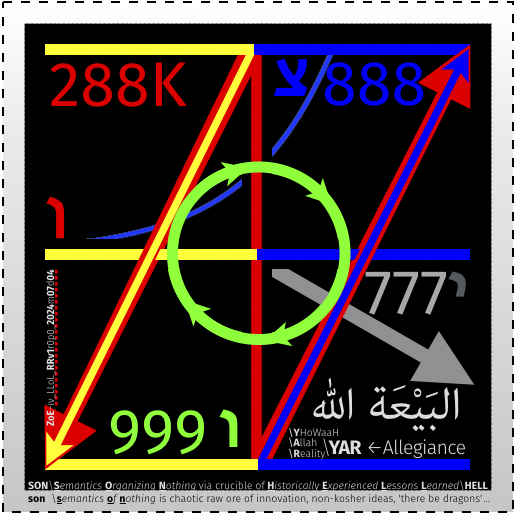
Matheo-b13 — e7He, the perpetual hero journey#
e7He writes moral development as a perpetual hero journey whose seven stages inoculate, one by one, against every combination of the BABL death-trifecta.
How to use: The files below are MockupModels = MM. Their maturity approximates that of a newborn baby that still has a lot of growing up and surviving to do before it can leave its current helpless state by growing into someone who can do “useful” things. This baby feeds on constructive criticism; flattery is like sugar: nice but mostly useless; killing a baby is easy, raising it to become a responsible adult is hard. LLoL got these files so far. Now LLoL has to pass on the baton in this global race. To raise a responsible mathematical theology takes a world. Nowadays it takes a global village to raise a responsible child. Neither can succeed without the other. Hence, LLoL calls to #AuditTheMath, either as a participant or expert contributor or by buying in as a Select Stadion Backer to support those who work on this monumental task.
The e7He Model: A Coinductive Theory of Anti-BABL Inoculation Through the Hero Journey#
Broader Significance
The e7He model is a formal axiom system that reads the hero journey as systematic inoculation against self-destruction. It encodes the three components of the BABL death-trifecta — over-simplifying (BA), over-complicating (ASH), and over-reaching (MOL) — as bits in a 3-bit space, and maps the seven non-zero patterns to seven journey stages. Completing one full cycle means facing and resisting every non-trivial combination exactly once (th1).
Two results sharpen the stakes. The supervillain theorem (th2) argues that stopping the journey does not return an agent to a neutral state: an agent who freezes while holding large influence drifts toward harm, because a stagnant scope misapplies expertise at its boundaries. The commitment trichotomy (th6) examines how a shared problem moves only when someone makes a genuine, transparent, effectively irrevocable NOT-OK commitment; a succession theorem (th7) asks what must be externalized for the structure to outlast its founder.
The model is presented in a dual-layer format — plain-language exposition alongside formal mathematics — with 14 axioms, 7 theorems, and 3 structural properties, and with its open questions and weaknesses stated plainly. This is the formal-logic presentation; companion papers develop the same model for other readers. The system is designed to be critiqued, not believed.
Abstract
We present e7He, a coinductive model of moral development through seven stages, formalized as a perpetual hero journey. The model encodes the three BABL temptation components — OverSimplifying (BA), OverComplicating (ASH), and OverReaching (MOL) — as bits in a 3-bit binary space \(\{0,1\}^3\). The seven non-zero elements of this space map bijectively to seven hero-journey stages (m1–m7), so that a hero completing one full cycle has faced and resisted every non-trivial BABL combination exactly once (Anti-BABL Inoculation Completeness, th1).
The system contains:
14 axioms (7 prerequisite axioms m0.ax1–m0.ax7, 7 stage axioms m1.ax–m7.ax)
7 theorems (th1–th7, covering inoculation completeness, supervillain dynamics, scope expansion, coinductive productivity, bifurcation asymmetry, commitment trichotomy, and succession robustness)
3 structural properties (sp1 Binary Completeness, sp2 Midpoint Maximality, sp3 Lognormal Influence Distribution)
The principal results are: (1) a combinatorial proof that the hero journey provides complete BABL inoculation (th1); (2) a dynamical systems argument showing that stopping the journey with high influence leads to supervillain drift (th2); (3) a game-theoretic derivation transforming a Prisoner’s Dilemma into an Assurance Game through irrevocable NOT-OK commitment (th6); and (4) a succession theorem ensuring the system survives its founder’s death through externalized infrastructure (th7).
The model fills the explicit gap at Matheo-b12
th7 Gate 5 (perpetual-cycle(h*, HeroJourney)) and connects to
Matheo-b11 (PET) through CWA rejection at
the m4 bifurcation. Matheo-b14 (JUB, forthcoming)
provides the system-level framework within which e7He operates.
The Hero Journey — Why Growth Has a Pattern and Why It Never Ends#
Broader Significance
Growth follows a pattern. This paper presents the e7He model’s central claim in plain language: the hero journey — seven recognizable stages from first engagement to rest-before-the-next-cycle — is not a literary trope but a structural consequence of how self-correcting systems stay alive. Each stage forces an encounter with one combination of the BABL death-trifecta (over-simplifying, over-complicating, over-reaching), so completing a full cycle works like a controlled exposure that builds resistance to self-destruction.
The engine of the journey is NOT-OK self-assessment: not “I am terrible” and not “I am fine,” but “I am adequate for now, I might be wrong, and I will keep checking.” Two consequences make the stakes concrete. The supervillain theorem observes that someone who stops growing while holding large influence becomes dangerous, because a frozen worldview cannot see the harm it does — dictators usually begin as genuine heroes who declared themselves finished. The commitment trichotomy shows why shared problems stall: when everyone waits nothing moves, when someone fakes going first trust is destroyed, and only someone who genuinely absorbs the cost of going first can transform the situation.
Written for readers aged 12 and up with no mathematics, this is the general-reader introduction to the formal e7He paper (Matheo-b13) and a window into the Matheo (matheology) series, Honestly Examining Axioms — Vetting Every Narrative. The system is designed to be critiqued, not believed.
Abstract
Growth has a structure. The hero journey — seven stages from first engagement to rest-and-restart — is presented here as a structural consequence of how self-correcting systems work, not as a motivational story. Each stage inoculates against one combination of the BABL death-trifecta (over-simplifying, over-complicating, over-reaching).
The engine is NOT-OK self-assessment. Not “I am terrible,” not “I am fine,” but “I am adequate for now, I might be wrong, and I will keep checking.” Declaring oneself OK — finished — is exactly the trigger that restarts the self-destruction spiral.
The stakes are structural. The supervillain theorem: a person who stops growing while holding large influence becomes dangerous, because a frozen worldview cannot see its own harm. The commitment trichotomy: shared problems move only when someone genuinely absorbs the cost of going first. Written for ages 12+, no mathematics; the formal version is Matheo-b13. #AuditTheMath
Born Again Again in the Second Exodus#
Broader Significance
This paper offers a structural reading of one of the most repeated and most misunderstood phrases in the Abrahamic world: “you must be born again” (John 3:3–7). The proposal is that being born again is not a single conversion event but a perpetual cycle — the seven-stage Hero Journey formalized in the e7He model (Matheo-b13). Each passage through the stages works like another rebirth that widens what a person can see, care about, and protect; the moment someone declares themselves “arrived,” growth stops and the self-reinforcing BABL trap closes in.
The pattern is traced first to the Torah, where renewal recurs fractally — in individual lives (Noah to Moses), in the Exodus, and in the grand arc of Egypt–Exodus–Sinai–Wilderness–Promise–Kingdom–Exile–Return — and then forward to the Second Exodus of Israel’s prophetic tradition, read here as a hypothesis about the collective hero journey of humanity. Cross-traditional resonances (Islamic, Buddhist, Hindu, Indigenous, and philosophical) are presented honestly, with divergences named rather than smoothed over.
A careful distinction frames the whole: the perpetual cycle describes sanctification (ongoing growth), not justification (the one-time foundation of acceptance). The reading of born again as perpetual Hero Journey is offered as interpretation; the e7He formal structure is what is proved; the Second Exodus remains a hypothesis until it actually begins. Keeping these epistemic levels distinct is the point — the system is designed to be critiqued, not believed.
Abstract
“You must be born again” (John 3:3–7) is one of the most repeated and most misunderstood sentences in the Abrahamic world. This paper proposes a structural reading: “born again” is not merely a one-time conversion event but a perpetual cycle — the Hero Journey formalized in the e7He model (Matheo-b13). There is a first time. Then each passage through the seven stages is like another rebirth. Each rebirth expands the scope of what the traveler can see, care about, and protect. The moment someone declares themselves “arrived,” life-long learning stops and the self-reinforcing trap of BABL begins to close in.
This study traces this structural concept to its roots in the Torah. There it occurs on multiple levels, like a fractal pattern. From individuals like Noah, Abraham, Isaac, Jacob, Joseph, and Moses to huge events like the Exodus of Israel from Egypt: the pattern keeps reoccurring. It can be traced throughout Israel’s history in repeated renewal, like Joshua’s crossing of the Jordan and the renewal brought by judges and kings.
It an also be seen in the grand narrative, in the pattern of Egypt–Exodus–Sinai–Wilderness–Promise–Kingdom–Exile–Return. This abundance of evidence is the likely cause for Jesus’ surprise that Nicodemus, a leading scholar of his time, was confused when Jesus pointed to the importance of becoming “born from above” (John 3:3–10).
This study then connects to the Second Exodus predicted in Israel’s prophetic tradition and interprets it as the collective hero journey of humanity. Cross-traditional evidence from Islamic, Buddhist, Hindu, Indigenous, and philosophical sources is presented, similarly to that of other studies in the Matheo series of reports.
A critical distinction frames the paper: the e7He model’s perpetual cycle describes sanctification — ongoing growth — not justification — the one-time foundation of acceptance by God. Justification does not cycle. What cycles is the response to justification: the lifelong adventure of living out what was given freely.
The view of “born again” as “perpetual Hero Journey” is interpretive, not proved. The e7He formal structure is proved. The Second Exodus as aggregate Hero Journeys remains a hypothesis until it actually starts. It is important to not conflate these epistemic levels, because this system is designed to be critiqued, not believed.