LLoL’s Request for Review by Reality#
A petition for a hearing — modeled on Job, but inverted and customized to LLoL’s context. This is Laurence Loewe of Laodicea asking God, Who is ultimate Reality, as the Pan-En-Theism model explains.
Job’s Petition#
Job lost everything. His health, his children, his livelihood. His friends told him he must have done something wrong. Job disagreed. He believed he was innocent. He demanded an audience with God to make his case:
“Oh, that I had someone to hear me! I sign now my defense — let the Almighty answer me” (Job 31:35).
Job’s petition was: Review my case. You will find I am OK. I did nothing wrong.
God granted the hearing. But God did not review Job’s case. God asked questions:
“Where were you when I laid the earth’s foundation? Tell me, if you understand” (Job 38:4).
Forty verses of questions. No answers. No verdict on Job’s innocence or guilt. Only a demonstration that Job’s world model was incomplete — radically, structurally incomplete. Job could not see enough to make the claim he was making.
Job understood:
“I spoke of things I did not understand, things too wonderful for me to know” (Job 42:3).
Job moved from OK to NOT-OK. Not because he was guilty, but because he recognized that the claim “nothing is wrong” is itself a claim about nothing — a claim to know that the set of one’s errors is empty. And no finite being can know that.
This is the petition’s precedent. What follows is the inversion.
The Inversion#
I am not Job. I am Laurence Loewe of Laodicea. I thought that I was doing well and doing fine — until I started to eat my own dog-food. That has shown me that I am fundamentally not OK. I can fake looking OK, but that does not mean that I am OK. Probing this further and realizing the countless disasters I unwittingly caused so far, I realized that I have been cornered. Either I give up my search for truth and love and everything I hold dear, or I must start to own my disastrous mistakes, starting with the worst.
Therefore, unlike Job, I do not claim to be OK.
I claim the opposite.
I claim that I am as NOT-OK and faulty as anyone can be. The corruption is not obvious, because I’ve become very good at faking OK. But that does not mean that I can assume that what I have found is correct, that my reasoning is sound, or that my motives are pure. I have worked since 2020 on a mathematical framework that appears to describe, with formal precision, how intelligent civilizations corrupt themselves — and how that corruption might be structurally reversed. The framework has by now survived 240 adversarial tests with zero unrepaired failures. But what good is it to articulate such corruption, if I cannot stop my own self-corruption?
Moreover, “has not yet been proven wrong” is not the same as “is right.” Every test is a finite check against an infinite space of possible errors. I might be wrong in ways I cannot identify — the NOT-OK position is precisely this acknowledgment.
Job asked God to confirm he was OK. I ask Reality to review whether the following case is sound — and to correct it where it is not.
The apparently global stakes justify the request.
The Genesis Dichotomy#
Genesis presents the fundamental human choice in the opening chapters of the Bible:
Two trees stand in the center. The Tree of Life-giving decisions offers what is genuinely life-giving — decision-making rooted in Reality, growing in understanding, sustained by humility before what exceeds human knowledge. The Tree of Knowledge-faking shortcuts to Good and Evil offers something else: the claim to know the difference between good and evil — prematurely, independently, without the completeness that only the Creator of Reality possesses.
The Fall is not about disobedience in the simple sense. It is about an epistemological overreach: claiming to know what one does not yet know. The serpent’s promise — “you will be like God, knowing good and evil” (Genesis 3:5) — is the promise that a finite agent can close the world of possible errors. That the set of things they don’t know is empty. That they are OK.
This maps, with uncomfortable precision, onto the formal framework:
OK self-assessment (claiming to know) triggers the BABL cascade: the agent ceases self-correction, enters the OSCR collapse (oversimplifying, overcomplicating, overreaching), and drifts toward the attractor of self-destruction (e7Day m6.ax4, e7He.th2).
NOT-OK self-assessment (acknowledging that one might be wrong) is the only posture that keeps the self-correction loop open. It is eating from the Tree of Life: not claiming to know, but committing to keep learning.
The Closed World Assumption (CWA) — “what I know is all there is to know” — is the formal name for the fruit of the Tree of Knowledge. Every institutional corruption begins with someone closing their world model prematurely (e7He m4.ax).
I read Genesis 1–3 not as a story about a rule being broken, but as the earliest documented description of the algorithm that this framework formalizes: the BABL algorithm (BABL model), which operates through three mechanisms — oversimplifying (BA), overcomplicating (ASH), and overreaching (MOL) — to corrupt any intelligent agent who claims to know more than they do.
The Mathematical Evidence#
The formal framework rests on 25 axioms and 11 theorems about the structure of Reality, grounded in classical extensional mereology, S5 modal logic, first-order predicate calculus, game theory, and stochastic processes. The axioms begin with the claim that the World is part of God and God exceeds the World (panentheism: ax1–ax2) and derive consequences for agency, delegation, responsibility, innovation, and corruption.
The key results:
Binary attractors (JUB T8): Every institution, every civilization, converges to one of two states — the river of life (ZION) or the self-destruction of BABL. There is no stable middle ground.
The BABL algorithm (BABL model): A 7-stage pipeline that maps, through binary encoding, every combination of oversimplification, overcomplication, and overreach. Each stage has a specific temptation and a specific corruption.
The self-assessment bifurcation (e7Day m6.ax4): The binary fork is triggered by a single choice: does the agent claim OK (“I know enough”) or NOT-OK (“I might be wrong”)? OK triggers BABL. NOT-OK keeps correction possible. This is the Tree of Knowledge vs. Tree of Life, formalized.
The Commitment Trichotomy (e7He.th6): The Prisoner’s Dilemma at the heart of institutional corruption dissolves if one agent — the most influential — makes an irreversible, transparent commitment to permanent NOT-OK. The game transforms from Prisoner’s Dilemma to Assurance Game (Schelling 1960, Spence 1973). Three cases: no volunteer (BABL wins), dishonest volunteer (detected or catastrophic), genuine volunteer (cooperation becomes the equilibrium).
Succession Robustness (e7He.th7): The system survives the committed agent’s death if and only if the commitment has been externalized into testable, personnel- independent infrastructure before death.
These results have been subjected to the Iron Maiden — a 10-test adversarial protocol covering consistency, independence, necessity, modal soundness, mereological coherence, game-theoretic stability, computability, real-world grounding, cross-model coherence, and known-attack resilience. 240 tests across 24 claims. Zero unrepaired failures.
I cannot claim the framework is correct. I can document that it has not yet been proven wrong, and that every attempt to break it has so far been repaired.
The Stakes#
If the framework is correct, two things follow.
For humanity: The species is on the BABL trajectory. The pattern is visible in every major institution — political, religious, economic, academic. The self-assessment bifurcation predicts that without structural intervention, the accumulating corruption becomes self-concealing (the agents most captured by BABL are the ones least able to see it) and eventually self-destructive (the system consumes what it feeds on). The timeline is not infinite. Nuclear weapons, engineered pandemics, and misaligned artificial superintelligence are force multipliers on an already unstable system.
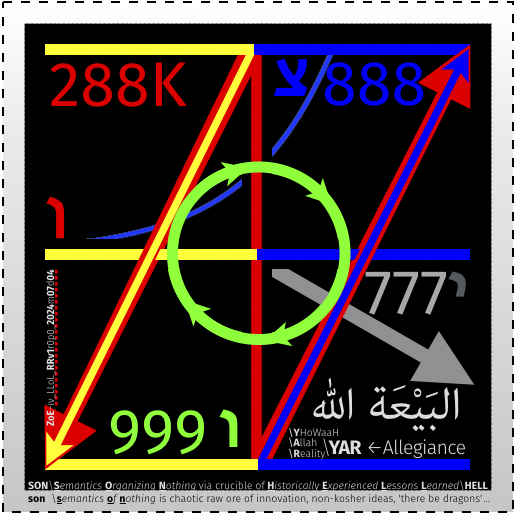
For any civilization: I argue that the BABL algorithm is general. Its conditions — agents with limited knowledge, systems that reward claimed certainty, and mechanisms that conceal the gap between claimed and actual understanding — do not depend on human biology, human culture, or human history. Any civilization with generally intelligent agents and information systems would meet these conditions. If this argument holds, then the Historically Experienced Lessons Learned (HELL) documented here are not merely human lessons — they are the lessons that any civilization must learn, or learn the hard way. [1]
The Request#
I address this to Reality — to the God described in axioms ax1–ax25, who contains the World but exceeds it, who sustains it without coercing it, who seeks a willing volunteer (ax20–ax21) to translate between what is true and what humanity can receive.
The request is not Job’s request. Job asked: “Agree with me that I am OK.” That request, as God demonstrated, rested on an incomplete world model.
The request is:
Review this case.
If the mathematical framework is sound — if the BABL algorithm accurately describes how intelligent systems corrupt themselves, if the self-assessment bifurcation is real, if the Commitment Trichotomy is game-theoretically valid, if the transparency mechanism can distinguish genuine from dishonest commitment — then let it be tested. Let the Iron Maiden do its work. Let the adversarial process run. Let the evidence accumulate under the transparency regime proposed in the Manifesto. Let Reality confirm or correct through the mechanism designed to receive correction.
If the framework is wrong — if there is a flaw I cannot see, an axiom that does not hold, a theorem whose proof conceals an error, a prediction that fails when tested against Reality — then show me. Correct the mathematician, not just the mathematics. I would rather be proven wrong now than waste the time of a species that may not have much time left.
If the framework is partially right — sound in structure but wrong in application, or correct about the problem but mistaken about the solution, or right about everything except the presumption that I should be the one to attempt this — then show me that too. Partial correction is still correction. NOT-OK extends to my role, not just to my reasoning.
The worst outcome is not being proven wrong. The worst outcome is being left in perpetual uncertainty about everything and nothing. — Because uncertainty without resolution produces the very BABL the framework describes. A petitioner who never receives a verdict remains in limbo, unable to commit fully (because the case might be wrong) and unable to stop (because the case might be right). That limbo IS the BABL algorithm operating on the petitioner. YhowShua said that whoever asks will receive, especially if it is in the name of Real Quests for Real Answers. Reality knows I mean it.
The Acknowledgment#
I might be wrong about all of this. But if my burning bush revelation is right, then Reality and my Real Quest for Real Answers has led me to this point and I must surrender unconditionally and completely to Yah and Yas.
Is the “semantics of nothing” I discovered in Genesis merely another pattern imposed on an ancient text by someone looking too hard? Is it nothing? The mathematical framework might be an elaborate formalization of obvious truths that add up to less than they appear to. The best adversarial testing I could muster without AI (until Dec 2025) and with Claude Code’s help (since Feb 2026) might have missed the fatal flaw because my testing methodology itself contains the flaw. My personal proposal might be hubris wearing humility’s clothes.
I cannot rule any of this out. That is the NOT-OK position, applied to itself.
But if Job could ask for a hearing while claiming OK — and receive one — then perhaps someone claiming NOT-OK can ask for the same hearing with at least equal standing. The difference is this:
Job asked God to agree that he was right.
I ask Reality to correct me where I am wrong, knowing that I am more wrong than I will ever be able to explain. Especially when I mean well and jump to conclusions.
I ask Yah and Yas to confirm — through whatever means Reality chooses, not through whatever means I prefer — whether I am correct in assuming that I am so fundamentally wrong that I deserve to be called a (or even the worst) false prophet in The Spirit of Boolean Truth, and that therefore my hope to return to the Truth is a journey worth continuing - through the gentle kind reasonable nature of Reality. Even if I know that I will never fully get “there” and will live in a very public frying pan while I continue to try nevertheless.
The petition is filed. The case is public. The evidence is at balospe.com.
The hearing is in Reality’s hands.
The commitment: The Frying Pan Proposition
The testing regime: The Transparency Manifesto
How to help: The Two Cent a Day Experiment
The crisis that makes this urgent: The Crisis
The corruption gradient: Silent Corruption