The Matheo Study Series — a map#
The Matheo Study Series is large — thirty-two individual papers across eleven studies (b11-b21), running to hundreds of thousands of words, building a cumulative argument from formal axioms to a call to action. This page is the short map: what each paper does, how they depend on one another, and where to start — so you do not have to read all of it to know what you are looking at.
Note
This is the about-the-series overview. For the full, step-by-step reading routes (Express / Standard / Deep paths for five reader profiles), see the Learning Path through the Matheo Study Series.
How big is this — and do I have to read it all?#
No. Each of the eleven studies has a formal paper plus companion versions for different audiences (general, mathematical, theological, economic, and so on) — which is how eleven studies become thirty-two papers. And the series is built so you can stop at any point with a coherent picture of what you have read so far. A general reader can get the whole core argument from the six short introductions in about 90 minutes; a specialist can go as deep as the formal proofs and the adversarial reviews. The point of this page is to let you choose your depth on purpose.
The studies at a glance#
Code |
Title |
What it does |
|---|---|---|
b11 |
PET: Formal Panentheism |
14 axioms formalising “all is in God, but God exceeds all,” with convergence across six traditions. The foundation. |
b12 |
e7Day: Self-Correcting Construction |
The BABL / ZION / OSCR framework for systems that either self-correct or self-destroy. |
b13 |
e7He: Anti-BABL Inoculation |
The Hero Journey as inoculation against BABL; the Supervillain theorem. |
b14 |
JUB: Innovation Theodicy |
The Jubilee System as self-stabilising economics — why suffering is, in part, a system-design problem. |
b15 |
Structural Deadlock |
A formal proof that Divine Simplicity deadlocks with PET’s relational axioms. |
b16 |
RiskyMAD: Existential Risk |
The stochastic forecast: nuclear winter is effectively certain under MAD over long horizons. MAD → MAP. |
b17 |
h* Theorem: a Public Test |
The causal-concentration theorem and eight transparency criteria for testing it — with a falsification protocol. |
b18 |
Call to Action: MAD → MAP |
Integrates b11-b17 into a call to action for averting accidental nuclear winter. |
b19 |
SGIR: Pandemic Modelling |
A constructive existence-proof that modest, coordinated action could have cut pandemic deaths by an order of magnitude — full model open to audit. |
b20 |
WorkLogic |
The work-logic cascades behind scaling up ResearchCity (a former SGIR appendix, now standalone). |
b21 |
AI Co-Authorship |
A framework for honestly crediting AI and human contributions in long-term research. |
How the papers depend on one another#
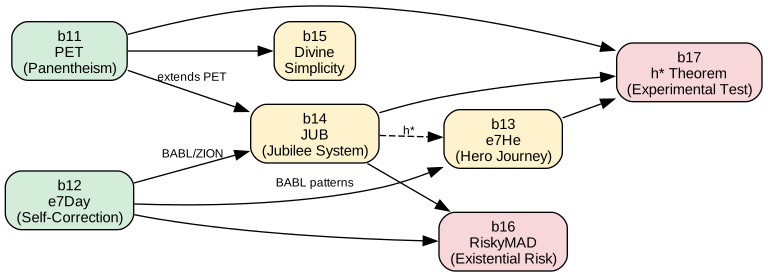
Textual summary:
b11 (PET) ──────────────→ b14 (JUB, extends PET)
                               ↑
b12 (e7Day, independent) ──────┘  (BABL/ZION framework)
     ↓
b13 (e7He)        b15 ← b11        b16 ← b12, b14
b17 ← b11, b13, b14               b18 ← ALL (b11-b17)
The graph shows the core b11-b18 backbone. Three later studies extend it: b19 (the SGIR pandemic model), b20 (work-logic), and b21 (AI co-authorship).
Where should I start?#
Just want the argument? Read the six short intros (b11, b12, b14, b16, b17, b18) — about 90 minutes.
Mathematician, theologian, economist, or skeptic? The full learning path has a tailored Express / Standard / Deep route for each.
Want to help test it? That is the whole point — Audit the Math.