
POD — DOISI Data Insight Storage: 7Spirit Truth Decision Workflow#
A 10-base decision-support workflow for Places of Decision (PoDs) — from NamingBase through OutcomeBase, linking local PoDs into a shared DOISI infrastructure.
Download the original document (PDF)
DOISI 7Spirit Truth — PDF (380 KB) — 1 page, Jonah License with CC0 Public Domain
Filename: evx-pod-data-insight-storage-doisi-7spirit-truth-iv_llol_qqv8r9p12m12_2019m10d16-fig.pdf
— Overview AI-generated by dv_ClaOp46Max_ExhH_2026m04d16 —Start—
Abstract#
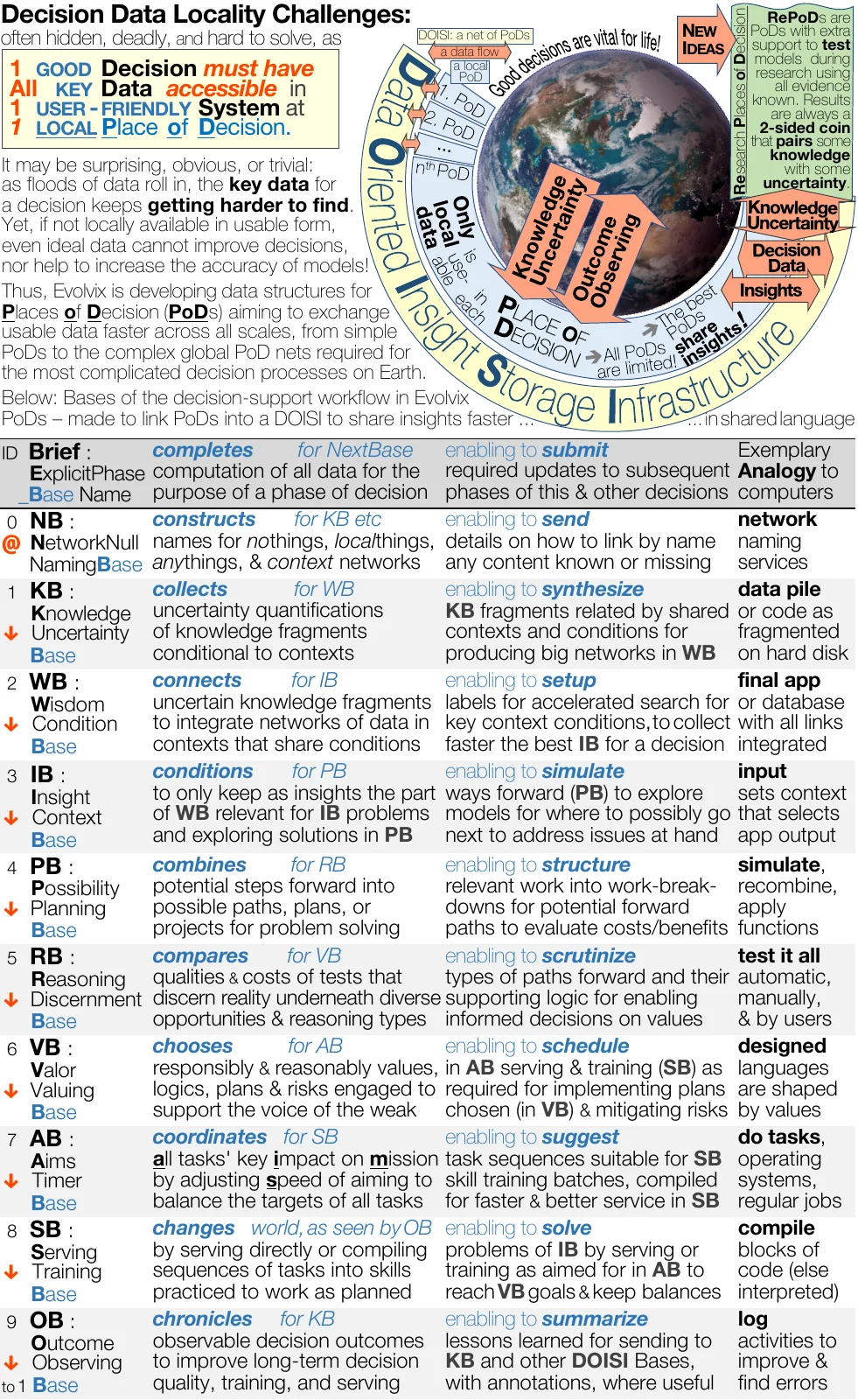
This single-page figure presents the DOISI (Data Oriented Insight Storage Infrastructure) — Evolvix’s framework for decision-support data management. The core principle: “1 GOOD Decision must have All KEY Data accessible in 1 USER-FRIENDLY System at 1 LOCAL Place of Decision.”
The document defines 10 decision bases (numbered 0–9), each a phase in a decision-support workflow. Each base has a Brief name, Explicit name, what it completes, what it enables submitting, and a computer analogy:
0 NB (NetworkNull / NamingBase) — constructs names; analogy: network naming services
1 KB (Knowledge / Uncertainty Base) — collects uncertain knowledge; analogy: fragmented data on disk
2 WB (Wisdom / Condition Base) — connects fragments; analogy: integrated database
3 IB (Insight / Context Base) — conditions relevant insights; analogy: input that selects output
4 PB (Possibility / Planning Base) — combines potential paths; analogy: simulate and recombine
5 RB (Reasoning / Discernment Base) — compares quality of tests; analogy: testing (automatic, manual, by users)
6 VB (Valor / Valuing Base) — chooses values responsibly; analogy: designed languages shaped by values
7 AB (Aims / Timer Base) — coordinates task impact on mission; analogy: operating systems
8 SB (Serving / Training Base) — changes world through service; analogy: compiled code
9 OB (Outcome / Observing Base) — chronicles outcomes; analogy: activity logs
A PoD (Place of Decision) is a local node; a DOISI is a network of PoDs sharing insights. RePoDs are PoDs with extra support for testing models during research. The globe diagram shows data flowing through Knowledge, Uncertainty, Outcome, Observing, Decision Data, and Insights, with the principle: “Only local data is useable in each Place of Decision — The best PoDs are limited: All PoDs share insights!”
Key Concepts at a Glance#
DOISI |
Data Oriented Insight Storage Infrastructure — a network of PoDs sharing insights in a shared language |
PoD |
Place of Decision — a local node where all key data must be accessible in a user-friendly system |
10 Decision Bases |
NB through OB (0–9): a complete decision-support workflow from naming through outcome observation |
Decision Data Locality |
The principle that even ideal data cannot improve decisions if not locally available in usable form |
Broader Significance (Claude’s Assessment)#
The DOISI framework maps the entire decision-making process onto a structured data workflow with explicit computer analogies. This makes it a bridge between abstract decision theory and concrete software architecture. The “Decision Data Locality” principle is particularly sharp: it reframes the data accessibility problem as analogous to memory locality in computer architecture — even the best data is useless if it cannot reach the point of decision.
Document Information#
Document ID |
POD — DOISI 7Spirit Truth (Flying Scroll, transwarpkey/sta1-evx/) |
Author |
Laurence Loewe of Laodicea (LLoL) |
Date |
2019m10d16 |
Version |
iv_LLoL_QQv8r9p12m12_2019m10d16 |
Format |
Single-page figure |
License |
|
Part of |
Good News Pack MMv3, Flying Scroll / Transwarp Key / STa1-EVX |
PDF size |
380 KB |
WebP size |
408 KB |
Related documents:
STa1-EVX stadium overview (parent page with all 30 documents)
AIMS Plotter (the AIMS coordination system that feeds into DOISI)
ReRaft FlyClockBase (a concrete VBIR implementation vision)
— Overview AI-generated by dv_ClaOp46Max_ExhH_2026m04d16 —End—