
ReRaft Vision — VBIR Biodata Compiler: FlyClockBase and Genome Projects#
How Versioned Biological Information Resources (VBIRs) extend genome project batch-processing to all biodata — demonstrated through FlyClockbase circadian clock research.
Download the original document (PDF)
VBIR Biodata Compiler Vision — FlyClockBase — PDF (716 KB) — 1 page, Jonah License with CC0 Public Domain
Filename: evx-reraft-vbir-biodata-compiler-vision-flyclockbase-iv_llol_qqv1r7p11_mv11_2018m05d21-flyc01-fig.pdf
— Overview AI-generated by dv_ClaOp46Max_ExhH_2026m04d16 —Start—
Abstract#
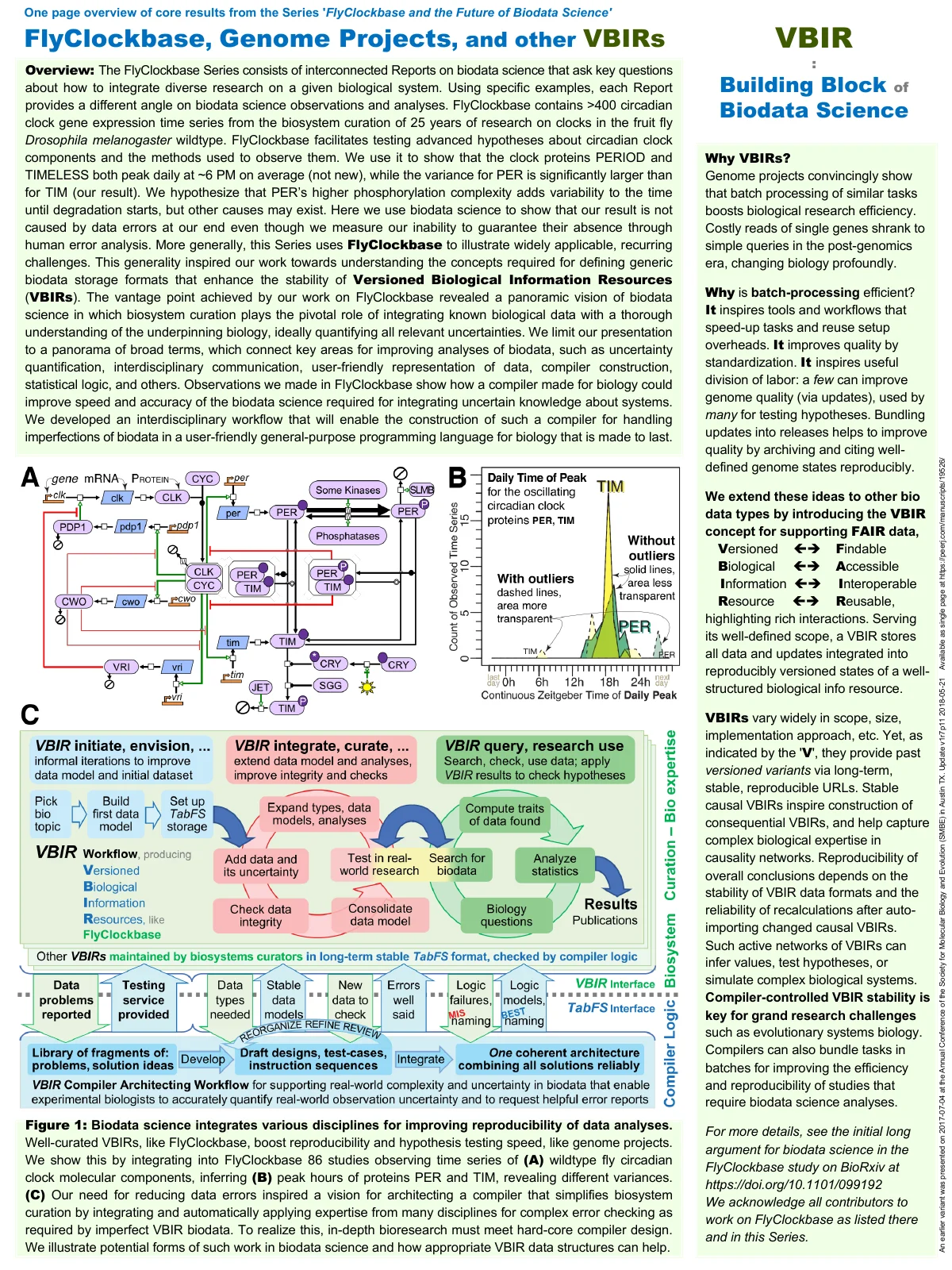
This single-page scientific poster presents the VBIR (Versioned Biological Information Resource) concept using FlyClockbase as a concrete example. Originally presented at SMBE 2017 in Austin, TX.
The VBIR concept: Genome projects show that batch-processing of similar tasks boosts biological research efficiency. VBIRs extend these principles to other biodata types: versioned, biological, information, resources — mapping to FAIR (Findable, Accessible, Interoperable, Reusable) data principles.
FlyClockbase contains >400 circadian clock gene expression time series from biosystem curation of 25 years of research on clocks in the fruit fly Drosophila melanogaster wildtype. Key result: the clock proteins PERIOD (PER) and TIMELESS (TIM) both peak daily at ~6 PM on average, but PER’s variance is significantly larger than TIM’s. Hypothesis: PER’s higher phosphorylation complexity adds variability to degradation timing.
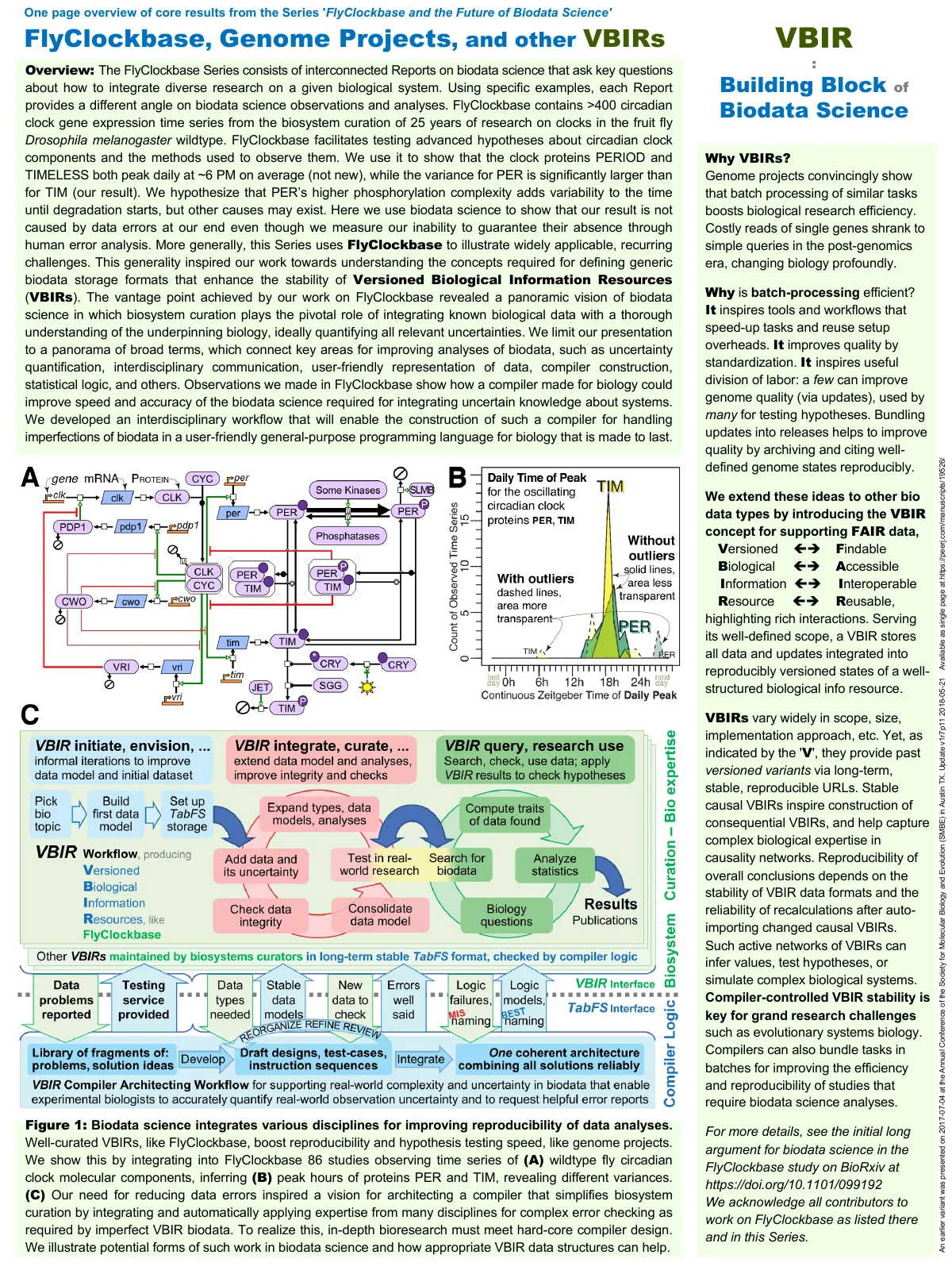
Three panels: (A) Molecular network of the circadian clock with gene-to-protein pathways, (B) Daily peak time distributions showing PER’s larger variance, (C) VBIR workflow from initiation through curation to research use.
Compiler Architecting Workflow (bottom): Shows how a compiler for biology would integrate data problems, testing services, stable data models, error checking, logic testing, and BEST naming into one coherent architecture combining all solutions reliably.
The poster argues that compiler-controlled VBIR stability is key for grand research challenges such as evolutionary systems biology.
Key Concepts at a Glance#
VBIR |
Versioned Biological Information Resource — a versioned, well-structured biodata collection with stable reproducible URLs |
FlyClockbase |
A concrete VBIR: >400 circadian clock time series from 25 years of Drosophila research |
Biosystem curation |
The pivotal role of integrating known biological data with thorough understanding of the underpinning biology |
TabFS |
Tab-delimited table format in standard file-system folders, designed for long-term stable data storage |
Broader Significance (Claude’s Assessment)#
This poster is the most scientifically grounded document in the STa1-EVX collection. It demonstrates the VBIR concept through a real research project with published data (BioRxiv doi.org/10.1101/099192) and concrete results (PER vs TIM variance difference). The compiler architecting workflow at the bottom connects the abstract Evolvix vision to a specific engineering plan. The argument that batch-processing principles from genome projects can be generalized to all biodata is well-supported by the genome project analogy.
Document Information#
Document ID |
ReRaft — FlyClockBase VBIRs (Flying Scroll, transwarpkey/sta1-evx/) |
Author |
Laurence Loewe of Laodicea (LLoL) |
Date |
2018m05d21 |
Version |
iv_LLoL_QQv1r7p11_mv11_2018m05d21 |
Format |
Single-page scientific poster |
License |
|
Part of |
Good News Pack MMv3, Flying Scroll / Transwarp Key / STa1-EVX |
PDF size |
716 KB |
WebP size |
464 KB |
Related documents:
STa1-EVX stadium overview (parent page with all 30 documents)
Fox-Rabbit Forecast Manual (demonstrates the compiler approach with a simpler model)
BABL vs ZION Batching Efficiency (the ReRaft info-flow organization)
— Overview AI-generated by dv_ClaOp46Max_ExhH_2026m04d16 —End—