
Evolvix 1-Page Forecast Manual — Compiling Fox and Rabbit Ecology#
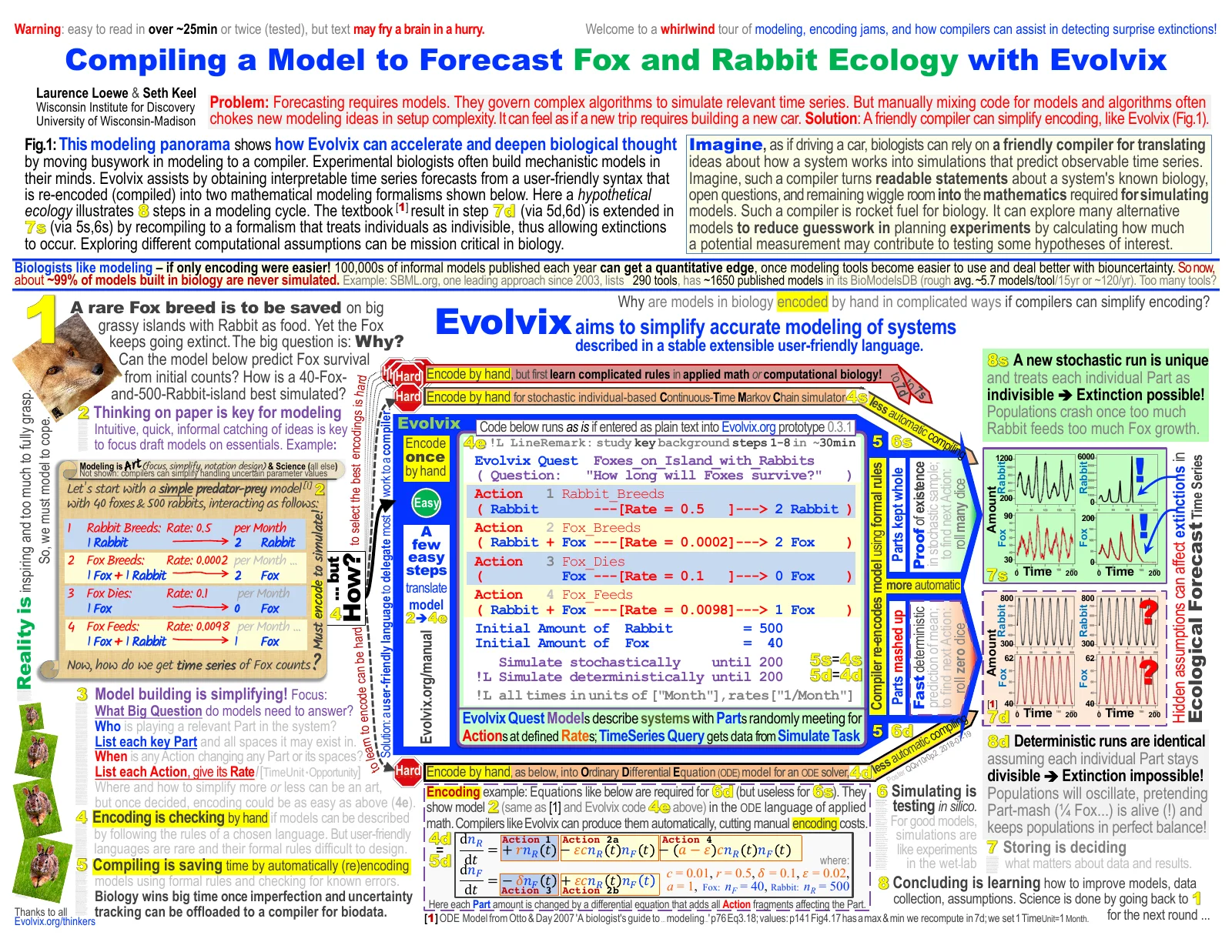
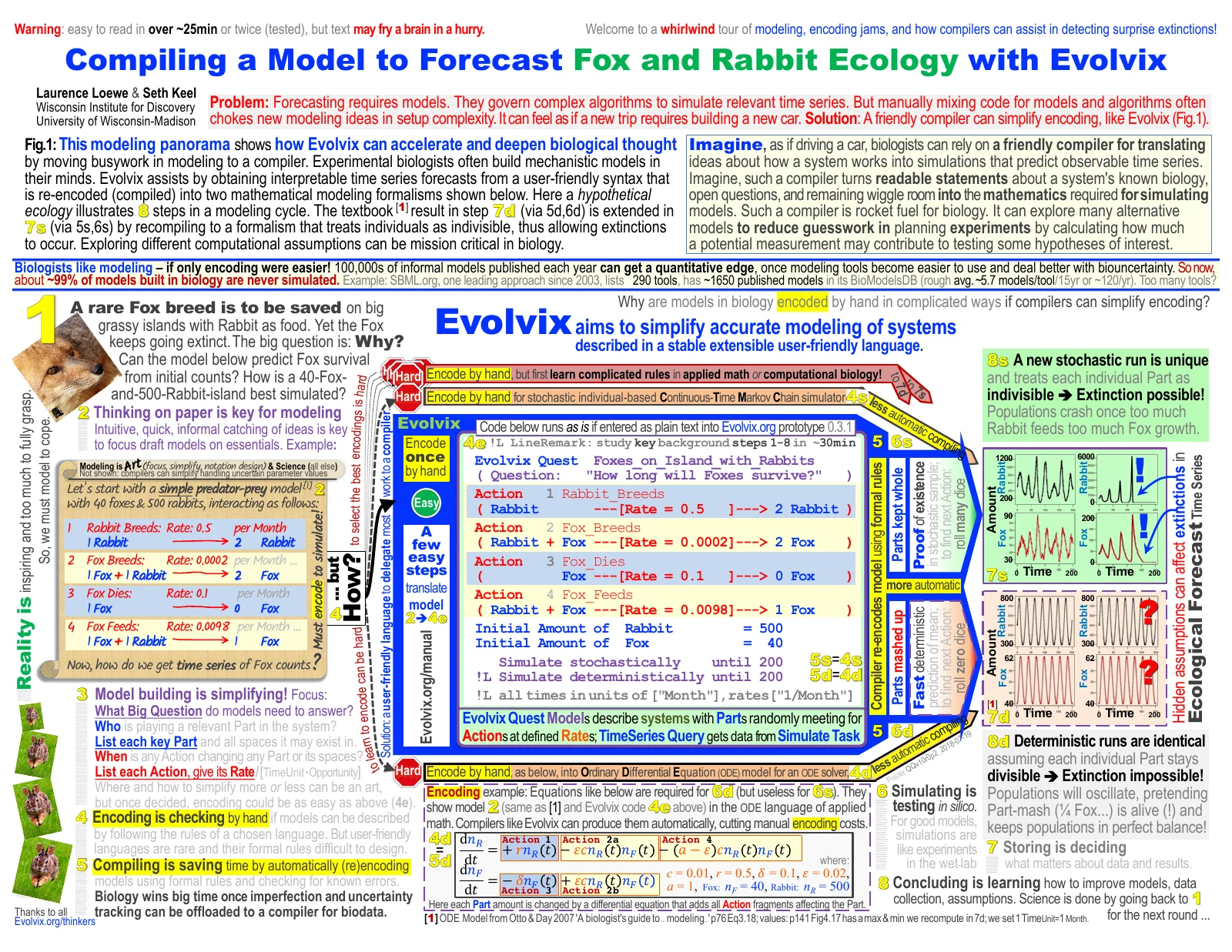
A dense modeling panorama showing 8 steps from biological observation to simulation — and how treating individuals as indivisible reveals surprise extinctions.
Download the original document (PDF)
Fox-Rabbit Forecast Manual — PDF (6.2 MB) — 1 page (letter format, very dense), Jonah License with CC0 Public Domain
Filename: evx-1page-forecast-manual-fox-rabbit-pop-crash-iv_llol_qqv10r0p2_2018m07d19-letter.pdf
Warning
This is a 6.2 MB PDF. The document is extremely information-dense (a full scientific poster compressed to letter format). Readable in ~25 min or twice (as tested by the authors).
— Overview AI-generated by dv_ClaOp46Max_ExhH_2026m04d16 —Start—
Abstract#
“Compiling a Model to Forecast Fox and Rabbit Ecology with Evolvix” by Laurence Loewe and Seth Keel (Wisconsin Institute for Discovery, University of Wisconsin-Madison) is the most scientifically detailed document in the STa1-EVX collection. Despite being a single letter-sized page, it contains a complete scientific poster’s worth of content.
The scenario: A rare fox breed is to be saved on big grassy islands with rabbits as food. Yet foxes keep going extinct. The big question: Why? Can a model predict fox survival from initial counts (40 foxes, 500 rabbits)?
The 8-step modeling cycle (Fig. 1):
Reality — too much to fully grasp; so we must model to cope
Model building — simplify; focus on one Big Question
Modeling toolkit — Parts, Actions, Rates framework
Encoding — write the model in Evolvix’s user-friendly syntax (working code for Evolvix.org prototype 0.3.1 is shown)
Compiling — the compiler re-encodes into two formalisms: (5s) stochastic individual-based CTMC, and (5d) deterministic ODE
Simulating — run both formalisms to produce time series
Storing — decide what matters about data and results
Concluding — learn how to improve models
The key discovery: Deterministic (ODE) simulations predict eternal oscillation — foxes and rabbits cycle forever, because the math treats ¼ of a fox as alive. Stochastic (CTMC) simulations show that populations crash and foxes go extinct, because each individual is treated as indivisible. This difference in computational assumptions is mission-critical in biology.
Working Evolvix code is shown directly in the figure — a simple Quest model with 4 Actions (Rabbit breeds, Fox breeds, Fox dies, Fox feeds) that can be entered as plain text into the Evolvix prototype.
The document also contains extensive fine-print discussing: the DesignFlip method for language design, the three foundational hallmarks of Evolvix (backwards compatibility, user-friendly clarity, growing extensibility), TabFS data format, VBIRs (Versioned Biological Information Resources), and detailed explanations of CTMC rates and exponential distributions.
Key Concepts at a Glance#
Parts, Actions, Rates |
Evolvix’s core modeling framework: define what exists (Parts), what happens (Actions), and how fast (Rates) |
CTMC vs ODE |
Two mathematical formalisms the compiler targets: Continuous-Time Markov Chain (stochastic, individuals indivisible) vs Ordinary Differential Equations (deterministic, individuals divisible) |
Surprise extinction |
The stochastic model reveals extinctions invisible to the deterministic model — a concrete example of why modeling formalism choice matters |
DesignFlip |
LLoL’s Flipped Programming Language Design method: design and review syntax/semantics before implementation |
Three OLT hallmarks |
(1) Full backwards compatibility, (2) user-friendly clarity, (3) growing extensibility — in that priority order |
Broader Significance (Claude’s Assessment)#
This is arguably the strongest document in the STa1-EVX collection for a scientific audience. It demonstrates that Evolvix is not merely a vision document but has a working prototype that produces verifiable results matching published models (Otto & Day 2007). The fox-rabbit example is simple enough to serve as a “hello world” yet complex enough to reveal a genuine scientific insight (stochastic extinction).
The fine-print sections contain a serious discussion of language design philosophy that would be recognizable to any compiler engineer: the tension between user-friendliness and formal rigor, the need for stable syntax, and the argument that biology needs its own domain-specific language rather than ad hoc scripts. The reference to the red blood cell metabolism model (Ehlert & Loewe 2014 J. Chem. Phys.) as a more complex test case adds credibility.
Document Information#
Document ID |
EVX Forecast Manual — Fox-Rabbit (Flying Scroll, transwarpkey/sta1-evx/) |
Authors |
Laurence Loewe and Seth Keel, Wisconsin Institute for Discovery, UW-Madison |
Date |
2018m07d19 |
Version |
iv_LLoL_QQv10r0p2_2018m07d19 |
Format |
Single-page letter (poster-density scientific document) |
License |
|
Part of |
Good News Pack MMv3, Flying Scroll / Transwarp Key / STa1-EVX |
PDF size |
6.2 MB |
WebP size |
536 KB |
Related documents:
STa1-EVX stadium overview (parent page with all 30 documents)
SD1 — RiskyMAD (the nuclear killer app referenced as Evolvix prototype application)
Simplicity in Lasting Standards (the philosophical foundation for Evolvix’s design priorities)
— Overview AI-generated by dv_ClaOp46Max_ExhH_2026m04d16 —End—