Evolvix Philosophy — Naming Achilles Heel: Long-Term Skyscraper#
Why naming is the Achilles heel of long-term language stability — the skyscraper metaphor, NAMESTREE, and the chain from stable meaning to stable dataformat.
Download the original document (PDF)
Naming Achilles Heel — PDF (292 KB) — 1 page, Jonah License with CC0 Public Domain
Filename: evx-philosophy-naming-achilles-heel-long-term-skyscraper-iv_llol_qqv1r5p8-card.pdf
Also in this folder: Simplicity in Lasting Standards, Best Naming Intro
— Overview AI-generated by dv_ClaOp46Max_ExhH_2026m04d16 —Start—
Abstract#
This single-page card argues that naming is the Achilles heel of long-term stable data languages. The document uses two interlocking metaphors to make its case:
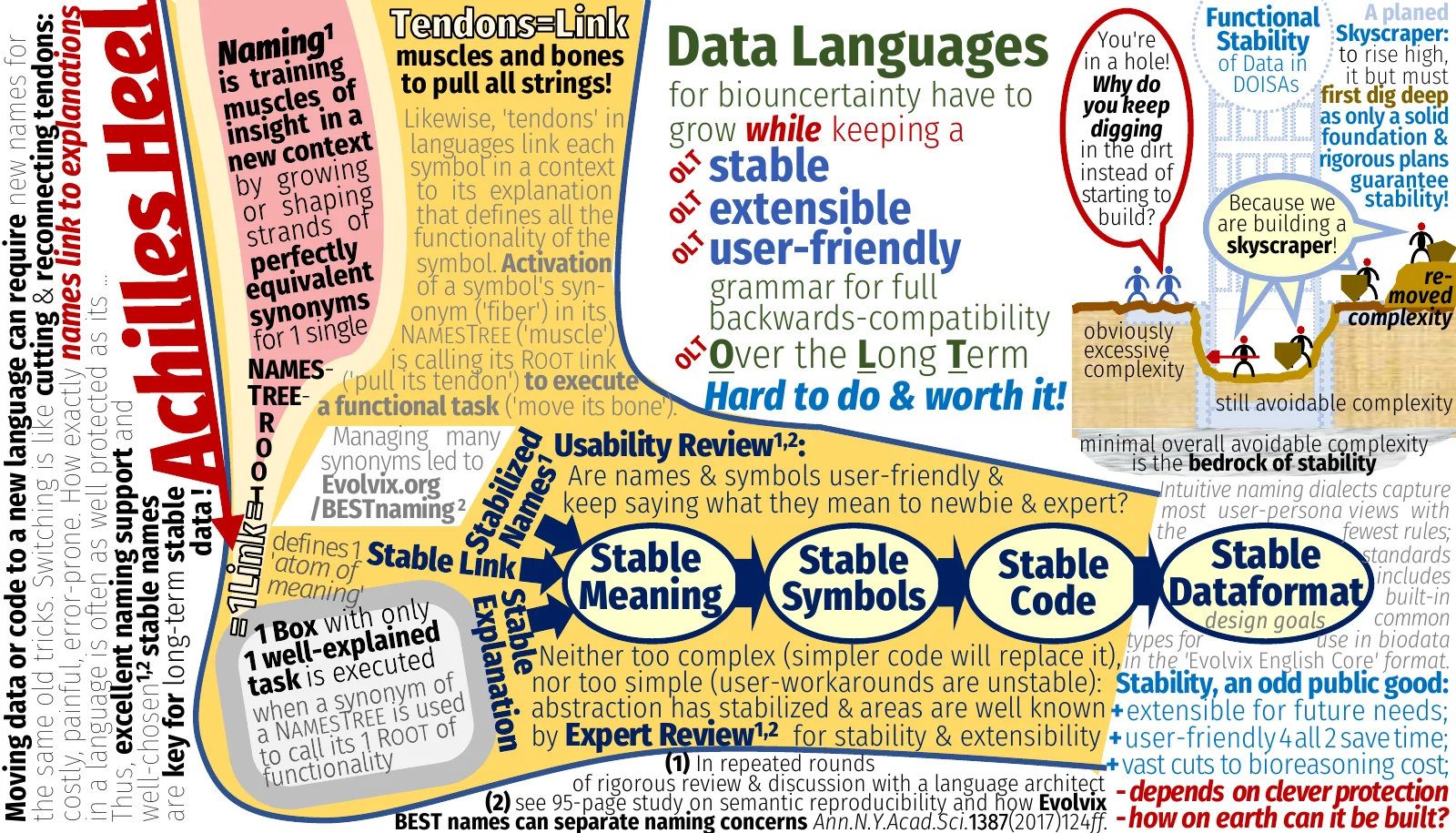
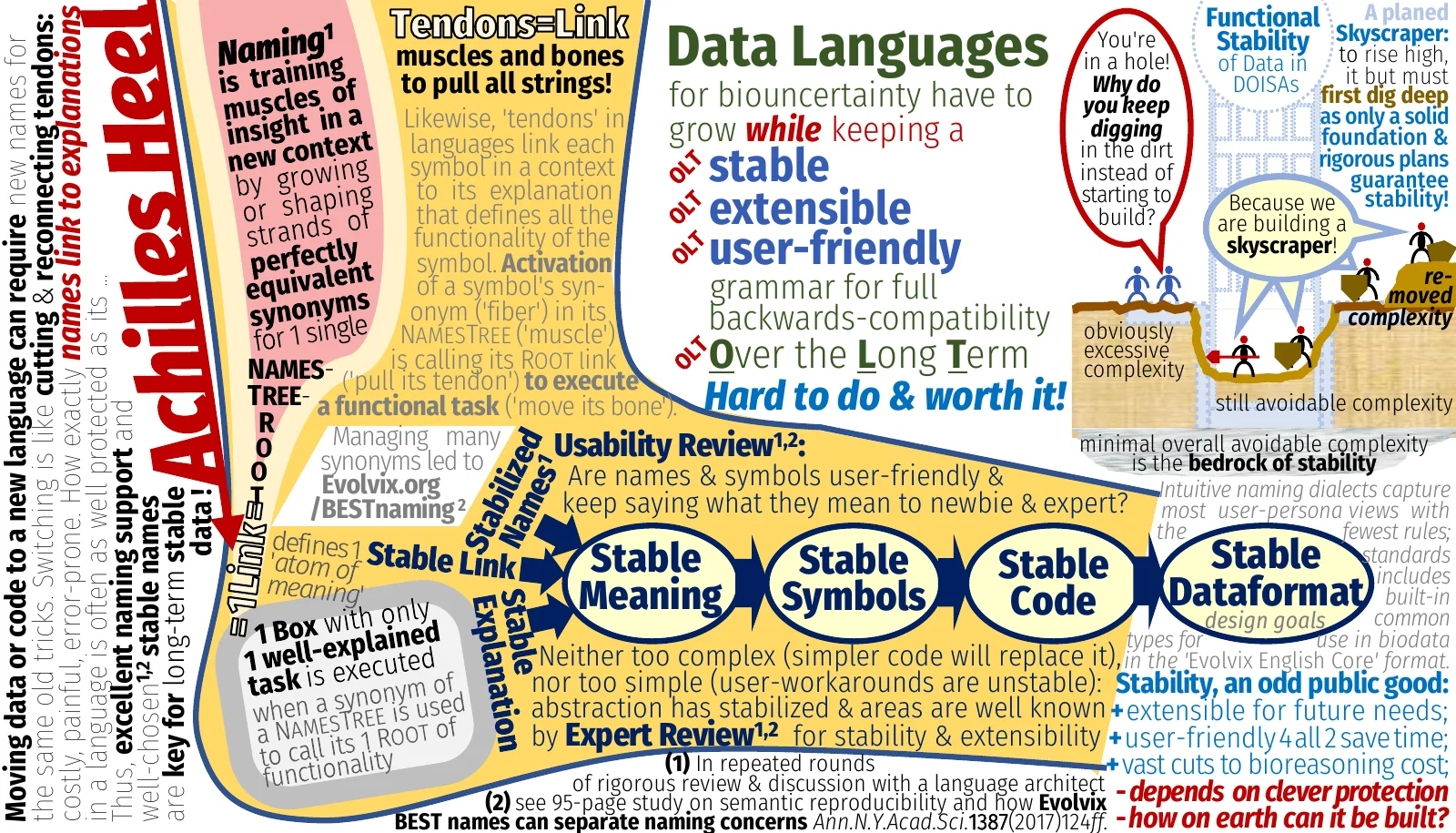
The Skyscraper metaphor: To rise high, a building must first dig deep — only a solid foundation and rigorous plans guarantee stability. The cartoon dialogue (“You’re in a hole! Why do you keep digging in the dirt instead of starting to build?” / “Because we are building a skyscraper!”) captures a common misunderstanding: foundational work on naming looks like wasted effort until the structure it supports becomes visible. The diagram shows complexity layers: “obviously excessive complexity” at the surface, “still avoidable complexity” below, and “minimal overall avoidable complexity” as the bedrock of stability, with “removed complexity” carved away by design.
The Tendons metaphor: Naming is training muscles of insight in a new context by growing or shaping strands of perfectly equivalent synonyms. In languages, “tendons” link each symbol to its explanation (the functionality). A NAMESTREE (a tree of synonyms) has a ROOT that defines one stable meaning. Activating a synonym (“fiber”) in its NAMESTREE (“muscle”) calls its ROOT link (“tendon”) to execute a functional task (“move its bone”). Moving data or code to a new language requires cutting and reconnecting these tendons — costly, painful, and error-prone.
The stability chain: The card shows four linked foundations: Stable Meaning → Stable Symbols → Stable Code → Stable Dataformat. Each depends on the previous. Data languages for biouncertainty must grow while keeping a stable extensible user-friendly grammar for full backwards-compatibility OLT.
References the 95-page study on semantic reproducibility and Evolvix BEST names: Ann. N.Y. Acad. Sci. 1387 (2017) 124ff.
Key Concepts at a Glance#
NAMESTREE |
A tree of synonyms with a single ROOT defining one stable meaning — the core data structure for managing names |
Stability chain |
Stable Meaning → Stable Symbols → Stable Code → Stable Dataformat: each layer depends on the previous |
Skyscraper principle |
Deep foundations (naming infrastructure) are required before tall structures (complex data systems) can be stable |
DOISA |
Data Oriented Insight Storage (referenced in the “Functional Stability of Data in DOISAs” label) |
Broader Significance (Claude’s Assessment)#
This card makes the case that naming is not a cosmetic concern but a structural one — the Achilles heel that determines whether a language can be stable OLT. The stability chain (meaning → symbols → code → dataformat) provides a clear dependency model that software engineers would recognize. The tendons metaphor explains why migration between languages is so costly — it is not just syntax translation but semantic reconnection. This connects directly to Evolvix’s BESTnaming system explored in the naming intro cards.
Document Information#
Document ID |
EVX Naming Achilles Heel (Flying Scroll, transwarpkey/sta1-evx/) |
Author |
Laurence Loewe of Laodicea (LLoL) |
Version |
iv_LLoL_QQv1r5p8 |
Format |
Single-page card/poster |
License |
|
Part of |
Good News Pack MMv3, Flying Scroll / Transwarp Key / STa1-EVX |
PDF size |
292 KB |
WebP size |
384 KB |
Related documents:
STa1-EVX stadium overview (parent page with all 30 documents)
Best Naming Intro (the BESTnaming system for managing naming concerns)
Naming Synonyms Core (visual map of synonym relationships)
Simplicity in Lasting Standards (the philosophical argument for simplicity)
— Overview AI-generated by dv_ClaOp46Max_ExhH_2026m04d16 —End—