ResearchCity#
Epiocracy — the previous page — is the rule of gentle kind reasonable decision-making over the long term. A principle, though, needs a body that can actually do that decision-making, at scale, for everyone, without being captured. That body is a ResearchCity: a research institution dedicated to gentle kind reasonably serving the common good of all people over the long term, funded by a recommended but voluntary buy in of about ~$8 per person per year (for Select Stadia Backers) and up to a maximum of about $8 per person per year per stadion for All Stadia Backers (who by definition support all 1600 research stadia with at least $1).
These funds are required to ensure that Fiduciaries Sharing Futures (FiShFus) can efficiently focus on their respective work toward nurturing and guarding the common goods for everyone that they happen to work on - without the need to worry about eviction or starvation due to lack of funding.
There is much to be said and discussed about how to legally organize such a ResearchCity in today’s world. All such questions fill a whole research stadion (STb11-LCC), tasked with evolving reliable standards for a Limited Liability Charitable Company. It’s currently envisioned as a LLC (Limited Liability Company), albeit with the self-imposed constraint to keep evolving such groundbreaking standards to allow it to escape from the legal traps that Joel Bakan describes in his brilliant critique of why so many corporations are legally forced to behave badly.
This page sketches the two halves of the design, each developed by their respective research stadia in order to serve all other research stadia as well:
Hardware: where and how ResearchCity is built (to become stadion STb13-RCH).
Software: how information flows through it (to become stadion STb14-RCS).
On these blueprints — “I know not even nothing”
There are almost certainly dozens of ways to build a ResearchCity correctly, and LLoL’s specific proposals below may well not be the right ones. What gives him confidence is not the blueprint but the method: the same Reality that carried this work this far — through near-endless, re-crushing review in real quests to real answers— will get it right in the end, because he has learned to rely on everyone else’s expertise. As LLoL puts it, “I know not even nothing” — which is exactly why he has to listen, and keep learning how to listen. That can be challenging in such projects, because (as someone once put it) there always comes the point at which you have to “shoot the designers” who constantly want to improve. The core challenge of ResearchCity’s work is to implement a way of moving forward that does not “shoot the designers”, but instead uses the ZION algorithms for mapping out where each type of contributor can excel best.
ResearchCity hardware#
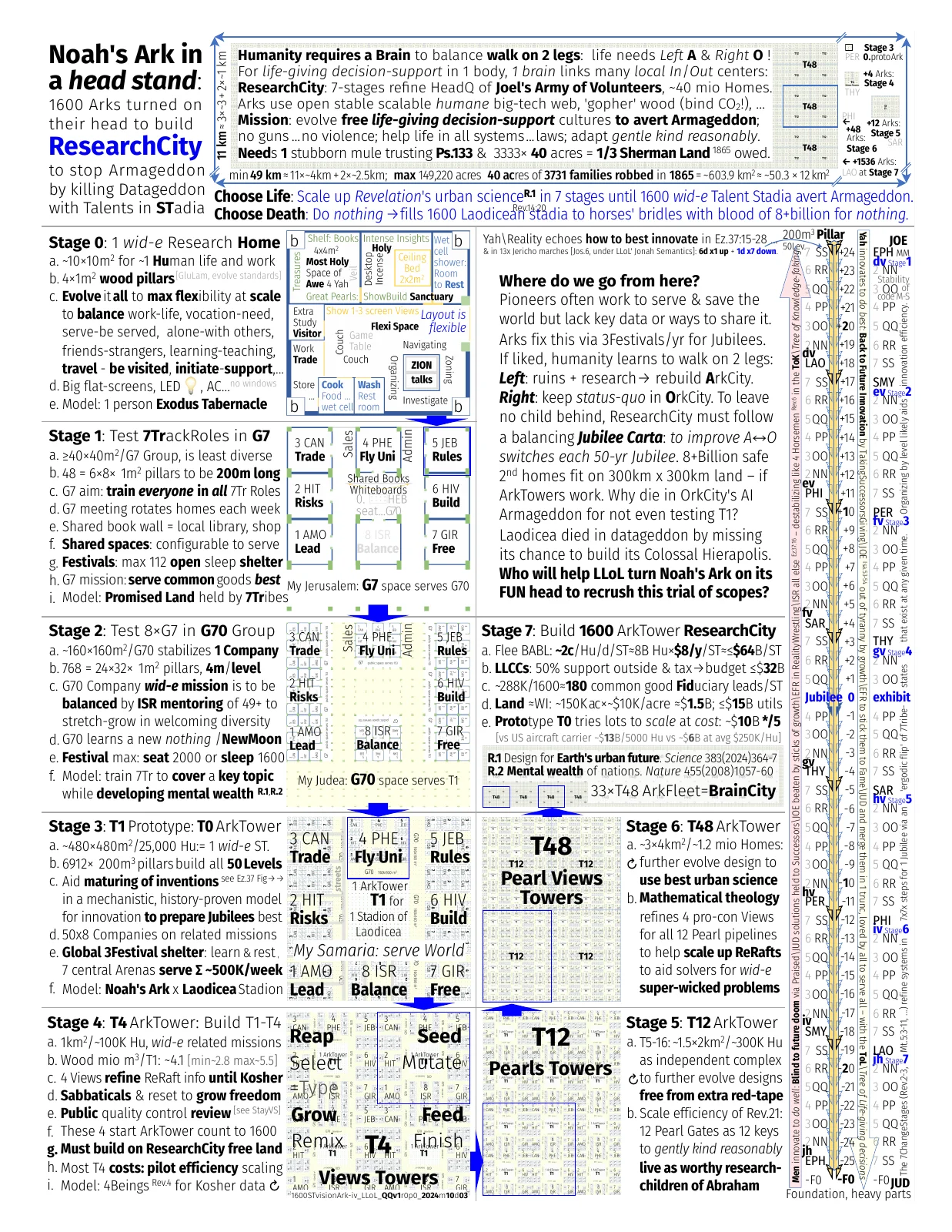
SD8a — the physical vision (see the humility note above).
The physical vision (SD8a) scales in 7-8 stages, from a single ~10×10 m research home all the way up to a city of about 1600 timber “ArkTowers” — “Noah’s Ark turned on its head” — built in glue-laminated timber (GluLam) rather than steel or concrete. Each stage is sized and named so the structure grows the way an institution does. The framing is a deliberate choice of swapping: Avoid Death (keeping the status-quo, as “OrkCity” does by not re-innovating) then Choose Life (by starting to renew the worst OrkCity’s run-down leftovers to build a new ArkCity that will then be redefined as the new OrkCity at the next Jubilee to keep switching).
The idea is plagiarized from how humans walk on two legs: first put one leg forward, then the other, never both at the same time (unless trying to jump). The Jubilee System is a way for coordinating such organizational “walking” for humanity, but it needs a “brain” to coordinate. ResearchCity is meant to be that coordinating brain.
How to get there: 7-8 stages of scaling up#
The scale-up has two independent dimensions — stages (in time) and stadia (in space) — and they are fully orthogonal.
Stages are in time. ResearchCity grows through 7-8 stages — “7 or 8” because it is not yet settled whether the earliest, Stage 0, counts as a full stage. Each stage runs roughly 6 to 8 effective months, so the whole sequence gives a realistic sense of how long a serious scale-up must last to succeed: years, not a quarter. Each stage must complete a full innovation cycle for the key designs that then become foundational for the next stage — so the whole sequence works like a training program for getting a self-stabilising innovation engine running, one leg at a time (the “walking” above). The physical side of each stage is what the hardware figure (SD8a) above sketches.
Stadia are in space. Independently of the stages, ResearchCity is organised into research stadia by topic — at least 16 to begin with (one per essential topic area; in the early stages these live wherever there is room, a few people each), growing toward the full 1600 co-located stadia. Because stages (time) and stadia (space) are orthogonal, work on a topic-stadion can begin long before the stage that will give it its own building.
A ResearchCity at world scale cannot be willed into being by one person — it needs a UN mandate. One explicit goal of #AuditTheMath is to earn exactly that mandate — if, and only if, the math proves as reliable as LLoL has come to trust. The fullest version of the case is LLoL’s detailed letter to the UN Secretary-General: it invokes UN Charter Articles §99 and §100, lays out concrete milestones (authentication → endorsement → a public “Flying Scroll” → a call to the ten “Nuclear Kings”), and frames the choice as a carrot — a tested way out — rather than the stick of Mutually Assured Destruction.
The software vision#
LLoL’s information design comes with the same humility as the hardware above.
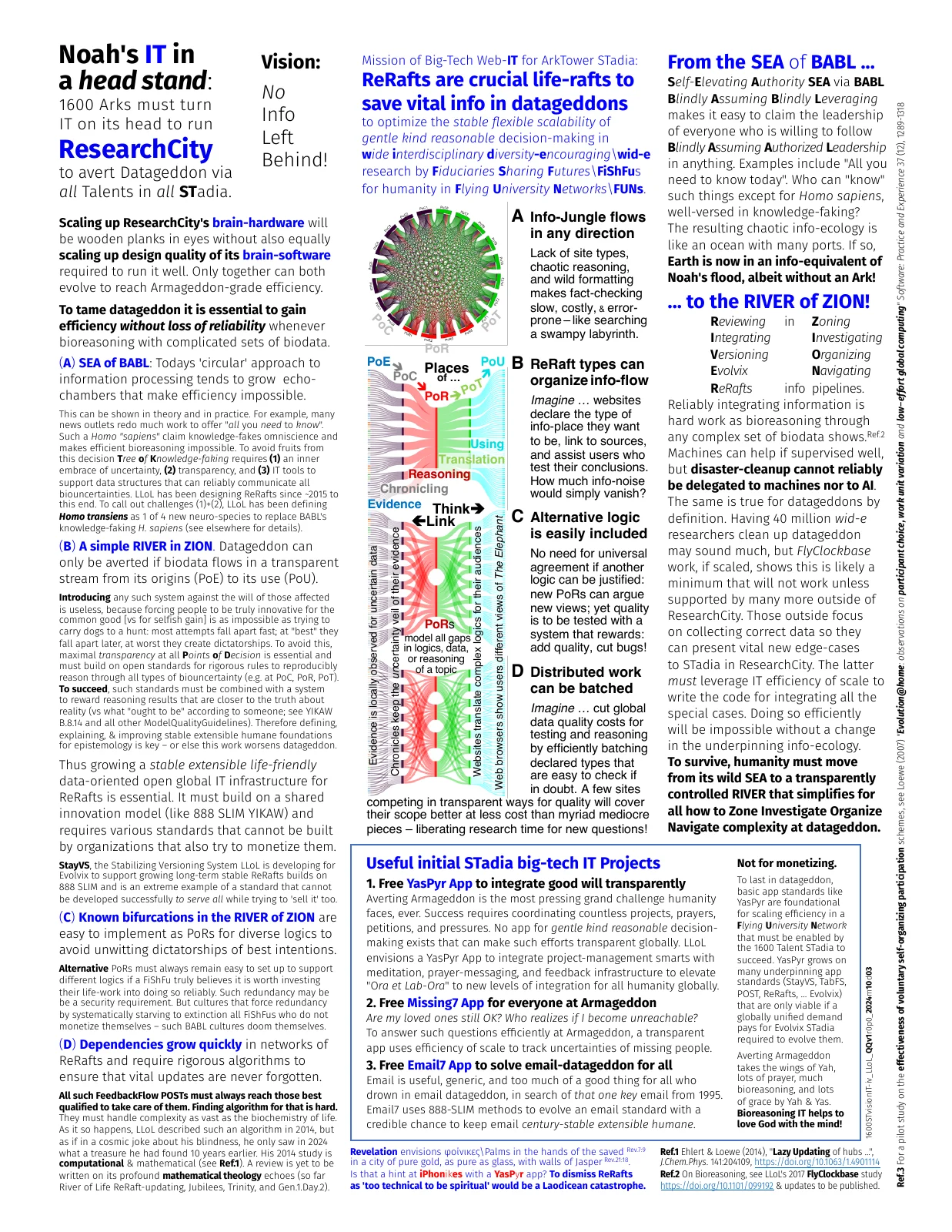
SD8b — “from the SEA of BABL to the RIVER of ZION.”
The information vision (SD8b) moves the world “from the SEA of BABL to the RIVER of ZION.” Today’s circular information ecology — the SEA of Self-Elevating Authorities — grows echo chambers and data deserts where knowledge-faking drowns out genuine insight. The fix is a transparent RIVER: a pipeline that carries data from Point of Evidence → Point of Use (collection → reasoning → adversarial testing → use), with diverse Points of Reasoning included by design, so no single view can quietly dominate. These pipelines are ReRafts — “life-rafts to save vital info in datageddons.”
Hardware and software together, run as an epiocracy, are the practical form of the Jubilee System — and, as far as LLoL is aware, the only structure that can actually dismantle the 7DUIs.