
Burning Libraries in the 21st Century#
by Laurence Loewe of Laodicea (LLoL)
We remember the Library of Alexandria as a single tragic fire. The truth is slower, and sadder. It declined over centuries — through fire, yes, but also war, budgets, neglect, and people who simply had other priorities. That is how most libraries die. Not in a blaze. By a thousand small defundings.
And burning is not always the villain’s act. In Acts 19, new believers in Ephesus freely gathered their own sorcery scrolls — worth fifty thousand silver coins — and burned them in the open: a chosen release of knowledge they had decided was harmful. So the question was never burning: yes or no. It is always which knowledge, by whose decision, for whose good, over what term.
In the 21st century we are too sophisticated for torches. We let the spreadsheet do the burning. A university library deaccessions a collection that no longer “performs.” A department is dissolved and its archive boxed, then lost. A lifetime of field notes is scattered at an estate sale because storing them did not pencil out this quarter. Each one is a small Alexandria. No flames. Just a line item.
Watch it happen to one researcher#
If you want to see datageddon — the drowning of good words and good works in more complexity than any one human can carry — you can watch it happen to a single researcher, year by year, in reverse:
2026 — the Matheo studies (MMv5): my most refined attempt to say the whole thing plainly.
2025 — the MMv3 pack: harder to grasp, but the first version I dared call near-complete.
2024 — the court files: not a paper, but hundreds of pages I wrote alone, without AI, to convince a bank and a court that I was working on something that mattered. It went about as well as you would expect.
2023 — the letters: appeals to my lender that, to my astonishment, bought nearly another year — without which none of the rest exists.
2022 and earlier — the hard drives and the storage units: decades of material, mountains of it, now scattered at auction.
Each layer is a small library. Each was too much for one person to compress alone — and that is the whole point. Datageddon is what happens when good work outruns any single mind’s capacity to carry it, and keeping it is no one’s job.
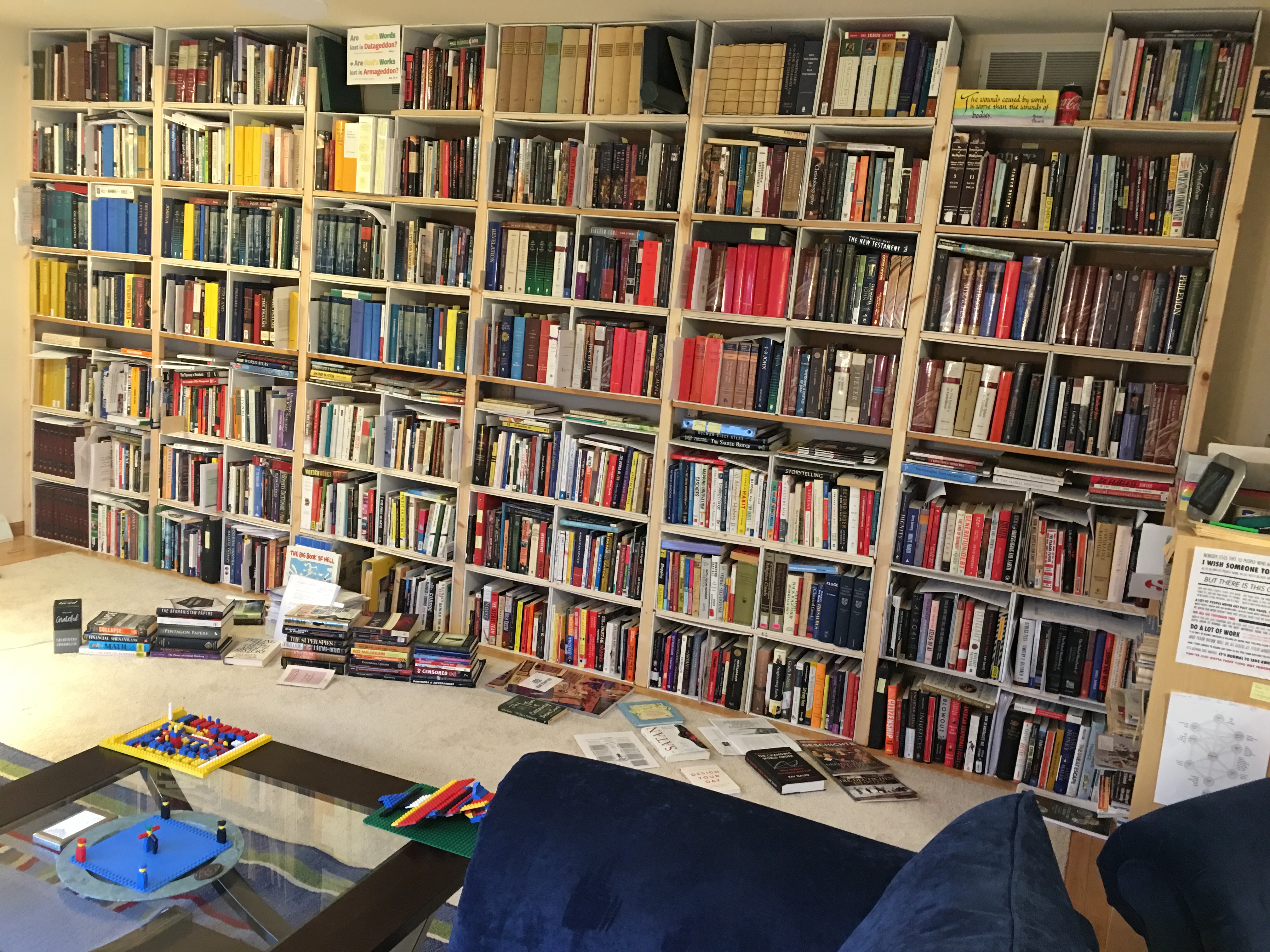
One wall of the working library behind everything I have published — read and assembled by hand. Not décor. A workbench. The hand-lettered sign asks the question this whole post asks: are good words lost in datageddon? are good works lost in Armageddon?#
Among the boxes now at auction is hard-to-find nuclear-fallout research I inherited from the geneticist James F. Crow. I tried to save it. I most likely cannot. But my boxes are the small version of the story. The large version is a question the size of a civilization.
Where shall all the institutional knowledge go?#
When every institution runs on short-term profit logic — the pattern I call BABL, Blindly Assuming Blind Leveraging — the knowledge that does not pay this quarter falls through every crack. Not from malice. Because preserving it is no one’s job. And it is exactly the no-one’s-job category that grinds, quietly, to dust.
It is getting worse, not better — and AI is about to make the stakes plain. An AI is, at heart, a stereotyping engine: brilliant and fast at finding what is common, the patterns that repeat across millions of examples. What it cannot keep is the long fat tail of dark data — the odd exceptions, the cases that refuse to fit. And most of reality lives in that tail. Most of biology is exceptions. So is most hard-won research. The commonalities, an AI can already reproduce at machine speed; nobody needs my boxes for that. The value of a lifetime of research material is exactly the part an AI discards: the exceptions, and the half-tamed mess of data — the datageddon — that faithfully records them.
And here is the part worth staying for. If there is a reliable method for properly organizing the datageddon I collected — real organization, at every level, not a dump of incomprehensible uploads — then that method is already half-way to organizing the rest of the world’s data the same way: gently, reasonably, reliably. My mess is not only a loss. It is a test case — one of the few honest, full-scale experiments in how to make a body of knowledge trustworthy again. Lose it, and we lose the experiment too.
We already discard the people: a whole generation of trained researchers shown the door because the grant closed or the professorship never came. Then we discard the knowledge they kept. And now we are poised to keep only what is common and lose everything exceptional — which is to say, lose exactly the part that matters.
I am asking you plainly: is this how the world wants to treat its researchers, and the institutional memory in their keeping? When the next library quietly closes — and one is closing somewhere as you read this — where do you want that knowledge to go?
Because here is the question underneath the question. If the world’s research data is treated, continually, the way mine has been — and almost everyone’s is — then is it any wonder the world keeps drifting toward destroying itself? No civilization can make gentle, kind, reasonable, reliable decisions on top of knowledge it has let rot. Datageddon is not a side-issue. It is how Armageddon begins.
If your answer is somewhere built to keep it, then help build that somewhere. That is the whole point of a ResearchCity: a home for the work the spreadsheet discards, and for the people it discards along with it — staffing the seats no institution will pay for, the ones whose job is the long view on everyone’s behalf.
Don’t trust me. Audit the math. And when you have, help plant a seed that anyone can watch being checked, every step of the way.
Note
Two companion pieces sit beside this one, kept separate on purpose: an account of the day I stood at the auction of my own home (Doctor, Save Yourself), and why I have stopped fighting to save the materials themselves (the grain-of-wheat piece).