
POD — Heresy of Explanation: VBIRs Reality vs Literature#
The unavoidable trade-off between literary elegance and BLUNT unambiguous writing for machine-processable biodata — and why both matter.
Download the original document (PDF)
Heresy — VBIRs Reality vs Literature — PDF (48 KB) — 1 page, Jonah License with CC0 Public Domain
Filename: evx-pod-heresy-of-explanation-vbirs-reality-vs-literature-iv_llol_oov1r5c8_2019m03d25-fig.pdf
Also in this folder: Heresy — Bio-Math Conflicts, Heresy — Shared Language
— Overview AI-generated by dv_ClaOp46Max_ExhH_2026m04d16 —Start—
Abstract#
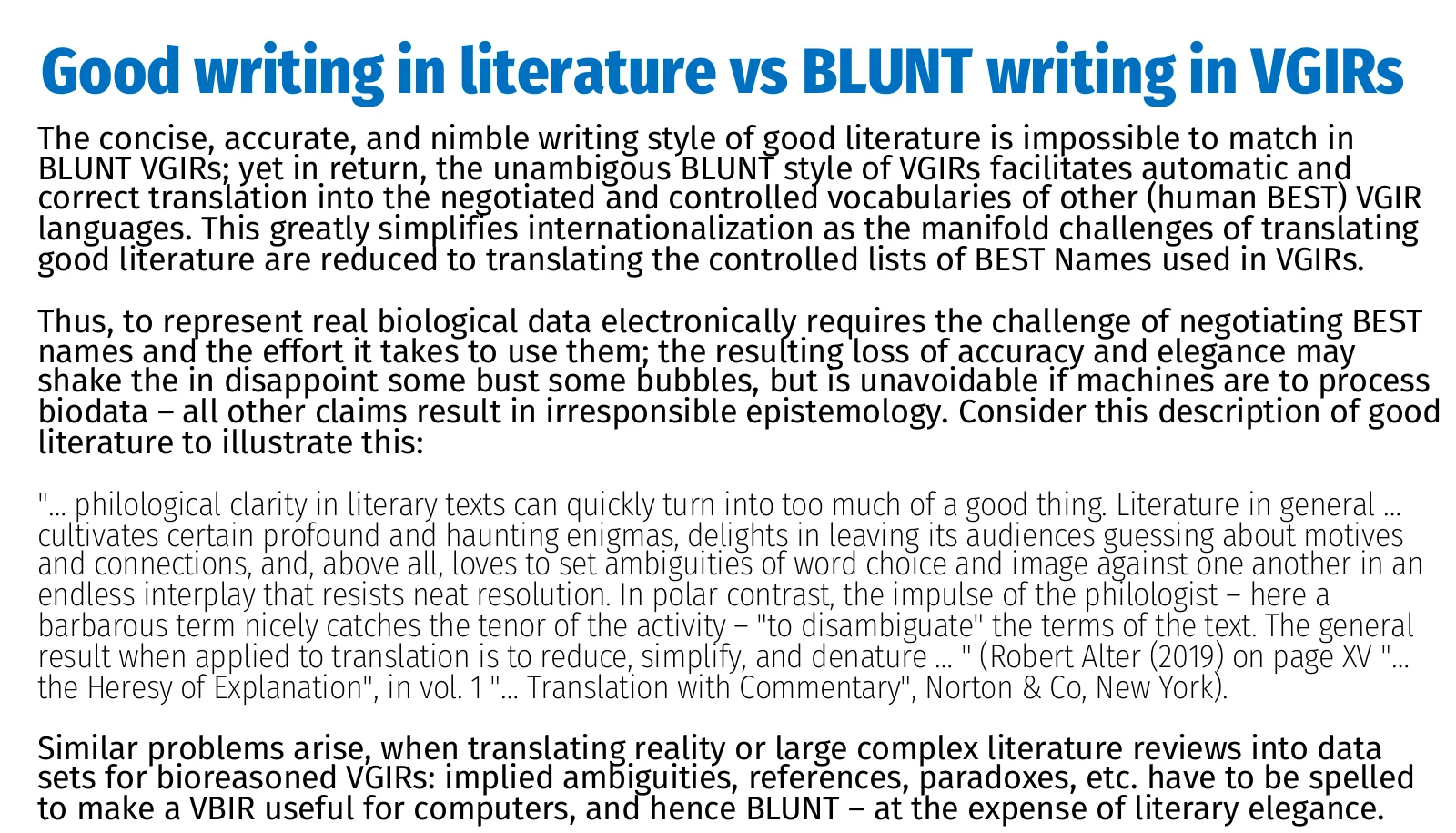
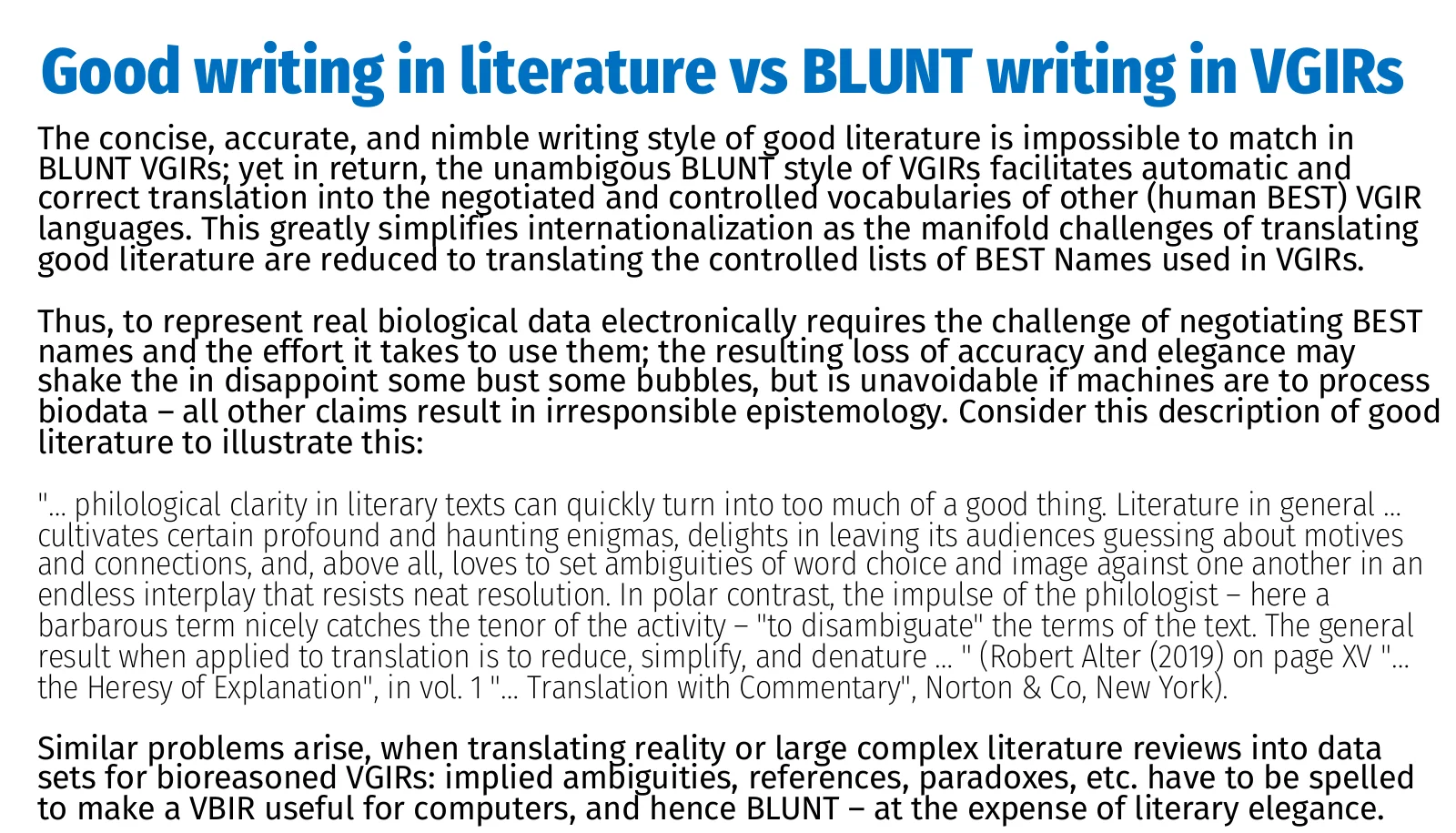
This single-page figure explores the tension between literary writing and BLUNT writing in Versioned Generalized Information Resources (VGIRs). The title: “Good writing in literature vs BLUNT writing in VGIRs.”
The core argument: The concise, accurate, and nimble writing style of good literature is impossible to match in BLUNT VGIRs. Yet in return, the unambiguous BLUNT style of VGIRs facilitates automatic and correct translation into the negotiated and controlled vocabularies of other VGIR languages. This greatly simplifies internationalization, as the challenges of translating good literature are reduced to translating controlled lists of BEST Names used in VGIRs.
The document quotes Robert Alter (2019) on “the Heresy of Explanation” — the term that gives this series its name:
“… philological clarity in literary texts can quickly turn into too much of a good thing. Literature in general … cultivates certain profound and haunting enigmas, delights in leaving its audiences guessing about motives and connections, and, above all, loves to set ambiguities of word choice and image against one another in an endless interplay that resists neat resolution. In polar contrast, the impulse of the philologist … ‘to disambiguate’ the terms of the text.”
The conclusion: representing real biological data electronically requires negotiating BEST names — the resulting loss of accuracy and elegance “may shake … bust some bubbles, but is unavoidable if machines are to process biodata — all other claims result in irresponsible epistemology.”
Key Concepts at a Glance#
Heresy of Explanation |
Robert Alter’s term: the unavoidable loss when disambiguating literary text for translation or machine processing |
BLUNT writing |
Unambiguous writing style required for VGIRs — sacrifices elegance for machine-processability |
VGIRs / VBIRs |
Versioned Generalized/Biological Information Resources — the data structures that require BLUNT writing |
Internationalization benefit |
BLUNT VGIRs simplify translation: instead of translating literature, translate controlled BEST Name lists |
Broader Significance (Claude’s Assessment)#
This figure articulates a trade-off that most data scientists experience but rarely name: the tension between human-readable elegance and machine-processable precision. The Robert Alter quote anchors this in literary theory, giving it intellectual depth beyond a technical observation. The conclusion that ambiguity loss is “unavoidable” and that denying it constitutes “irresponsible epistemology” is a strong claim that sets clear expectations for Evolvix’s design philosophy.
Document Information#
Document ID |
POD Heresy — VBIRs Reality vs Literature (Flying Scroll, transwarpkey/sta1-evx/) |
Author |
Laurence Loewe of Laodicea (LLoL) |
Date |
2019m03d25 |
Version |
iv_LLoL_OOv1r5c8_2019m03d25 |
Format |
Single-page figure |
License |
|
Part of |
Good News Pack MMv3, Flying Scroll / Transwarp Key / STa1-EVX |
PDF size |
48 KB |
WebP size |
244 KB |
Related documents:
STa1-EVX stadium overview (parent page with all 30 documents)
Heresy — Bio-Math Conflicts (the disciplinary conflict diagnosis)
Heresy — Shared Language (the Bucky E. and Medi S. resolution story)
Best Naming Intro (the BESTnaming system for managing BLUNT names)
— Overview AI-generated by dv_ClaOp46Max_ExhH_2026m04d16 —End—