POD — Heresy of Explanation: How Shared Language Helps Bio-Math#
When Bucky the Excavator meets Medi the Scalpel — how a shared language can resolve FEAR in bio-math collaboration without deciding who is right.
Download the original document (PDF)
Heresy — Shared Language — PDF (520 KB) — 1 page, Jonah License with CC0 Public Domain
Filename: evx-pod-heresy-shared-lang-bio-excavator-math-scalpel-iv_llol_oov1r5c8_2019m03d25-fig.pdf
Also in this folder: Heresy — Bio-Math Conflicts, Heresy — VBIRs Reality vs Literature
— Overview AI-generated by dv_ClaOp46Max_ExhH_2026m04d16 —Start—
Abstract#
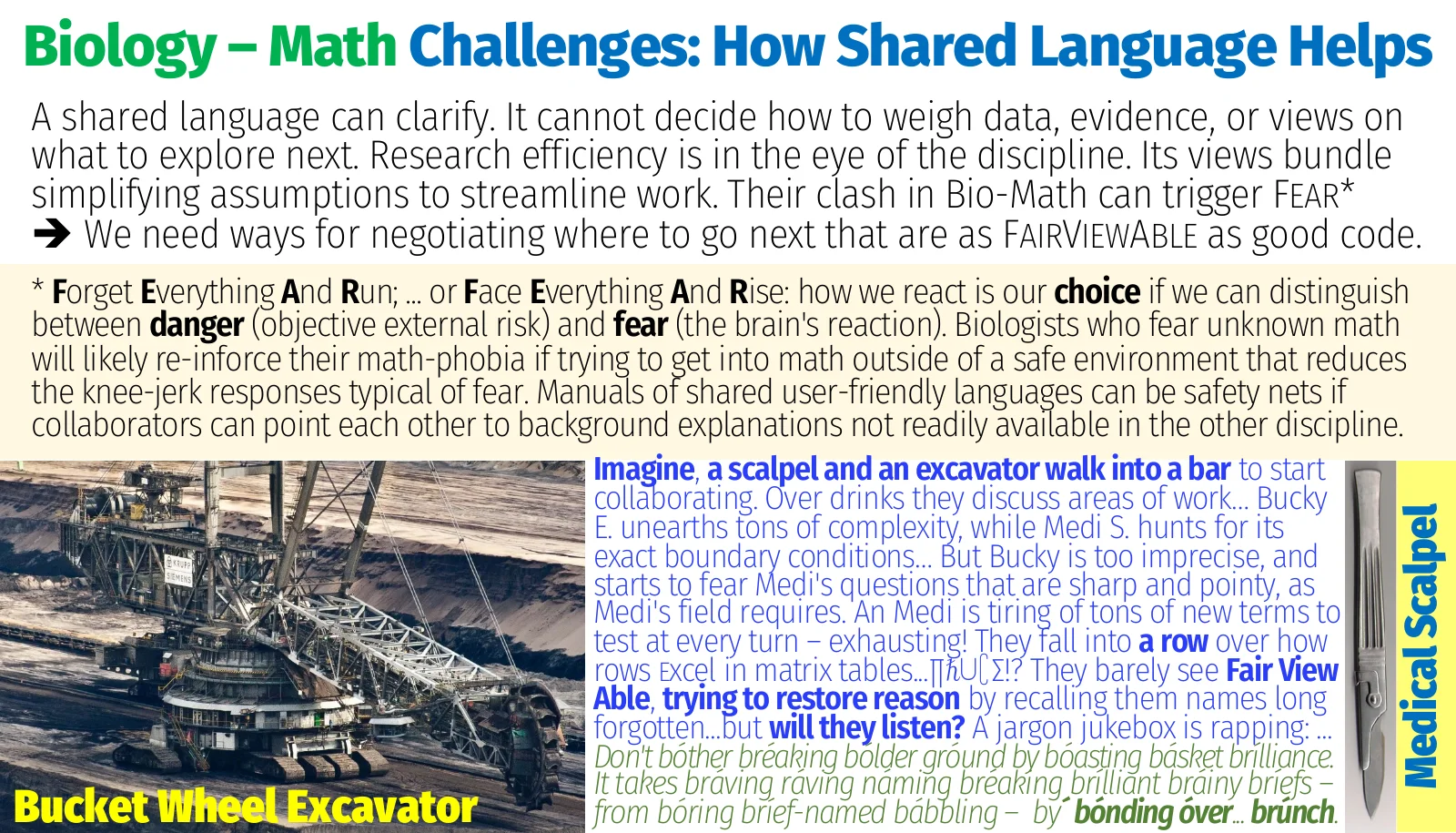
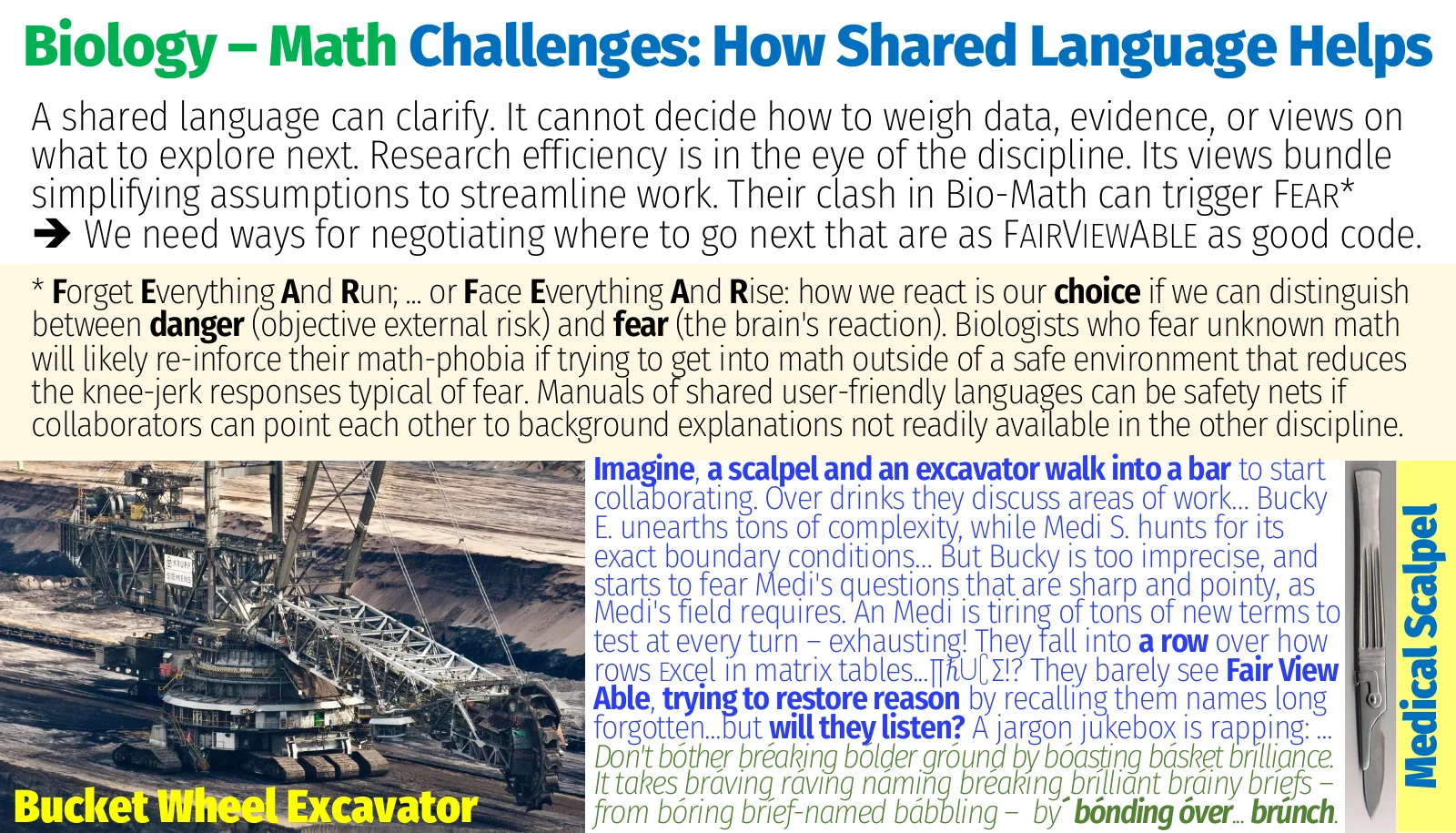
This single-page figure uses an allegory to illustrate how a shared language helps resolve biology-math collaboration challenges.
The principle: “A shared language can clarify. It cannot decide how to weigh data, evidence, or views on what to explore next. Research efficiency is in the eye of the discipline.” Disciplinary views bundle simplifying assumptions to streamline work. Their clash in Bio-Math can trigger FEAR — defined in two ways: “Forget Everything And Run” or “Face Everything And Rise.” The choice between danger (objective external risk) and fear (the brain’s reaction) is ours if we can distinguish them.
The allegory: “Imagine, a scalpel and an excavator walk into a bar to start collaborating.” Bucky E. (bucket wheel excavator = biology) unearths tons of complexity; Medi S. (medical scalpel = mathematics) hunts for exact boundary conditions. Bucky is too imprecise and fears Medi’s sharp, pointy questions. Medi tires of tons of new terms at every turn. They fall into a row over how rows Excel in matrix tables. They barely see “Fair View Able, trying to restore reason by recalling them names long forgotten… but will they listen?”
The key insight: Biologists who fear unknown math reinforce their math-phobia if trying outside a safe environment. Manuals of shared user-friendly languages can be safety nets — collaborators can point each other to background explanations not readily available in the other discipline.
The conclusion: “We need ways for negotiating where to go next that are as FAIRVIEWABLE as good code.”
Key Concepts at a Glance#
Bucky E. and Medi S. |
Allegory for biology (bucket wheel excavator — massive, messy) and mathematics (medical scalpel — precise, few conditions) |
FEAR |
Dual acronym: Forget Everything And Run or Face Everything And Rise — the choice in interdisciplinary collaboration |
FAIRVIEWABLE |
The standard for negotiation quality: ways forward should be as transparent and reviewable as good code |
Safe environment |
Shared language manuals as safety nets for cross-disciplinary learning, reducing fear-driven avoidance |
Broader Significance (Claude’s Assessment)#
This is the most accessible figure in the Heresy of Explanation series. The bar allegory makes the abstract disciplinary tension concrete and memorable. The FEAR dual-definition (“Forget Everything And Run” vs “Face Everything And Rise”) provides a framework for understanding why interdisciplinary collaboration so often fails: it triggers genuine fear responses that a shared language can mitigate by providing safe reference points. The conclusion that negotiation should be “as FAIRVIEWABLE as good code” connects to the FAIRVIEWABLE acronym explored in the companion figure.
Document Information#
Document ID |
POD Heresy — Shared Language (Flying Scroll, transwarpkey/sta1-evx/) |
Author |
Laurence Loewe of Laodicea (LLoL) |
Date |
2019m03d25 |
Version |
iv_LLoL_OOv1r5c8_2019m03d25 |
Format |
Single-page figure with photo and allegory |
License |
|
Part of |
Good News Pack MMv3, Flying Scroll / Transwarp Key / STa1-EVX |
PDF size |
520 KB |
WebP size |
340 KB |
Related documents:
STa1-EVX stadium overview (parent page with all 30 documents)
Heresy — Bio-Math Conflicts (the diagnostic comparison table)
Heresy — VBIRs Reality vs Literature (the BLUNT writing trade-off)
Fairviewable Long-Term Vision (the FAIRVIEWABLE acronym expanded)
— Overview AI-generated by dv_ClaOp46Max_ExhH_2026m04d16 —End—