
Loewe & Charlesworth (2007) — Background Selection in Single Genes May Explain Patterns of Codon Bias#
Demonstrating how deleterious mutations shape genome evolution at the fine scale of individual genes — another high-impact collaboration building the population genetics foundation for EvoSysBio.
Download the original document (PDF)
Loewe & Charlesworth (2007) — Background Selection — PDF (600 KB) — 13 pages, Jonah License with CC0 Public Domain
Filename: loewe-charlesworth-2007-study-quantify-background-selection-in-single-genes-13page.pdf
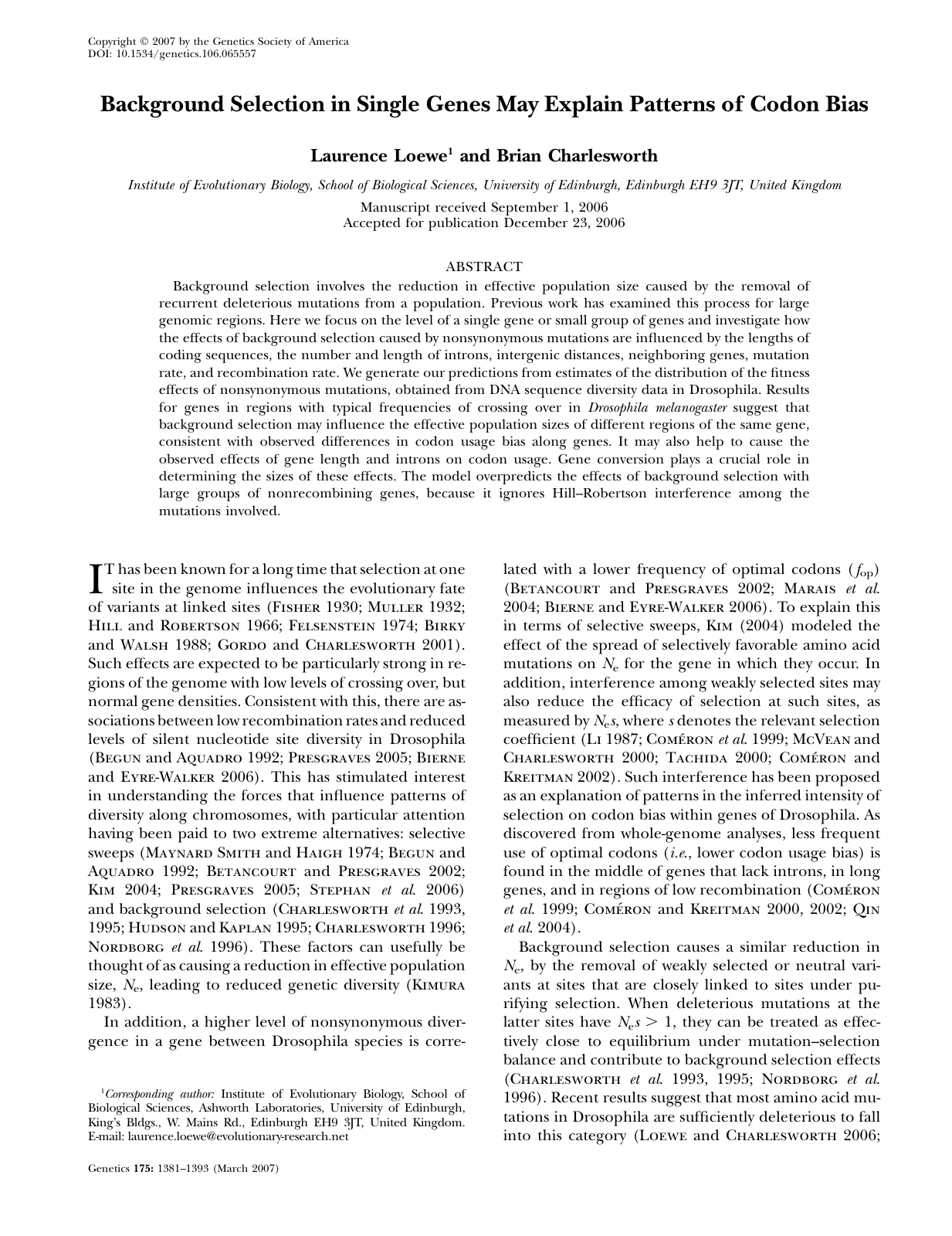
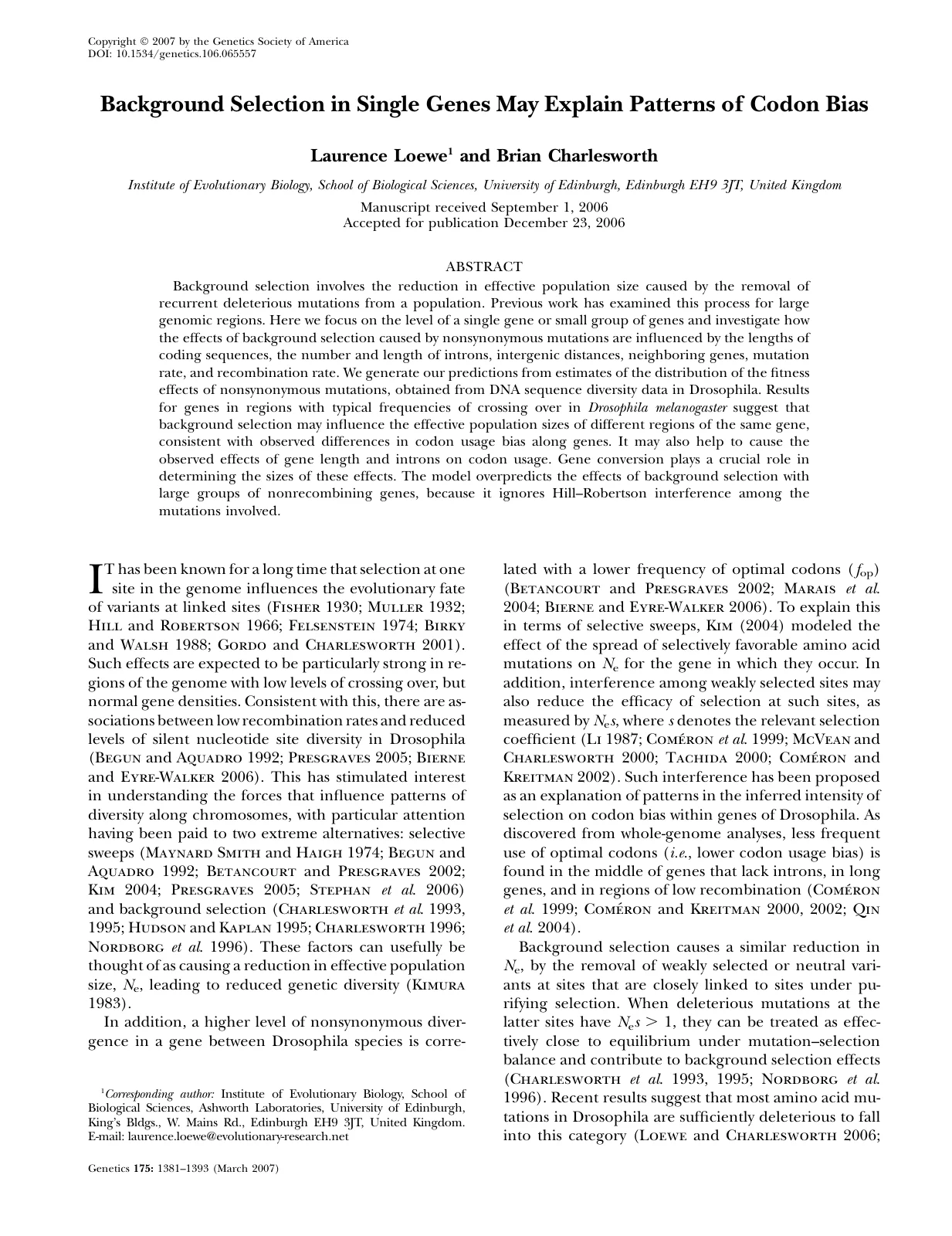
— Overview AI-generated by dv_ClaOp46_ExhB_2026m04d14 —Start—
Abstract#
This paper examines background selection — the reduction in effective population size caused by the removal of linked deleterious mutations — at the level of single genes. The study investigates how background selection caused by nonsynonymous mutations is influenced by gene structure: coding length, intron presence, intergenic distances, neighboring genes, mutation rate, and recombination rate.
Using estimates of the distribution of fitness effects of nonsynonymous mutations in Drosophila melanogaster (building on the DME work from Loewe & Charlesworth 2006), the authors show that background selection can significantly reduce the effective population size of different regions within the same gene. This within-gene variation in effective population size provides an explanation for the observed patterns of codon usage bias — the non-random use of synonymous codons that correlates with gene expression level and position within genes.
The results demonstrate that the interplay between selection, mutation, and recombination operates at a finer spatial scale than previously appreciated, with consequences visible in codon usage patterns across the Drosophila genome.
Broader Significance (Claude’s Assessment)#
This paper demonstrates how deleterious mutations shape genome evolution at remarkably fine scales:
Within-gene variation in effective population size. The key insight is that background selection is not uniform even within a single gene. Different regions of the same gene can have different effective population sizes depending on their proximity to sites under strong purifying selection. This is a finer resolution than most previous background selection analyses.
Explaining codon bias mechanistically. Codon usage bias is one of the classic puzzles of molecular evolution. This paper provides a mechanistic explanation rooted in background selection rather than requiring ad hoc hypotheses about translational selection alone.
Building on the DME foundation. This paper directly uses the distribution of fitness effects estimated in the 2006 DME paper (Loewe & Charlesworth 2006), demonstrating how foundational parameter estimates propagate through to explain observable genomic patterns. The research program is cumulative.
Charlesworth collaboration continued. This is the second major paper with Brian Charlesworth in this collection, reflecting a sustained and productive collaboration at the intersection of theoretical population genetics and genomic data analysis.
Published in Genetics. Publication in Genetics, the journal of the Genetics Society of America, places this work in one of the field’s premier venues, alongside the foundational literature on population genetics theory.
Who This Is For#
Audience |
What you will find |
|---|---|
Population geneticists |
Quantitative analysis of background selection at single-gene resolution with realistic fitness effect distributions |
Molecular evolutionists |
A mechanistic explanation linking background selection to observed codon usage bias patterns in Drosophila |
Genomics researchers |
Evidence that effective population size varies within genes, with implications for interpreting genomic diversity data |
Evolutionary biologists |
How gene structure (introns, coding length, recombination) mediates the impact of deleterious mutations on linked variation |
General scientists |
An example of how invisible selective forces leave detectable signatures in DNA sequence patterns |
Key Concepts at a Glance#
Background selection |
Reduction in effective population size at linked neutral sites caused by the removal of nearby deleterious mutations |
Codon bias |
Non-random usage of synonymous codons, correlated with gene expression and position — here explained by background selection effects |
Effective population size |
The idealized population size that would produce the same genetic drift as the actual population; reduced by background selection |
Nonsynonymous mutations |
Mutations that change the amino acid sequence, subject to purifying selection, and the source of background selection effects analyzed here |
Gene structure |
Coding length, introns, intergenic distances, and neighboring genes — all factors modulating background selection intensity |
Recombination rate |
The rate of genetic exchange between chromosomes; higher recombination reduces background selection by decoupling linked sites |
Document Information#
Document ID |
Key Paper 7 (Dusty Deep Data, loewe-researchcity-key-papers/) |
Full title |
Background Selection in Single Genes May Explain Patterns of Codon Bias |
Authors |
Laurence Loewe, Brian Charlesworth |
Journal |
Genetics 175: 1381–1393 (March 2007) |
DOI |
|
Publisher |
Genetics Society of America |
Received / Accepted |
2006m09d01 / 2006m12d23 |
Pages |
13 |
License |
|
Part of |
Good News Pack MMv3, Dusty Deep Data / Key Papers collection |
PDF size |
600 KB |
WebP size |
288 KB |
Related documents in the Good News Pack:
Loewe & Charlesworth (2006) — DME in Drosophila (provides the DME estimates used as inputs here)
Loewe & Hill (2010) — Complexity Barrier (extends population genetics analysis to mutation-selection balance)
— Overview AI-generated by dv_ClaOp46_ExhB_2026m04d14 —End—