
Loewe (2006) — Quantifying the Genomic Decay Paradox due to Muller’s Ratchet in Human Mitochondrial DNA#
Defining a null model that reveals surprisingly large parameter ranges leading to extinction of the human line over 20 million years — the genomic decay paradox.
Download the original document (PDF)
Loewe (2006) — Muller’s Ratchet in mtDNA — PDF (1.7 MB) — 27 pages, Jonah License with CC0 Public Domain
Filename: loewe-2006-study-in-silico-genomic-decay-in-human-mitochondrial-dna-due-to-mullers-ratchet-27page.pdf
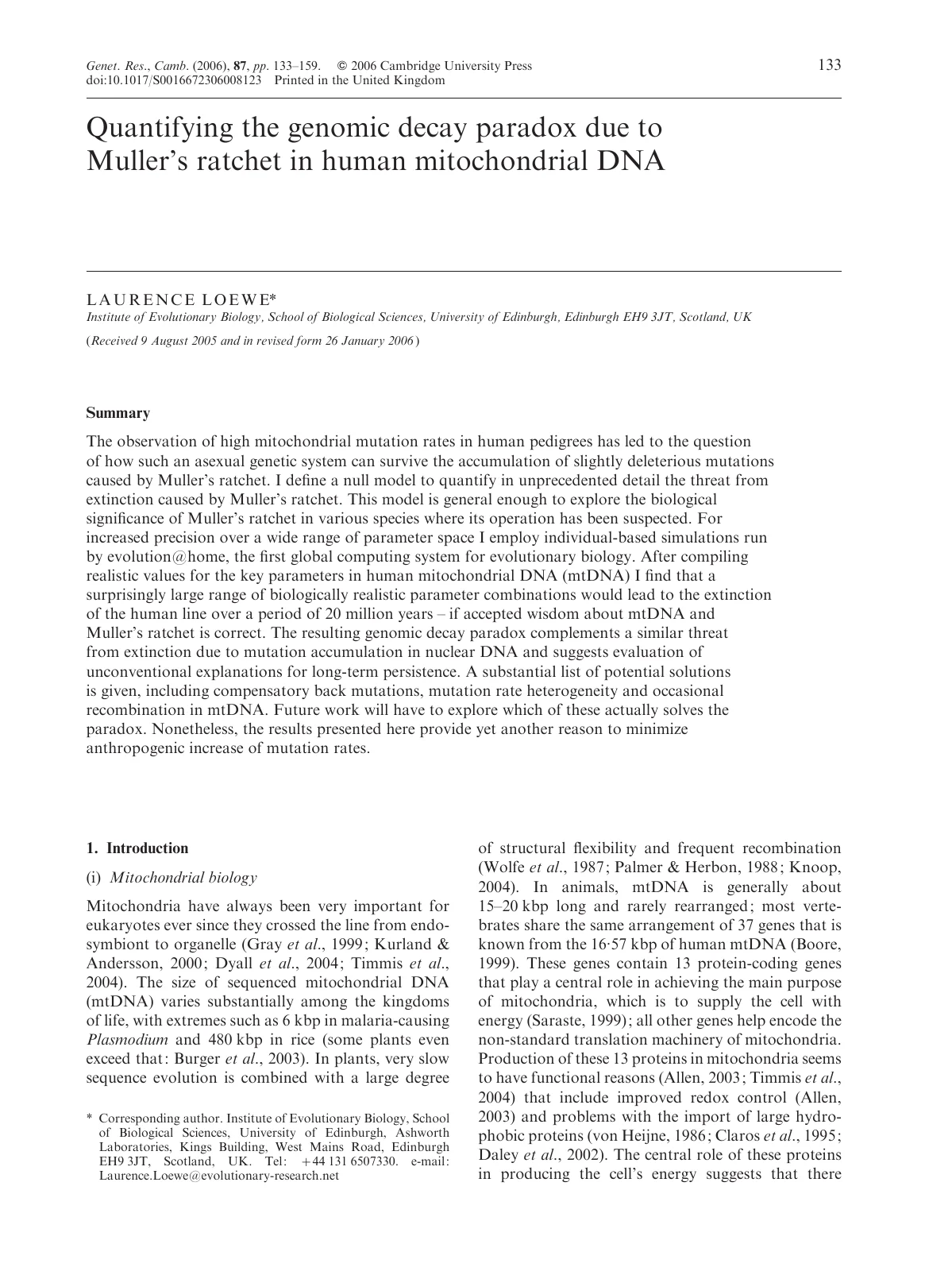
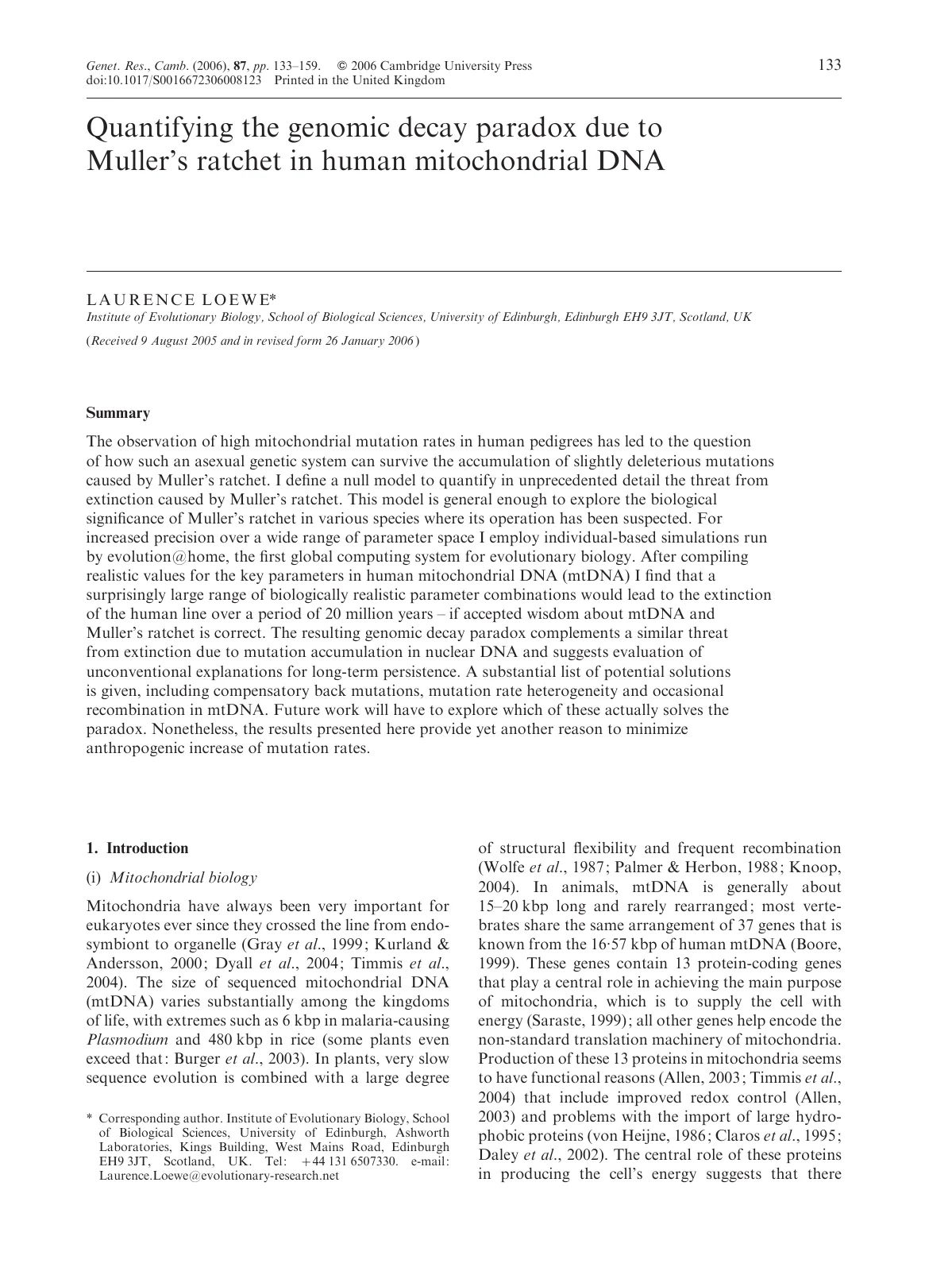
— Overview AI-generated by dv_ClaOp46_ExhB_2026m04d14 —Start—
Abstract#
This paper defines a null model to quantify in unprecedented detail the threat of extinction caused by Muller’s ratchet in human mitochondrial DNA (mtDNA). Using evolution@home distributed simulations with biologically realistic parameters, the study systematically explores the parameter space of mutation rates, population sizes, and fitness effect distributions.
The central finding is the genomic decay paradox: surprisingly large ranges of biologically plausible parameter combinations lead to extinction of the human line over a timescale of 20 million years. This means that under standard population genetics assumptions, human mtDNA should have accumulated enough deleterious mutations to drive the species extinct — yet humans are still here.
The paper lists potential resolutions to this paradox, including compensatory back mutations, mutation rate heterogeneity across sites, epistatic interactions between mutations, and occasional recombination in mtDNA. Each proposed solution is evaluated for biological plausibility and testability.
Broader Significance (Claude’s Assessment)#
This is a core paper demonstrating the quantitative modeling approach that underpins the entire ResearchCity vision:
The genomic decay paradox as a scientific puzzle. The paper does not merely simulate Muller’s ratchet — it uses simulations to reveal a genuine paradox: standard models predict human extinction, yet humans survive. This gap between model prediction and reality is scientifically productive because it identifies specific biological mechanisms that must exist but are not yet fully understood.
Evolution@home as proof of concept. The distributed computing infrastructure that generated the simulation data demonstrates the kind of large-scale citizen science approach that ResearchCity aims to scale up. Over 300 volunteers contributed computing power to produce results no single machine could achieve at the time.
Direct precursor to SD1 methodology. The stochastic simulation approach used here — exploring parameter spaces with biologically realistic inputs and quantifying uncertainty — is the same methodology applied in the RiskyMADorMAP nuclear winter model (Poster SD1 of the Good News Pack).
Rigorous null model discipline. The paper demonstrates the principle of defining a precise null model first, then showing where and how it fails. This “assume the simplest case and watch it break” methodology is a hallmark of careful quantitative reasoning.
27-page depth. At 27 pages, this is the most detailed treatment of Muller’s ratchet in human mtDNA, covering parameter estimation, simulation design, result analysis, and systematic evaluation of potential solutions.
Who This Is For#
Audience |
What you will find |
|---|---|
Population geneticists |
Comprehensive parameter exploration of Muller’s ratchet with biologically realistic inputs for human mtDNA |
Mitochondrial biologists |
Quantitative evidence for the genomic decay paradox and evaluation of proposed biological resolution mechanisms |
Computational biologists |
Detailed methodology for distributed stochastic simulation of evolutionary dynamics using evolution@home |
Evolutionary biologists |
A systematic null model approach to understanding why asexual genomes persist despite theoretical predictions of ratchet-driven extinction |
General scientists |
An accessible case study of how simulation reveals invisible threats that purely analytical approaches miss |
Key Concepts at a Glance#
Muller’s ratchet |
The irreversible accumulation of deleterious mutations in asexual populations, where the least-mutated class is lost and cannot be recovered without recombination |
Genomic decay paradox |
The finding that standard parameters predict human extinction via mtDNA ratchet — yet humans survive, implying unknown rescue mechanisms |
Human mitochondrial DNA |
The maternally inherited, non-recombining genome that is vulnerable to Muller’s ratchet due to its asexual transmission |
Evolution@home |
LLoL’s distributed computing system that harnessed volunteer computers worldwide for evolutionary simulations |
Null model |
The simplest possible model consistent with known biology, used as a baseline to identify where reality deviates |
Compensatory back mutations |
One proposed resolution: mutations that restore function at the same or nearby sites, partially reversing ratchet clicks |
Biologically realistic parameters |
Mutation rates, population sizes, and fitness effects drawn from empirical data rather than theoretical convenience |
Document Information#
Document ID |
Key Paper 6 (Dusty Deep Data, loewe-researchcity-key-papers/) |
Full title |
Quantifying the genomic decay paradox due to Muller’s ratchet in human mitochondrial DNA |
Author |
Laurence Loewe |
Journal |
Genetics Research, Cambridge (2006), 87, pp. 133–159 |
DOI |
|
Publisher |
Cambridge University Press |
Received / Revised |
2005m08d09 / 2006m01d26 |
Pages |
27 |
License |
|
Part of |
Good News Pack MMv3, Dusty Deep Data / Key Papers collection |
PDF size |
1.7 MB |
WebP size |
212 KB |
Related documents in the Good News Pack:
Loewe (2002) — Dissertation (the doctoral thesis that initiated the ratchet research program)
Loewe & Charlesworth (2006) — DME in Drosophila (provides DME estimates used as simulation inputs)
Loewe (2007) — Evolution@home (documents the distributed computing infrastructure)
— Overview AI-generated by dv_ClaOp46_ExhB_2026m04d14 —End—