
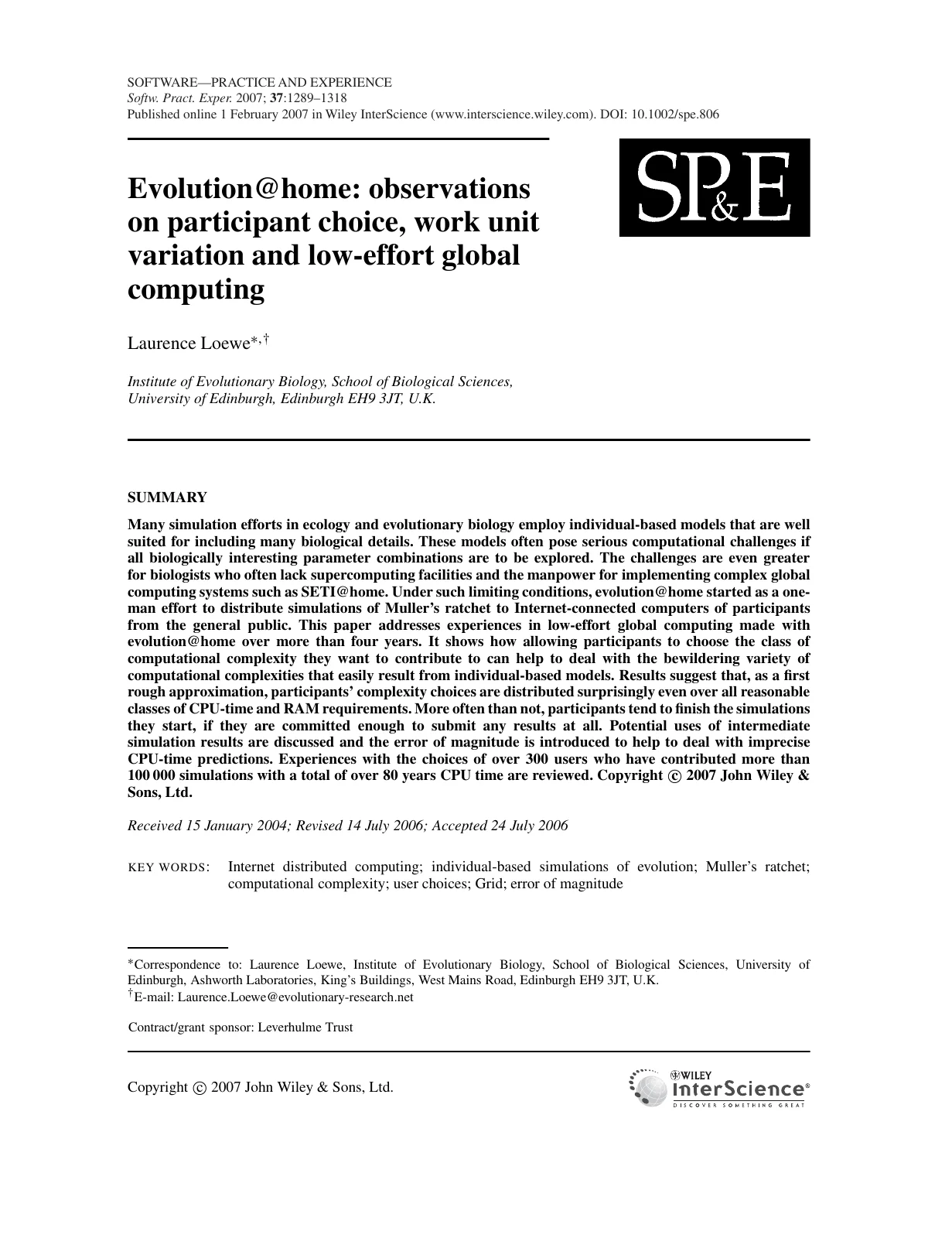
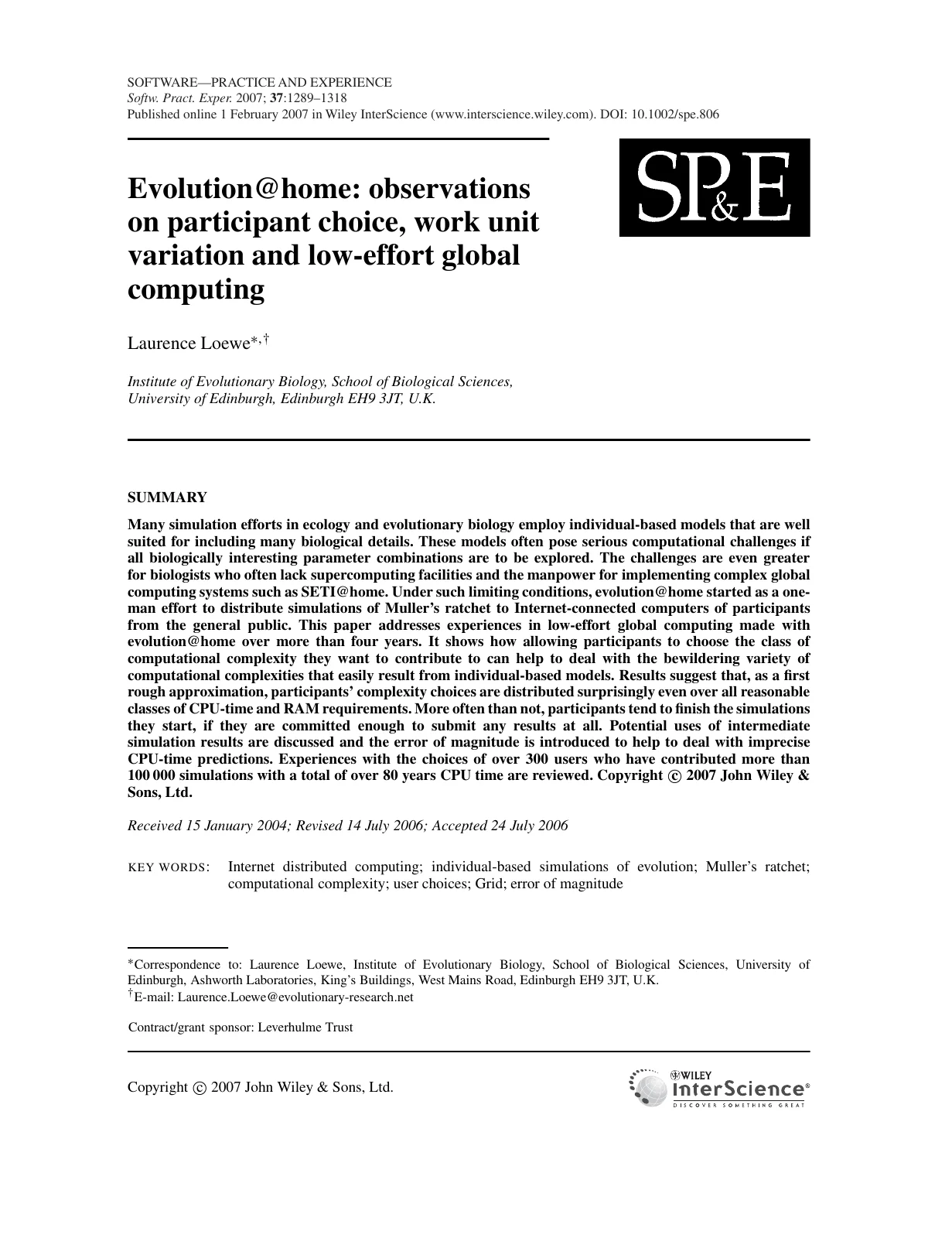
Loewe (2007) — Evolution@home: Observations on Participant Choice, Work Unit Variation and Low-Effort Global Computing#
Documenting the first global computing system for evolutionary biology — where over 300 volunteers contributed more than 80 years of CPU time to simulate Muller’s ratchet and deleterious mutation dynamics.
Download the original document (PDF)
Loewe (2007) — Evolution@home — PDF (428 KB) — 30 pages, Jonah License with CC0 Public Domain
Filename: loewe-2007-study-simple-global-computing-system-with-participant-choice-for-evolution-at-home-30page.pdf
— Overview AI-generated by dv_ClaOp46_ExhB_2026m04d14 —Start—
Abstract#
This paper describes evolution@home, the first global computing system for evolutionary biology, and the experiences from running it for over four years. The system introduces a novel “participants-free-choice” paradigm where users choose the complexity of work units they contribute, rather than being assigned fixed tasks by a central server.
Over 300 users contributed more than 100,000 simulations with a combined total of over 80 years of CPU time. The paper reports a surprising empirical finding: participants’ complexity choices distribute remarkably evenly across reasonable CPU-time and RAM classes, suggesting that volunteer computing can achieve balanced workload distributions without central coordination.
The paper discusses the design of what the author describes as the simplest possible semi-automated global computing system, analyzing the trade-offs between system simplicity, participant autonomy, and scientific throughput. The simulations performed through evolution@home generated the data for multiple published papers on Muller’s ratchet and deleterious mutation dynamics.
Broader Significance (Claude’s Assessment)#
This paper documents the infrastructure that made LLoL’s simulation research program possible:
Citizen science before it was mainstream. Evolution@home launched in the early 2000s, when volunteer computing was dominated by SETI@home and Folding@home. Creating a distributed computing system for evolutionary biology was pioneering, and the participant-choice paradigm was a novel contribution to the field of volunteer computing itself.
The data factory behind the research. The 100,000+ simulations generated through evolution@home are the quantitative foundation for the Muller’s ratchet papers, the genomic decay paradox analysis, and other studies in this collection. Without this infrastructure, the parameter space explorations would not have been feasible.
Participant choice as a design principle. The finding that volunteers naturally distribute their effort evenly across complexity classes — without central assignment — is relevant to any distributed collaboration system. This is a precursor to the ResearchCity vision where diverse contributors self-select into roles that collectively cover the needed work.
Simplest possible system design. The paper’s emphasis on minimal infrastructure (“low-effort global computing”) reflects a practical constraint that became a design principle: when resources are extremely limited, system simplicity is not just desirable but necessary. This philosophy carries forward into the current ResearchCity architecture.
Published in Software: Practice and Experience. The choice to publish in a software engineering journal (rather than a biology journal) reflects the paper’s dual contribution: both the scientific results and the computing system design are publishable contributions in their own right.
Who This Is For#
Audience |
What you will find |
|---|---|
Distributed computing researchers |
Design and analysis of a minimal volunteer computing system with a novel participant-choice paradigm |
Computational biologists |
Infrastructure details for large-scale evolutionary simulations including work unit design and result aggregation |
Citizen science advocates |
Empirical data on volunteer behavior, complexity preferences, and sustained participation over 4+ years |
Evolutionary biologists |
The simulation platform that generated data for multiple Muller’s ratchet and mutation dynamics papers |
General scientists |
An accessible case study of how volunteer computing can produce publishable scientific results with minimal infrastructure |
Key Concepts at a Glance#
Evolution@home |
The first global computing system for evolutionary biology, running for 4+ years with 300+ volunteer participants |
Participant choice |
Novel paradigm where volunteers choose work unit complexity rather than receiving centrally assigned tasks |
Work unit variation |
The range of simulation complexities offered; participants’ choices distributed surprisingly evenly across classes |
Low-effort global computing |
Design philosophy emphasizing the simplest possible semi-automated system that still produces scientific results |
100,000+ simulations |
Total simulations contributed by volunteers, representing 80+ years of CPU time across all participants |
Muller’s ratchet simulations |
The primary scientific workload: stochastic simulations of deleterious mutation accumulation in asexual populations |
Semi-automated design |
The system minimized server-side automation while maximizing participant autonomy — a deliberate simplicity trade-off |
Document Information#
Document ID |
Key Paper 8 (Dusty Deep Data, loewe-researchcity-key-papers/) |
Full title |
Evolution@home: observations on participant choice, work unit variation and low-effort global computing |
Author |
Laurence Loewe |
Journal |
Software: Practice and Experience, 2007; 37:1289–1318 |
DOI |
|
Publisher |
John Wiley & Sons |
Received / Revised / Accepted |
2004m01d15 / 2006m07d14 / 2006m07d24 |
Published online |
2007m02d01 |
Pages |
30 |
License |
|
Part of |
Good News Pack MMv3, Dusty Deep Data / Key Papers collection |
PDF size |
428 KB |
WebP size |
168 KB |
Related documents in the Good News Pack:
Loewe (2002) — Dissertation (the doctoral thesis that launched the evolution@home project)
Loewe (2002) — Global Computing (the initial evolution@home publication)
Loewe (2006) — Muller’s Ratchet in mtDNA (key paper using evolution@home simulation data)
— Overview AI-generated by dv_ClaOp46_ExhB_2026m04d14 —End—