
Loewe & Charlesworth (2006) — Inferring the Distribution of Mutational Effects on Fitness in Drosophila#
Testing whether deleterious mutations follow a lognormal rather than gamma distribution — a key input for evolutionary systems biology models.
Download the original document (PDF)
Loewe & Charlesworth (2006) — DME in Drosophila — PDF (180 KB) — 6 pages (5 + refs), Jonah License with CC0 Public Domain
Filename: loewe-charlesworth-2006-study-lognormal-deleterious-mutational-effects-fitness-6page.pdf
— Overview AI-generated by dv_ClaOp46_ExhB_2026m04d14 —Start—
Abstract#
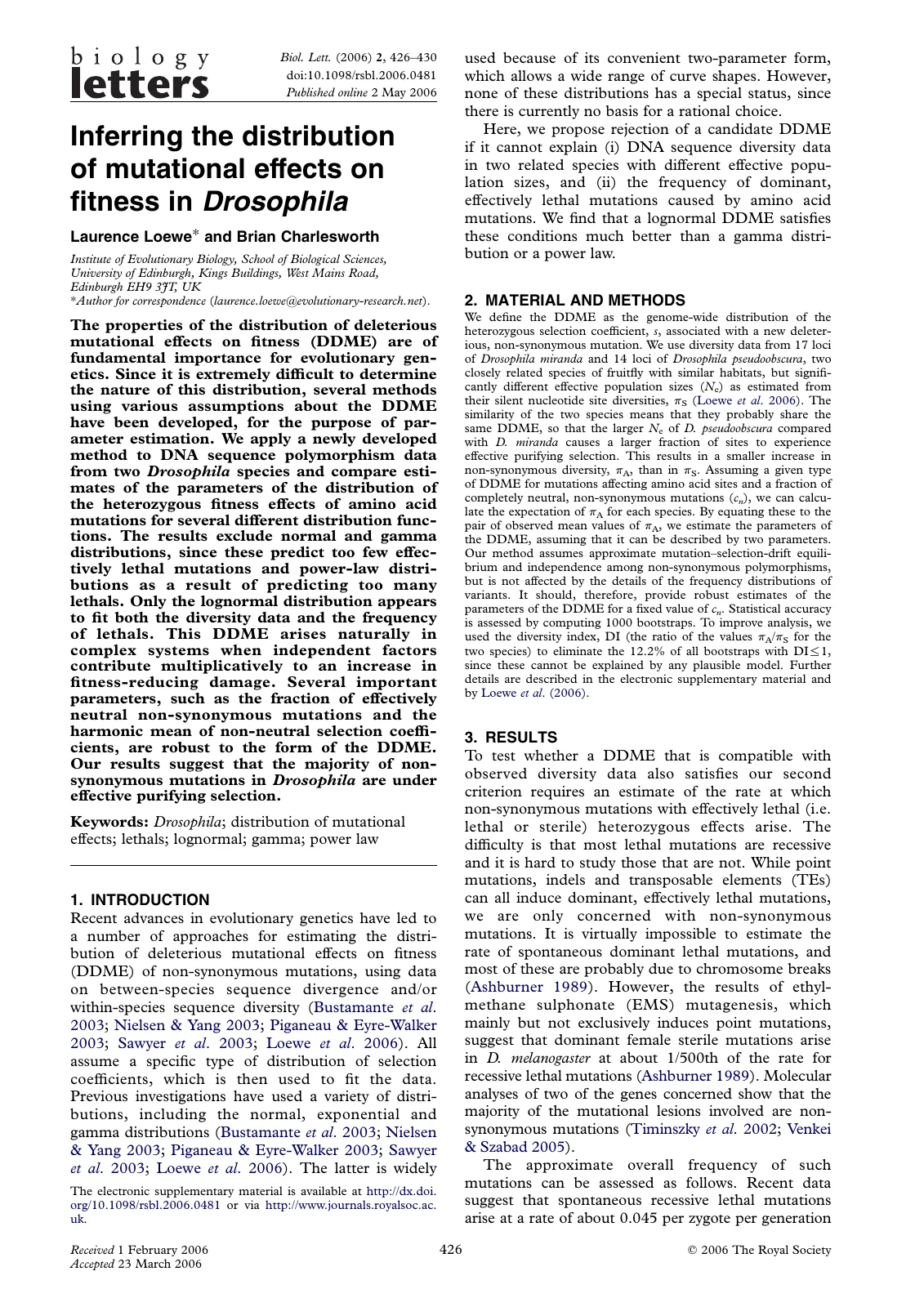
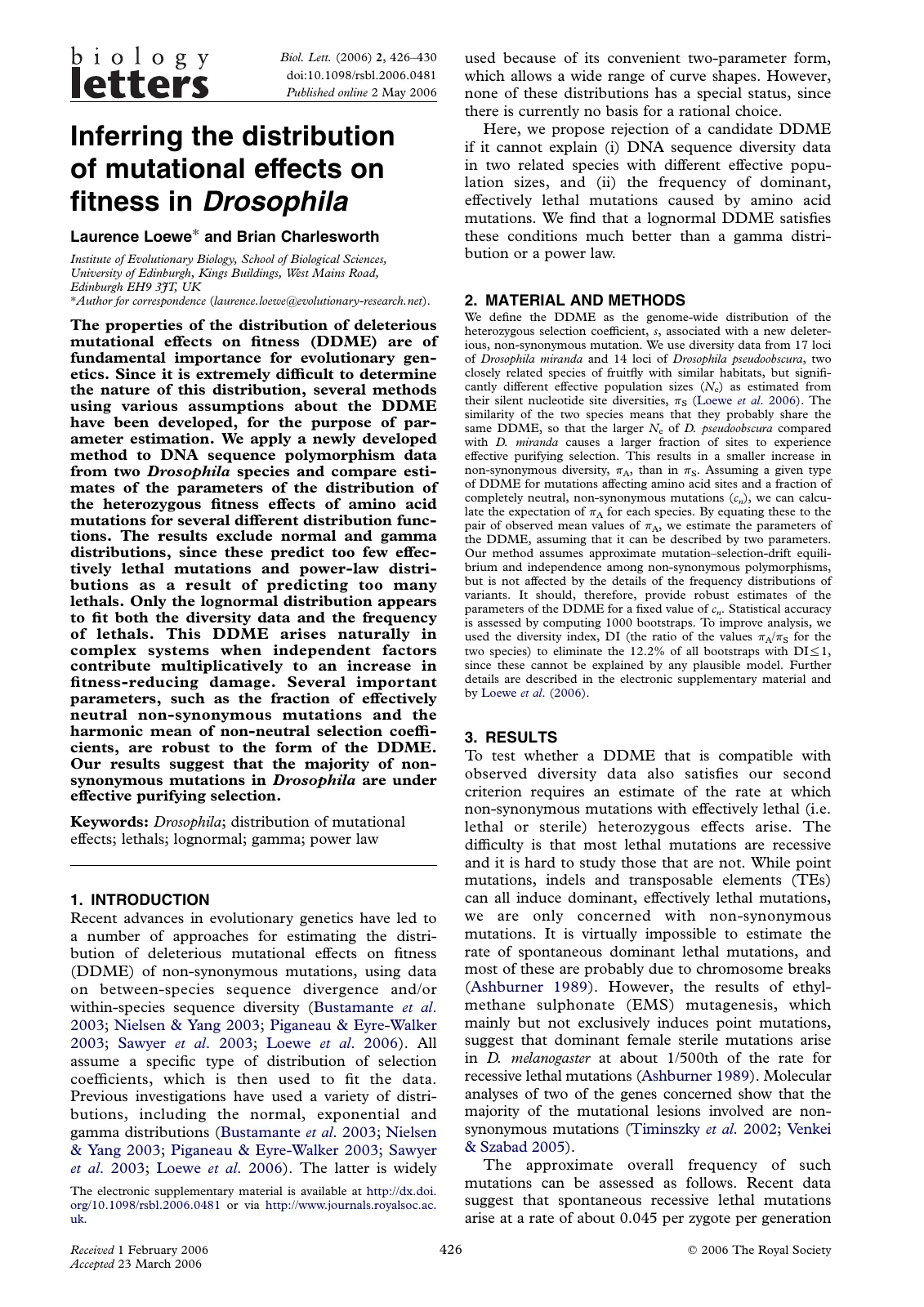
This paper investigates the distribution of deleterious mutational effects (DME) on fitness in Drosophila. The authors test four candidate distributions — normal, gamma, Pareto, and lognormal — against DNA sequence diversity data from two Drosophila species. The study finds that a lognormal DME satisfies the conditions imposed by the data better than a gamma distribution under certain parameter regimes.
The lognormal distribution arises naturally in complex biological systems when many independent factors contribute multiplicatively to fitness-reducing effects. This is a biologically plausible mechanism: mutations damage organisms through cascading interactions across pathways, and the product of many small independent effects is lognormally distributed by the central limit theorem applied to logarithms.
The paper provides quantitative parameter estimates and discusses the implications for models of molecular evolution and population genetics that require a specified DME as input.
Broader Significance (Claude’s Assessment)#
This paper addresses a fundamental input parameter for all evolutionary genetics models that account for deleterious mutations:
Foundational input for evolutionary systems biology. Any model that simulates the fate of deleterious mutations in populations requires a DME as input. Establishing that the lognormal distribution fits the data better than the commonly assumed gamma distribution changes the quantitative predictions of all downstream models.
Collaboration with a leading population geneticist. Brian Charlesworth is one of the most influential population geneticists of the modern era. This collaboration reflects the rigorous theoretical population genetics foundation underlying LLoL’s simulation work.
Multiplicative argument. The biological reasoning for why mutations should follow a lognormal distribution — many independent factors contributing multiplicatively — is elegant and connects population genetics to the broader theory of multiplicative processes in complex systems.
Direct link to simulation parameterization. The parameter estimates from this paper feed directly into the Muller’s ratchet simulations and other evolutionary dynamics models that form the quantitative backbone of the ResearchCity approach.
Who This Is For#
Audience |
What you will find |
|---|---|
Population geneticists |
Quantitative comparison of DME distributions against empirical data; parameter estimates for Drosophila models |
Evolutionary biologists |
Evidence that mutational effects follow lognormal rather than gamma distributions, with implications for molecular evolution |
Computational biologists |
Concrete DME parameterizations for use in simulation models of deleterious mutation accumulation |
General scientists |
An accessible example of how mathematical distributions describe biological damage patterns in living organisms |
Key Concepts at a Glance#
DME |
Distribution of Mutational Effects — the statistical shape describing how harmful different mutations are to fitness |
Lognormal distribution |
A distribution arising when many independent factors multiply together; found to fit Drosophila DME data well |
Gamma distribution |
The previously standard assumption for DME shape; shown here to be outperformed by lognormal under certain conditions |
Selection coefficient |
The quantitative measure of how much a mutation reduces fitness; the variable whose distribution is being estimated |
DNA sequence diversity |
Polymorphism data from two Drosophila species used to constrain the DME parameter space |
Multiplicative effects |
The biological mechanism explaining lognormal DME: many independent damage contributions compound multiplicatively |
Document Information#
Document ID |
Key Paper 5 (Dusty Deep Data, loewe-researchcity-key-papers/) |
Full title |
Inferring the distribution of mutational effects on fitness in Drosophila |
Authors |
Laurence Loewe, Brian Charlesworth |
Journal |
Biology Letters (2006) 2, 426–430 |
DOI |
|
Received / Accepted |
2006m02d02 / 2006m03d23 |
Pages |
6 (5 + references) |
License |
|
Part of |
Good News Pack MMv3, Dusty Deep Data / Key Papers collection |
PDF size |
180 KB |
WebP size |
372 KB |
Related documents in the Good News Pack:
Loewe (2006) — Muller’s Ratchet in mtDNA (uses DME estimates in ratchet simulations)
Loewe & Charlesworth (2007) — Background Selection (extends this work to codon bias)
Loewe & Hillston (2008) — Computational Biology (integrates DME into EvoSysBio framework)
— Overview AI-generated by dv_ClaOp46_ExhB_2026m04d14 —End—