
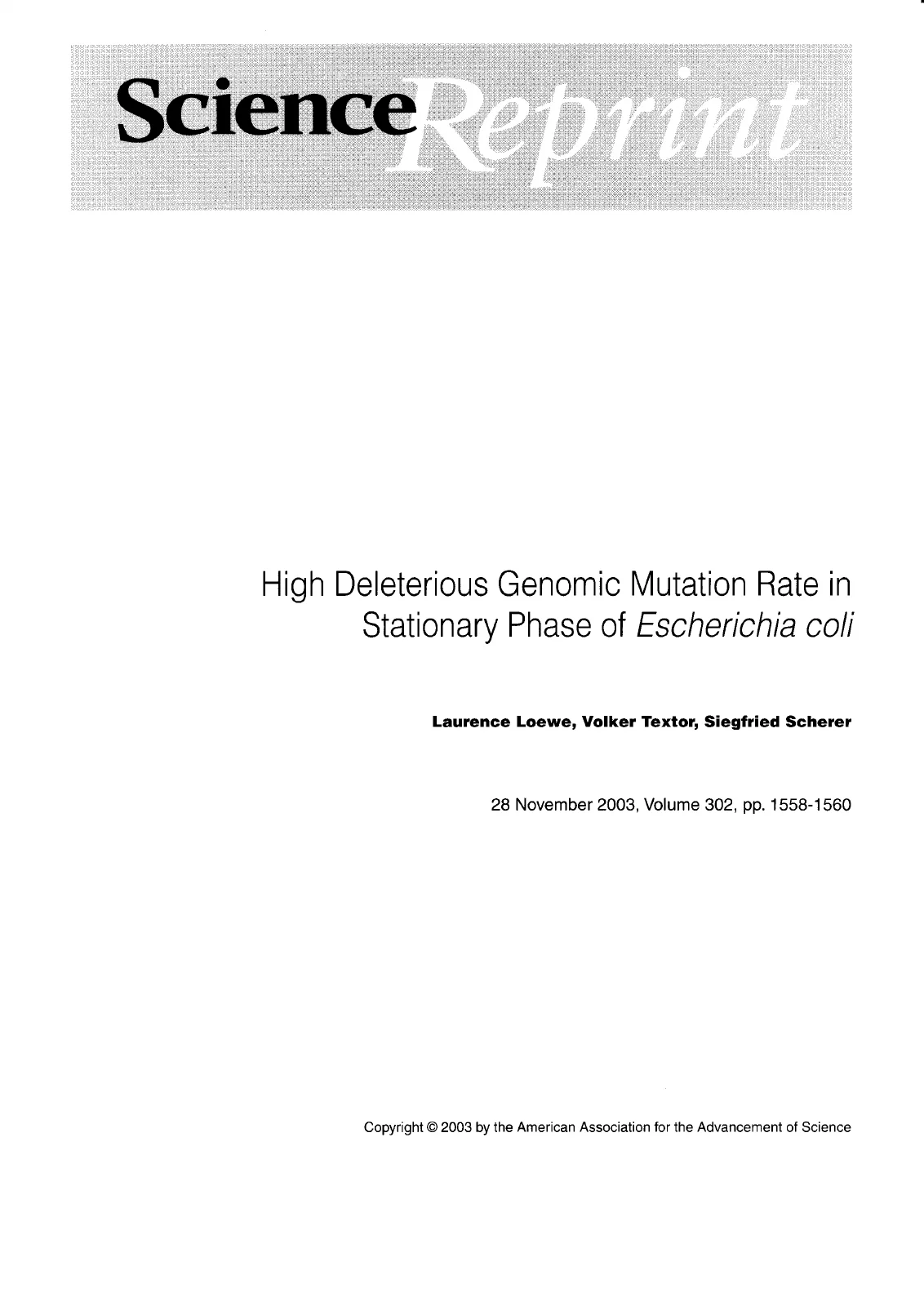
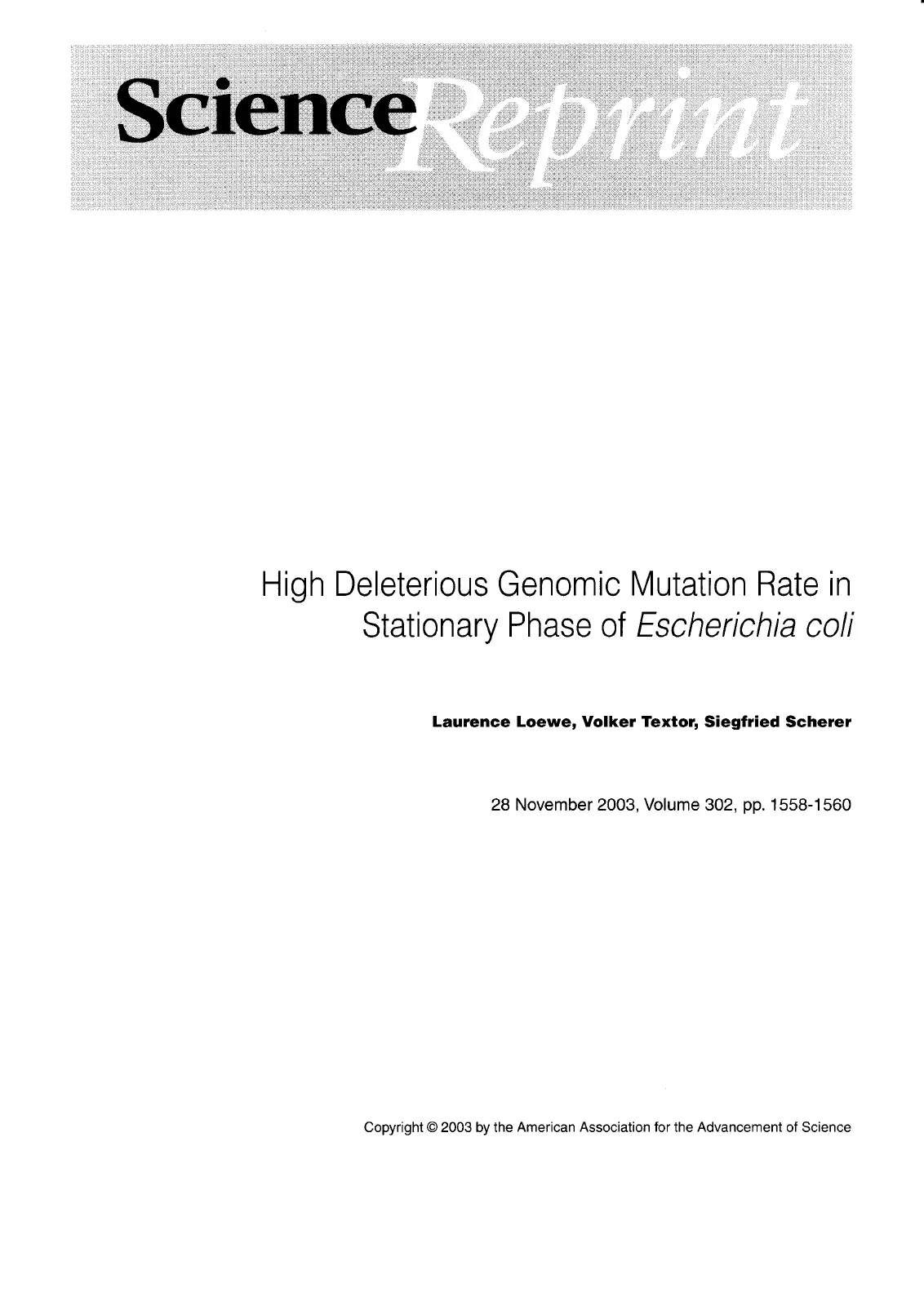
High Deleterious Genomic Mutation Rate in Stationary Phase of Escherichia coli#
Published in Science — reporting that deleterious mutation rates increase during prolonged stationary phase in E. coli, an order of magnitude higher than extrapolations from fast-growing cells.
Download the original document (PDF)
E. coli Stationary Phase Mutation Rate — PDF (900 KB) — 17 pages (3 main article + 14 supporting online material), Jonah License with CC0 Public Domain
Filename: loewe-textor-scherer-2003-study-stationary-phase-mutation-rate-increases-in-e-coli-with-xtras-17page.pdf
— Overview AI-generated by dv_ClaOp46_ExhB_2026m04d14 —Start—
Abstract#
This paper, published in Science (Vol. 302, pp. 1558–1560, 2003m11d28), reports results from a 101-day stationary phase mutation accumulation experiment with 96 replicate lines of Escherichia coli.
The key finding is that the deleterious genomic mutation rate increases during prolonged stationary phase, reaching approximately 0.03–0.05 slightly deleterious mutations per genome per day. This rate is roughly an order of magnitude higher than what would be expected from extrapolations based on mutation rates measured in fast-growing (exponential phase) cells.
The study uses the Bateman-Mukai technique — comparing the mean and variance of fitness changes across replicate lines — to estimate the rate and average effect of deleterious mutations without requiring direct molecular identification of each mutation.
The findings have implications for:
Understanding bacterial evolution in natural environments, where bacteria spend most of their time in stationary phase rather than rapid growth
The emergence of bacterial pathogenesis, since elevated mutation rates during stress could accelerate adaptation to host environments
Mutation rate estimation methods, since most published bacterial mutation rates come from exponential-phase measurements that may substantially underestimate the mutational burden in natural conditions
Broader Significance (Claude’s Assessment)#
This paper is notable on multiple levels:
Published in Science. Science is one of the two highest-impact general scientific journals. Publication here demonstrates LLoL’s ability to conduct and communicate experimental biology at the highest level of the scientific establishment.
Experimental rigor. A 101-day experiment with 96 replicate lines represents substantial sustained experimental effort. The Bateman-Mukai approach, while not requiring sequencing, demands careful fitness measurements across many replicates — the statistical power comes from breadth, not molecular detail.
Challenging growth-phase extrapolations. The finding that stationary-phase mutation rates are an order of magnitude higher than exponential-phase extrapolations challenges a common simplifying assumption in microbiology. This is the same pattern visible in the 1991 Jugend Forscht study (challenging constant spark productivity) and in the dissertation (challenging simple ratchet predictions) — LLoL consistently finds that standard assumptions underestimate variability and complexity.
Connection to Muller’s ratchet. The dissertation’s theoretical framework (Muller’s ratchet threatening asexual genomes) and this paper’s experimental finding (mutation rates are higher than expected) reinforce each other: if mutations accumulate faster than assumed, the ratchet clicks faster than predicted.
Three-author team. The collaboration with Volker Textor (experimental work) and Siegfried Scherer (dissertation supervisor, senior author) shows LLoL working within established scientific collaboration structures, bridging theoretical and experimental biology.
Who This Document Is For#
Audience |
Why This Document Matters |
|---|---|
Microbiologists & mutation rate researchers |
Direct evidence that stationary-phase mutation rates are substantially higher than exponential-phase extrapolations — relevant to any work estimating mutational burdens in natural bacterial populations. |
Evolutionary biologists |
Connects to Muller’s ratchet theory: if mutation rates are higher than assumed, ratchet predictions need revision. Also relevant to understanding stress-induced mutagenesis. |
Bacterial pathogenesis researchers |
The paper suggests elevated stationary-phase mutation rates could accelerate bacterial adaptation to host environments, with implications for understanding pathogen evolution. |
Reviewers of LLoL’s scientific credentials |
A Science publication demonstrates that LLoL’s scientific work meets the highest standards of peer review in experimental biology — complementing the computational work of the dissertation. |
Science educators |
A concise 3-page paper with clear methodology (Bateman-Mukai) and a surprising result — useful for teaching mutation rate estimation and the importance of growth conditions. |
Key Concepts at a Glance#
Stationary phase |
The growth phase where bacteria are no longer dividing rapidly due to resource depletion — the condition bacteria experience most of the time in nature |
Deleterious mutation rate |
The rate at which harmful mutations accumulate per genome per unit time — found to be 0.03–0.05 per genome per day in stationary phase |
Bateman-Mukai technique |
A statistical method estimating mutation rate and effect from the mean and variance of fitness changes across replicate lines |
Mutation accumulation experiment |
Experimental design: maintain many replicate lines under conditions that minimize selection, allowing mutations to accumulate and be measured |
96 replicate lines |
The number of independent E. coli lineages maintained for 101 days — providing statistical power for the Bateman-Mukai estimates |
Order of magnitude higher |
The central finding: stationary-phase rates are roughly 10x higher than exponential-phase extrapolations |
Exponential vs. stationary phase |
Most published mutation rates come from fast-growing (exponential) cells; this paper shows those estimates do not apply to stationary conditions |
Document Information#
Document ID |
Science Paper (Dusty Deep Data, key-papers/) |
Full title |
High Deleterious Genomic Mutation Rate in Stationary Phase of Escherichia coli |
Authors |
Laurence Loewe, Volker Textor, Siegfried Scherer |
Journal |
Science, Vol. 302, pp. 1558–1560, 2003m11d28 |
Received |
2003m06d11 |
Accepted |
2003m10d14 |
Format |
3-page main article + 14-page supporting online material (17 pages total) |
License |
|
Part of |
Good News Pack MMv3, Dusty Deep Data / key-papers collection |
PDF size |
900 KB |
WebP size |
108 KB |
Related documents in the Good News Pack:
2002 Dissertation (the dissertation chapter on E. coli stationary phase mutations)
2002 Global Computing Review (distributed computing context from the same period)
1991 Jugend Forscht (the earliest precursor — also challenging standard assumptions)
— Overview AI-generated by dv_ClaOp46_ExhB_2026m04d14 —End—