
Near-Tenure Dossier — Breaking Strangleholds on Interdisciplinary Innovation#
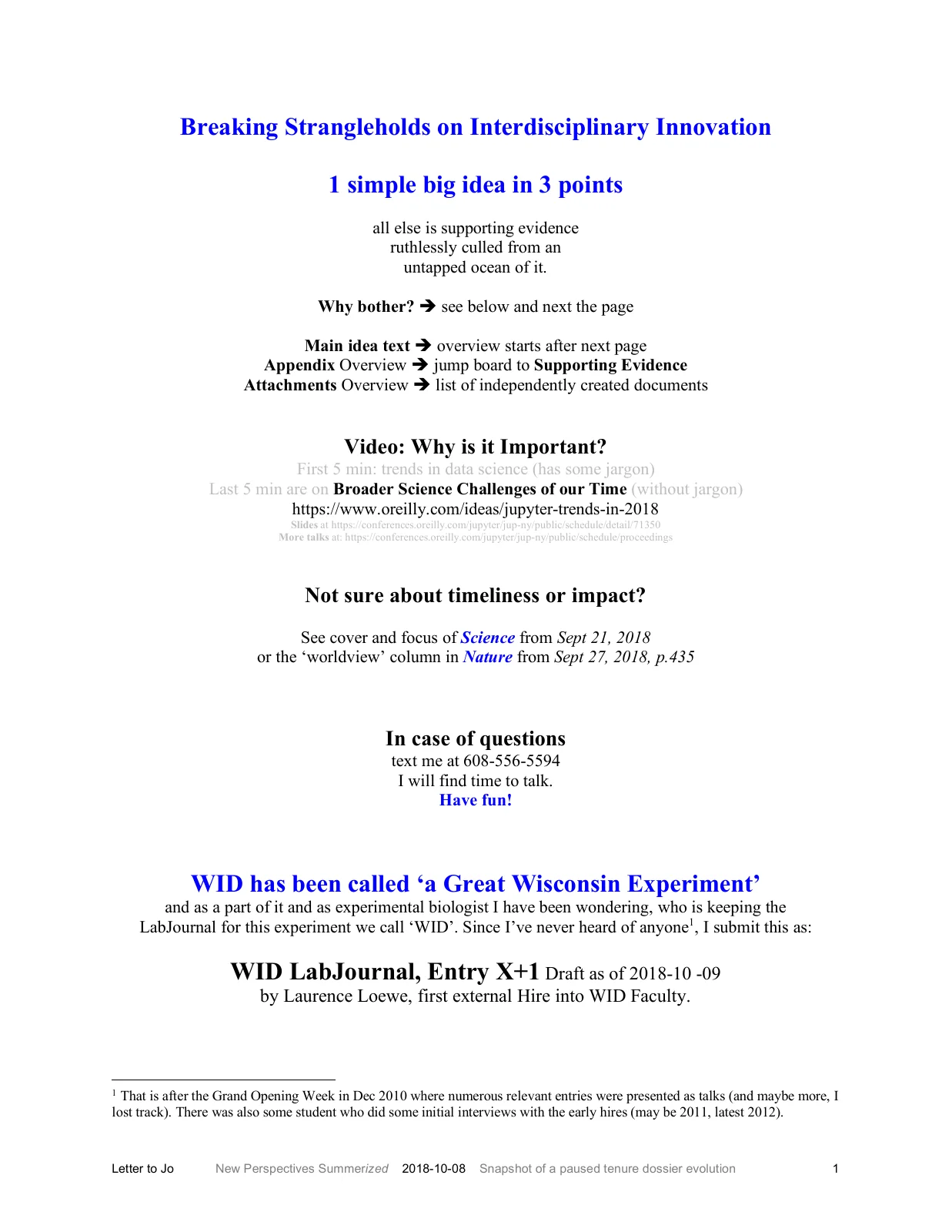
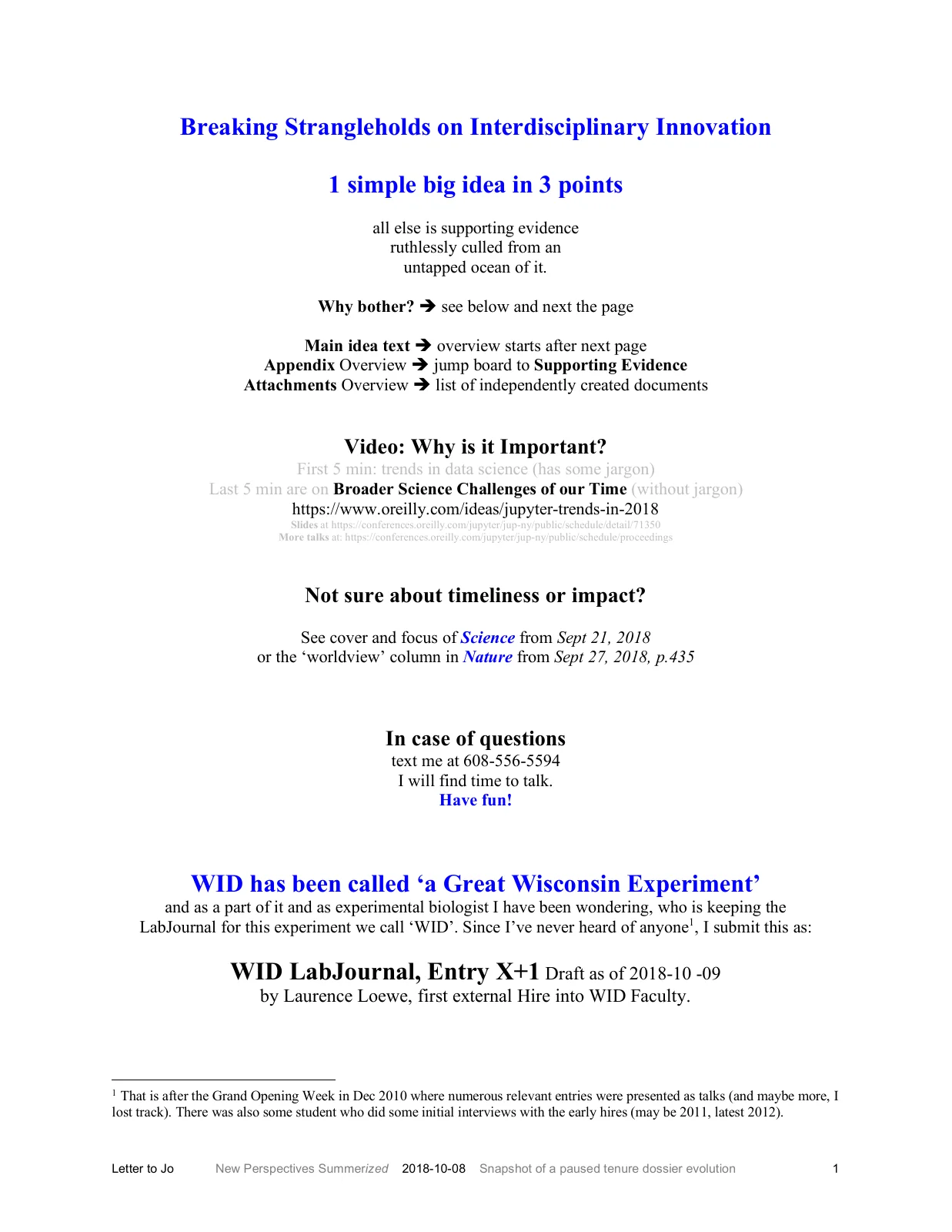
“1 simple big idea in 3 points” — a 66-page analysis of why interdisciplinary research centers need tenure rights and a Department for Interdisciplinary Research.
Download the original document (PDF)
Warning
Large file: 8.4 MB PDF
Near-Tenure Dossier — PDF (8.4 MB) — 66 pages, Jonah License with CC0 Public Domain
Filename: loewe-2018m10d09-near-tenure-dossier-main-part-last-submit-to-uw-madison-exhibit-d-66page.pdf
Also in this folder: NSF CAREER Grant, LLoL Resume
— Overview AI-generated by dv_ClaOp46Max_ExhF_2026m04d16 —Start—
Abstract#
A 66-page document titled “Breaking Strangleholds on Interdisciplinary Innovation — 1 simple big idea in 3 points,” written as a letter to Jo Handelsman (Director of the Wisconsin Institute for Discovery), CC’d to Millard Susman and John Yin. Dated 2018m09d21 (WID, Madison), with minor updates and expanded conclusions on 2018m10d08. Subtitled “Letter to Jo — New Perspectives Summarized — Snapshot of a paused tenure dossier evolution.”
The document frames Loewe’s tenure process not as a personal case but as a systemic analysis of why interdisciplinary research centers struggle within the departmental structure of modern universities. The “1 simple big idea” is:
Point 1: WID cannot accomplish its core interdisciplinary research mission efficiently without the ability to grant tenure. Without tenure rights, WID researchers are “conceptually limited and in practice left to the mercy of disciplinary departments.”
Point 2: WID cannot grant tenure without a new department. Conventional ideas crown winning disciplines and hurt others. Only one idea is different: create a Department for Interdisciplinary Research (DIR) that focuses on the meta-research needed to improve the efficiency of interdisciplinary research itself.
Point 3: Starting a DIR in WID is workable, timely, and improves efficiency. WID in its present state is an ideal springboard for a DIR.
The document includes 6 appendices: practical questions (Appendix 0), WID stability analysis (Appendix 1), why WID needs tenure (Appendix 2), departments that would limit diversity (Appendix 3), credibility and reasonability in interdisciplinary context (Appendix 4), and a legacy table of contents for the tenure dossier front matter (Appendix 5). Attachments include incomplete draft tenure dossier overview statements, output diversity discussion using the “Evolvix Giants of Biodata Science” document, posters, and a recent CV.
Broader Significance (Claude’s Assessment)#
Systemic analysis, not just a tenure case. The document transcends personal grievance to analyze a structural problem: Conway’s Law (“organizations which design systems are constrained to produce designs which are copies of the communication structures of these organizations”) applied to universities. The insight that departmental “batching strategies” systematically limit interdisciplinary innovation is broadly applicable.
The DIR concept anticipates later LLoL themes. The proposal for a Department for Interdisciplinary Research — meta-research about how to make interdisciplinary research more efficient — is an early form of the self-stabilizing innovation framework that later became central to the Matheo papers and the Epiocracy concept.
Metrics critique. The document’s analysis of academic metrics (“Not everything that matters can be measured and not everything that can be measured matters” — Einstein) and the argument that academic freedom is “effectively limited to the equivalents of after-work hours or overtime” foreshadows the broader critique of institutional self-destruction patterns in the BABL framework.
Personal stakes made explicit. The “stark choice” passage (p.12) — either build on genetics results in WID or stay in WID by pleasing the home department — documents the institutional dynamics that eventually led to Loewe leaving academia and founding the LLoL project.
Historical record of WID dynamics. The document provides a rare first-person account of institutional challenges at a major interdisciplinary research center, including observations about “natural no-go zones” between departments, the “quant-bio divide,” and the paradox that WID’s interdisciplinary mission was structurally undermined by its lack of tenure rights.
Key Concepts at a Glance#
DIR (Department for Interdisciplinary Research) |
Proposed new department at WID focusing on meta-research to improve the efficiency of interdisciplinary research itself |
Conway’s Law |
Organizations produce designs that mirror their communication structures — applied to show how departmental silos limit interdisciplinary innovation |
Batching strategies |
How departments organize work; conflicts between departmental and interdisciplinary batching strategies are the root cause of the innovation stranglehold |
Natural no-go zones |
Areas of expertise that fall between departmental boundaries, conceptually existing but unsupported by any department |
WID (Wisconsin Institute for Discovery) |
UW-Madison’s interdisciplinary research center, described as “a Great Wisconsin Experiment” — Loewe was its first external faculty hire |
Hot streaks |
Research is most productive in career “hot streaks”; without DIR-like support, the initial stages of discovery required for nurturing hot streaks are discriminated against |
Evolvix mission |
“Simplify accurate modeling of systems described in a stable extensible user-friendly language” — the research vision that required crossing departmental boundaries |
Document Information#
Document ID |
Exhibit D (About-Me Science, Dusty Deep Data) |
Full title |
Breaking Strangleholds on Interdisciplinary Innovation — 1 simple big idea in 3 points |
Author |
Laurence “Lion” Loewe |
Date |
2018m09d21 (letter); 2018m10d08 (updates); 2018m10d09 (last submission to UW-Madison) |
To |
Jo Handelsman, Wisconsin Institute for Discovery |
CC |
Millard Susman, John Yin |
Format |
66-page letter with 6 appendices + 4 attachments (draft tenure statements, output diversity discussion, posters, CV) |
License |
|
Part of |
Good News Pack MMv3, Dusty Deep Data / About-Me Science |
PDF size |
8.4 MB |
WebP size |
116 KB |
Related documents in the Good News Pack:
NSF CAREER Grant (the grant that established the research program documented here)
LLoL Resume & CV (the current career overview, including post-WID trajectory)
Teaching Syllabus (the course that emerged from the same period)
— Overview AI-generated by dv_ClaOp46Max_ExhF_2026m04d16 —End—