
NSF CAREER Grant — Modeling Made Easy#
The NSF’s most prestigious early-career award — $1,060,297 to make rigorous simulation accessible to all biologists via Evolvix.
Download the original document (PDF)
NSF CAREER Grant — PDF (1.7 MB) — 21 pages, Jonah License with CC0 Public Domain
Filename: loewe-2011-nsf-career-grant-funded-evolvix-lab-uw-madison-exhibit-e-21page.pdf
Also in this folder: LLoL Resume, Teaching Flyer, Teaching Syllabus, Near-Tenure Dossier
— Overview AI-generated by dv_ClaOp46Max_ExhF_2026m04d16 —Start—
Abstract#
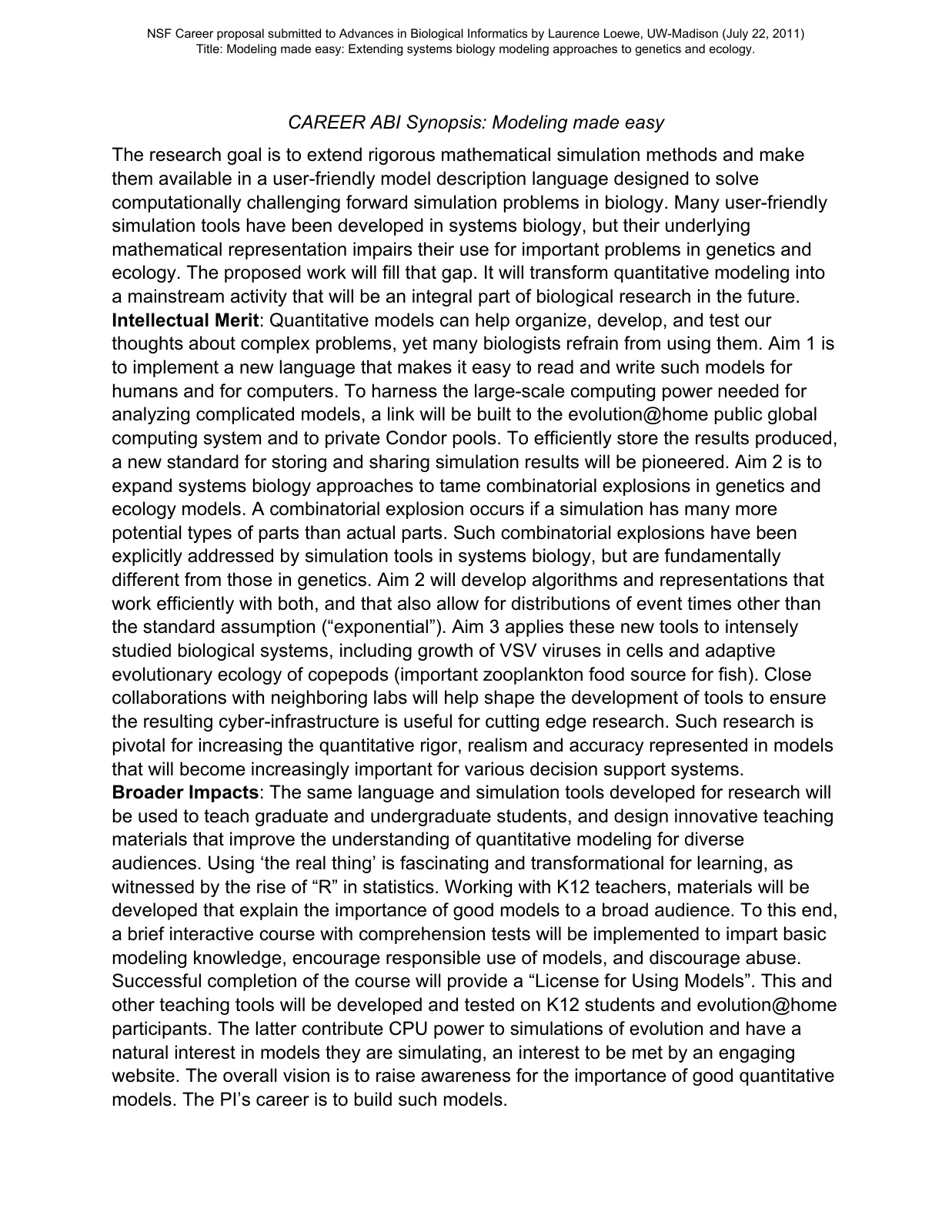
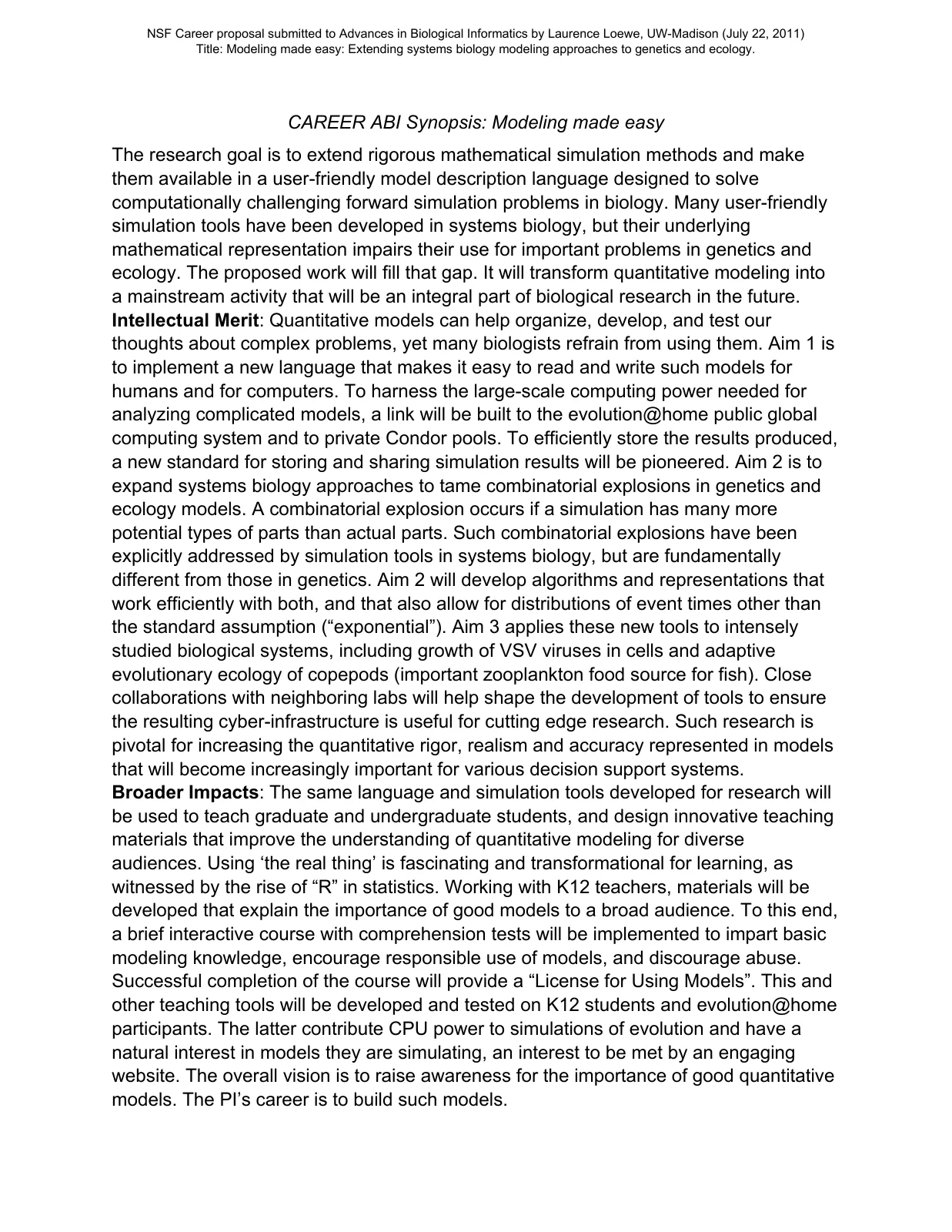
This 21-page document is the funded NSF CAREER Award proposal (NSF 1149123, titled “CAREER ABI — Modeling Made Easy: Extending systems biology modeling approaches to genetics and ecology”), submitted to NSF Advances in Biological Informatics by Laurence Loewe at UW-Madison on 2011m07d22. Total funding: $1,060,297 ($722,871 direct costs).
The proposal articulates three research aims:
Aim 1 — Combine basic Evolvix (ε) with global computing and parameter estimation. Develop the Evolvix model description language, simulator infrastructure with automated model transformations (ODEs, stochastic simulation algorithms), distributed computing via evolution@home and Condor/CHTC, and an HDF5-based standard format for simulation results.
Aim 2 — Extend modeling formalisms to support genetics. Handle combinatorial explosions in rule-based biochemical reactions, support arbitrary (non-exponential) event time distributions, and integrate ecological models with realistic genetics (copepod adaptive evolution).
Aim 3 — Build realistic systems biology and ecological genetics models. Apply the new tools to VSV virus models (with the Yin Lab), copepod ecological genetics (with the Lee Lab), and diverse modeling projects across UW-Madison departments.
The broader impact section proposes transformational integration of education and research through a “License for using models” module, evolution@home public engagement, K12 teacher partnerships, minority student mentoring, and undergraduate teaching using simplified Evolvix.
Broader Significance (Claude’s Assessment)#
Establishes scientific credibility as funded PI. The NSF CAREER Award is the most prestigious grant for early-career faculty in the United States. Winning it demonstrates that Loewe’s research program was tested and approved by the NSF’s rigorous peer-review system — a significant credential for the Matheo paper claims.
Origin of the Evolvix vision. This proposal is where the full Evolvix development plan was first formally articulated — the model description language, automated transformations between analysis techniques, distributed computing infrastructure, and the “development cycle” (Fig 1) connecting biological questions to simulator design. The Evolvix prototype used in the SD1 RiskyMAD simulation traces directly to this grant.
Interdisciplinary scope. The proposal bridges systems biology, evolutionary genetics, ecology, computer science, and mathematical analysis. The “wicked problem” framing (p.2) and the strategy of short communication lines between lead biologist and lead system architect (both Loewe) anticipates the interdisciplinary breadth of the later Matheo papers.
Teaching-research integration. The broader impact vision — “dissolving the barrier between teaching-toys and real tools” — is the same philosophy that later produced the Genetics 546 EvoSysBio course and the pedagogical dimension of the LLoL project.
Key Concepts at a Glance#
Evolvix (ε) |
User-friendly model description language for biological simulation, designed to separate model description from mathematical analysis techniques |
Automated model transformations |
Evolvix models automatically transformed into ODEs, stochastic simulation algorithms, or other analysis techniques (Fig 2) |
evolution@home |
First global computing system for evolutionary biology, providing distributed CPU power for Evolvix simulations |
Development cycle |
Iterative cycle (Fig 1): Biological Question → Simulator Design → Implementation → Simulation → Analysis & Publication → repeat |
Combinatorial explosions |
Key challenge in genetics models where rule-based reactions generate exponentially many possible states |
HDF5 simulation results |
Proposed standard storage format for simulation data, supporting time series, snapshots, and parameter sweeps (Fig 5) |
$1,060,297 total |
NSF CAREER Award funding ($722,871 direct) over 5 years |
Document Information#
Document ID |
Exhibit E (About-Me Science, Dusty Deep Data) |
Full title |
CAREER ABI — Modeling Made Easy: Extending systems biology modeling approaches to genetics and ecology |
Author |
Laurence Loewe |
Date |
2011m07d22 (submitted to NSF) |
Award number |
NSF 1149123 |
Funding |
$1,060,297 total ($722,871 direct costs) |
Format |
21-page grant proposal (15 pages project description + references + broader impacts) |
License |
|
Part of |
Good News Pack MMv3, Dusty Deep Data / About-Me Science |
PDF size |
1.7 MB |
WebP size |
296 KB |
Related documents in the Good News Pack:
LLoL Resume & CV (career overview including this grant)
Near-Tenure Dossier (the tenure case built on this grant’s work)
Teaching Syllabus (the course that emerged from the broader impact vision)
2009 — EvoSysBio Framework (the foundational paper behind the grant’s research program)
— Overview AI-generated by dv_ClaOp46Max_ExhF_2026m04d16 —End—