
Teaching Flyer — Genetics 546 EvoSysBio Modeling Introduction#
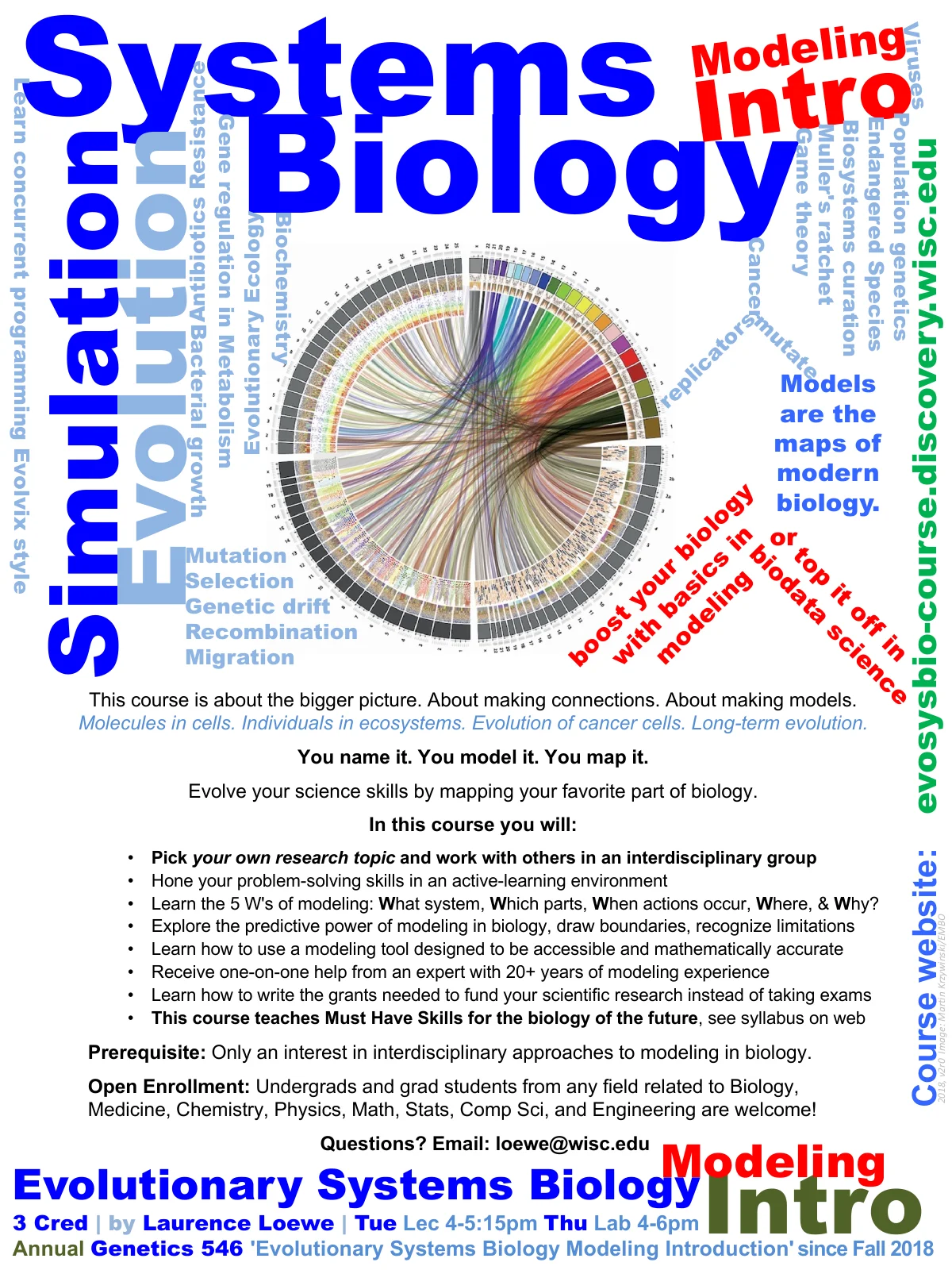
“You name it. You model it. You map it.” — a visually striking invitation to interdisciplinary biological modeling.
Download the original document (PDF)
Genetics 546 Course Flyer — PDF (1.9 MB) — 1 page, Jonah License with CC0 Public Domain
Filename: loewe-2018-teach-intro-evosysbio-fall-course-genetics546-flyer-2018m04d05-page.pdf
Also in this folder: Teaching Syllabus (the full 14-page syllabus for this course)
— Overview AI-generated by dv_ClaOp46Max_ExhF_2026m04d16 —Start—
Abstract#
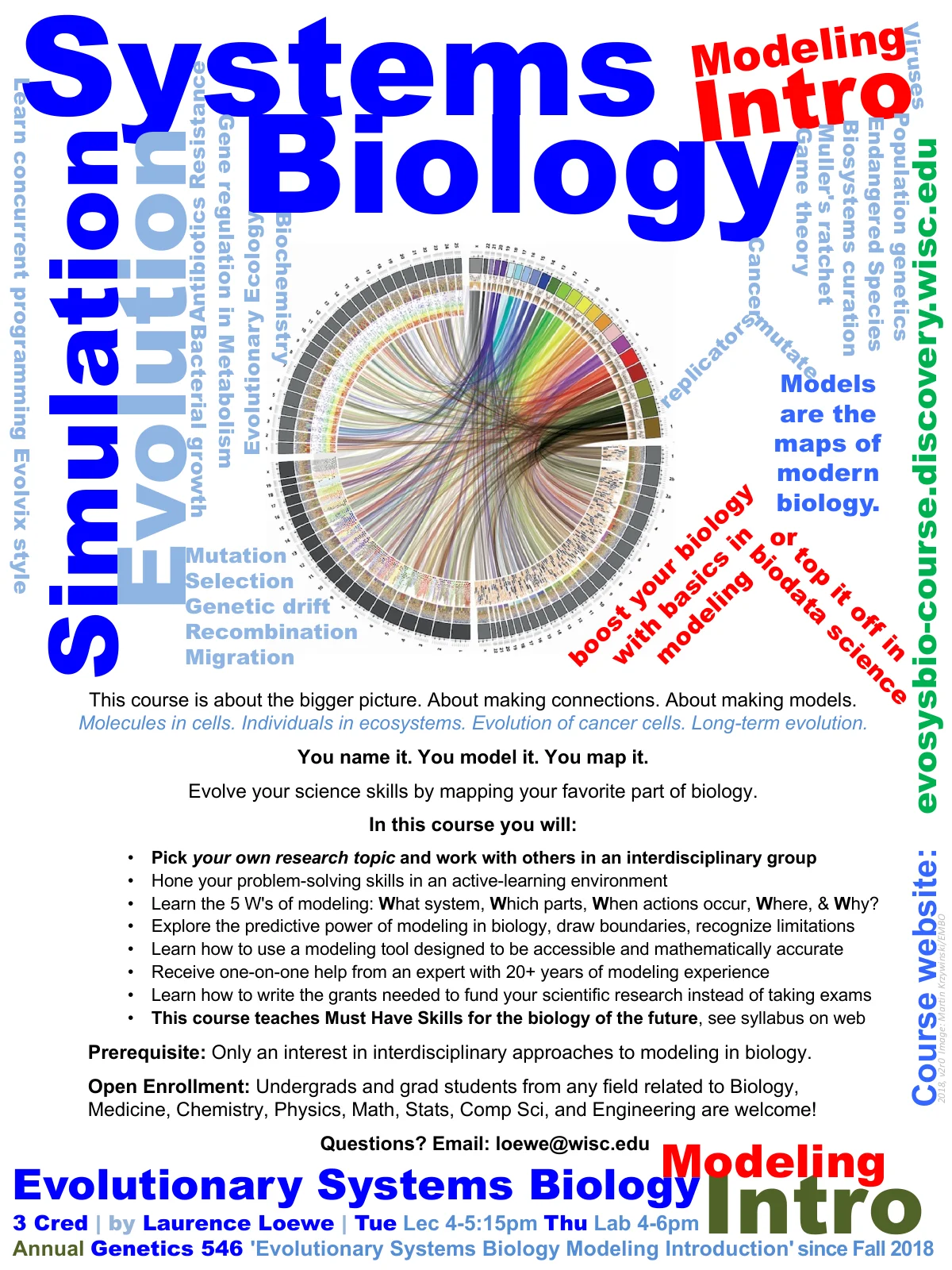
A 1-page promotional flyer for Genetics 546: Evolutionary Systems Biology Modeling Introduction, a 3-credit course at UW-Madison designed and taught by Laurence Loewe. The flyer features a striking circular genome/interaction diagram (image: Martin Krzywinski/EMBO) and the motto “Models are the maps of modern biology.”
The course promises:
Pick your own research topic in interdisciplinary groups
Problem-based active learning environment
Learn the 5 W’s of modeling: What system, Which parts, When actions occur, Where, and Why
Use Evolvix, a modeling tool designed for accessibility and mathematical accuracy
One-on-one help from an expert with 20+ years of modeling experience
Learn grant writing instead of taking exams
“Must Have Skills for the biology of the future”
Prerequisite: Only an interest in interdisciplinary approaches to modeling in biology. Open to undergraduates and graduate students from Biology, Medicine, Chemistry, Physics, Math, Stats, Computer Science, and Engineering.
Schedule: Tuesday lecture 4–5:15pm, Thursday lab 4–6pm. Annual offering since Fall 2018. Topics spiral from molecules in cells to individuals in ecosystems to cancer evolution to long-term evolution.
Broader Significance (Claude’s Assessment)#
Teaching side of the research program. This flyer represents the broader impact vision from the NSF CAREER grant made real. The promise to “dissolve the barrier between teaching-toys and real tools” materialized as a course where students use the same Evolvix platform that powers research-grade simulations.
Interdisciplinary philosophy. The open enrollment policy (any field related to biology) and the emphasis on “making connections” across disciplines reflects the same cross-boundary thinking that characterizes the Matheo papers and the broader LLoL project.
Grant-writing pedagogy. Replacing exams with grant proposals is a distinctive pedagogical choice: students learn to articulate research value, not just recall facts. This is unusual at the undergraduate level and aligns with the ZION cycle principle of learning by doing real work.
Key Concepts at a Glance#
Genetics 546 |
UW-Madison course: Evolutionary Systems Biology Modeling Introduction, 3 credits, annual since Fall 2018 |
5 W’s of Modeling |
What system, Which parts, When actions occur, Where, and Why — the course’s framework for building biological models |
Evolvix |
The modeling tool used in the course, designed to be accessible and mathematically accurate |
Active learning |
Problem-based approach: students pick topics, build models, write grants instead of taking exams |
Open enrollment |
No formal prerequisites beyond interest — deliberately interdisciplinary across science and engineering fields |
Document Information#
Document ID |
Course Flyer (About-Me Science, Dusty Deep Data) |
Full title |
Genetics 546 — Evolutionary Systems Biology Modeling Introduction |
Author |
Laurence Loewe |
Date |
2018m04d05 (v2r0) |
Format |
1-page promotional flyer with circular visualization |
License |
|
Part of |
Good News Pack MMv3, Dusty Deep Data / About-Me Science |
PDF size |
1.9 MB |
WebP size |
328 KB |
Related documents in the Good News Pack:
Teaching Syllabus (full 14-page syllabus for this course)
NSF CAREER Grant (the grant whose broader impact vision produced this course)
2009 — EvoSysBio Framework (the paper defining the field this course teaches)
— Overview AI-generated by dv_ClaOp46Max_ExhF_2026m04d16 —End—