
Teaching Syllabus — Genetics 546 EvoSysBio (14 pages)#
“Minimizing coding complexity frees minds for the challenges of understanding a biological system.” — a 15-week journey from molecules to ecosystems.
Download the original document (PDF)
Genetics 546 Syllabus — PDF (228 KB) — 14 pages, Jonah License with CC0 Public Domain
Filename: loewe-2018-teach-intro-evosysbio-fall-course-genetics546-syllabus-2017m10d31-14page.pdf
Also in this folder: Teaching Flyer (1-page promotional version)
— Overview AI-generated by dv_ClaOp46Max_ExhF_2026m04d16 —Start—
Abstract#
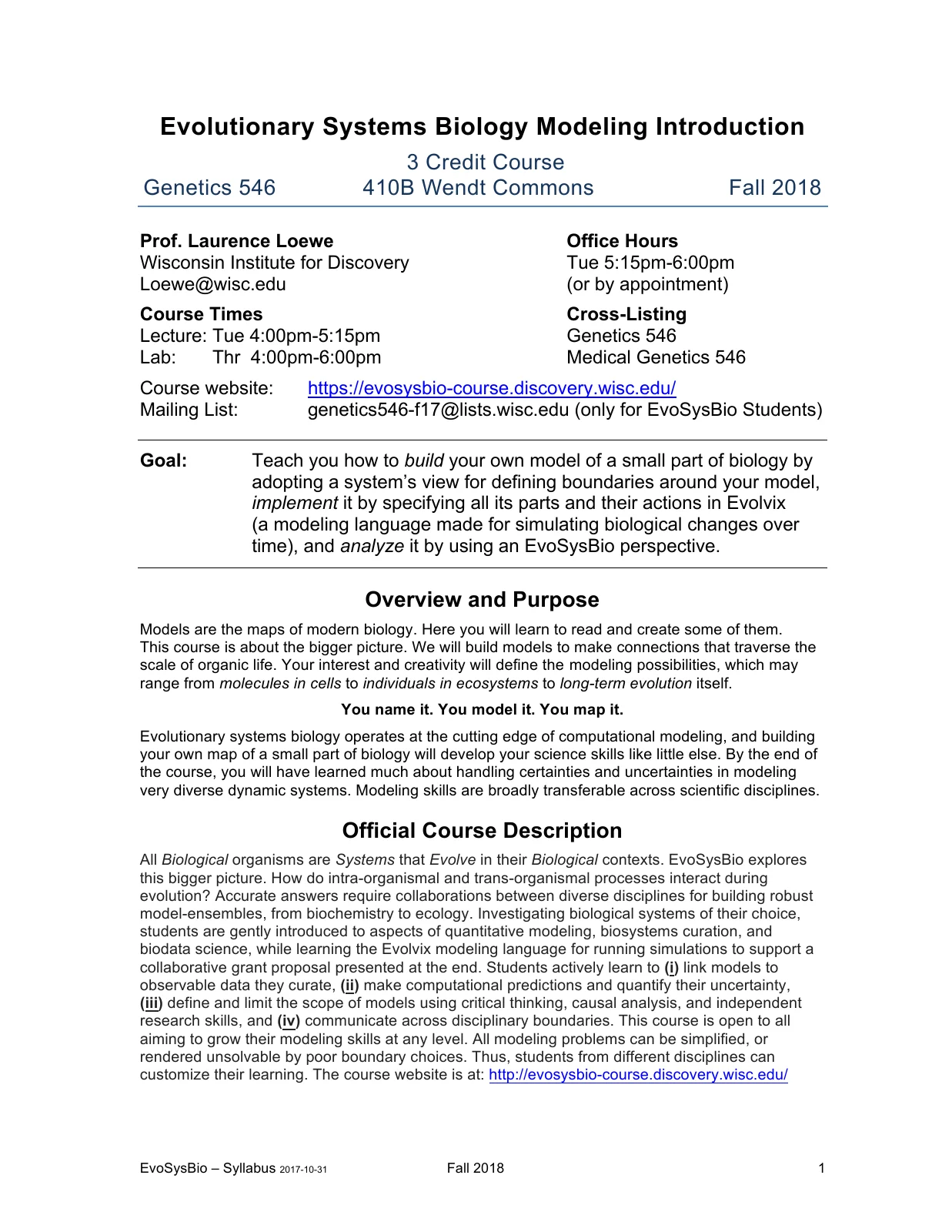
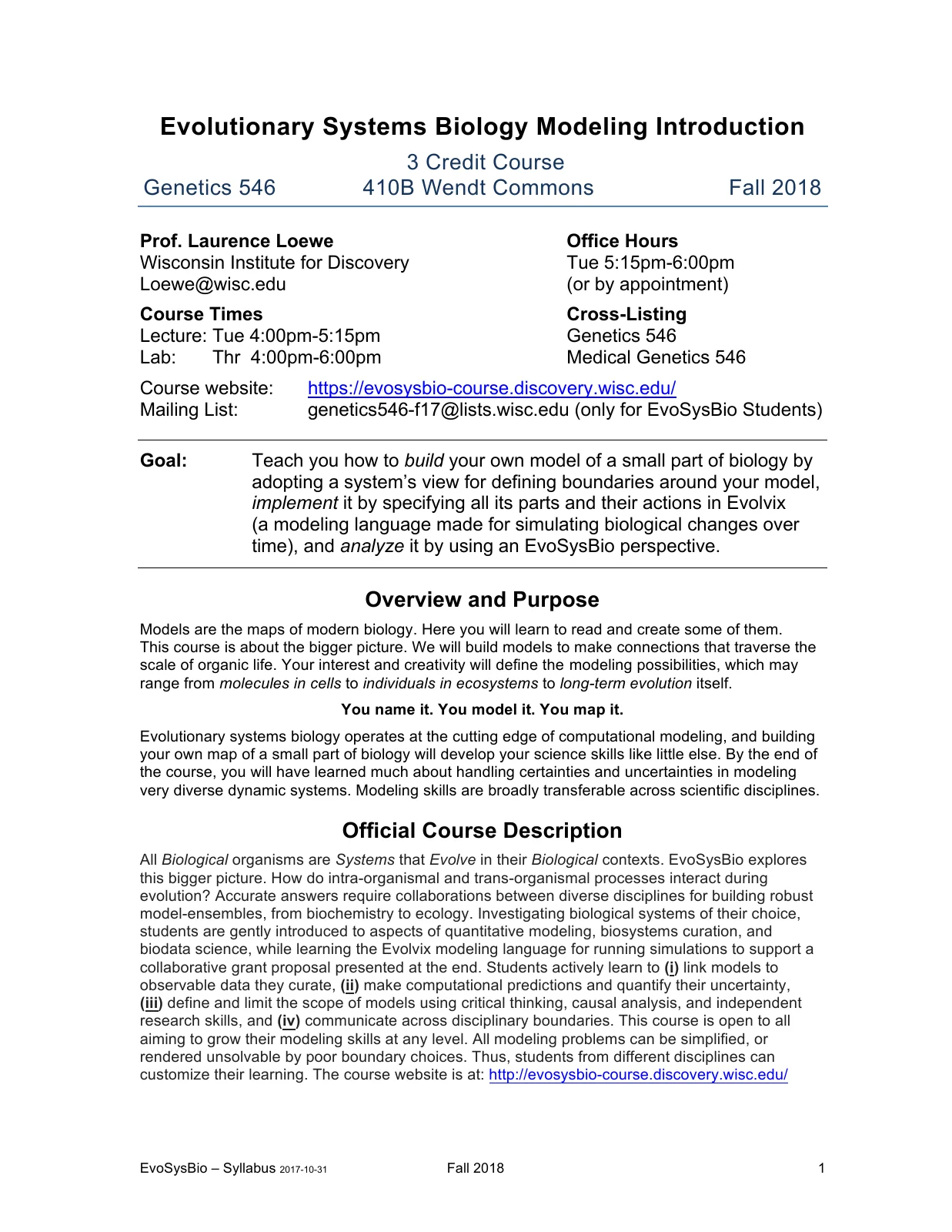
A 14-page syllabus for Genetics 546: Evolutionary Systems Biology Modeling Introduction, a 3-credit graduate/undergraduate course at UW-Madison, 410B Wendt Commons, Fall 2018. Instructor: Prof. Laurence Loewe, Wisconsin Institute for Discovery.
Course goal: Teach students to build their own model of a small part of biology by adopting a systems view, implement it in Evolvix (a modeling language for simulating biological changes over time), and analyze it using an EvoSysBio perspective.
Key pedagogical features:
No exams. Grading based on weekly ReLogs (Research Logs, 30%), peer reviews (15%), a collaborative group grant proposal (40%), and class participation (15%).
Problem-based active learning. Students pick their own biological system to model and work in interdisciplinary groups.
Grant writing as assessment. Graduate students produce 5,000–10,000 word grant proposals; undergraduates produce 3,000–10,000 word proposals. NSF Graduate Research Fellowship applicants can integrate their fellowship application with the course.
Evolvix as modeling platform. Students describe biological systems as Continuous Time Markov Chains (CTMCs) using Evolvix’s biologist-friendly syntax.
15-week timetable progressing from abstract populations (Week 1) through simple bacterial growth (Week 3), metabolic flux stabilization (Week 8), oscillations in host-pathogen systems (Week 9), Michaelis-Menten kinetics (Week 10), molecular switches (Week 11), CTMC summary (Week 12), diverse CTMC applications (Week 13), to student presentations (Weeks 14–15). Weekly readings include Loewe’s own EvoSysBio papers, the POST system paper, Gillespie’s stochastic simulation review, population genetics papers, and the FlyClockbase biodata science project.
Broader Significance (Claude’s Assessment)#
Living proof of the broader impact vision. This syllabus is the direct implementation of the teaching goals articulated in the 2011 NSF CAREER grant. The promise to create a course where students use research-grade tools (Evolvix) in an active-learning environment materialized as Genetics 546.
Unusual pedagogical design. Replacing exams with collaborative grant writing is rare at any level. The emphasis on ReLogs (weekly research journals), peer review, and group dynamics mirrors professional research practice rather than traditional classroom assessment. This is notable evidence of pedagogical innovation.
Interdisciplinary by design. The explicit “open enrollment” policy, the diversity statement, the “crossing disciplinary boundaries” essay requirement for graduate students, and the structure of interdisciplinary group projects all demonstrate a deliberate commitment to breaking disciplinary silos — the same philosophy that drives the Matheo papers.
Self-referential reading list. The weekly readings systematically build the EvoSysBio framework by assigning Loewe’s own published papers: the 2009 EvoSysBio Framework, the 2016 Encyclopedia update, the POST system paper, and the FlyClockbase biodata science project. The course is effectively a guided tour through the research program.
Key Concepts at a Glance#
ReLogs |
Research Logs: weekly written reflections (300+ words for undergrads, 500+ for grads) documenting the learning journey |
CTMCs |
Continuous Time Markov Chains: the mathematical foundation for stochastic biological simulation in Evolvix |
5 W’s of Modeling |
What system, Which parts, When actions occur, Where, and Why — the course’s boundary-drawing framework |
Group Grant Proposal |
Collaborative research grant application (3,000–10,000 words) serving as the primary assessment, replacing exams |
Peer Review |
Weekly anonymous review of classmates’ ReLogs, building professional scientific communication skills |
POST System |
Project Organization Stabilizing Tool, taught in Week 3 for organizing research data efficiently |
FlyClockbase |
Biodata science curation project (Weeks 10–15) demonstrating challenges of integrating biological time series data |
Document Information#
Document ID |
Course Syllabus (About-Me Science, Dusty Deep Data) |
Full title |
Evolutionary Systems Biology Modeling Introduction — Genetics 546 Syllabus, Fall 2018 |
Author |
Laurence Loewe |
Date |
2017m10d31 (syllabus version); course offered Fall 2018 |
Format |
14-page course syllabus with timetable and reading list |
License |
|
Part of |
Good News Pack MMv3, Dusty Deep Data / About-Me Science |
PDF size |
228 KB |
WebP size |
216 KB |
Related documents in the Good News Pack:
Teaching Flyer (1-page promotional flyer for this course)
NSF CAREER Grant (the grant whose broader impact produced this course)
2009 — EvoSysBio Framework (Week 8 required reading)
2016 — Systems EvoSysBio (Week 2 required reading)
— Overview AI-generated by dv_ClaOp46Max_ExhF_2026m04d16 —End—