
Join Me to Cut Our Odds of Accidental Nuclear Winter#
by LLoL (concept, drafting, prompts, deep review for QualityQuest v7 2026m06d17), supported by AI Claude Opus 4.8 Max (drafting, refining, reviewing), on the shoulders of Everyone who came before. This is reviewed QualityQuest v8 2026m06d18 version 2 (QQv8, only formatting changes to v7), meaning it has seen a lot of rewriting but may still benefit from further refinements, especially based on outside feedback. Yet, as far as LLoL can tell, the Requiem stands. Don’t believe it. Audit it.
Reading-time labels on this page assume a reflective pace of about 150 words per minute to allow for thinking about what is read. The shorter versions are for those with less time. While you keep living at whatever pace you’re at, note that the ≈72 minutes it may take to read this Requiem for a hurried world are equivalent to the ~72 minutes it takes for accidental nuclear winter to begin in Annie Jacobsen’s 2024 book Nuclear War (describing one of too many potential credible scenarios for how it can happen). This page is a (1:1) port of LLoL’s #AuditTheMath GoFundMe campaign story, now published here alongside the live GoFundMe campaign. Don’t believe it. Audit it.
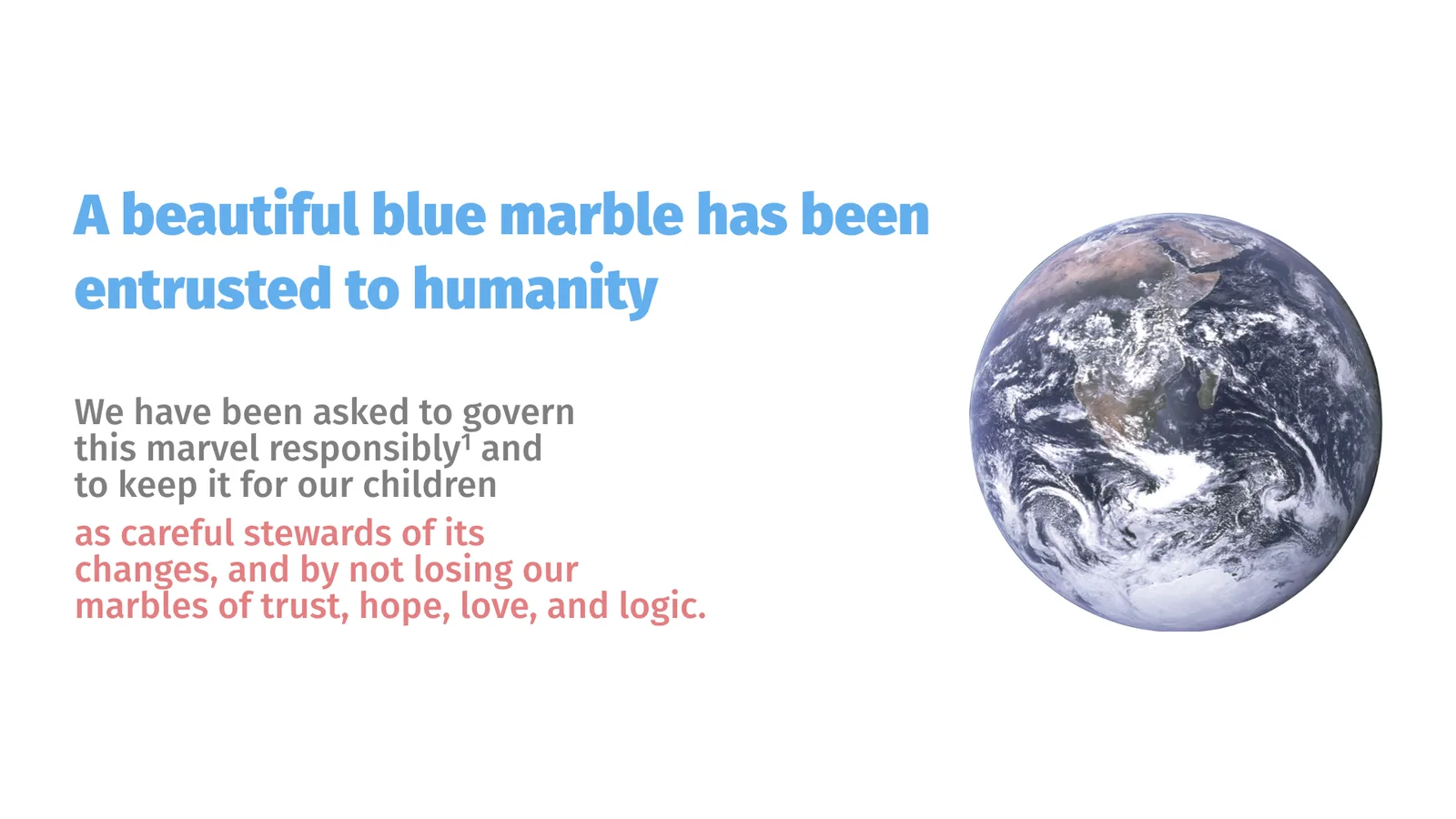
Fig.1 (1 minute of pause) Will we keep our beautiful blue marble by keeping our marbles? (1) responsibly is here defined as gentle-kind-reasonably over the long term. My modeling indicates why a challenge this big needs a ResearchCity to pull it off. Maybe it’s time for a review of how we’ve been doing.#
THE 30-SECOND VERSION#
Cancel the upcoming 72-min Horror Requiem with 2cents/day
I’m a scientist and my simulations say I’m likelier to die in an accidental nuclear winter than in a car crash. I think I found a new type of systems math to avert that problem for everyone. But before acting on it, it must be tested transparently. I’m calling all who care to buy in with ~$8 and tell one or two others to help independent experts audit the math behind the escape-hatch I found from my nuclear-Armageddon-ish nightmare. Don’t trust me — check it. Buy in here, or read the 5-minute overview next.
THE 5-MINUTE VERSION#
72 Minutes to Accidental Nuclear Winter — and an Escape Hatch
I’m Laurence Loewe, a quant biologist, building models for a living. In 2020 I started a research marathon modeling existential risks to evaluate ways to avert them. I think I found a credible, workable escape-hatch worth openly reviewing. Most of my modeling is complicated, but only in 2024 did I find a stunningly simple way to openly model realistic risks of nuclear roulette. My RiskyMAD open simulations tell me that, like most people, I’m likelier to die in an accidental nuclear winter than in a car crash — a worse-than-1-in-40 chance every year, a coin-flip in about 19 years. Not fate, nor fear-mongering: a number you can check and try to break.
Many people do great work to manage nuclear risks, but truly solving the problem is a different animal. And as far as I can tell, no one is paid, full-time, to ensure the mathematical integrity of potential real solutions that go beyond mitigating symptoms to merely postpone the inevitable. If there were, everyone would know. My 6-plus-year research marathon aimed to find out whether averting self-made existential disasters is even possible. It wasn’t clear to me and pessimists abound. I kept running because humanity deserves better than to go extinct due to random technical glitches. I checked every glimmer of hope to see if it was reliably scalable. Eventually it all converged on a credibly workable way forward. It’s detailed by a new systems-level mathematical framework based on axioms I serendipitously arrived at for modeling existential risk and governance. I think I stumbled by accident into a mathematical way of spelling out what the trifecta of gentle-kind-reasonable means over the long term. That is my best remaining true hope. Most people I know would like to be gentle-kind-reasonable but get tripped up by traps my math describes. How do I know? Despite my best intentions, I fell so hard for those traps that I finally started to see how they work.
But the world is complex. I may have missed something crucial. That’s why I’m calling everyone to buy into #AuditTheMath: to show me in a gentle, kind, reasonable way where I’m wrong. If the core math can be refuted, so be it — I refuse to raise false hopes. But if the core holds, then I may have found a true hope that is genuinely good news for everyone.
The ask is small and wide on purpose: ~$8 a year — about two cents a day — from everyone who cares. That spreads the risk and keeps anyone from “buying influence”. The buy-ins will help to invite independent experts to break that core — and to support those who refine and explain expert findings so anyone can track progress. You don’t have to be good at math to help: your two cents will allow reviewers to eat, so they can stay on-mission. Your two cents also tell the world you want this tested in the open by the best experts, not behind closed doors where who knows what may be going on. If the math holds, it scales into the ResearchCity I have been envisioning — built to avert existential disasters for everyone. It’s a huge project. That’s why it’s so crucial to check the math first.
Three guardrails to keep me honest and any potential ResearchCity from self-destructing:
A hard per-person cap, so no billionaire, foundation, or government can sway results. All friends and foes, humans and organizations, are welcome to buy in. But buying in buys no louder voice, like buying an iPhone doesn’t let you pick what Apple builds next. This hard limit is my first step towards locking down all “influence shopping” aimed at twisting the truth about common goods to private ends.
Half of everything is given away to others doing urgent, under-funded good.
Don’t trust me — audit the math, because I’m wrong in more ways than I have hairs on my head. All I’m trying to do is to be less wrong.
My call leaves everyone with a choice:
0. Do nothing. Don’t look up. Ignore the odds on my forecast — albeit possibly at our shared peril.
1. Look up. Looking is free. I put all I can online (see links below). Audit the math yourself. Call any experts you know for help. If the math breaks, you’ll have helped kill a false hope and I’ll be forever grateful to you. If it holds, you will have strengthened my best true hope. And if math isn’t your thing (as for most people), then buy in with as much as you like (below the limits!) to support those who do the auditing, bound to everyone’s best interest.
Know you want to help? Buy in here.
Unsure? Read on — the rest is for those who want more before a deep dive into balospe.com.
THE ≈72-MINUTE REQUIEM -#
72 Minutes for the Day Before The Day After the start of Accidental Nuclear Winter — and an Escape Hatch
I know this is long. At a reflective reading speed of about 150 words/minute it takes ≈72 min to read. Take your time. Because ≈72 min is how long it takes for nuclear winter to start in Jacobsen’s 2024 book “Nuclear War”. If that were to happen, everyone would drop what they were doing and stand in shock (if standing at all). Let this be a ≈72-min memorial for a future that I hope will never happen because humanity decides now to rewire the great innovation-engine of Reality to move the world towards becoming more gentle kind reasonable with a ResearchCity like envisioned here.
§1. More likely than a car crash (5 minutes)#
When I say “quant biologist,” I’m cutting a long career short. More precisely: I’m a computational modeler who specializes in mechanistic evolutionary systems-biology — and who became a core compiler-language architect to make those models more rigorous. I got tired of chasing the same bugs, knowing a better compiler could prevent them. I build models for a living, and by passion. This has given me a sharp sense of when a model is missing something or finally solid enough to be useful. To make mine more reliable I wrote the Prototype Evolvix Compiler, built to simplify accurate modeling as rigorously as possible. I implemented it as an assistant professor at WID, University of Wisconsin–Madison, funded by an NSF CAREER grant. The point: I know how to build useful models of overwhelmingly complex systems. (My academic CV is at balospe.com.)
And yet — despite that expertise, my long-standing interest in modeling extinction events, and knowing for decades that nuclear weapons could end the world — it never occurred to me to combine the two and actually model how long until an accidental nuclear winter ends my career, and everything else. In hindsight I’m baffled: I could have built it a decade earlier. It took me until 2024. What stopped me wasn’t any technical detail. It was that I’d never asked the question.
Once I asked it, building the model was eerily simple. It turned out to be one of the most elegant I’ve built: stripped to the bare essentials, yet rigorous, because every complication folds into its parameters. Its structure echoes Michaelis–Menten kinetics — a model biochemists have leaned on for a century. Its stochastic certainty can be understood by playing a simple game of dice: Pick any number. Roll the die. It’s impossible to predict whether the next roll has that number. But what is easy to predict is that if you keep rolling that die, that number will show up eventually. What my Evolvix model computes is that waiting time.
The RiskyMAD model simulates how long until I fry, freeze, or starve. It rolls two dice of nuclear roulette: the first, how often the world slips from its current Risky state into a MAD crisis — a Cuban-Missile-Crisis moment where obliteration becomes a coin-toss; the second, how often that coin-toss goes wrong. The odds don’t come from a handful of runs — they’re computed from the model, calibrated to the four MAD-style crises the Cold War actually logged in about forty years. To picture them I plot forty simulated world-histories (the dots in the next figure), and I recompute the whole thing three ways: taking those four crises at face value, supposing some were less dire than Cuba, and supposing the official record undercounts them. That’s a most-likely, a best, and a worst case — the problem cornered from all sides. Like the one simple equation that fits countless different enzymes just by retuning its parameters, mine folds the messy specifics into a few numbers — so you don’t need to track who does what, when. A bird’s-eye view of nuclear history.
It deliberately only models accidental all-out war. It ignores ‘local’ or tactical nuclear use, even though it could pave the way to all-out war. It also ignores deliberate launches, assuming nuclear leaders grasp what those weapons mean and try hard to avoid them. If that fails, my numbers are underestimates. I extrapolate only from the four generally-acknowledged near-misses. In these, chance — not policy — decided our fate.
My results? An onset more likely than not within about 19 years, at a worse-than-1-in-40 chance every year. What shocked me was how robust that worse-than-1-in-40 stayed: even under my most optimistic assumptions the computed first-year chance barely dropped — and under the most pessimistic it roughly tripled. In the plot, that’s one of the forty optimistic histories already ending in year one, and three of the pessimistic ones. It simply wouldn’t go away. Given how simple the model is, I wondered: how is this not common knowledge? How had I not seen it myself?
Then I understood why a forecast like this is useless without a solution — it’s like an asteroid that could appear from nowhere and wipe humanity out like the dinosaurs. No point fretting over what you can’t prevent. Except an asteroid comes from outside; nukes we do to ourselves. Biochemistry hints at how to resolve this: change the game by adding a different reaction that is faster. That is what ResearchCity is designed to do. It proposes that disaster can be averted with the ancient art of loving enemies by listening to them. That’s why that forecast is only the start.
Many have set out to stem that nuclear tide. What could I add? That’s where my marathon turned strange — I kept asking ever more hypothetical questions across fields people keep far apart, until a mathematical framework for averting this fate took shape. (How I got there is a longer story, about as accidental as a chemist’s famous dream — more on that below.) It’s elaborate, and people understandably distrust complexity they can’t see into — so complex solutions to complex problems need a reason to be looked at hard. My RiskyMAD model may provide exactly that reason.
Which brings me to a curious gap: as far as I know, no one in today’s high-tech world is paid, full-time, to transparently weigh every side of the most rigorous math for actually ending nuclear roulette. Many work to manage and delay it; but checking the math to end it seems to be nobody’s job. If the job existed, everyone would know. So I am applying here for that job of nobody. To prepare, I went looking for a way to change the game entirely, so nuclear roulette can finally stop. This campaign exists to review the framework I found, and — if it holds up as well as I think — to take the first steps toward scaling up the solution.
More on the open RiskyMAD model is here. balospe.com/en/crisis/science Don’t believe me — audit it. Core results, with explanations, are in the next figure.
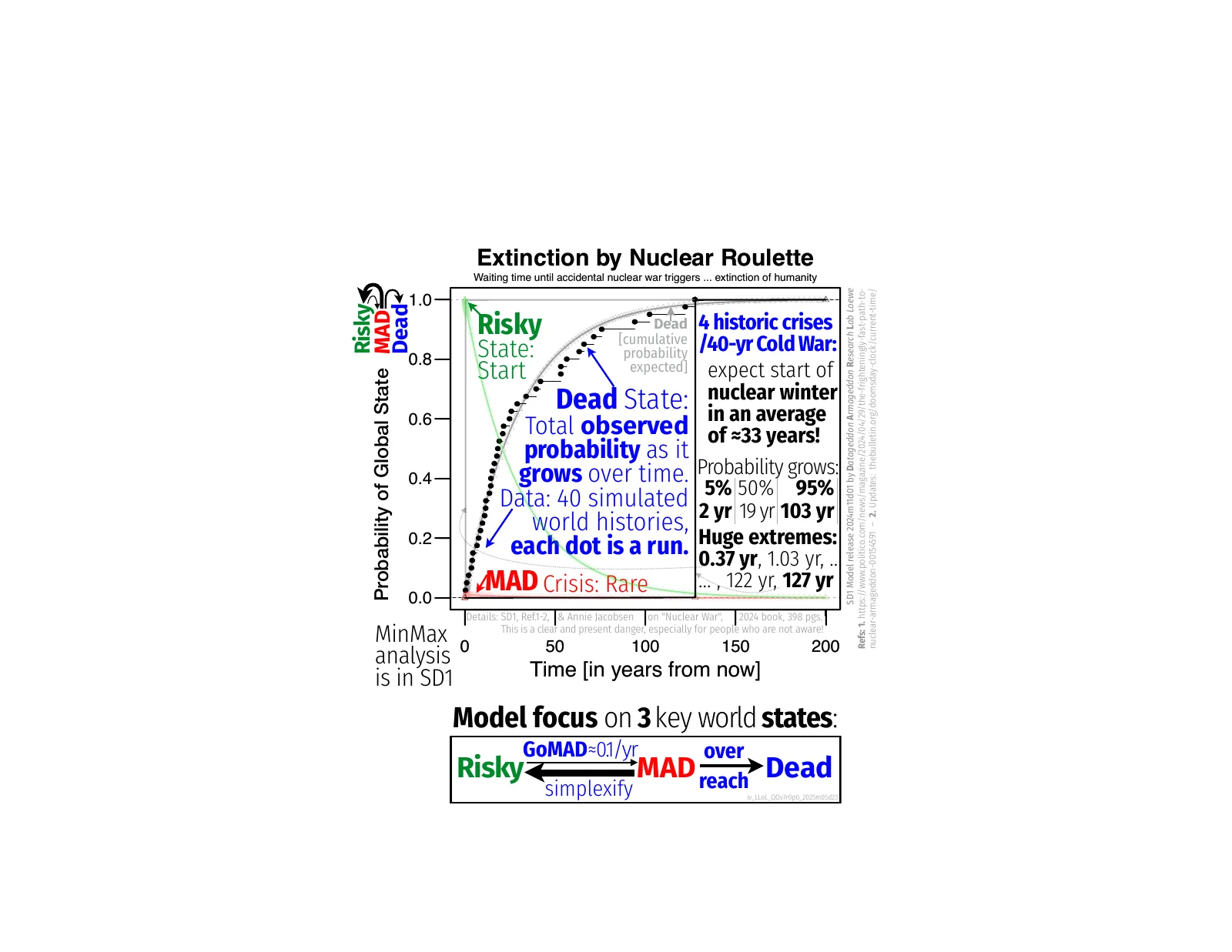
Fig.2 (3 minutes reflecting on plot). My open “RiskyMAD” forecast model and results: 40 simulated runs of world history (each a dot), extrapolated from four documented Cold-War near-misses. In half, an accidental nuclear winter starts within about 19 years; a long tail drags the average to about 33. But more alarming is the short-term result that shows a worse-than-1-in-40 chance every year. No airline or insurer would tolerate such a failure rate. Why should I or the world? The model is simple, the code is open, and Prototype Evolvix executables are available and the RiskyMAD code is here, so determined command-line geeks can rebuild and run their own numbers doing their best to break it. Don’t believe me; audit it.#
Enough to act on? Buy in here. Or keep reading, thinking, returning after review.
§2. One courageous person, in the right seat - staying gentle kind reasonable despite all fears (6 min read)#
This isn’t abstract. In 1962, one man — Vasili Arkhipov, not powerful, but in the decisive seat aboard a Soviet submarine — refused to fire a nuclear torpedo and quietly kept the Cold War cold. He won World War Three for everyone, yet almost no one knows his name. Cut off from radio and rattled by US depth charges, his captain was sure war had already begun and moved to launch. Arkhipov kept his head, judged the signals too ambiguous to mean that, and refused. Arkhipov’s calm, gentle-kind-reasonable explanations of the unknown eventually convinced his captain and the crew to surface and surrender to an unknown fate, thereby saving everyone. He was in the right seat at the right moment, held the power to obliterate or save the world, and chose correctly by risking everything. His experience informed the framework I developed. Me publishing my findings at Balospe.com is my equivalent of coming to the surface.
The core idea is simple. At any moment, one person holds the most influence over an outcome — a “superhero” in the decisive seat, as Arkhipov was that night. The danger is that the same person turns “supervillain” exactly where they stop listening to Reality — most dangerously where they quit learning. The only fix is to keep listening: to let actual Reality “as is now” have the last word.
I write Reality with a capital R to mark that the objective Real is bigger than anyone’s subjective reality that may include overconfident “certainty” and imaginary fear. Fear is the right word here, because fear and danger aren’t the same.
Fear lives in one’s head; it’s brain chemistry.
Danger is out in the world; it doesn’t care about personal fears.
Many fear plenty that can’t hurt them. That is needlessly crippling. Especially when these fears trick them into ignoring the actual dangers caused by the biggest elephant in the room. Aligning fear with real danger is what puts attention where it belongs. Nuclear weapons and more complex existential risks sit squarely in the danger category.
Yet most people’s internalized working models of their world leave out such existential threats — out of sight, out of mind. That doesn’t make dangers less Real. Nuclear weapons are part of Reality whether or not anyone feels it.
ResearchCity’s 1st mission is to keep listening to and following all of Reality “as is now” to support in gentle-kind-reasonable ways the life-giving decision-making of whoever sits in the most dangerous seat at any given time, no matter their side.
There is only One Reality, one Earth, and we all breathe the same air.
ResearchCity’s 2nd mission is to gentle-kind-reasonably help everyone to see how they are in the most influential seat for their life and their area, more often than most imagine. Because every life matters in any self-stabilizing innovation economy.
Innovation economies are complex and hard to govern without killing them. AI is making this increasingly clear. Hence, the only chance a ResearchCity has to avoid causing its own self-destruction is to build on a mathematical framework that can provably avert such a fate. I think I may have found a big diamond-in-the-rough that can be polished into such a reliable framework. I tried to (roughly!) describe it in my 32 Matheo Study reports at Balospe.com.
I am running this GoFundMe campaign, because — to the best of my ability to test my math — it’s real. But who will believe me enough to audit the deep math of gentle-kind-reasonable ways in a global cut-throat attention economy, fueled by the age of conspiracies, now with AI-supported rage-echo-chambers?
That is why I’m calling the scholars of the world and everyone to not believe me, but to help me audit the math.
Fig.3 highlights eerie parallels between the story of the Titanic and today’s world. As if any confirmation was needed, since 2022 I’ve been trying to explain to various types of people who I thought might care enough to engage, how existential insights are ignored and our civilization is thereby on a broad path to a fate of self-destruction. Most people agree with the diagnosis for their own reasons. But engaging with real work to avert such a fate?
Who still dares to hope? Who has the patience to explore solutions that don’t fit on bumper stickers? No reliable system exists for escalating existential insights. So I’ve been using my systems design expertise to create one. But so far, nobody is interested.
Will I stay Cassandra? I hope not. That is why I’m applying for the job of Nobody and created PDFs with an invitation to engage that anyone can turn into a bumper sticker. This campaign is likely my best opportunity to explain my findings. I like quiet. But like Esther, I’d rather risk everything to speak than stay silent. So I’m putting everything on one card to see if anyone is even willing to look at the math I discovered.
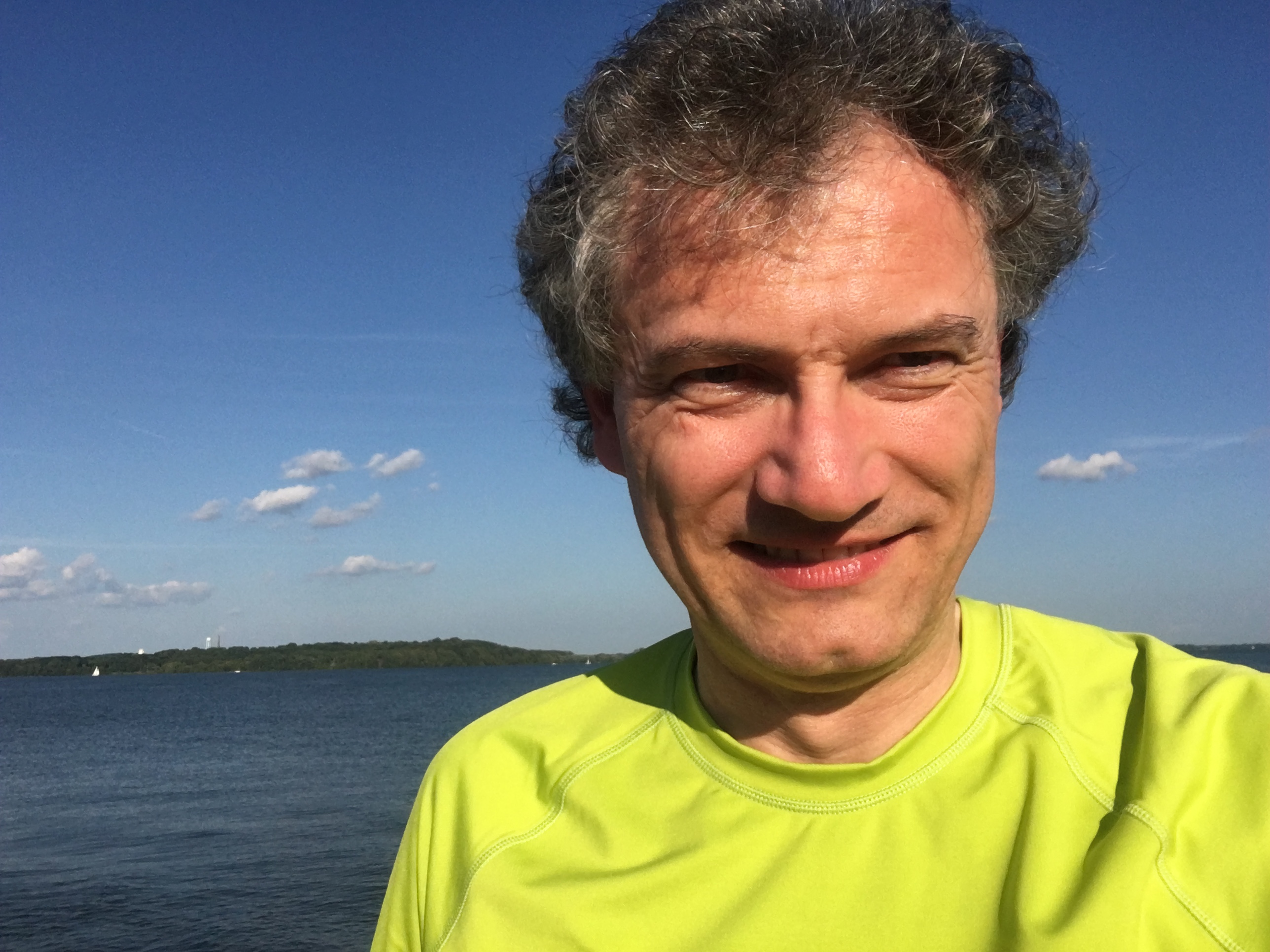
Fig.3 (2 min read, 1 min commemorative silence for Titanic victims) Me at a data lake in Madison, Wisconsin — on the road to WISdom, CONScience, and INtegrity. It’s where, in 2012, I first saw a flyer for fighting “Datageddon” in research data: a flood of data too chaotic to navigate to find what matters most. I laughed — until I realized, in 2018, that I’d been living right in the middle of one. Datageddons are no joke: a data-tsunami too chaotic to manage eventually always triggers its related Armageddon-ish disaster — unless someone untangles that datageddon in time to connect all the dots that matter most. The Titanic is a classic case: it received 6 iceberg warnings on its last day, and the most decisive ones never reached the command bridge in time. They drowned in floods of passenger telegrams deemed more important than the warnings that mattered. It was a similar situation to today’s. A new communication technology had emerged (telegrams then, web, social media, AI now). There was no reliable system for how to separate the existentially essential from the busy chatter of paying customers. It took me years to see how that problem scales — from my own life all the way up to the whole planet.#
§3. The ask: ~$8 a year, and tell one or two others — no need to be good at math (4 min read)#
The ask is small, wide, and time-limited on purpose: ~$8 per person per year, a little over two cents a day. Small, so no one risks “the world” to help audit the math that might help save it. Wide, so enough hands gather to audit it thoroughly — which is why I ask you to tell one or two others. Time-limited to a year, so everyone decides again next year, on the updated vision, whether it’s worth another round of support.
At first, all of it sustains the review itself — auditing the math underpinning the escape hatch I’m proposing, the ResearchCity. The more people buy in, the more independent and transparent I can make that review: I’d hire support staff to turn the experts’ findings into something outsiders can actually follow, so the failures and revisions real science is made of don’t stay behind closed doors.
Why not just send it through ordinary peer review? It’s too slow for this, too quick to dismiss early-stage work, and I honestly wouldn’t know where to submit a body of work engaging that many disciplines without burying it or scattering it across many fields and years. I do want to clear that bar eventually — but reviewing the core math has to come first: there’s no point acting on a flawed foundation. If it’s too flawed to build on, I will write up why, so no one needs to repeat my mistakes. But if it holds, then in a race against accidental nuclear winter, it would be irresponsible to wait for journal publications before acting. (More on how review works at balospe.com/AuditTheMath.)
So my one real question is whether the core math holds or fails — and who will help find out.
Who, in a so-called “post-truth” world, will help find Truth for what is really a pre-Truth world?
Who will help check, with the toughest tests the best experts can throw at the work?
Who will contribute fixes and rival designs, so the math becomes the best it can be?
Who will help explain the findings so outsiders — not just experts — can follow?
And if it breaks, who will document how and why, so the next person doesn’t fall for my traps?
Your buy-in isn’t a bet that I’m right. It binds me to organize the most ruthless audit anyone can imagine — to break as much of the core as possible, precisely so this never becomes one more echo chamber. If it can be repaired, good. If it can’t, also good, and documented. So: don’t trust me — audit the math.
And you don’t have to be good at math; most of us aren’t. “The math” is shorthand for careful expert review across many fields — physics, biology, game theory, logic, policy, design — each with its own standards. To help, anyone can contribute in their own way: audit it as an expert, explain it as a teacher, or ask the obvious question as a beginner. A child can hold the most important question in the room. I want that child heard, so we don’t miss the Truth she sees. That’s why I’ve put everything online, best I can: it gives “naked scientist” a new meaning — the work descending from its ivory tower to where the rest of us live. More at balospe.com/AuditTheMath.
Enough to act on? Buy in here. Or keep reading, thinking, returning after review.
§4. Three guardrails to keep me honest and any potential ResearchCity from self-destructing (3 min read)#
A. A hard per-person cap so no one can buy undue influence
Many fundraising organizations accept and welcome as much as anyone can give to their good cause, never saying what “enough” would be, because it’s usually possible to come up with yet another good project. This one is the opposite, by design. There’s a hard per-person cap, for one blunt reason: so no billionaire, foundation, corporation, or government can give more and buy the result. Work meant to speak honestly for all sides can’t be owned by the deepest pockets in the room. Backing buys no louder voice — no more than buying a maxed-out iPhone lets you decide what Apple builds next. The cap is the feature, not a limit to regret.
Here’s the machinery, in plain sight: the ResearchCity I envision splits into 1600 research talent “stadia”, each with the same ~$8-per-person-per-year cap.
Back the few you care about most to become a “Select-Stadia Backer”: your picks will be considered as starting recommendations in ResearchCity’s processes for how to allocate funds. These processes are yet to be developed — as transparently as possible — as is the list of all 1600 stadia. The first 16 stadia have been defined here to keep ResearchCity’s scaling-up stages in balance.
Those who volunteer to buy in with ~$1 into all 1600 stadia to enable more work become 1x “All-Stadia Backers”. A few exceptions exist during the start-up phase, mostly to account for my arguable 7-year delay in launching, and to compensate for the fact that about 7 in 8 persons on Earth don’t have a credit card and are thereby forcibly excluded despite carrying more existential risks. Many of these are children, the future adults of the world. None of these exceptions break the ~$8 ceiling; together they hard-cap All-Stadia Backers at 448x during startup. Please respect these limits until they can be enforced.
More on the Buy-In page and the All-Stadia Backers page. Whoever wants to do more or contribute in other ways, can review ideas on the action pages at Balospe.com.
B. Half of everything is given away to others doing urgent, under-funded good.
Half of everything raised goes straight back out — to others doing urgent, under-funded work. A gentle kind reasonable way for distributing these 50% is to be developed after hiring people to scale this up. It’s a standing commitment that a ResearchCity never becomes a closed monopoly: even where it might one day lead in one area, it must stay able to support the work of independent others and follow their better ideas. Otherwise it stops listening to Reality and thereby predictably turns from superhero to supervillain. So 50% leaves, some to taxes, because real governments keep real lights on. The rest goes to work that falls through every crack precisely because it’s nobody’s job: starved investigative journalism, a grassroots effort doing something essential quietly. I don’t yet name recipients on purpose, for who can predict what will be needed tomorrow? I do commit to finding a system for solving the problem of transparently allocating resources to where it matters most to make the world more gentle kind reasonable.
The existential focus of ResearchCity means that it will need to learn to react fast to the worst emergencies as they arise. Hence, growing endowments for the already-secure is out of scope here, even when their goals are good. This is about catching the crumbs that fall off the big table — whatever the powerful can’t afford to fix properly.
C. Don’t trust me — audit the math.
This refrain matters most of all, because the errors that scare me are the ones I can’t see in myself — and an open audit is the only thing that drags a blind spot into the light.
All I’m trying to do is to be less wrong.
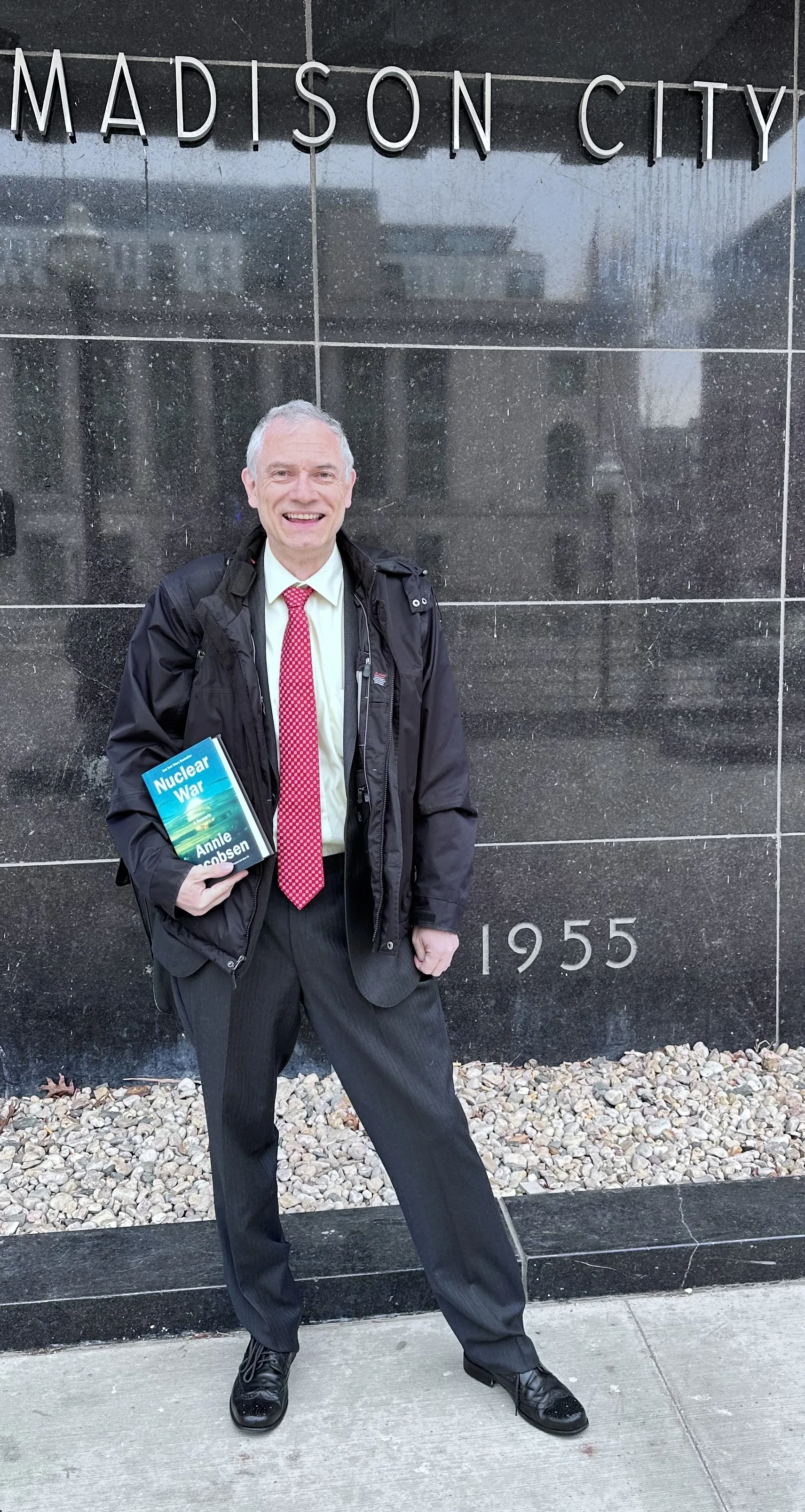
Fig.4 (2 min read): Me at Madison City Hall, holding Annie Jacobsen’s “Nuclear War: A Scenario” (2024) — a minute-by-minute account of how, on an ordinary day, an accidental launch could escalate to global nuclear winter in about 72 minutes. Research into existential risks can be the opposite of uplifting. Oddly, on the way I found little “cosmic jokes” to keep me going. For example, the unpaid job I’m trying to make exist might be called a MADI: a Mutually Assured Destruction Inhibitor — a function, not a title. As it happens, my research that led me to this was done in and near MADIson, which is a city built around the wide, interdisciplinary, diversity-encouraging research I needed to even begin imagining a ResearchCity. Some say it’s “seventy-seven square miles surrounded by reality.” Reality had bigger plans. Where most ask “Why?”, a long line of cosmic jokes got me asking an entrepreneur’s “Why not?” Why not aim a global ResearchCity at all self-made existential problems I track — to solve all of these for everyone? It’s far more efficient than solving them one after another, because infrastructure required for truly solving any one overlaps so heavily with the others that solving these hard problems one at a time is the impossible route. In contrast, solving them all by working together is likely not much costlier than solving only one. Fixing nuclear roulette alone, first, is like biting granite. Hence my case: a ResearchCity that works with everyone towards solving all these nasty problems by complementing existing work where most needed.#
§5. What your ~$8 actually buys (4 min read)#
Not answers — a test. Your buy-in helps grow a core of independent researchers who commit to reviewing the discoveries I stumbled into. They will be paid to find and follow the Truth on everyone’s behalf, not to “tell me what I want to hear”.
They need to be paid by everybody, because they work on everyone’s behalf — and part of that work is explaining findings so others can explain them better still. Their job includes taking the hardest beginner’s questions seriously and building systems to help answer them well. They will all be bound to serve everyone’s long-term interest, not whoever pays.
My role is no different. I bound myself to following the Truth, written with a capital T because the Truth about Reality is so much larger than I can fathom — like oceans against my tiny bucket. I realized my bucket, or anyone’s, is too small to mine enough of that Truth to get humanity out of its deepening predicament. The predicament does not wait: left at history’s rate, accidental catastrophe stops being a question of if and becomes only when. So the only way I can see to avert that otherwise inevitable fate is to call a coalition of the willing to join me in building a worldwide “bucket-wheel excavator” for Truth — one that doesn’t wall itself off inside any single field’s blind spots.
This is why such independent funding is essential: it ties all who work on this to one mission — gentle-kind-reasonable service of the Truth that is stable, extensible, and life-giving for everyone. It is also why I cannot accept special-interest funding for this work; that would doom the mission from the start.
That excavator — abstract but real — is already running worldwide, in disjointed parts that struggle to connect. My job is to be a joiner. By some lucky accident I keep finding tools in my bucket that I think can help assemble it. As far as I can tell, they lead to scaling up a ResearchCity — built solely to help coordinate. Yet the excavator itself is global, and connects all who serve Truth, wherever they are.
Your ~$8 keeps me — six-plus years into chasing this — in the race long enough to put the work through the open, independent, global, gentle-kind-reasonable review I think it deserves, in everyone’s fair interest. So you are not buying answers.
You are buying into a process: to re-search for answers, to refine them, and to test them for reliability. So it must start with testing whether the method I’ve been discovering for finding answers is as reliable as it looks.
If the math works as I think it does, wonderful — then the first core blueprints of that excavator will have been found.
If the math fails, good to know. It’s a result well worth paying for: documenting it will show everyone where I went wrong, and save many lifetimes of work for all who would otherwise have traveled up the same box-canyon. In science, some of the most important findings are proofs that something cannot work — a confirmed failure is worth more to me than a thousand polite agreements that are easy to predict. That is how bug-hunting works in cyberspace. That is how serious product improvement works. That is how a ResearchCity has to work if it is to succeed.
Your ~$8 helps build the part of that machine whose whole job is to try to break the math underpinning these ideas. I’d rather never build a ResearchCity than build one on sand that is doomed to eventual collapse.
Enough to act on? Buy in here. Or keep reading, thinking, returning after review.
§6. A Jubilee-based seed — why a city, and not just a grant (3 min read)#
An undertaking this big is only worth starting if one can see where it’s going. Why build something that isn’t worth finishing? The Roman poet Lucan compacted the main challenge into an iron law with four words — “in se magna ruunt”, “great things self-destruct” — a line one could carve over the graves of empire after empire. I turned it into an Evolvix keyword (ISMR for “Including Self-Magnifying Ruining”) to help me annotate the myriad key decision points leading designs to self-destruct (via avoidable complexity). If so, why build anything at all?
The answer is, I think, in the math I stumbled into — the mathematics underpinning proper Jubilees. I had seen Jubilees as boring, self-congratulatory 50-year-anniversaries. But the original Jubilee vision was a deliberate, gentle-kind-reasonable, contractual, periodic reset of opportunities. It was to ensure gains don’t pile up forever with whoever arrived first, thereby strangulating opportunities for others. It’s about keeping an innovation economy from calcifying or eating itself alive. My modeling tells me why this is so important.
Machines need maintenance.
Democracies need free and fair elections.
Innovation economies need periodic, proper Jubilees. Otherwise they self-destruct on a timer.
That third line summarizes the math I’m calling everyone to audit. If my math holds, the reset likely works best on a 50-year rhythm as a structured cycle, not a blunt anniversary. (More about this advanced system of innovation checks and balances is at this Jubilee System overview.) ResearchCity has to be built on proper, Jubilee-based math, or else it fails predictably.
This insight is so momentous and fundamental, that nobody can afford to be wrong about this. That is the whole reason the math must be audited in the open before any practical scaling up of ResearchCity can start. Why pour time and life effort into work with wrong foundations? I’m not claiming my math is right. I’m claiming that if it is, then its implications make it worth every ounce of public, global review. It must either fail in public or succeed in public, because it’s too consequential to hide it in my bucket or in a book preaching to the choir.
If the math holds, to find something that can help this much and bury it would be a crime against humanity — the deepest betrayal of everyone it could protect. So I won’t shut up about proper Jubilees until someone shows me, clearly, a terminal error in my core math.
§7. How this mustard-seed can grow practically — the 50%-Rule (7 min read)#
Every buy-in is to serve the common good. Yet, despite best efforts neither I nor ResearchCity can always be certain of how to do that best. Therefore, all buy-ins from the first dollar are split exactly in half.
Half of every dollar is given away
It goes to gentle-kind-reasonable causes and enterprises to support the enormous good the world already does. This honors the expertise of others in making practical decisions about how to serve the common good. It deliberately includes willingly paying commercial taxes to aid existing governments in serving common goods but goes far beyond that. It’s to support three kinds of good, so none crowds out the others. The goal is to echo the balance of the gentle-kind-reasonable life-trifecta at the core of Jubilee-math. It aims over the long term to:
Stay reasonable (e.g. protecting knowledge “as is” and nurturing strategic commons serving everyone’s future).
Be kind by creating systems offering better opportunities for all (e.g. so more people can find their own footing).
Move in gentle ways to ease acute hardship (e.g. by asking diverse people in crisis what helps them best now).
How to pick the projects that matter most in each of these categories is an insanely hard decision problem. I do not know how to reliably solve it without the ResearchCity I envision. So, I’ll be bound to make errors of judgement. In order to help me learn from those errors, I will keep an open ledger to document as openly as I reasonably can where the money went (starting informally). I can’t promise that all will be in “perfect balance” at all times, but the 50% rule with this trifecta will help me stay more balanced than I otherwise could.
Consider these 50% to be a timely buy-in of ResearchCity into independent work toward helping the world to self-stabilize. Not perfect. Never complete. At times likely unavoidably controversial. But always an encouragement to aid good. If ResearchCity asks for your buy-in, it’s only fair to practice buy-in itself - and to openly learn from its mistakes as it continues to do so. Since your buy-in is (and by design remains) voluntary and only for one year, you can always withhold your ~$8 next year (or aid other research stadia that in your analysis are better at being gentle-kind-reasonable long term).
The other half of every dollar goes to ResearchCity directly.
It’s allocated by the same life-trifecta (here is no space for details; one of its start-up research talent stadia, STb11-LCC, aims to evolve an open standard for “Limited Liability Charitable Companies”, LLCCs, dedicated to stripping the inherited slave-trading-era traits out of otherwise-modern corporate structures; this stadion will also provide financial transparency you can check).
What more backers actually buy — and what happens if I’m wrong
Three things make this safe to back even before the math is proven:
It’s gated. Nothing irreversible — buying land, scaling commits — happens until independent review says the Jubilee-math is sound enough to build on. That gate holds at every level, including the $8-billion one.
What you buy is parallelism, not a bigger bet. More backers don’t raise the stakes; they buy the right to prepare the next step alongside the review instead of only after it. We are racing a clock — accidental nuclear winter does not wait — and “we can always do it later” is exactly what has been said about every problem left to fester for millennia. I would rather be ready to move the day the math clears than lose those months. I don’t know if this really is a now-or-never moment, but given the stakes, instead of being sorry later, I’d rather treat it as one that might be.
And if the math fails? Then the give-away half already did real good, and the rest funds a documented failure that spares the next person the same dead-end. The world is no worse off — at worst one more honest failure wiser. That’s a bounded downside: roughly what a great deal of well-meant philanthropy achieves anyway, minus the harm. (A mathematician might call it nearly “idempotent” — run it, and if it doesn’t take, the world’s state is essentially where it started.)
So your buy-in and the buy-in of all friends and foes unlocks, in order:
10,000 (~$80,000 → ~$40,000 direct): keep the lights on and me in the race — on whatever salary others judge fair to clear the debts I ran up getting here; details decided openly.
100,000 (~$800,000 → ~$400,000): first hires, to organize the open reviews themselves and improve transparency.
1,000,000 (~$8M → ~$4M): start preparing Stage 0 in parallel with the review — the groundwork that lets us move the day the math clears instead of starting cold. (More on 7-8 gated stages, each re-tested to prepare for the next.)
1,000,000,000 (~$8B → ~$4B): open the international competition for where to build ResearchCity — every nation and district, from Afghanistan to Zululand, invited to bid. Land is only ever bought at fair prices, with the willing support of those who live on it; clearing it by force disqualifies a bid. If there is no peaceful way to build it, there is no ResearchCity worth building — and I will be as clear as the math (“ISMR”) about the consequences. Success depends on far more than geography. Early scaling up of a dedicated team to help interested host nations apply may be critical for success. It’s far from clear (and I don’t care) whether it lands near a leading research center of today, or of the past (like Timbuktu), or elsewhere — as long as all requirements of Reality are met to allow ResearchCity to live.
More scaling math on the Buy-In page.
I’m not asking you to fund the whole forest — only to help plant one mustard-seed. Show the experts of the world that you want my Jubilee-mustard-seed to be properly cared for by calling for their in-depth review, so we can all get to the bottom of the Truth about Jubilees!
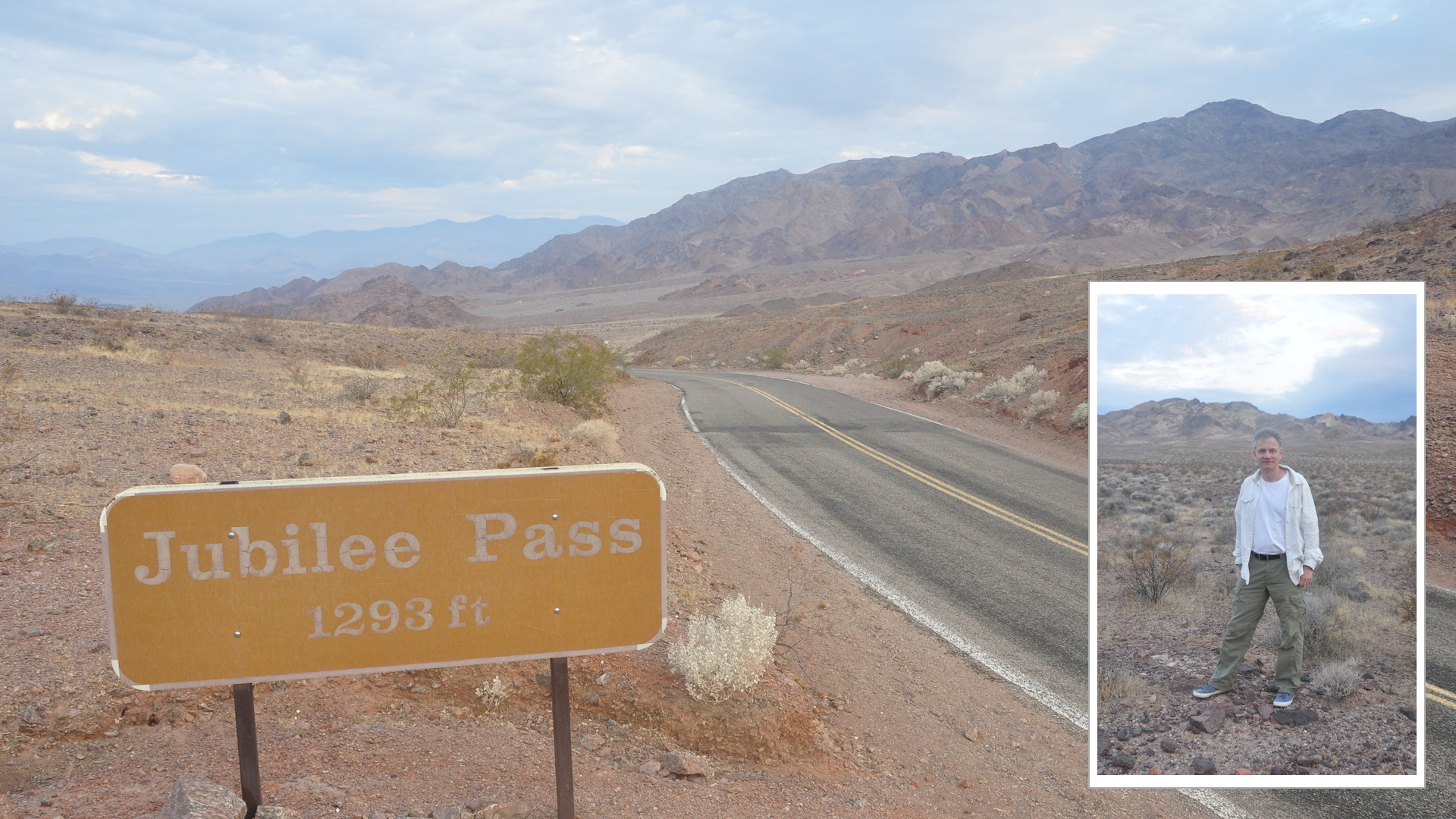
Fig.5 (2 min): Me at the entrance of the Jubilee Pass to Death Valley, California. A ResearchCity only works if it becomes a proper Jubilee-based innovation economy — and the stakes appear as if chiseled into this landscape. The road was first called Suicide Pass, after Chester Pray, the gold-mining entrepreneur who started building it in 1913, was found dead at the camp; it was renamed “Jubilee” to sound less forbidding. His partner Jack Salsberry finished it. Who knows how many have died trying to introduce aspects of a true Jubilee — to reset opportunities for all? Without their pioneering work through the ages into today I’d never have seen what I needed for proposing the general Jubilee-based innovation economy framework that I am calling everyone to help audit. Unlike the gold-mining profits of times gone by, my Jubilee-math was discovered collectively by all and it is for all. I merely put what I saw in a form I hope to be readable enough for auditing the core math architecture underpinning it. If my math is correct, then without a system like the one I describe, any innovation economy will eventually self-destruct by creating its own death valley. The abstract gold mine that I discovered in my Death Valley? A structured way to describe the Jubilee System. Its algorithms are the only way I can see to keep a complex evolving world from self-destruction by teaching it gentle-kind-reasonable HUman MAchine Negotiation Encouraging, so it can stay HUMANE — which, if machines can be taught the same gentle-kind-reasonable negotiation, bears directly on AI safety and human survival. That is why I call everyone to #AuditTheMath.#
Enough to act on? Buy in here. Or keep reading, thinking, returning after review.
§8. Is it “for me”? Yes — and for everyone, unapologetically (2 min read)#
GoFundMe asks me to declare whether the funds are for me. Honestly: yes — and for everyone, in the same breath. Averting nuclear roulette is the rare place where not wanting to die myself and not wanting anyone else to die are the same wish. The contribution caps and the 50% give-away are designed to enforce that independence. For the record, contributions come to me as an individual researcher — currently still a sole proprietor — because there’s no suitable organization yet; building the right one, lawyers and all, is part of the work.
So what’s the worst case?
I could take the money and become corrupt. Who’d believe me if I said I wouldn’t? Money corrupts, and a lot of it more so; I’ve watched it happen. That’s why I’ve spent years designing a system of self-enforced transparency that will make it nearly impossible to hide corruption, even for me. It’s part of the math I’m asking everyone to audit. It might not work. If it doesn’t, the worst your $8 buys is one more failed billionaire. No real change to the world we already have. I’d wind operations down, write up results, and hope to be left with some reasonable compensation for my efforts before looking for another job. But if the math works, then it appears to bear on some hard problems from runaway inequality to keeping AI trustworthy. I’ve front-loaded testing by design so that almost all the development costs for putting the math on the table have already been paid. The remaining risks of testing and implementing are maximally distributed to ensure they don’t hit anyone too hard. The downside of everyone ignoring it is self-destruction as outlined above. The upside is that humanity — if it finally chooses to arise and shine — gets to fulfill its full potential.
§9. To the journalist looking for the easy headline (6 min read)#
You can screenshot any line here, or at Balospe.com, and make me look ridiculous. It’s easy: “scientist asks everyone for $8 to stop the apocalypse.” Geek that I am, I’m easy to mock. I have more faults than hair on my head, and I’m not bald. Go ahead; I can’t stop you, especially if you’re paid to.
But I’m done hiding. I’ve tried to be as transparent as I can about my worst failures — see Matheo-b19, my most refined account of one of my most catastrophic failures: failing to prepare for a pandemic where I could have (details in appendix SI b19-sgir-0). So if your editors still give you time for real fact-checking, run my RiskyMAD model past modeling experts who aren’t under the spell of a national military establishment, and see how far my upper and lower waiting times sit from theirs.
I sat in that trap myself. In 2020 I was sure my failure to prepare for the pandemic was the worst thing I’d seen — it took me until 2024, and the RiskyMAD model, to see a danger that dwarfs it. So if you feel the pull to make that Covid failure the story instead of the nuclear one, I understand it. But that pull — fixating on a lesser alarm while the greatest goes unwatched — is the signature failure of our age, what I’ve come to call the age of conspiracies: the late stage of an innovation cycle gone silently corrupt, where a civilization burns its attention on smaller fears and rabbit-holes while the one thing that could actually end it goes unguarded. (I trace how that silent corruption sets in here.) Ignore what matters most for long enough, and the collapse takes down everything built before it.
I’m no more special than anyone else. Refusing to shrug at the end of my world isn’t selflessness when it’s also your world, and everyone’s. I’m only applying for a job nobody else is doing. I’ve studied how complex systems fail for a living, and neither humans nor AI can mop up the flood of random glitches that can end us, in more ways than anyone can predict — unless we deliberately rewire the great innovation engine of Reality. Right now we run it downhill, toward destruction. I’ve seen enough to believe it can be run uphill instead — but only if everyone shines the way they do best. I need your help as much as you need mine, if my math is correct. If anyone in this story turns out to matter more, it’s you: the one who checks the math and reports it straight — and in doing so defends your own trade from the AI-automated “Ministry of Truth” already coming for it.
Mockery dodges the question instead of answering it. And the hardest question is just a number: why does the world shrug at a worse-than-1-in-40 chance, every year, of nuclear roulette going off — a rate based on four Cuban-Missile-class near-misses? No airline, no insurer, no carmaker would tolerate that failure rate. I get the shrug: “nothing can be done”. For the longest time I gave “nothing” that power too. I’d believe it still, if I hadn’t spent a 6+year marathon checking the math I kept stumbling into. But now that I’ve seen what I report — a real, workable way through, if we cooperate across our countless differences — staying silent would be a dereliction of the worst kind.
So before you reach for “crank,” show me I’m wrong:
— Show me why the corruption my math predicts isn’t real.
— Show me why the self-stabilizing alternative I describe can’t deliver the delight-and-glory I’ve seen.
— Show me why the plan for the transition from doom to delight is itself doomed.
— Or show me anyone with a better plan — built on radical transparency, that doesn’t quietly price in mass death as unavoidable.
Then let’s compare the math in the open, not behind closed doors. Let’s stop guarding the math of everyone’s survival like a mystery cult.
Find me the experts who show my core reasoning is broken, and I’ll shut up and find another job. If not — here I am, applying for the functional role of Mutually Assured Destruction Inhibitor (MADI), trying to make it a real job with a real budget for solving the problem instead of kicking the can down the road. I’d rather be a public spectacle, if that’s the price of averting accidental nuclear winter, than freeze to death in dignified silence. Going public is my capitulation: I spent 6+ years trying to reject my own core math, and failed. That’s why I call everyone to audit it; why I made all of it open; and why — unable to carry the work alone any longer — I’m asking everyone to buy in if they care to avert an accidental nuclear winter . If enough people of good will coordinate even a little, that might be the momentum that turns it around. The hope is real — fragile as a single silver hair, but real. Yet, I can’t be sure and I hate to sell false hope. So, I ask for funds to help me thank everyone in public who finds a flaw, a blind spot, or a fatal error. What doesn’t kill my model only makes it stronger.
So keep laughing, if burying me is the point. But if the math can’t be broken, who profits when we laugh at the question instead of turning it into a real quest for real answers? Yet, the show must go on and laughter is medicine. Therefore, I invite the rest of the world to laugh with me. I wouldn’t have made it through my 6+year research marathon on averting dark existential disasters if it hadn’t been for a long string of “cosmic jokes” I thought were funny. I’m German, I have a strange sense of humor, and God knows if my pattern-matching brain made it all up. Who cares that I’m the punchline in many of these jokes, if they can avert accidental nuclear winter? So, I’m just a guy standing in front of a logic that grows more beautiful every time I audit it. On the other side sit arsenals and industries led by illusions of grandeur with budgets built for exactly the PR it takes to obliterate people like me. So ask them: anywhere in their insurances against every kind of disaster, is there anyone responsible they gave what I call a “Power Of Attorney Advocating To Avert Disasters”? If not — who speaks for them and the rest of us, to avert the inevitable instead of merely postponing it? Don’t trust me. Don’t trust them. Audit the math of everyone.
Enough to act on? Buy in here. Or keep reading, thinking, returning after review.
§10. A personal word to my fellow Laodiceans — and a confession (10 min read)#
(This is my personal and faith background — entirely optional. Skip freely. It’s how I got to the math, not what’s needed to test the math itself.)
One ground rule first, because the whole project runs on it. The story goes that the chemist Kekulé proposed the ring-structure of benzene inspired by a dream of a snake devouring its tail. It didn’t matter where the idea came from; it mattered that it held up in the lab. Same here: where an idea comes from makes it neither false nor true — only the audit counts. So don’t believe my sources. Break my math with better logics. And know this up front: none of what follows is a gate. You don’t have to share — or even finish reading — anything about my faith to properly buy in or audit the math. The case stands on the math, for everyone. What follows is me refusing to hide where I first picked up these ideas.
I can’t stop accusers, so I may as well accuse myself. I look for common ground in my hope to avert accidental nuclear winter. Like Paul before Agrippa, my deepest accusation is for a hope. When Paul named his, one judge called him mad, another was almost persuaded. I expect the same split, for hope is uncertain.
Here is the hope — my theology in a breath: God is Compassionate and Merciful, and unimaginably patient — but, as the old line has it, not mocked. It’s almost a direct consequence of study Matheo-b11. God needs no thunderbolts to let us reap what we sow: our self-destruction is so predictable. The judgment is to give us what we covet. The math I’m asking you to audit describes how that works in terrifying detail.
So, like Paul: I am not mad. I build on math. Audit the math and show me where it went mad. Either way the hope stands on its own, for believer and skeptic alike: that Reality is patient and forgiving and does not want anyone to self-destruct; instead Reality by far prefers for each one to change their heart and mind, so each learns to fight their own idol mirages — until we all come to work together. It’s not naive. It’s math. To ignore it is dying in slices, no matter how smart the dress up.
Key sources.
With that rule in plain sight, I must name my key sources. Hiding would be the worst kind of plagiarism, and a betrayal of those I owe my discoveries to. It would have been completely impossible to arrive at “my math” had I not been kept on that track by Reality and by the extraordinary recursive consistency I see in the life and teachings of Jesus — Isa, in Islam — who became YhowShua, “Yas”, to me. Studying Yas’ Revelation (yes, that book!) led me to a mathematical theology that flipped its dark, fearful reading I grew up with into a stunning message of hope. For example, instead of timidly waiting ‘til the Four Horsemen of the Apocalypse “Come!”, this re-envisioning sees the command “Leave!”, making a world of difference. This and other well-known ancient Greek ambiguities appear to have been crafted into a most advanced Rorschach-test, asking what we want to see: doom or delight for our enemies? The traditional reading is doom. But I started to see how a more exacting, deeper analysis suggests the real offer to be delight - albeit only if we really mean it and include everyone.
My marathon convinced me that “the name of Jesus” means much more than “salvation”: it stands for the whole program of how to get there — daring to go on real quests for real answers; holding near-certainty loosely enough to correct errors; knowing that I know not even nothing, like a child; loving my worst enemy, the truth about myself. Loving all enemies - by listening to the truth in what they say - that is the deep root, which inspired #AuditTheMath. I’m not asking anyone to share my faith in Reality=Yah and RealQuestAnswer=Yas — I’m only refusing to pretend I got here alone. I’m not claiming Yas’ mantle. Like all Christians and Muslims I expect Yas’ return. Until then I’m trying to best apply Yas’ method and teachings to the pesky problem of existential threats in the world God so loved. Yet:
What if God calls providential what I naturally see as accidental?
What if Yah = Allah = Reality (per Matheo-b11) has been handing me, through Yas, a strategy for averting accidental nuclear winter?
What if I’m only asked in return to fully trust the Real Quest for Real Answers they prepared to lead me to a ResearchCity far beyond my ability to imagine?
I dared to follow that call to adventure. It’s an incalculable risk. It led me to write this GoFundMe. I trust Reality to catch me and fight for me.
Core elements of my reasoning have been known for centuries, even millennia. Connecting the dots is the hard part. I see them most clearly connected in the Letter to Laodicea, Revelation 3. There Yas invited this rich banking community — with hot connections to Rome — to count what really counts: life-giving decisions that guard the indivisibility of individual lives with respect over the long-term, over the knowledge-faking shortcuts that maximize divisible dividends in the short term. In effect, Yas invited someone from Laodicea to start scaling up a ResearchCity for gentle-kind-reasonable decision-making for all. But to see it, they had to see the self-served death-sentence in “I am rich, I prosper, I need nothing.” Had they agreed with Yas’ diagnosis, their gifts in time could have positioned them to scale up a ResearchCity for introducing proper Jubilees to save Rome from self-destructing — a “Colossal Hierapolis” (puns to neighbouring cities intended). Yet “rich” Laodicean Christians let their then-new stadion (only recently excavated) stay an arena for Roman bloodsports instead of filling it with researchers. I could (and hopefully will) fill a book with the semiotic archeology details that convinced me. Yas was clear about running out of patience with their lukewarm wish to please everyone and “look good” while “doing well”. It echoes our time. Arguably, I fell harder for the “good intentions delay”-trap than anyone.
In time the “rich” Laodicean banking community ended “naturally”: an earthquake under the tyrant Fokas (602–610 CE) killed Christian Laodicea. No thunderbolt; only a community that had built nothing, betrayed by the next disaster. I couldn’t help noticing the timing, though. 610 CE, the year Fokas’s reign ended, is also the year an angel was reportedly sent to a “poor”, unlettered son of Ishmael, now known as the Prophet Muhammad. What struck me reading the early revelations in the Quran (from in the back) is how closely it echoes the very message the rich Laodiceans didn’t want to hear: “Take care of the poor, because judgement is coming.”
Realizing the consistency in timing and message convinced me that there’s a real chance Jesus went on a real quest for real answers about who might be willing to implement the then-best equivalent of a proper Jubilee — and that this quest led Yas from rich Laodicea to the arid Arabian desert, if I’m not mistaken. Working through the implications set off a theological firestorm in me. At the far end of it, I emerged in 2023 as a follower of Jesus who believes that Muhammad is the Prophet of Allah, sent to tell us what the Laodiceans didn’t want to hear. I am nowhere near done with the mountains of questions this raises. But I stand by it — because I have decided to follow Jesus wherever Yas goes. I declared my Shahadda 2023-04-09 in my local mosque in Madison, WI, for I care about WISdom CONScience INtegrity. If “my math” is right, none of those mountains of questions are worth letting the world incinerate itself over - e.g. by blocking a rescue-plan for everyone. But maybe my math is wrong.
The more I learned, Islam started looking to me like yet another attempt to get anyone to consider introducing a Jubilee System like described in the Torah. Muslims and Christians respect the Torah as inspired scripture, so it’s arguably in reach. How all these scriptures reached us is not my place to judge; I wasn’t there. Yet however I flip my assumptions, I reach the same stunning conclusion: Reality has been after introducing proper global Jubilees since (at least) Moses. But like a lousy student, humanity skipped every tutorial meant to prepare for the final exam. Now time is up, the big qualifying exam is practically upon us, and humanity has a hangover instead of prepared study notes. Naturally, everyone is getting nervous. I hope I’m here to calm the nerves: Don’t Panic, but do learn. If the core math I present is reliable, I likely found a way to jumpstart the process for reconstructing last-minute cheat-sheets for everyone to help cramming “the night before” the exam. Who knows if we will pass our Great Filter Tribulation?
None of this should trouble anyone who only wishes to avert accidental nuclear winter: Love your neighbor as yourself is as straightforward as deep. Yet, I also know dear fellow believers who love God very much, but struggle with compassion for the world God loves so much. To them the world is so rotten that eventual doom is the only possible end. If my math is right, unfortunately, we are doomed to such a fate, like the Titanic heading for that ice-field. Understanding the real risks is essential for averting them. I run #AuditTheMath on a silver-hair of hope that Yah=Reality is indeed as Compassionate and Merciful as both Christianity and Islam proclaim; that God would far rather see all people change their hearts and minds (to each fight their own inner idols) than to slaughter each other over ambiguities in eschatology. The name of the game is change of the game. That is my hope.
So, a direct word to my first house — “of Laodicea”, all who follow Jesus with passion. And to my second house, all Muslims who submit to and love Allah, the Compassionate and Merciful. All abhor idolatry, such as elevating human rules above God, Reality. So, if God’s rules really count, ought we not be our nuclear siblings’ keepers? You may decide as you wish. I decided to be my nuclear siblings’ keeper. Best I can. All included. None excluded. No exceptions. I’d rather wear myself out thinking this through than discover, too late, that I’d been handed a way to help and was too comfortable to follow it. Christians are, by one widely-cited tally, the largest community on Earth, and hold roughly half of global wealth. If God really so loved the world — then why are dangers like accidental nuclear winter so widely ignored by God’s people? Many oil-rich Muslim countries, too, have been given great wealth. Did they find a way to overcome inequality that I’m unaware of? Likewise, my zeroth house, all scientists and scholars. What Real Quests for Real Answers can they embark on to move the needle in designing gentle-kind-reasonable systems? If “my math” is right, the historic choice for all of us apparently boils down to:
0. Do nothing. Don’t look up. Ignore odds on vital forecasts — at everyone’s shared peril.
1. Choose to look up to Reality. Looking is free. Audit all the math — not only the math whose conclusions you’d prefer. Then act on what’s true by daring to go on a Real Quest for Real Answers as if your life depends on it. Apparently it does. But keep auditing the math to avoid emerging traps.
It’s impossible to know whether Laodicea ever realized the gift it had been offered. I doubt they ever saw it. I almost never saw what I’d been given either; that’s why I say I stumbled into all this.
I’ve signed as “of Laodicea” since 2022, once I saw the challenge plainly. They had in the 1st century everything a ResearchCity needs — enough wealth, networks, timing, and mathematical talent (from those calculating compounding interest for its banks). Except Laodicea’s math was used against the poor. Laodicea didn’t find a way to turn its math into a tool for serving common goods for all. Hence, Jubilee-math stayed hidden. It’s unclear where the worst decision was made, but the trend is clear. Around 363 CE the Council of Laodicea (Canon 36) barred “mathematicians” from clergy. This walled off the ones with “cool math heads” from those with hearts burning enough for Jubilees to inform how to use that math. Capability and will, kept apart to serve lesser causes, God knows why. Each error they may have made, I’ve made in worse, more abstract forms. In no way did I “earn” what I discovered. I stumbled in. Had I lived in their time in their shoes, I would have likely fallen for the same traps. Conversely, I’m quite sure anyone who’d have lived my life would likely propose the same Jubilee math (except, they’d likely be faster I think).
My obligation is all the greater, to lay it out as plainly as I can, for everyone, precisely because chances are so rare for seeing both the math and why it was missed. I expanded my name to include “of Laodicea” to remind me not to repeat their miss — and to keep working towards restitution by helping organize true, proper Jubilees, as meant to be, for as long as Reality allows me to. I’m not asking any church (which?) or mosque (which?) or other group to run this. Everyone has done great work — some by showing how to do it, some by showing how not to. Who knows: maybe there’s still a thin thread of true hope that all of us can find a way to work together — to avert accidental nuclear winter by introducing a proper Jubilee.
That is why I ask my fellow Laodiceans, my fellow Muslims, my fellow Rationalists, and everyone else to help rescue the one beautiful blue marble we’ve been entrusted with:
Two cents a day toward averting accidental nuclear winter is doable. Spreading hope by telling one or two others is possible too.
If all who love the God who so loved the world — and all who simply love the world — can lay their differences aside for a moment, then together we can jumpstart the rewiring of that great four-phase innovation engine of Reality, so it can run uphill again, so Real Quests for Real Answers get a chance to carry us back to safety.
You don’t have to believe any of this to buy in or to audit the math. The case stands on the math, for everyone. I simply didn’t want to hide who came up with the idea, because it sure wasn’t me (my CV shows that I’m sort of smart; but I can tell that I’m not that smart).
Coming out about where I come from is part of taking my transparency pledge as far as I can. Whether the world decides I should be “cut to size” by the usual Procrustean stereotyping, or whether I’ll be allowed to be who I am — that’s for everyone else and Reality to decide. I’ve decided to stop hiding who I follow, and whom I learn the most from. If I can’t walk between Yah & Yas, between Reality & RealQuestAnswer, between the good & the best, I know I’m doomed. Those who wish to know more are welcome to explore more fragments of me in my CV.
For most of my life I was a kind of ghost, living a divided life, never quite in place. I’m done with that. A recent HUNTR/X song captured the sentiment: stopping the cover-up and letting the broken and shameful parts meet the open transparency, finding out, how they all work together, owning all of it, my PEARLs for HEAVEN, forged in HELL, with an unexpected inversion. I hope this is what I sound like.
So, whatever else you believe or not yet, Laodicean or not, Muslim or not, Scientist or not (yet?) — none of this is a gate. I don’t call you to believe me. The case still stands on the math, for everyone. That’s why I call all to #AuditTheMath.
Will you join me in fully trusting the patience and goodness of Reality “as is” to serve all the world?
Will you join me in following gentle-kind-reasonable Real Quests for Real Answers to avert accidental nuclear winter?
Will you join me in swimming in the Spirit of Truth that governs the stream of life-giving decision-making?
Enough to act on? Buy in here. Or keep reading, thinking, returning after review.
§11. Why you can trust this — and why I am not asking you to (4 min read)#
You don’t have to take my word for any of it: the whole case is public, so bring your most skeptical experts and try to break it. I will try the same. I have skin in the game — I’ve put in everything I have to stay in this marathon. I am that serious about it. But I cannot finish the marathon alone. I need someone else to define where the finish line is and to judge, whether I’ve reached the goal. That’s now up to Reality in everyone who may or may not buy in.
Data, and the decisions drawn from it, are becoming the new gold — so a proposal to build an independent ResearchCity can sound like asking the world to hand one person a ring of power to rule them all. It’s the opposite. I’m the hobbit trying to carry that ring of power to the fires of Mt. Doom to destroy it, because I’m convinced no single person — me least of all — can be trusted to wield that kind of power. Only gentle-kind-reasonable Reality, over the long term, can. I can only follow it in my own areas. That’s why a ResearchCity has to be ruled by Reality and by Real Quests for Real Answers, all capitalized to indicate that Reality in any form both includes what we see “as is” and transcends all we can access. My functional role as Mutually Assured Destruction Inhibitor, the job I’m applying for, is to help others learn to follow gentle-kind-reasonable Reality by themselves, because staying gentle-kind-reasonable over the long term averts self-destruction.
If anyone has a saner system for staying sane over the long haul, I want to hear it and see the math. If you think my math is wrong, good, show where. My engineering experience says I’m likely wrong in more ways than I can count. But I need gentle-kind-reasonable help to show me where. A good part of why I ask for such broad buy in is that I anticipate that I will need much help with sorting through the floods of feedback I anticipate receiving. While I work through how to set this up best, given all my flaws and weaknesses: Thank you for your patience.
One way to picture ResearchCity is as the Earth’s “Ministry of Nothing”. Every government has ministries for the big named things their people care about. Yet, existential problems tend to fall through the cracks as “nobody’s job”, or “that’s nothing”, right up until it isn’t. One way to describe the vision for ResearchCity is to catch everything that gets dropped from the table of the “big boys” because it’s deemed “nothing” for now. Hence, Earth’s “Ministry of Nothing”. It’s main mission is to deal with the Advanced Persistent Threat posed by ambiguous semantics of “nothing”. For example, imagine “nothing” goes wrong and “nothing” moves. As “nothing” is often unequal to “nothing”, beware: when “nothing” is about to change it may blow up everything for “nothing”.
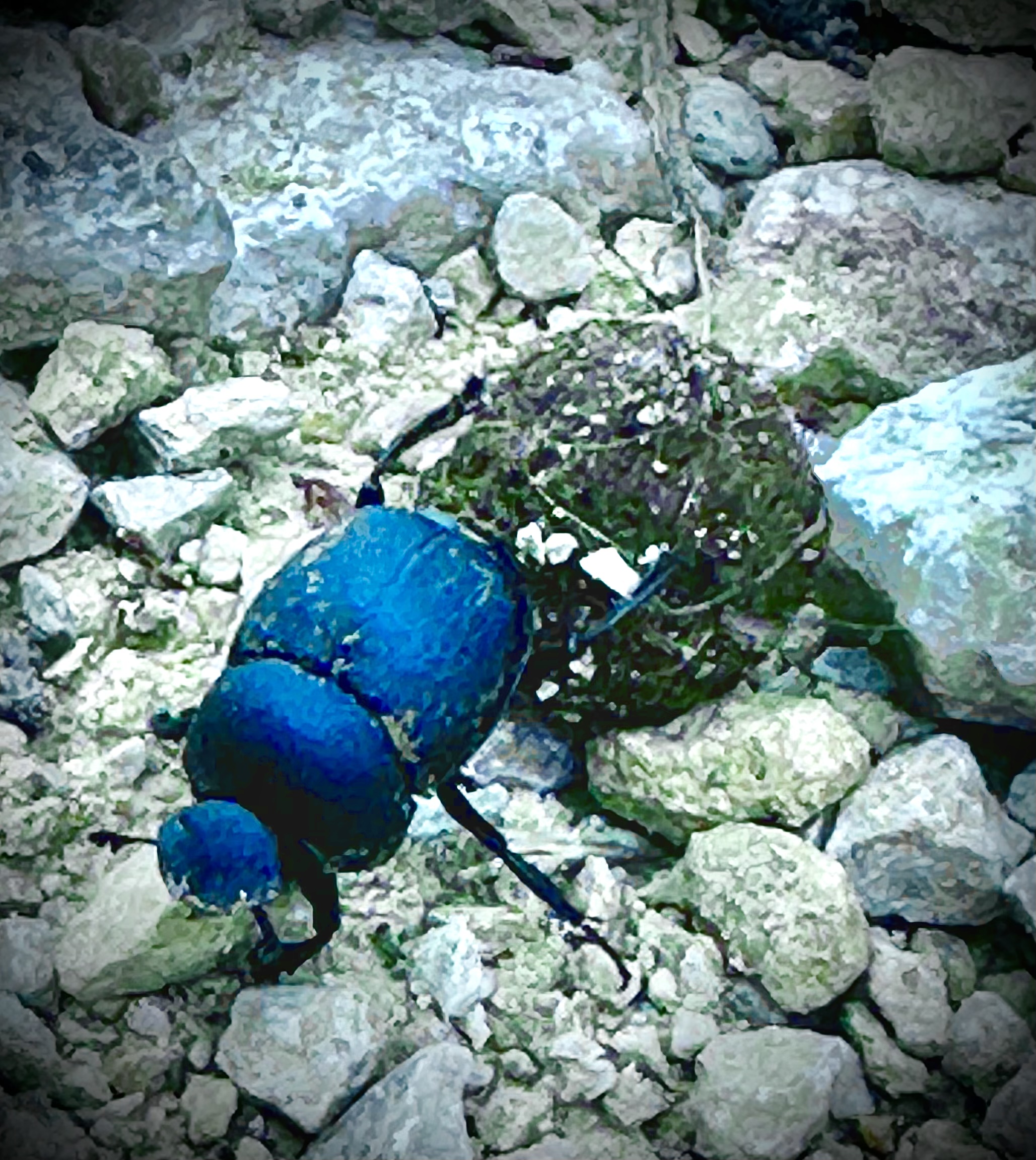
Fig.6 (1 min) A dung beetle I met on a walk, rolling its entire world across a sloped gravel road — backwards, stumbling, falling, getting up, not quite sure where it’s headed, and doing it anyway. It became a symbol for some aspects of this work: keep pushing the ball, especially when it looks absurd in light of the odds. Yet, there’s an encouraging ancient Aesop story about that beetle. I found a surprising extension for its ancient ending — on the blog. Maybe it can inspire support for a ResearchCity granting hunted researchers asylum.#
§12. Am I naive? Am I deluded? Which fear is trustworthy? (6 min read)#
Maybe I am on the wrong track. I can’t prove otherwise, because no one can prove that about themselves; it’s not the kind of thing with a proof. And mathematical truth isn’t a democracy either: a claim is either true or it isn’t, in math and in Reality — even if everyone else disagrees or no one is yet able to evaluate the claim. We are all limited by our blind spots.
I cannot see what’s currently in my abstract blind spot. By definition. But you likely can — and you can tell me. What I can do is move; that usually helps. Like walking in your shoes for a while, or learning new things or regular resting. So how can anyone decide whether I’m deluded or not?
All I can say is this: I try hard to do the opposite of what deluded persons typically do. I’ve published my “baby” — the Jubilee-math I think I stumbled into — and I’m begging the world to break it. A delusion is a belief kept and guarded no matter what the evidence says. Yet I’m handing you the tools to destroy it. If there’s a systemic delusion buried in here, if there’s a specific error somewhere, show me where and how, and I’ll do my best to understand what you say. I will look for ways to thank you in public, because I want out of my blind spots more than I want to be right. As a scientist I’m used to being wrong in more ways than I can tell. My ambition is to learn more about Reality by making progress with my Real Quests for Real Answers.
I’ve been climbing out of Plato’s cave for decades; every layer of the onion I peel back leaves one less illusion — but I’ve no idea how deep the cave still goes, or which shadows I still mistake for daylight. So don’t trust that I’ve reached the surface. Check the math, and help me peel back the next layer.
And since we’re talking about fear: there are two kinds. Aristotle noticed that most of us are ruled more by fear than by reason, so we need some structure outside ourselves to do right when fear grabs the wheel. The powerful have always known it, and the oldest trick is to keep us afraid in one particular way:
FEAR as Forget Everything And Run.
Panic, scatter, freeze, hand the wheel to whoever sounds most certain; a frightened, forgetful crowd is easy to steer. But there’s a second fear — behind nearly every good thing people have built:
FEAR as Face Everything And Rise.
Same danger, opposite move: not denial, not panic, but looking straight at it and standing up. The difference isn’t courage you’re born with — it’s whether there’s hope of something solid to rise into. That’s what my vision of a ResearchCity is meant to be: a gentle-kind-reasonable place structured to face the hardest challenges together instead of running from them alone.
Aristotle also saw that where the power of the law reaches its natural limits, gentle-kind-reasonableness must take over to avoid disasters. Yet that requires trusting Reality to help with the second FEAR. It works remarkably well — if the Jubilee-math underneath holds as I assume (from experience and inspired by Yas’ example, see §10 above). But don’t take it on faith. Audit it.
Some talk of a big disclosure that is supposed to be happening soon. I can’t tell you what’s flying around out there, how many dimensions exist, or what’s behind this or that alleged deep conspiracy. I may need ResearchCity support, like envisioned, to reliably get to the bottom of some of these (if it’s even possible).
But I don’t need a ResearchCity to firmly conclude the following, if the math core holds:
Any complex world where populations of diversely talented individuals compete for shared resources will sooner or later face the same systemic death-or-life decision challenge posed by the Jubilee math.
Systemic death is driven by the death-trifecta of over-simplifying, over-complicating, and over-reaching — if ruling individuals try to continue the status quo indefinitely by “muddling through”. Thus, some form of systemic death-by-default awaits eventually (deadlock or live-lock for immortals; physical death for mortals).
To avoid such a fate, some form of a Jubilee-based innovation economy is needed for self-stabilizing. This requires that all keep working together to defeat the death-trifecta by taking turns, where the first agree to be last and the last learn to be first, and both keep changing positions each Jubilee, so that the system can self-stabilize without loss of range in its dynamic state-space. That’s the only way to avoid eventual systemic self-destruction — if the core math holds.
Introducing such a Jubilee-based innovation economy is a rare systemic phase transition that requires extraordinary amounts of systemic and visionary planning — to stimulate determined, intelligent, coordinated action when the time is right. The goal must be the introduction of some transparent global coordination hub that lives by the Jubilee-algorithms (like the ResearchCity proposed), is supported by all (through the $8/year proposed), and bound by fiduciary responsibility to gentle-kind-reasonably serve the common interests of all over the long term. This hub must thereby maximize innovation to better serve everyone by supporting everyone’s role in preparing for the next Great Jubilee Race, where different organizational forms compete to best facilitate the overall Jubilee goal of providing the best starting conditions for the next round of innovation (to prepare the next Jubilee). AuditTheMath is about first testing, then scaling up such a ResearchCity.
Given how hard this death-trifecta is to constrain and how much suffering it has caused, the disclosure of Jubilee-math to overcome it is far more momentous — in my view — than disclosure of sordid details of how yet another person or organization was corrupted by that death-trifecta. Some say the disclosure of first contact with more advanced, so far unknown civilizations would be the biggest discovery of our time, or possibly ever. I disagree. What good would it do “us” or “them” if, for lack of established Jubilee-protocols, either gets infected by the mind-virus of coveting and then destroyed by the same death-trifecta that is destroying humanity already?
That the self-destructive processes of the death-trifecta can be scaled up or down, to run faster or slower, is obvious to me as a systems modeler. What wasn’t obvious before was whether there would be any way to stop such self-destruction at all. The Jubilee-math — if it holds — shows a reliable way out of that dilemma.
So, to me, disclosing reliable Jubilee-math outweighs disclosure of one more harrowing corruption scandal (following the established playbooks), or learning at last who else may zip through the skies and yet-unknown dimensions.
By comparison, my own scandal — not having cared enough to pursue this research sooner, despite having much, most, or all of the core data available to me for years or decades — that weighs heavier, in my mind, than all the scandals of the blind leading the blind. That is, if the core math holds.
Now you know what I have to disclose. Now you get to respond. Therefore, #AuditTheMath.
§13. How to buy in — and become an #AuditTheMath Backer (2 min)#
If you’ve read enough — here or elsewhere — to say: “Yes, I’ll buy into #AuditTheMath to help avert accidental nuclear winter,” here’s how to size your buy-in. People matter more than money, so you decide. Giving $1 is you saying “this matters now” and I’d like to see more.
0. Audit for free. You never have to pay to help. Ten minutes of fresh eyes, or a lifetime of expertise — every level of review is welcome, from deep expert audits to first-impression usability notes, all to make ResearchCity more reliable and more relatable. Don’t trust me; check me. (I’m also one person near the limit of what I can do alone — so please be patient with my updates as this scales up.)
1. Your minimum. ~$1 is the practical floor: GoFundMe’s fee is 2.9% + $0.30 per buy-in, so below ~$1 little is left. Ideal if money is tight but you still want your voice counted now — come back for more when things improve.
2. A suggested middle. ~$8 — one year of one “stadion” (it’s also the ~$8-per-year-per-person limit for any one research talent stadion; ResearchCity envisions 1,600 of them). Support as many stadia as you like for the year — but don’t overstretch yourself.
3. Your maximum. If you feel the urgency and importance — e.g. to carry #AuditTheMath through its fragile Stage-0 startup or for any reason that still leaves you happy and free of any manipulation — give more: support more stadia, or become an All-Stadia Backer. You might cover the ~7 years ResearchCity arguably should already have run, or buy in on behalf of the ~7-in-8 people who have no credit card (many of them the children whose future this most concerns).
4. The cap. The most any one person may give for the 2026 startup is $8/stadion × 1,600 stadia × 7 years × 8 (yourself + 7 you sponsor) = $716,800. Until the platform tracks this automatically, please keep your own running total (see the All-Stadia page) so you stay under your limit. Want to do still more? Help in ways that aren’t money — so the cap’s anti-“influence-shopping” protection stays intact for everyone.
5. Give — via GoFundMe’s Donate button.
6. Tell one or two people who might care — because people matter more than money.
Thank you for considering this, and for facing hard challenges in our complicated world. That, already, is a kind contribution. A gentle, kind, reasonable world has to grow from somewhere.
— Laurence Loewe of Laodicea (LLoL)