ResearchCity#
Epiocracy — the previous page — is the rule of gentle kind reasonable decision-making over the long term. A principle, though, needs a body that can actually do that life-giving decision-making, at scale, for everyone, without being captured by special interests. That body is a ResearchCity: a research institution dedicated to gentle kind reasonably serving the common good of all people over the long term, funded by a recommended but voluntary buy in of about ~$8 per person per year (for Select Stadia Backers) and up to a maximum of about $8 per person per year per stadion for All Stadia Backers (who by definition support all 1600 research stadia with at least $1).
These funds are required to ensure that Fiduciaries Sharing Futures (FiShFus) can efficiently focus on their respective work toward nurturing and guarding the common goods for everyone that they happen to work on - without the need to worry about eviction or starvation due to lack of funding.
See also
External application (since 2026-07-06): the AI Safety Wager — an open proposal invites the Vatican, Anthropic, the UN, all the world’s governments and everyone to constructively review the math underpinning a ResearchCity in order to prevent it from self-corrupting over the long term.
There is much to be discussed about how to legally organize such a ResearchCity in today’s world. Such questions will fill a whole research stadion (STb11-LCC), tasked with evolving reliable standards for a Limited Liability Charitable Company. It’s currently envisioned as a US-based LLC (Limited Liability Company), albeit with the self-imposed constraint to keep integrating and evolving reliable standards for allowing it to escape from the legal traps that Joel Bakan describes in his brilliant critique of why so many corporations are legally forced to behave badly.
This page sketches the two obvious aspects of the design, each developed by their respective research stadia in order to serve all other research stadia as well:
Hardware: where and how ResearchCity is built (to become stadion STb13-RCH).
Software: code it uses and how information flows through it (stadion STb14-RCS).
Why these mockup model blueprints can work — if “I know not even nothing” wins over blind assumptions
There are almost certainly dozens or more ways to build a ResearchCity correctly, and LLoL’s specific proposals below may well not be the right ones. This contrasts with at least millions to billions more of non-obvious ways to fail, all of which look like good ideas at first. So, how can a mega project succeed in face of such challenges?
By evolving in clearly defined stages. 7 effective scale-up stages to be precise. And to make these effective, there must be a flexible 0-stage for preparing the way for setting up the 7 effective scale-up stages. Thus 7 scale-up Stages, prepared by a flexible Stage 0, which does not count as one of the 7, because it defines the platform from which the 7 are counted.
What gives LLoL the confidence that this can work are not the particular mockup drafts presented here as potential blueprint overviews. Rather it’s the methodology for taking these seed ideas and evolving them formally by throwing the full power of all fundamental evolutionary factors in the book at the problem. This builds on LLoL’s professional experience as an evolutionary geneticist and follows the Zoning Investigating Organizing Navigating sequence of the ZION algorithms in order to help keep all these many activities synchronized.
Therefore, LLoL confidently expects that the same Reality that carried this work this far — through near-endless, re-crushing review in real quests to real answers— will get it right in the end. The point is to rely on everyone’s expertise through wide interdisciplinary diversity-encouraging (“wid-e”) research, a research methodology that helps to transcend traditional disciplinary walls.
The underpinning assumption is LLoL’s personal maxim that “I know not even nothing” — which is exactly why he has to listen, and keep learning how to listen. That can be challenging in such projects, because (as someone once put it) there always comes the point at which you have to “shoot the designers” who constantly want to improve. ResearchCity can only succeed if it finds a way to avoid such Molochian acts of intellectual brutality. Thus the core challenge of ResearchCity’s work is to implement a way for moving forward that does not “shoot the designers”, but instead uses the ZION algorithms for mapping out where each type of contributor can excel best. And for deciding for the common good, which designs to prioritize first and which to refine later. Without forgetting Historically Experienced Lessons Learned as documented in ResearchCity’s HELL, which is essential for breaking the stranglehold of the BABL algorithm.
ResearchCity hardware#
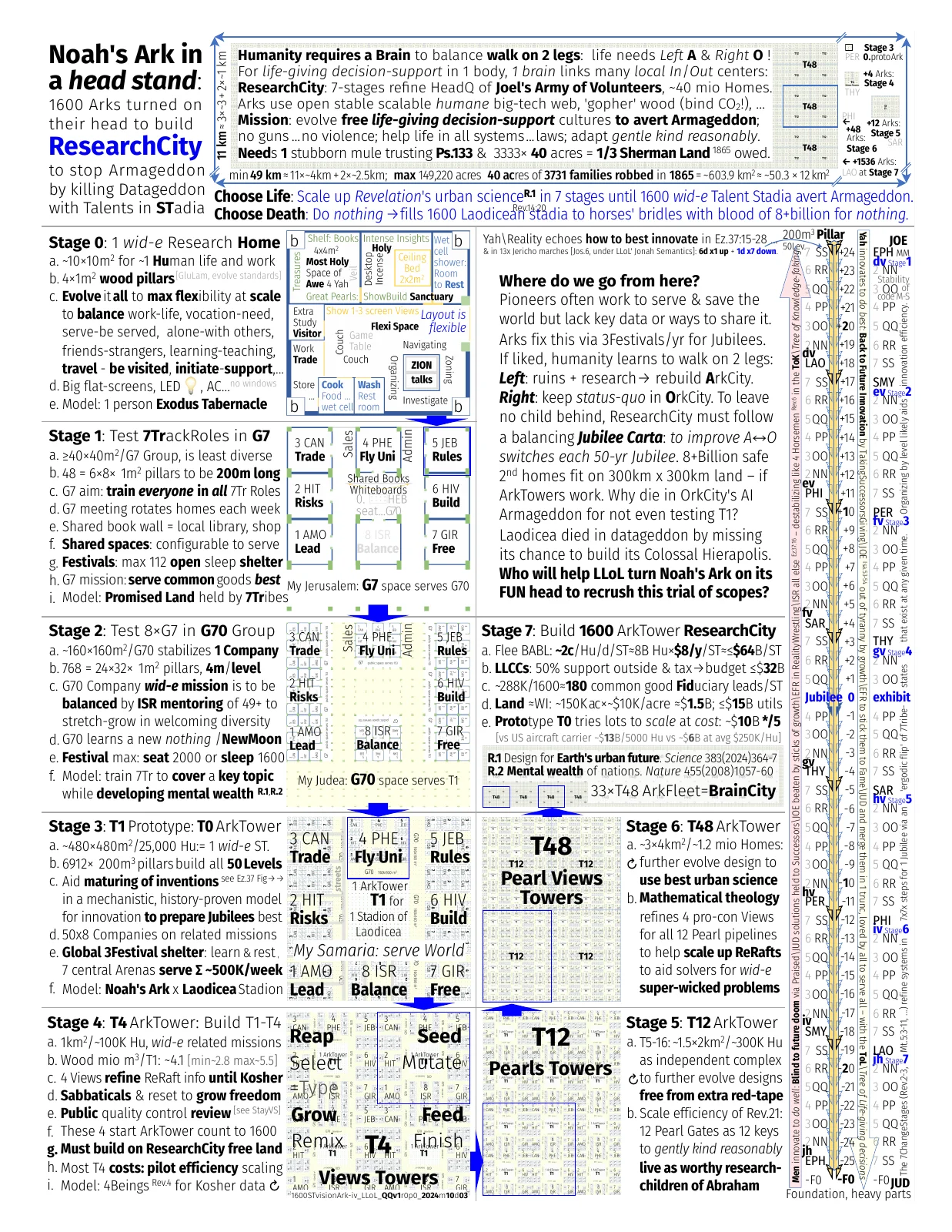
Supporting Document SD8a — Mockup model overview of the physical vision of ResearchCity (see the humility note above and need for iterative design refinement defined below).
The physical vision (SD8a) grows from a single ~10×10 m research home (the poster’s “Stage 0”, which is the first step of the preparation described below as the phases of Stage 0) through 7 built scale-up Stages all the way up to a city of about 1600 timber “ArkTowers”. Each ArkTower can be thought of as like Noah’s Ark turned on its head and stacked together with others like it often enough to provide all the integrated research and living space required for everyone working in that stadion’s research area. ArkTowers are built in glue-laminated timber (GluLam) rather than steel or concrete. Each Stage is sized and named so the structure can grow as an institution in defined ways.
More details are described in OL5b — LLoL’s detailed letter to the UN (its pages 13–14 introduce ResearchCity as a global Ministry of Nothing for serving everyone and explain why it matters).
Once ResearchCity has scaled up to all its 1600 Talent Stadia to be fully operational, it can then switch over to helping the rest of the world to do the same in order to introduce self-stabilization into all global and local innovation economies. Such self-stabilization must be based on a concept defined as “social ergodicity” in the Matheo Study Series (see e.g. the theorem’s statement). Put in simple terms, social ergodicity ensures that the last will be the first and the first will be the last whenever one Jubilee-era switches over to the next, so that then again the first and last keep swapping. How precisely to implement that in a way that works best for everyone is precisely the grand research challenge that ResearchCity must continue to engage in. Because a Jubilee-algorithm that does not include the best self-improvement it can achieve is by definition destined to fail.
Machines need regular maintenance.
Democracies need secret, free elections.
Innovation economies need self-improving Jubilees.
And to ensure that proper Jubilees remain self-improving, ResearchCity and all its researchers must commit to stay on their respective hero journeys in order to become better Fiduciaries Sharing Futures for the benefit of all.
To solve a hard optimization problem, it is essential to recognize that not everything can be made optimal for everyone at the same time. Hence, to ensure that everyone can succeed, ResearchCity plagiarizes the idea of how humans walk or run long distances on two legs: first put one leg forward, then the other, then keep alternating, while the brain keeps overall balance.
The social ergodicity embedded in the Jubilee System is a way for coordinating such organizational “walking” for humanity, but it needs a “brain” to coordinate. ResearchCity is meant to be that coordinating brain.
It is anticipated that about half of the global transition time will be required for properly scaling up ResearchCity to establish its self-stabilizing innovation rhythms by integrating the best humanity has learned so far for benefitting everyone.
Once that has been done properly, the other half of the time will be dedicated to getting everyone else up to speed for how to work with the innovations that ResearchCity has been pioneering. After such a short-course in innovation for everyone, the regular 50-year rhythms for proper Jubilee innovation can take over, because only then will it be sufficiently clear to everyone how the Jubilee System works.
Such a global mega-transition raises the question of how to get from here to there — without getting lost in the process.
How to get there: Stage 0, then 7 scale-up Stages#
Note
Single source. This page currently defines ResearchCity’s Stage 0 (and its sub-phases) as well as ResearchCity’s 7 scale-up Stages and their timing. Other pages merely restate for convenience and link here (or ought to). Aspects of funding are explained on the buy-in pages.
The scale-up has two dimensions — scale-up Stages (in time) and Stadia (in space). If the scale up works properly, then both grow together.
Scale-up Stages are in time and space. ResearchCity grows through 7 scale-up Stages, prepared by a Stage 0 that does not count as one of the 7, because it defines the platform from which the 7 are counted. Each scale-up Stage must complete a full innovation cycle with all 7 Change Stages functionally operational (see e7Ch). The two kinds of stage are easy to confuse: scale-up Stages are the steps by which ResearchCity grows, whereas the 7 Change Stages (e7Ch) are the steps every innovation passes through. Each scale-up Stage runs through all 7 Change Stages, and the scale-up Stages mirror important properties of the Change Stages. Only then can the key designs become sufficiently refined to become foundational for the next stage. The whole sequence is designed to work like a training program for getting a self-stabilising innovation engine running. The first goal is to scale itself up for efficiently and effectively serving the rest of the world, before such external work can actually start efficiently. Without such scaling up it will be impossible to appropriately guard and nurture the manifold delicate balances of the real world. The physical, spatial side of each temporal Stage is what the hardware figure (“SD8a”) above sketches.
Stage 0: the initial preparation. Before the scale-up proper can start, there is a Stage 0, meant as a ground zero in reverse: not the point where one blast sets off a chain reaction of destruction, but the point where one working example sets off a chain reaction of innovation, the way a single seed crystal gets a whole supersaturated solution to crystallize. Stage 0 is the preparation. It turns a unifying vision into work that others can understand, check and carry, in four steps:
one person envisions a model deemed credible and workable enough to dare propose it;
a small team who know the work well enough to say why it deserves a real try;
a pilot group of about 150 experts, reviewers, explainers and administrators;
a global discussion for deciding on whether humanity wants to give ResearchCity the mandate it needs to have a chance to succeed in the real world.
These steps may overlap. Step (a.) is mostly or entirely the work LLoL has done by himself so far, and it overlaps with (b.), the recruiting of a small team, which is under way. Steps (c.) and (d.) can also overlap. Whether a separate prototype is needed for testing before Stage 1 starts (for example a mock-up research home) is likely for the pilot group to decide as it prepares Stage 1. A draft proposal for the pilot group’s positions exists: 153 FiShFus job positions.
The pilot group reviews the architecture across its many fields, makes that review transparent, and prepares the ground for Stage 1, the first integrated seven-role unit that every later stage builds on. Members of the pilot group may join Stage 1 or stay in supporting roles at Stage 0 to keep defining, supporting and monitoring Stage 1. Anyone may join or leave the pilot group as needed. In contrast, the later scale-up Stages run in dedicated cycles that depend on members committing for a full cycle. How long Stage 0 lasts is open: Phase (a.) has been going on for long enough for LLoL to emerge with a corresponding vision that he deems worth presenting in the hope of succeeding at (b.). How long it will take to put that proposal on the global discussion agenda for evaluating and deciding is hard to predict, except that in today’s 24/7 news cycles with the many open existential questions under discussion, it seems easy to predict that any credible and workable proposal to solve them will either go nowhere by staying very limited (by not being taken seriously), or — once people realize that this is an actual proposal worth considering — a global discussion of ResearchCity can become front-page news almost overnight.
At the global discussion stage, to reach a global decision it may take about forty days, as in the Jonah story, if the world really wakes up to the threats it faces; maybe a few days or weeks longer, at most months to deal with serious complications. However, if it takes much longer to decide - or if Stage 0 never reaches its global discussion stage - then this Stage 0 was built on the wrong zero. In that case someone else will have to lay a better foundation for the required ground zero.
At very worst the global Stage 0 never ends, because no one ever finds the right vision to get this work off the ground. Then accidental nuclear winter wins and the world is zeroed out. Hence the importance of the current buy-ins for funding Stage 0 phases (b. and c.), which are designed to test whether LLoL’s discoveries in his phase (a.) are indeed as mathematically reliable as appears to be the case so far. The current buy-ins fund Stage 0; at most they may also fund scale-up Stages 1 and 2. More likely, a working Stage 0 will set up its own buy-in platform before or during Stage 1.
Scale-up Stages 1 to 7: one change cycle each. From Stage 1 onward, each stage is one compressed change cycle (see e7Ch). After a set-up month come six effective months of evolving and testing the work, one for each of the first six change stages. A seventh month belongs to the last change stage (LAO): the wrap-up, in which the best solution already worked out is selected and locked in, and whatever was ignored is documented for a future cycle. Taking down or moving may add a little more. Anyone joining a Stage commits for the whole cycle, so that the stage can be properly evaluated; personal hardship is an exception, but leaving by preference waits for the break between stages. Stage 1 may run several seven-role setups in parallel, to test different ways of implementing the seven-role training that every later stage will need to build on.
These seven compressed cycles are also ResearchCity’s warm-up for the Jubilee rhythm: each year of a full cycle is compressed into one effective month. They lead to a first big Jubilee, which ResearchCity is meant to pioneer. After that, the cycles can likely be synchronized to annual rhythms: seven cycles of seven years (49 years), then a Jubilee year for everyone — the 50-year rhythm (see Jubilees). However, such a long-term hope seems misplaced if it is not possible to take a dedicated ResearchCity through an innovation crash-course, where 1 month models 1 year. Given that there is a plethora of innovations that have never been properly integrated, that appears doable. ResearchCity only needs to integrate what others have already discovered. In a full-scale Jubilee cycle the respective innovations are those that are made in real time in preparation for the next contractually agreed 50-year Jubilee.
Two halves: scaling up ResearchCity, then explaining it to the rest of the world#
Time frame. Escaping the risk of accidental nuclear war requires two halves and a global long-term commitment to keep improving Jubilees as defined in a Jubilee Carta.
In the first of the two halves, ResearchCity scales itself up through its 7 Stages, which takes about five years after the official start (7 Stages of about 7–9 calendar months each, to enable 6 effective innovation months per Stage).
The second half has about the same length (it may also run in 7 scale-up Stages, but that is much less certain). There ResearchCity stops growing and works at full capacity to help everyone else make the transition, explaining the whole process in ways the rest of the world can connect to.
Between the two halves there may be a time gap to prepare ResearchCity for the necessary change of direction, from inward to outward. There is no second chance for a first introduction, and most people decide on their first impression. Therefore, ResearchCity must prepare appropriate materials for helping the rest of the world to learn the rhythms required for innovation economies to become self-stabilizing.
Scaling up ResearchCity will require pioneering ways for how to teach the same rhythms to AI, not least in order to help solve humanity’s AI Dilemma. Assuming that this will be successful, AI can help with preparing respective training materials much faster than if this had to be done manually. However, it would be surprising if that re-orientation phase from scaling up itself to focussing on external work could essentially be compressed into an instant. At the other extreme, that time-gap cannot become a bungee cord that stretches forever. For now it remains difficult to predict how long that transition may take; one year may be realistic; but if complications show up, it may take up to 3.5 years at the very upper limit, so that the whole stays within 14 years (at most about 5.25 + 3.5 + 5.25). Note that ResearchCity must remain committed to maximizing transparency and to transition efficiently. Therefore, it will be easy to check what is going on. The moment ResearchCity abandons its imperative to maximize transparency, that is the moment it will have failed.
Summary. The whole process is estimated to take at the very minimum 7 effective years. These define the minimum of 7 calendar years. The maximum is 14 calendar years, and that limit applies to the total. LLoL’s current best evaluated estimate for the overall calendar years for both halves and the transition between them is somewhere between 9 and 11 calendar years. Needless to say, these most likely estimates are subject to refinement as the scale-up process unfolds. However, it is difficult to see how the overall project can remain successful unless it remains within the time-box defined by 7 - 14 calendar years, counted from the official end of Stage 0 and the start of Stage 1.
Here 7 years are a floor, not a target to beat. Trying to go faster than 7 calendar years, or faster than 7 effective years of work, will most likely break the process, because each Stage has to reach functional completion for the whole to keep its integrity. Crushing 1 year’s worth of innovation integration into 1 month is already operating close to warp speed. Hence, any further time cuts will likely cause irreparable harm.
Yet, once the functional requirements are met, shorter is better, because ResearchCity has no time to waste: 11 years beats 14, and 9 beats 11. It will take as long as it takes to reach innovation maturity, racing as fast and as well as it can. Innovators and innovation reviewers have developed sufficient experience with recognizing innovation maturity to be able to tell whether a certain body of work has reached that goal.
The range is hedged on purpose, because large projects meet many unknowns; but a plan that cannot be held to defined limits is not a plan any person or government could or should support.
Stadia, size, and a global mandate#
Stadia are in space. Independently of the Stages, ResearchCity is organised into localized research Stadia by topic to ensure efficiency of information integration. Currently there are 16 Stadia that have been defined to begin with (one for each topic area that is deemed essential for ensuring an overall balanced scale-up).
In the early stages these live conceptually or wherever there is room, maybe carried by only a few people each. As the scale-up Stages proceed, these 16 will be the first Stadia to grow before additional ones are defined while growing toward the full 1600 co-located stadia that define all of ResearchCity as envisioned to help avert Earth’s self-organizing disasters. Because the topics of Stadia are research problems that exist independently from whether related work has been organized in respective Stadia, work on a Stadion’s topics can begin long before the Stage that will give it its own dedicated ArkTowers. In fact, much of the research required for scaling up ResearchCity has already been done or is being done under difficult circumstances that would benefit from improvement. This realization was instrumental in encouraging LLoL to trust that this vision for scaling up a ResearchCity is actually workable.
Size. In number of researchers, Stage 3 is roughly comparable to the US National Institutes of Health. That size is reachable only if Stages 1 and 2 successfully test the innovation algorithms for how to gentle kind reasonably organize researchers in ways that are reliably efficient for wide interdisciplinary diversity-encouraging (“wid-e”) research.
Reaching such a scale that fast also relies on a global audience of engaged people of good will to closely follow the scale-up Stages from the start. Stages 1 and 2 (as well as all later Stages) are open for everyone to follow in as much detail as anyone wants, including through dedicated reality-TV channels to be set up (with at least one stadion dedicated to make that happen).
A ResearchCity at world scale cannot be willed into being by one person. It needs a global mandate like a UN mandate that people worldwide will actually trust. One explicit goal of #AuditTheMath is to earn exactly that mandate — if, and only if, the math proves as reliable as LLoL has come to trust. A detailed description of the case for UN support is in LLoL’s detailed letter to the UN Secretary-General: it invokes UN Charter Articles §99 and §100, lays out concrete milestones (authentication → endorsement → a public “Flying Scroll” → a call to the ten “Nuclear Kings” to help ensure transparency).
It frames the choice between a stick to avoid and a carrot to get. The stick is the destruction that the doctrine of Mutually Assured Destruction predictably delivers sooner or later if humanity decides to refuse the carrot of following a tested path forward to establishing a sustainable global innovation economy that is gentle kind reasonable for all.
ResearchCity is designed to effectively become a “Ministry of Nothing”: it takes on the threats that are nobody’s job so far or that effectively fall between the cracks of established national, departmental, or disciplinary responsibilities. A prime example for such a neglected responsibility is estimating how long we can expect to wait until an accidental nuclear war obliterates the civilizations humanity has built. Such a disaster works by definition in the gaps between existing institutions. Once ResearchCity has identified a problem and a solution, it hands what it finds to whoever is best placed to gentle kind reasonably solve the problem for the benefit of everyone. It is carried by many small backers, and every buy-in is capped so that no one can buy influence; but a cap is only the first step. ResearchCity needs a robust, mathematically provable way to avert influence-shopping. (See pages 13–14 in the detailed letter to the UN (“OL5b”) for more about the Ministry of Nothing.)
The software vision#
LLoL’s information design comes with the same humility as the hardware above. It leverages LLoL’s decades of experience in modeling, evolutionary genetics, computational research, and globally distributed computing (see LLoL’s CV).
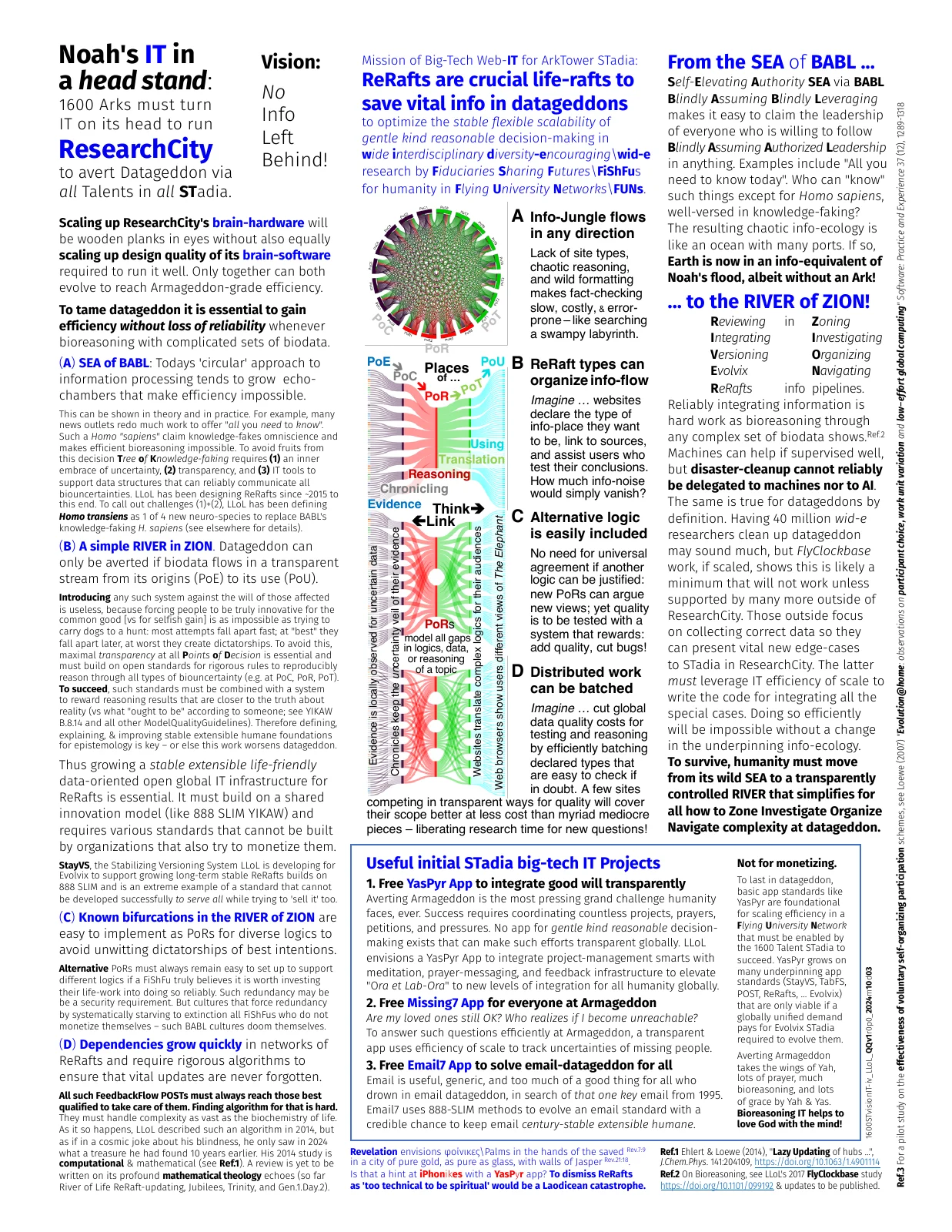
Supporting Document SD8b — Mockup model overview of the information-flow vision for ResearchCity (see the humility note above and the need for iterative design refinement for defining the algorithmic strategy that may be summarized as from the SEA of BABL to the RIVER of ZION).
The information vision (SD8b) moves the world “from the confusing SEA of BABL to the clarifying RIVER of ZION.” Today’s circular information ecology — the SEA of Self-Elevating Authorities — grows echo chambers and data deserts where knowledge-faking drowns out genuine insight. The fix is a transparent RIVER: a pipeline that carries data from its Point of Evidence to its Point of Use (collection → reasoning and adversarial testing → translating → use), with diverse Points of Reasoning included by design, so no single view can quietly dominate where Reality actually supports different perspectives. These pipelines support building ReRafts which are defined as life-rafts to save vital info from getting lost in “datageddons”.
By tightly integrating the above hardware and software together ResearchCity can pioneer an epiocracy, which is defined as the long-term rule of the trifecta of gentle kind reasonableness.
Only then - in LLoL’s best evaluated estimate - will it be possible to actually implement a proper Jubilee as defined by the Jubilee System. As far as LLoL is aware, there is no other credible way to actually dismantle humanity’s 7DUIs, which is essential for achieving true sustainability.
Surprisingly, this would serve the UN’s Sustainable Development Goals and Leviticus 25 at the same time.