
Evolvix Vision — Simplicity: Flipped Language Design (Detail)#
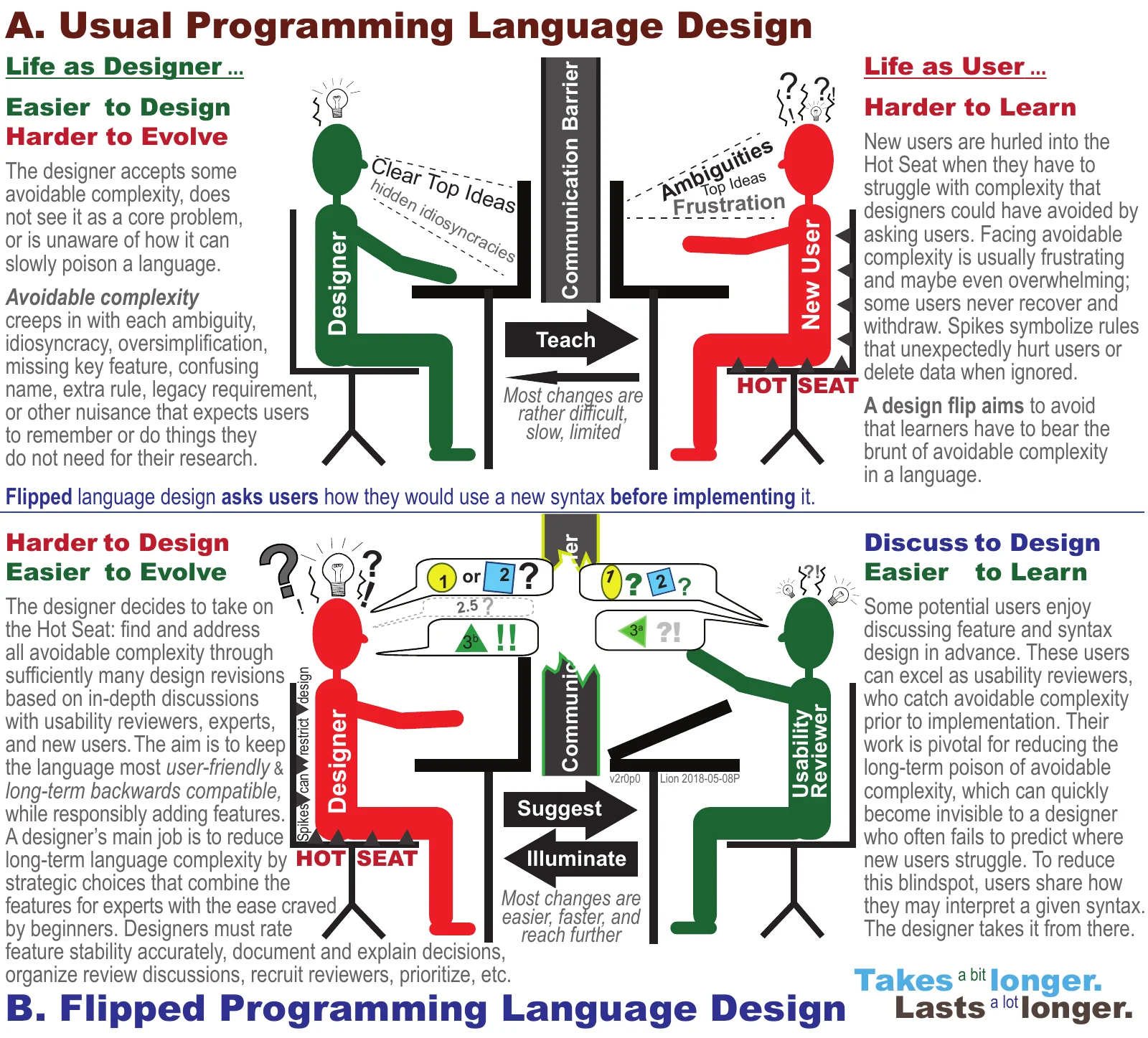
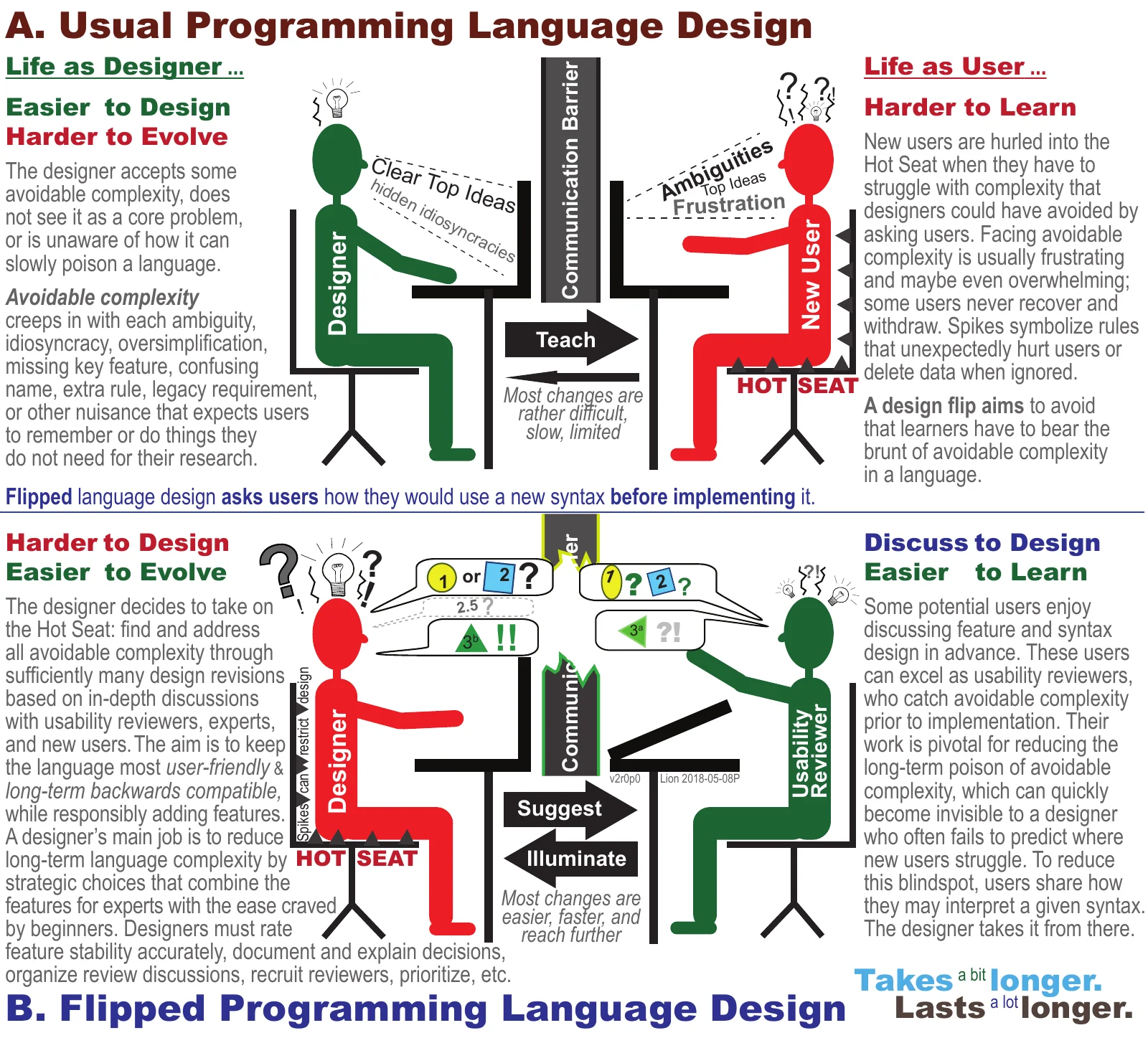
Detailed Design Flip diagram with full explanatory text — covering avoidable complexity, usability reviewers, and communication barriers for each quadrant.
Download the original document (PDF)
Simplicity Flipped Language Design (Detail) — PDF (212 KB) — 1 page, Jonah License with CC0 Public Domain
Filename: evx-vision-simplicity-flipped-lang-design-iv_llol_qqv2_2018m05d08-fig-detail.pdf
Also in this folder: Flipped Design (Brief), Flipped Language Design Flyer
— Overview AI-generated by dv_ClaOp46Max_ExhH_2026m04d16 —Start—
Abstract#
This single-page figure is the detailed version of the Design Flip diagram, sharing the same two-panel structure as the brief version but adding full explanatory paragraphs for each quadrant.
Panel A — Usual design: Explains how users are forced to accept avoidable complexity (because the designer did not remove it) and then suffer from it (workarounds, bugs, tribal knowledge). The HOT SEAT is on the user side. Text describes the communication barriers that prevent users from reporting avoidable complexity back to designers.
Panel B — Flipped design: Explains how designers must fight avoidable complexity (through deliberate simplification) and detect it (through usability reviewers and systematic feedback). The HOT SEAT is on the designer side. Text describes the role of usability reviewers as essential intermediaries who help the designer identify complexity that slipped through.
The detailed version makes explicit what the brief version implies: the flip is not just about attitude but about processes — specifically, embedding usability review and feedback loops into the design workflow so that avoidable complexity is caught and removed before it reaches users.
Key Concepts at a Glance#
Avoidable complexity (detailed) |
Complexity that persists not because it is inherent but because the designer did not invest the effort to remove it |
Usability reviewers |
Intermediaries who test the language from the user’s perspective, catching complexity the designer cannot see |
Communication barriers |
In Panel A, barriers prevent users from reporting problems; in Panel B, barriers are systematically reduced |
Process vs attitude |
The flip requires not just intent but embedded processes: review loops, feedback channels, systematic testing |
Broader Significance (Claude’s Assessment)#
The detailed version adds substantial value over the brief by making the mechanism of the flip explicit. The brief version says “flip the HOT SEAT”; the detailed version says “here is how: usability reviewers, feedback loops, communication barrier reduction.” This moves the Design Flip from a philosophical principle to a practical methodology. The emphasis on communication barriers is particularly important — many language designers genuinely want user feedback but have not built the channels for it. The pair of brief and detail versions together demonstrates a key Evolvix principle: the same idea must be available at multiple levels of detail for different audiences.
Document Information#
Document ID |
EVX Simplicity — Flipped Design Detail (Flying Scroll, transwarpkey/sta1-evx/) |
Author |
Laurence Loewe of Laodicea (LLoL) |
Date |
2018m05d08 |
Version |
iv_LLoL_QQv2_2018m05d08 |
Format |
Single-page figure (detailed) |
License |
|
Part of |
Good News Pack MMv3, Flying Scroll / Transwarp Key / STa1-EVX |
PDF size |
212 KB |
WebP size |
312 KB |
Related documents:
STa1-EVX stadium overview (parent page with all 30 documents)
Simplicity — Flipped Design (Brief) (same diagram without explanatory text)
Flipped Language Design Flyer (6-column flyer embedding the Design Flip in full Evolvix context)
Simplicity in Lasting Standards (philosophical foundation)
OneBrain Rule (the architect’s role in the flipped design approach)
— Overview AI-generated by dv_ClaOp46Max_ExhH_2026m04d16 —End—