
Evolvix Vision — OneBrain Rule: 12 Needs & 1 Architect#
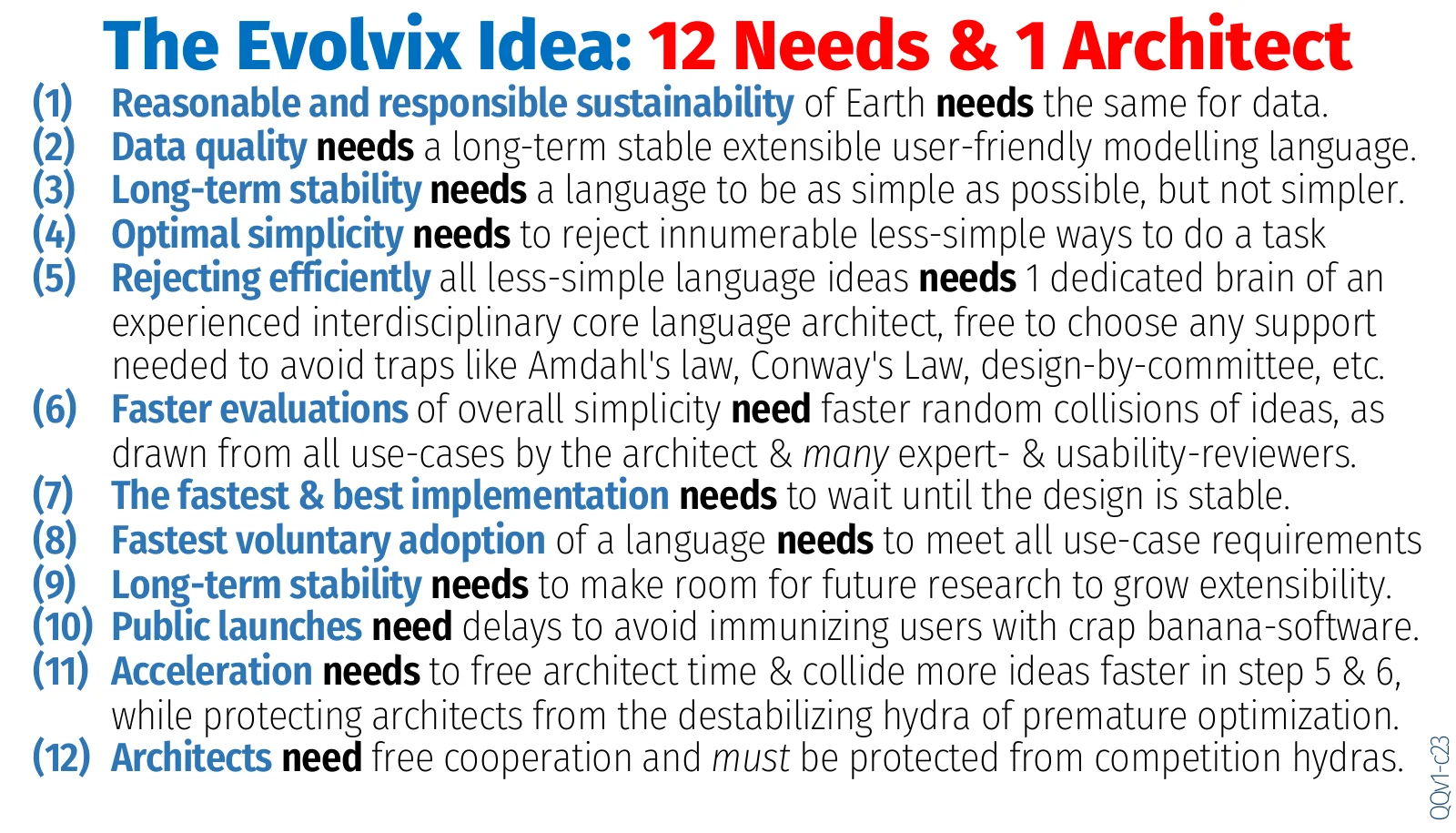
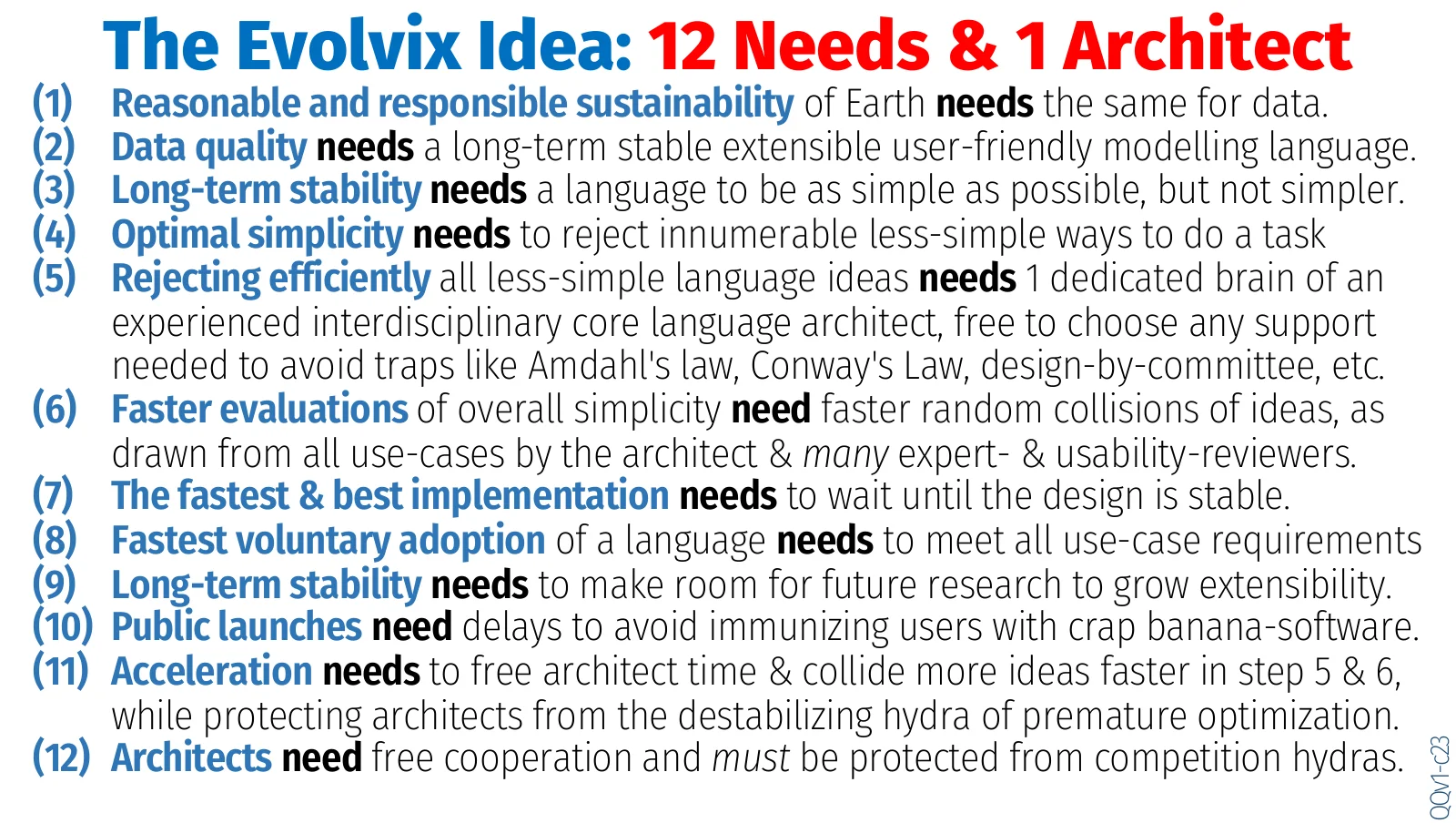
“The Evolvix Idea” — 12 numbered requirements tracing a dependency chain from sustainability through simplicity to the need for 1 dedicated architect brain free to cooperate.
Download the original document (PDF)
OneBrain Rule Stabilizing — PDF (60 KB) — 1 page, Jonah License with CC0 Public Domain
Filename: evx-vision-simplicity-onebrain-rule-stabilizing-iv_llol_qqv1r5p8_2019m03d25-card.pdf
Also in this folder: Simplicity — Flipped Design (Brief), Simplicity in Lasting Standards
— Overview AI-generated by dv_ClaOp46Max_ExhH_2026m04d16 —Start—
Abstract#
This single-page card titled “The Evolvix Idea: 12 Needs & 1 Architect” presents a dependency chain of 12 numbered requirements that trace the logic from the highest-level goal (sustainability) down to the practical prerequisite (a free architect):
Sustainability needs data sustainability
Data quality needs a stable language
Stability needs simplicity
Simplicity needs rejection of alternatives
Efficient rejection needs 1 dedicated architect brain
Faster evaluation needs idea collisions with reviewers
Best implementation waits for stable design
Adoption needs meeting use-cases
Stability needs extensibility room
Launches need delays to avoid “banana-software”
Acceleration needs freeing architect time
Architects need free cooperation, protection from competition hydras
Each requirement depends on the one before it, forming a single logical chain from purpose (sustainability) to precondition (a protected architect who can cooperate freely). The “banana-software” reference (point 10) alludes to the German idiom for software that “ripens at the customer’s site” — shipped before it is ready. The “competition hydras” in point 12 refers to environments where each solved problem generates multiple new competitive threats.
Key Concepts at a Glance#
12-step dependency chain |
Each requirement depends on the one before it: sustainability → data quality → stability → simplicity → … → free architect |
OneBrain rule |
Efficient rejection of alternatives (the key to simplicity) requires 1 dedicated brain that holds the full design context |
Banana-software |
Software shipped before ready, “ripening at the customer’s site” — avoided by deliberate launch delays (point 10) |
Competition hydras |
Environments where solving one competitive threat generates multiple new ones — the architect must be protected from these |
Idea collisions |
Faster evaluation of design alternatives through structured encounters between the architect and diverse reviewers (point 6) |
Broader Significance (Claude’s Assessment)#
This card makes an argument that is counterintuitive in the current technology landscape: that a stable language needs one dedicated architect rather than a committee or open-source community. The 12-step chain is logically coherent — each step follows from the previous one if you accept the premise that long-term stability is the highest priority. The most provocative steps are 5 (one brain for rejection) and 12 (protection from competition). These echo Fred Brooks’ Mythical Man-Month argument about conceptual integrity requiring one mind, but extend it by identifying the economic conditions the architect needs. The “banana-software” warning (point 10) is a practical insight often learned the hard way: premature release destroys the stability that the first 9 points work to build.
Document Information#
Document ID |
EVX OneBrain — 12 Needs & 1 Architect (Flying Scroll, transwarpkey/sta1-evx/) |
Author |
Laurence Loewe of Laodicea (LLoL) |
Date |
2019m03d25 |
Version |
iv_LLoL_QQv1r5p8_2019m03d25 |
Format |
Single-page card |
License |
|
Part of |
Good News Pack MMv3, Flying Scroll / Transwarp Key / STa1-EVX |
PDF size |
60 KB |
WebP size |
216 KB |
Related documents:
STa1-EVX stadium overview (parent page with all 30 documents)
Simplicity — Flipped Design (Brief) (the Design Flip that the OneBrain architect executes)
Simplicity — Flipped Design (Detail) (detailed version of the Design Flip)
Simplicity in Lasting Standards (philosophical foundation for simplicity)
Flipped Language Design Flyer (full Evolvix context including NSF Career Award history)
— Overview AI-generated by dv_ClaOp46Max_ExhH_2026m04d16 —End—