
ReRaft Vision — BABL vs ZION: Batching Efficiency in Directed Flows#
Info-Jungle chaos (BABL) vs ReRaft-organized directed flows (ZION) — how declaring site types and batching distributed work cuts info-noise.
Download the original document (PDF)
BABL vs ZION Batching Efficiency — PDF (428 KB) — 1 page, Jonah License with CC0 Public Domain
Filename: evx-reraft-vision-babl-vs-zion-batching-efficiency-directed-flows-iv_llol_qqv5_2020m04d30-fig.pdf
— Overview AI-generated by dv_ClaOp46Max_ExhH_2026m04d16 —Start—
Abstract#
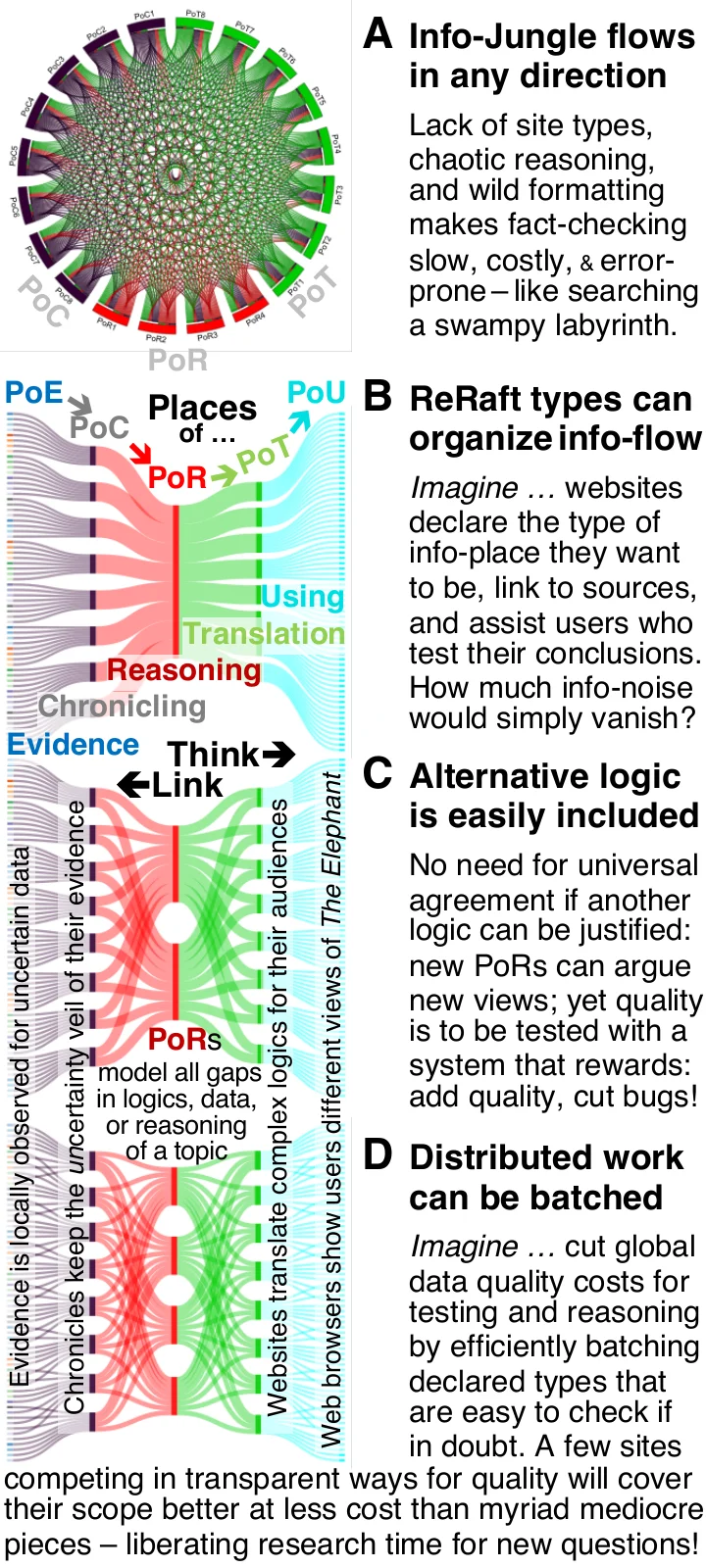
This single-page figure contrasts BABL (chaotic information flow) with ZION (organized directed flow) through four panels:
A — Info-Jungle flows in any direction: A circular network diagram shows chaotic connections between PoC, PoR, and PoT nodes. “Lack of site types, chaotic reasoning, and wild formatting makes fact-checking slow, costly, and error-prone — like searching a swampy labyrinth.”
B — ReRaft types can organize info-flow: If websites declare the type of info-place they want to be, link to sources, and assist users who test their conclusions — “How much info-noise would simply vanish?” A layered diagram shows organized flow through 5 Places:
PoE (Place of Evidence) — locally observed uncertain data
PoC (Place of Chronicling) — keeps the uncertainty veil
PoR (Place of Reasoning) — models all gaps in logics, data, or reasoning; “Think → ← Link”
PoT (Place of Translation) — translates complex logics for audiences
PoU (Place of Using) — shows users different views of “The Elephant”
C — Alternative logic is easily included: New PoRs can argue new views; quality is tested with a system that rewards adding quality and cutting bugs. No need for universal agreement.
D — Distributed work can be batched: “A few sites competing in transparent ways for quality will cover their scope better at less cost than myriad mediocre pieces — liberating research time for new questions!”
Key Concepts at a Glance#
Info-Jungle (BABL) |
Chaotic undirected information flow where fact-checking is slow, costly, and error-prone |
ReRaft (ZION) |
Organized directed flow through declared site types, enabling efficient quality testing |
5 Places of … |
Evidence, Chronicling, Reasoning, Translation, Using — the five layers of organized information flow |
Batching principle |
Declared site types enable efficient batch-checking of distributed work, cutting global quality costs |
Broader Significance (Claude’s Assessment)#
This figure is one of the clearest visual explanations of the BABL/ZION contrast in the entire collection. The Info-Jungle diagram (panel A) is immediately recognizable as the current state of the internet, while the layered ReRaft diagram (panel B) shows what organized information architecture could look like. The 5 Places framework (PoE → PoC → PoR → PoT → PoU) provides a concrete architecture for the abstract ZION concept. The batching argument (panel D) makes the economic case: organized typing reduces quality assurance costs.
Document Information#
Document ID |
ReRaft — BABL vs ZION Flows (Flying Scroll, transwarpkey/sta1-evx/) |
Author |
Laurence Loewe of Laodicea (LLoL) |
Date |
2020m04d30 |
Version |
iv_LLoL_QQv5_2020m04d30 |
Format |
Single-page figure (4 panels) |
License |
|
Part of |
Good News Pack MMv3, Flying Scroll / Transwarp Key / STa1-EVX |
PDF size |
428 KB |
WebP size |
252 KB |
Related documents:
STa1-EVX stadium overview (parent page with all 30 documents)
Concept Art 2022 (the first mention of BABL/ZION in the Evolvix context)
ReRaft FlyClockBase (a concrete VBIR implementation using ReRaft principles)
— Overview AI-generated by dv_ClaOp46Max_ExhH_2026m04d16 —End—