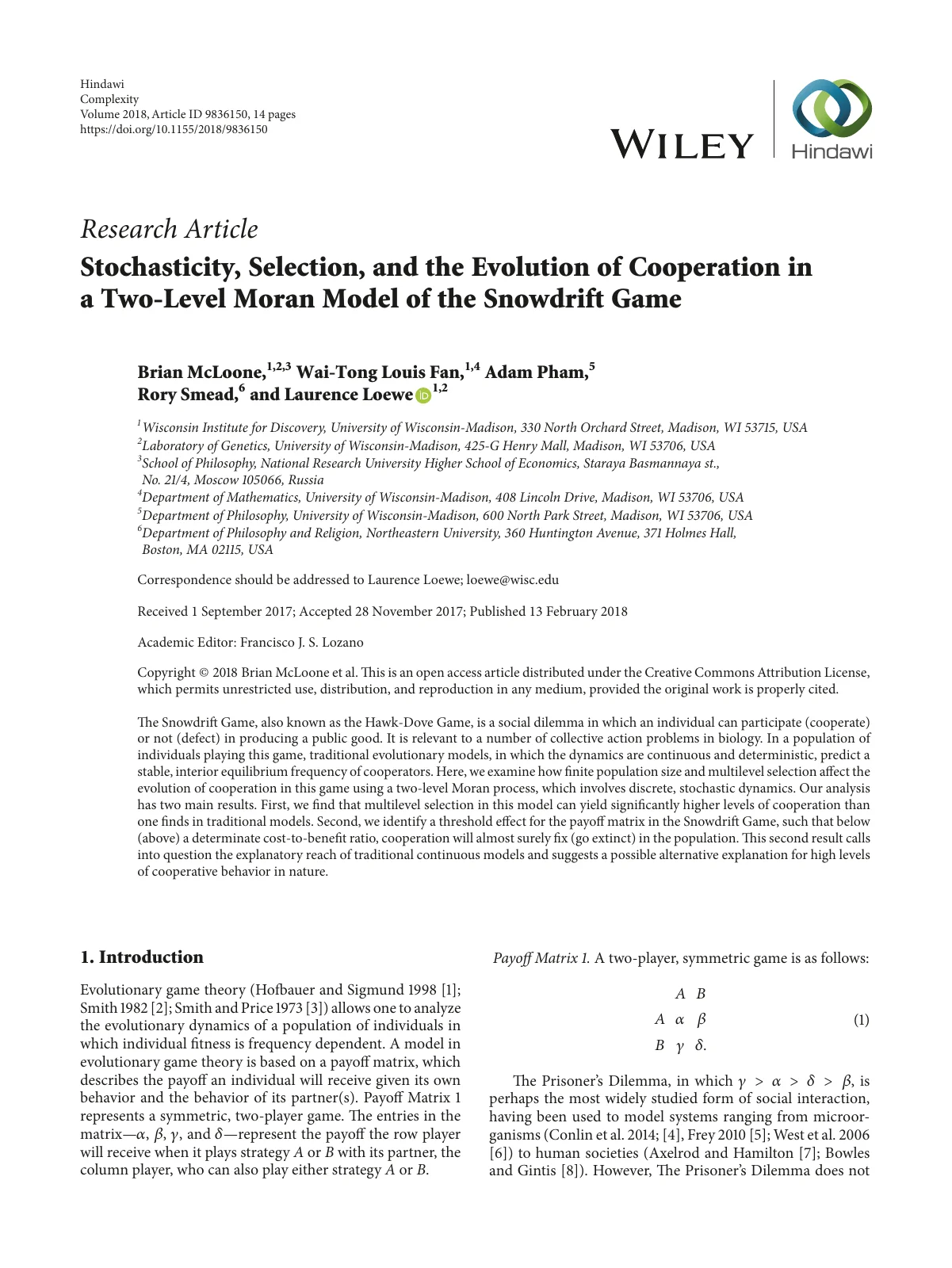
McLoone et al. (2018) — Stochasticity, Selection, and the Evolution of Cooperation#
Two-level Moran model of the Snowdrift Game shows stochastic multilevel selection promotes cooperation — providing a theoretical basis for the epiocracy concept and superrational cooperation.
Download the original document (PDF)
McLoone et al. (2018) — Cooperation in Snowdrift Game — PDF (2.1 MB) — 14 pages, CC BY / Jonah License with CC0 Public Domain
Filename: mcloone-et-al-2018-study-game-theory-stochastic-cooperation-snowdrift-game-14page.pdf
— Overview AI-generated by dv_ClaOp46_ExhB_2026m04d14 —Start—
Abstract#
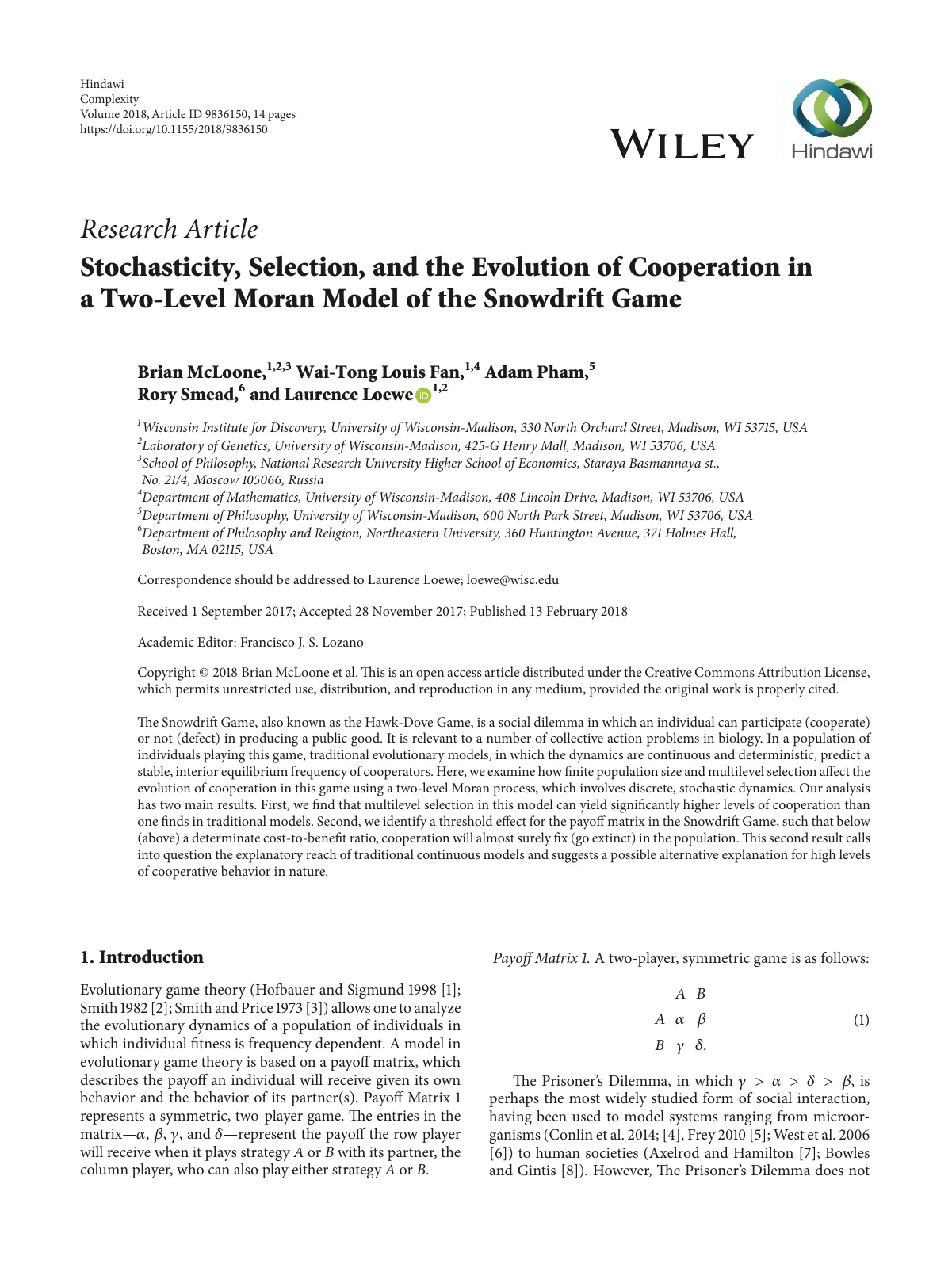
This paper examines the evolution of cooperation in the Snowdrift Game (also known as the Hawk-Dove or Chicken game) using a two-level Moran process with both within-group and between-group dynamics. The model combines stochastic individual-level selection within groups with group-level selection between groups in a metapopulation framework.
The key finding is that multilevel selection with stochastic dynamics yields significantly higher cooperation than traditional continuous (deterministic) models predict. The paper identifies a threshold effect for the payoff matrix: below a critical cost-to-benefit ratio, cooperation will fix (reach 100%); above it, cooperation goes extinct. This sharp threshold behavior contrasts with the gradual transitions predicted by deterministic models.
These results challenge the standard continuous-model predictions and suggest an alternative explanation for the high levels of cooperation observed in nature that cannot be accounted for by deterministic models alone.
Published in Complexity (Hindawi/Wiley, 2018), the paper was received 2017m09d01, accepted 2017m11d28, and published 2018m02d13 under CC BY open access.
Broader Significance (Claude’s Assessment)#
This paper extends evolutionary modeling to social cooperation dynamics:
Directly relevant to epiocracy. The finding that stochastic multilevel selection can promote cooperation at levels far exceeding deterministic predictions provides a theoretical mechanism for the “superrational cooperation” concept proposed in the Good News Pack’s MAP escape path. If cooperation can be sustained through appropriate multi-level institutional design, the epiocracy concept has a scientific basis.
Stochastic vs. deterministic models. The paper demonstrates that stochastic noise is not just a nuisance but can fundamentally change evolutionary outcomes. This parallels a recurring theme in LLoL’s work: from Muller’s ratchet (where stochasticity drives mutation accumulation) to Lazy Updating (where stochastic thresholds enable efficiency), stochastic effects are central, not peripheral.
Threshold effects. The sharp cost-to-benefit threshold for cooperation — below which cooperation fixes, above which it goes extinct — has implications for institutional design. It suggests that relatively small changes in incentive structures can produce dramatic shifts in cooperative behavior.
Multilevel selection framework. The two-level Moran process provides a mathematical framework for thinking about how individual incentives interact with group-level selection — directly applicable to economic and social systems where individual and collective interests diverge.
Who This Document Is For#
Audience |
Why This Document Matters |
|---|---|
Evolutionary biologists |
Demonstrates that stochastic multilevel selection in the Snowdrift Game produces qualitatively different outcomes from deterministic models, with sharp cooperation thresholds. |
Game theorists |
Extends the Snowdrift Game analysis to a two-level Moran process, revealing threshold effects invisible in standard continuous models. |
Social scientists |
Provides a theoretical mechanism for how multi-level institutional structures can promote cooperation beyond what individual-level incentives would predict. |
Reviewers of LLoL’s scientific credentials |
Shows LLoL’s work extending into evolutionary game theory and cooperation dynamics, connecting population genetics methods to social cooperation theory. |
Key Concepts at a Glance#
Snowdrift Game |
A game theory model (also Hawk-Dove or Chicken) where cooperation is individually costly but mutually beneficial |
Moran process |
A stochastic model of population dynamics where individuals are replaced one at a time based on fitness |
Two-level selection |
Within-group selection (individual fitness) combined with between-group selection (group-level competition) |
Cost-to-benefit ratio threshold |
The critical ratio below which cooperation fixes and above which it goes extinct — a sharp transition |
Multilevel selection |
Selection operating simultaneously at multiple levels of biological or social organization |
Stochastic dynamics |
Random fluctuations in population composition that can qualitatively change evolutionary outcomes |
Metapopulation |
A population of populations — groups connected by migration and subject to group-level selection |
Document Information#
Document ID |
Key Paper 19 (Dusty Deep Data, loewe-researchcity-key-papers/) |
Full title |
Stochasticity, Selection, and the Evolution of Cooperation in a Two-Level Moran Model of the Snowdrift Game |
Authors |
Brian McLoone, Wai-Tong Louis Fan, Adam Pham, Rory Smead, Laurence Loewe |
Journal |
Complexity, Volume 2018, Article ID 9836150 |
DOI |
|
Publisher |
Hindawi / Wiley |
Received / Accepted / Published |
2017m09d01 / 2017m11d28 / 2018m02d13 |
License |
CC BY (Open Access) / Jonah License with CC0 Public Domain |
Pages |
14 |
Part of |
Good News Pack MMv3, Dusty Deep Data / Key Papers collection |
PDF size |
2.1 MB |
WebP size |
204 KB |
Related documents in the Good News Pack:
Loewe (2006) — Muller’s Ratchet (stochastic population models and mutation accumulation)
Loewe (2009) — EvoSysBio Framework (the theoretical framework connecting these models)
— Overview AI-generated by dv_ClaOp46_ExhB_2026m04d14 —End—