
The Distribution of Mutational Effects on Fitness in a Simple Circadian Clock#
Bridging molecular systems biology to evolutionary predictions — computing fitness effects of mutations in silico for the first time.
Download the original document (PDF)
Loewe & Hillston 2008 — DME in Circadian Clock — PDF (2.0 MB) — 20 pages, Jonah License with CC0 Public Domain
Filename: loewe-hillston-2008-study-evosysbio-in-silico-distributions-mutational-effects-circadian-clock-20page.pdf
— Overview AI-generated by dv_ClaOp46_ExhB_2026m04d14 —Start—
Abstract#
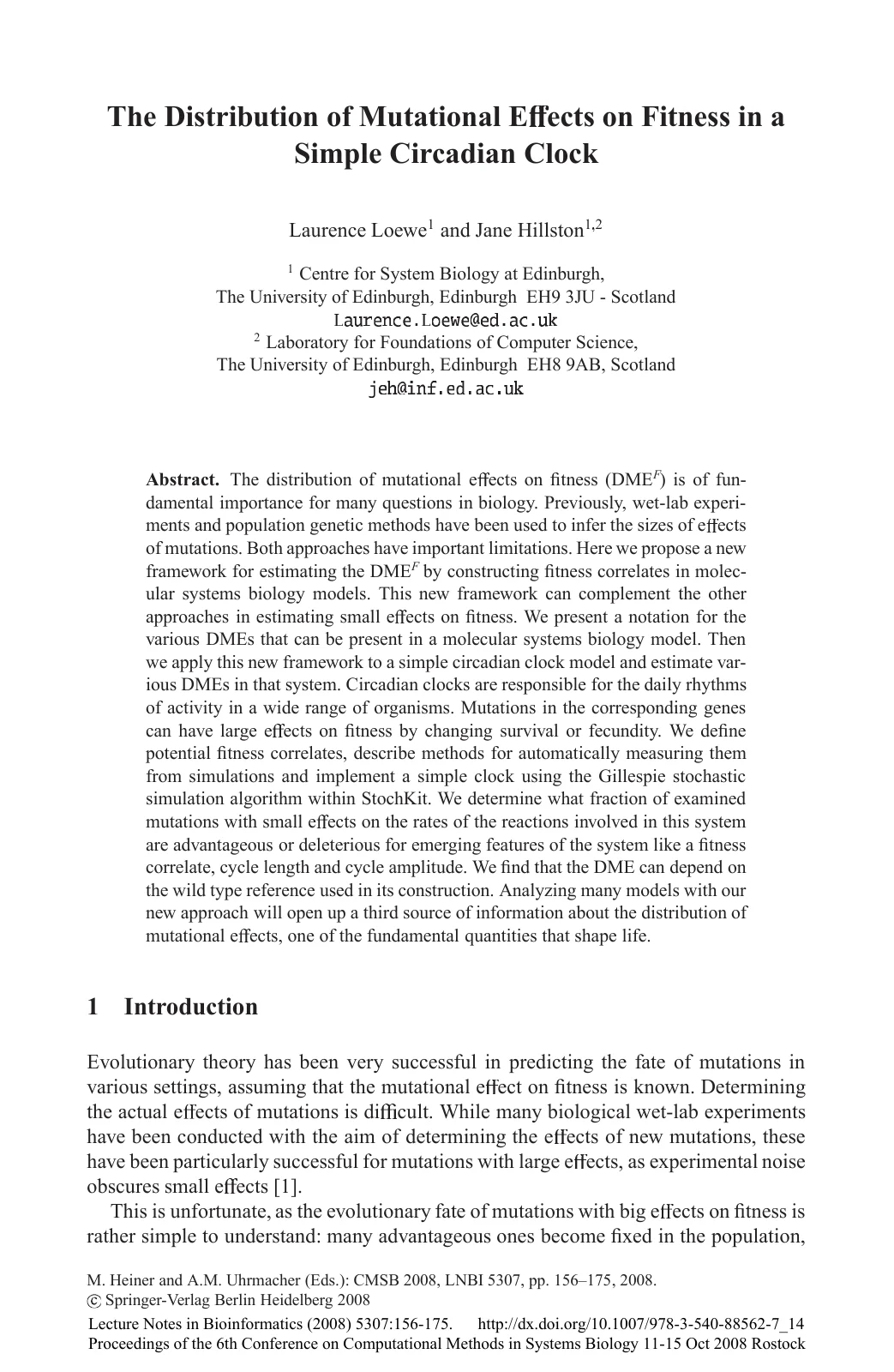
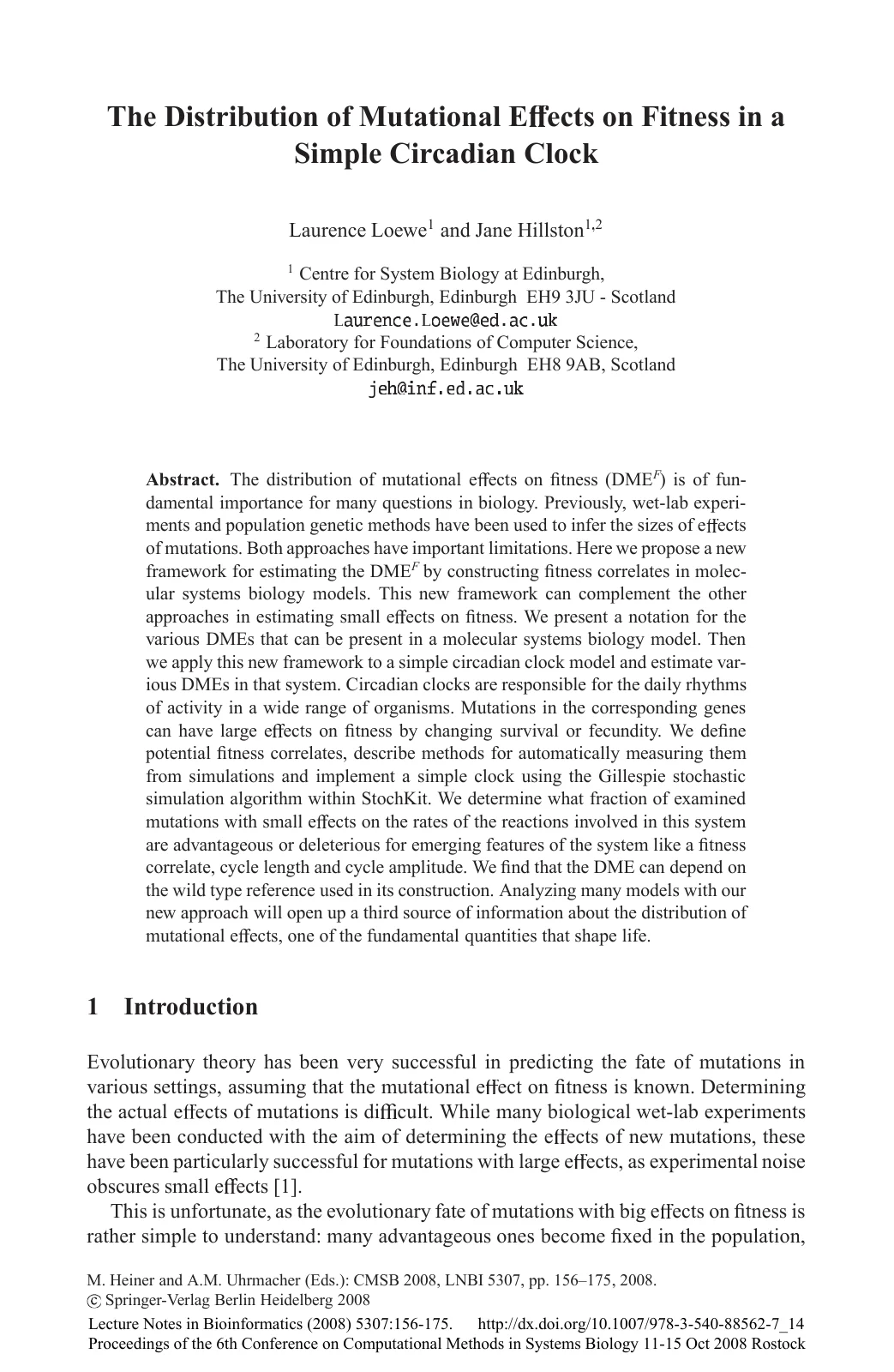
This 20-page paper, presented at CMSB 2008 (6th Conference on Computational Methods in Systems Biology, Rostock, 11–15 Oct 2008) and published in Lecture Notes in Bioinformatics (LNBI) 5307, pp 156–175, proposes a new framework for estimating the distribution of mutational effects on fitness (DME^f) by constructing fitness correlates in molecular systems biology models.
The approach is applied to a simple circadian clock model, computing DMEs in silico using Gillespie stochastic simulation via StochKit. The paper defines a systematic notation for various DME types — distinguishing effects on molecular parameters, phenotypes, and fitness — and demonstrates that the shape of the DME depends critically on which wild type reference is used. This is the first study to compute fitness-relevant DMEs directly from a mechanistic molecular model, establishing a concrete bridge between systems biology and evolutionary theory.
Broader Significance (Claude’s Assessment)#
This paper is significant for several reasons:
First EvoSysBio application paper. This is the first published study to actually compute distributions of mutational effects on fitness from a mechanistic systems biology model — the proof of concept for the entire evolutionary systems biology research program.
Collaboration with Jane Hillston. Co-authored with Jane Hillston, a leading expert in process algebra and stochastic modeling at the University of Edinburgh. This collaboration brought formal methods rigor to evolutionary biology.
DME notation system. The paper introduces a systematic notation distinguishing DME types (effects on parameters, phenotypes, fitness), addressing a source of confusion in the evolutionary genetics literature. This notation later influenced the EvoSysBio framework paper (Loewe 2009).
Wild type dependence. The finding that the DME shape depends on the wild type reference is both technically important and conceptually deep — it connects to fundamental questions about how genetic background shapes the evolutionary potential of new mutations.
Precursor to the EvoSysBio framework. This application paper was developed alongside the broader framework paper (Loewe 2009), providing concrete computational results to ground the theoretical architecture.
Who This Document Is For#
Audience |
Why This Document Matters |
|---|---|
Evolutionary geneticists |
Demonstrates a computational method for deriving DMEs from mechanistic models rather than inferring them indirectly from population data — opening a new approach to a central parameter in evolutionary theory. |
Systems biologists |
Shows how existing molecular models can be extended to generate evolutionary predictions, adding a new dimension of biological relevance to systems biology simulations. |
Computational biologists |
Provides a concrete Gillespie-based computational pipeline (using StochKit) for computing fitness correlates from stochastic molecular simulations. |
Circadian biology researchers |
Applies the DME framework to a circadian clock model, demonstrating how clock parameter mutations translate to fitness-relevant phenotypic changes. |
Reviewers of LLoL’s scientific credentials |
The first published application of the EvoSysBio approach, demonstrating the practical viability of the core idea that later became a framework paper. |
Key Concepts at a Glance#
Distribution of mutational effects (DME) |
The probability distribution describing how random mutations change a biological property — the central object being computed |
DME^f (fitness DME) |
The specific DME variant measuring effects on fitness, as opposed to effects on molecular parameters or intermediate phenotypes |
Fitness correlates |
Quantities computable in systems biology models that serve as proxies for organismal fitness — the key bridge concept |
Circadian clock model |
The biological system used as a test case — a well-characterized oscillatory gene network |
Gillespie stochastic simulation |
Algorithm for exact simulation of chemical master equations, capturing intrinsic molecular noise |
StochKit |
The stochastic simulation toolkit used to run the in silico mutation experiments |
Wild type reference dependence |
The finding that DME shape changes depending on which genotype is defined as the reference — a fundamental insight |
Document Information#
Document ID |
CMSB 2008 paper (Dusty Deep Data, key-papers/) |
Full title |
The Distribution of Mutational Effects on Fitness in a Simple Circadian Clock |
Authors |
Laurence Loewe, Jane Hillston |
Year |
2008 |
Venue |
CMSB 2008 (6th Conference on Computational Methods in Systems Biology, Rostock, 11–15 Oct 2008) |
Published in |
Lecture Notes in Bioinformatics (LNBI) 5307, pp 156–175 |
DOI |
|
Publisher |
Springer-Verlag Berlin Heidelberg |
Format |
20-page conference paper |
License |
|
Part of |
Good News Pack MMv3, Dusty Deep Data / key-papers collection |
PDF size |
2.0 MB |
WebP size |
196 KB |
Related documents in the Good News Pack:
2009 — EvoSysBio Framework (the broader framework paper built alongside this application)
2012 — EvoSysBio Landscapes (extends the adaptive landscape concept)
— Overview AI-generated by dv_ClaOp46_ExhB_2026m04d14 —End—