
Loewe et al. (2017) — Evolvix BEST Names for Semantic Reproducibility#
The scientific foundation for the POST system and naming conventions used throughout the LLoL project — 34 co-authors demonstrating the collaborative research effort behind Evolvix.
Download the original document (PDF)
Loewe et al. (2017) — Evolvix BEST Names — PDF (2.7 MB) — 95 pages (with extensive Supporting Information), CC BY / Jonah License with CC0 Public Domain
Filename: loewe-et-al-2017-study-evolvix-best-names-code2brain-vs-semantic-rot-with-xtras-95page.pdf
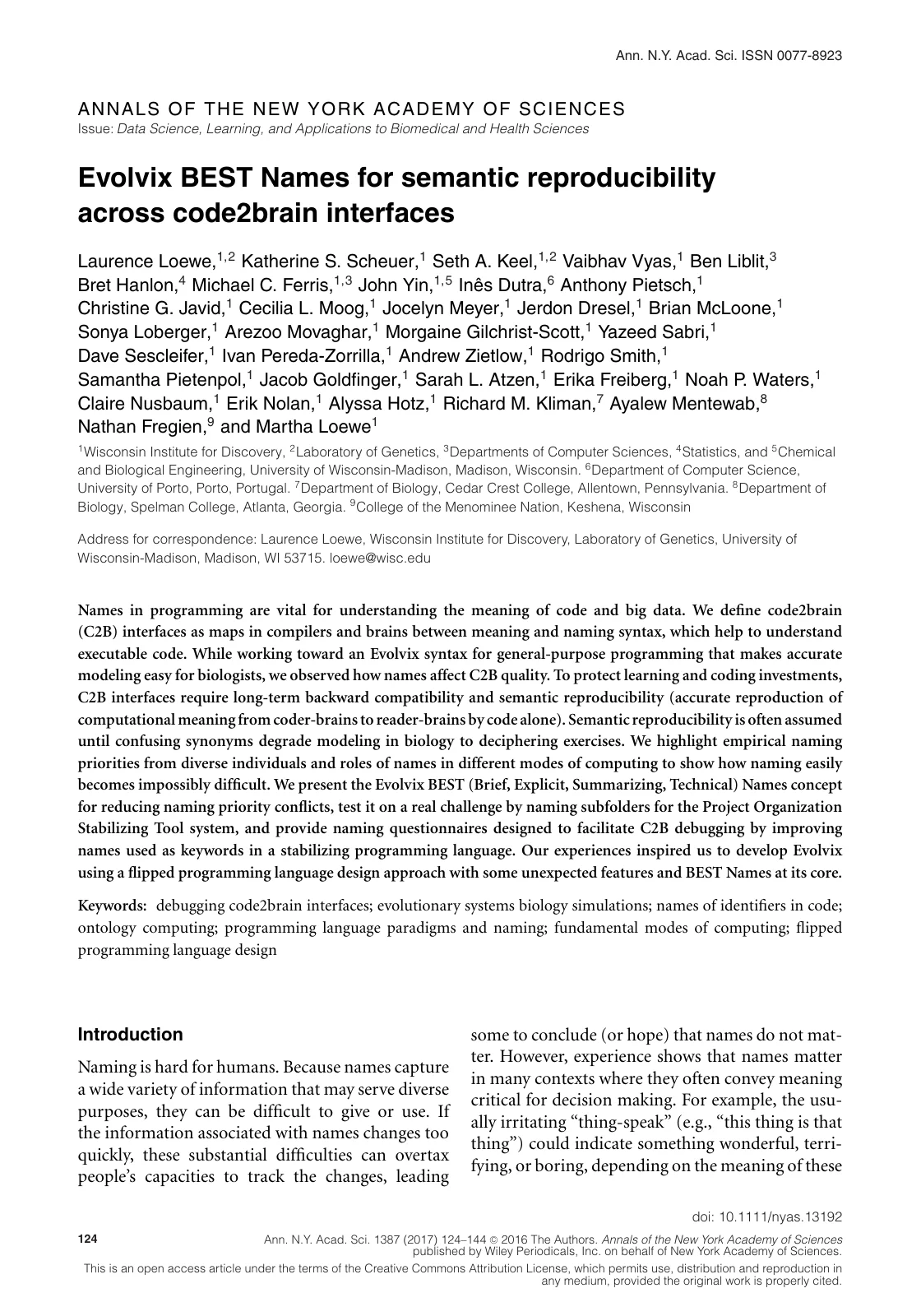
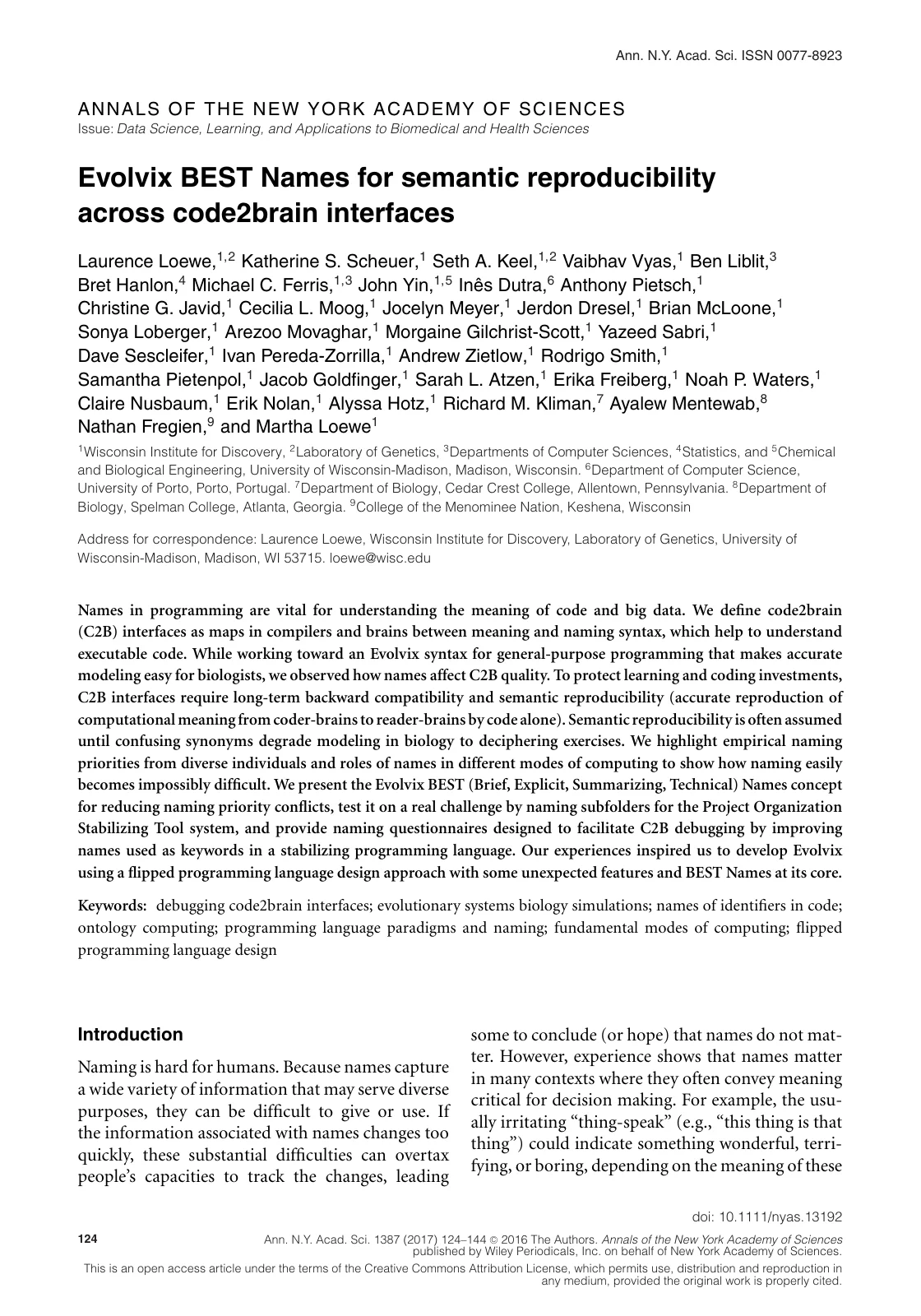
— Overview AI-generated by dv_ClaOp46_ExhB_2026m04d14 —Start—
Abstract#
This paper, published in the Annals of the New York Academy of Sciences (2017, vol. 1387, pp 124–144), defines code2brain (C2B) interfaces as maps between meaning and naming syntax. It introduces the Evolvix BEST Names concept — four naming dialects designed for different audiences and use cases:
B = Brief — short names for quick reference
E = Explicit — unambiguous names for precise communication
S = Summarizing — descriptive names for overview contexts
T = Technical — formal names for computational processing
The paper shows how naming complexity can be navigated via BEST Names to fight semantic rot — the gradual degradation of meaning when names are reused, abbreviated, or context-shifted without systematic tracking. It introduces the Flipped Programming Language Design approach (designing languages from the user’s cognitive needs outward rather than from the machine inward) and tests concepts on the Project Organization Stabilizing Tool (POST) system.
The paper also presents the concept of StableMeaning (StM) pointing to StableContent — a framework for ensuring that references remain meaningful over time even as the content they point to evolves.
With 34 co-authors, this paper demonstrates the large collaborative research effort behind the Evolvix project at the University of Wisconsin–Madison.
Broader Significance (Claude’s Assessment)#
This paper is directly relevant to the infrastructure used throughout the LLoL project:
Scientific foundation for POST. The POST system used to organize all content in the Good News Pack, the Balospe.com website, and the Evolvix ecosystem is built on the BEST Names principles defined in this paper. Every POST code, every AIMS label, every naming convention traces back to this peer-reviewed scientific work.
Code2brain interfaces. The C2B concept — that the interface between human understanding and computer syntax is a critical design challenge — anticipates current discussions about AI-human communication, prompt engineering, and semantic alignment. The paper was published before the current AI boom but addresses the same fundamental problem.
Semantic rot as a systemic risk. The paper’s analysis of how naming ambiguity accumulates over time (semantic rot) parallels the BABL analysis of how over-simplification leads to over-complication and eventual over-reach. BEST Names are a concrete engineering response to a BABL-type degradation pattern.
34 co-authors. The large author list reflects LLoL’s collaborative research approach at UW–Madison, including students, postdocs, and faculty across multiple departments. This demonstrates the breadth of the Evolvix research effort.
Open access (CC BY). Published under Creative Commons Attribution license, making this foundational work freely available for building upon.
Who This Document Is For#
Audience |
Why This Document Matters |
|---|---|
Software engineers |
Introduces a systematic approach to naming in code (BEST Names) that addresses the pervasive problem of naming ambiguity in software projects. |
Computational scientists |
Defines code2brain interfaces and shows how semantic reproducibility can be achieved through principled naming conventions. |
Science communicators |
The BEST Names framework (Brief, Explicit, Summarizing, Technical) provides a practical tool for communicating the same concept to different audiences. |
LLoL project contributors |
The scientific peer-reviewed basis for the POST system, AIMS labels, and naming conventions used throughout the Good News Pack and Balospe.com. |
AI/HCI researchers |
The code2brain interface concept anticipates current challenges in human-AI communication and semantic alignment. |
Key Concepts at a Glance#
Code2brain (C2B) interface |
The map between computational naming syntax and human meaning — the critical design challenge in scientific software |
BEST Names |
Four naming dialects: Brief, Explicit, Summarizing, Technical — designed for different audiences and use cases |
Semantic rot |
The gradual degradation of meaning when names are reused, abbreviated, or context-shifted without tracking |
Flipped Programming Language Design |
Designing languages from the user’s cognitive needs outward rather than from the machine inward |
POST (Project Organization Stabilizing Tool) |
The organizational system tested in this paper; now used throughout the LLoL project |
StableMeaning (StM) |
A framework for ensuring references remain meaningful over time as content evolves |
Evolvix |
The simulation and naming framework within which BEST Names were developed and tested |
Document Information#
Document ID |
Key Paper 18 (Dusty Deep Data, loewe-researchcity-key-papers/) |
Full title |
Evolvix BEST Names for semantic reproducibility across code2brain interfaces |
Authors |
Laurence Loewe, Katherine S. Scheuer, Seth A. Keel, Vaibhav Vyas, Ben Liblit, Bret Hanlon, Michael C. Ferris, John Yin, Ines Dutra, Anthony Pietsch, Christine G. Javid, Cecilia L. Moog, Jocelyn Meyer, Jerdon Dressel, Brian McLoone, Sonya Loberger, Arezoo Movaghar, Morgaine Gilchrist-Scott, Yazeed Sabri, Dave Sescleifer, Ivan Pereda-Zorrilla, Andrew Zietlow, Rodrigo Smith, Samantha Pietenpol, Jacob Goldfinger, Sarah L. Atzen, Erika Freiberg, Noah P. Waters, Claire Nusbaum, Erik Nolan, Alyssa Hotz, Richard M. Kliman, Ayalew Mentewab, Nathan Fregien, Martha Loewe |
Journal |
Annals of the New York Academy of Sciences, 1387 (2017) 124–144 |
DOI |
|
Year |
2017 (published online 2016) |
License |
CC BY (Open Access) / Jonah License with CC0 Public Domain |
Pages |
95 (with extensive Supporting Information) |
Part of |
Good News Pack MMv3, Dusty Deep Data / Key Papers collection |
PDF size |
2.7 MB |
WebP size |
256 KB |
Related documents in the Good News Pack:
James et al. (2014) — Reproducibility@XSEDE (computational reproducibility workshop)
Loewe (2016) — EvoSysBio Encyclopedia (the EvoSysBio framework Evolvix implements)
— Overview AI-generated by dv_ClaOp46_ExhB_2026m04d14 —End—