
Loewe (2012) — How Evolutionary Systems Biology Will Help Understand Adaptive Landscapes and DME#
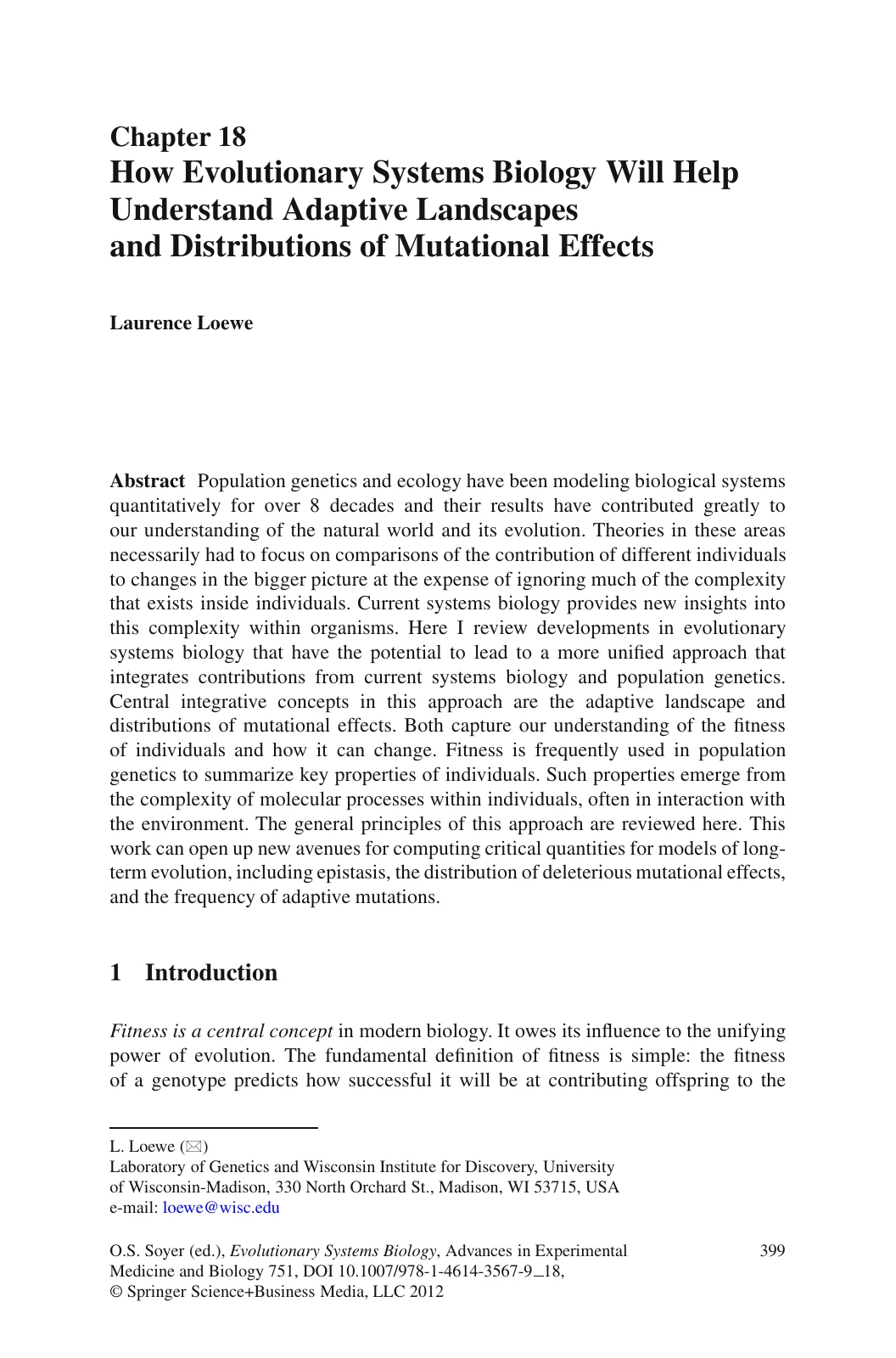
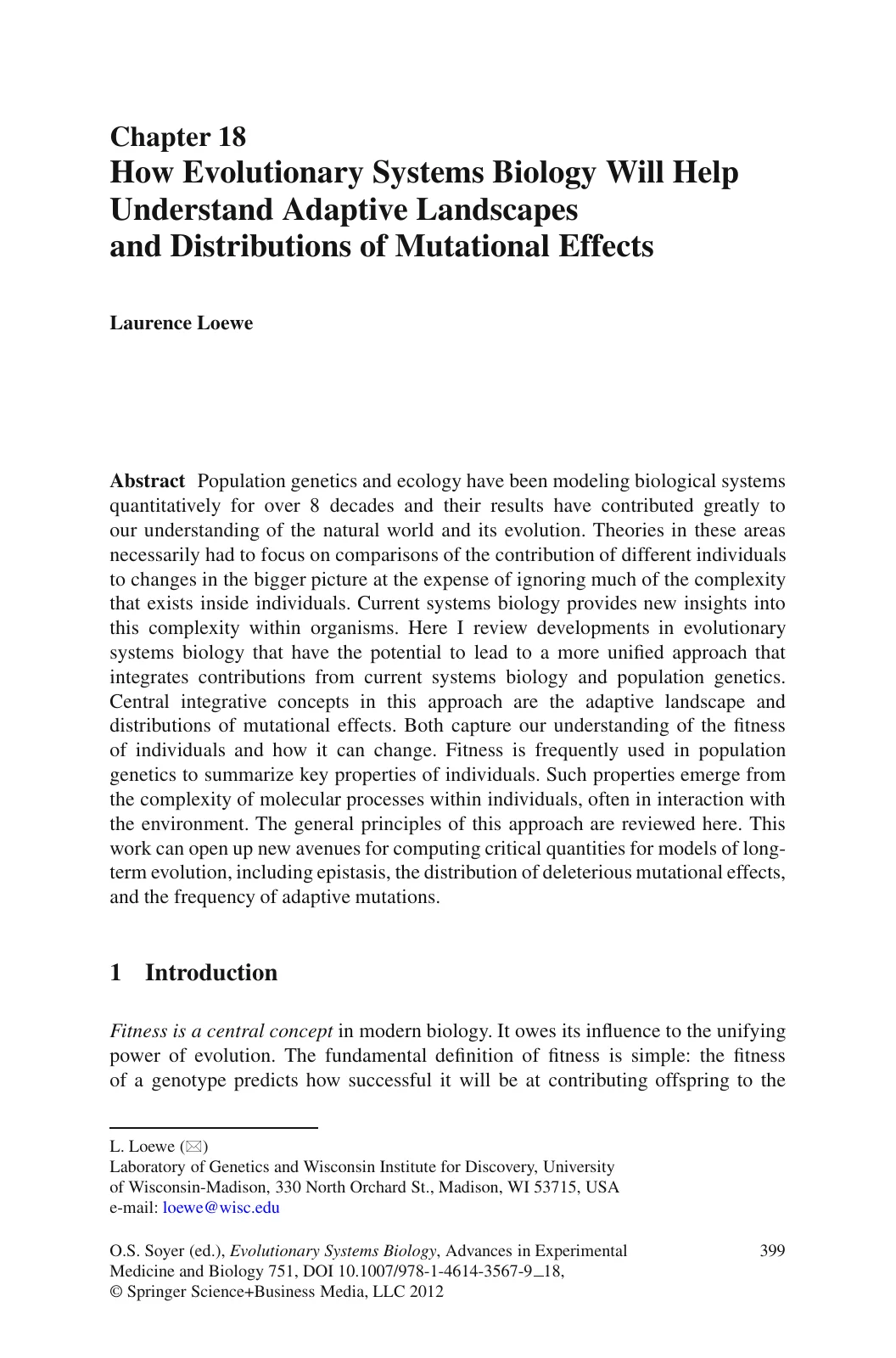
Updating the EvoSysBio framework for the first book dedicated to evolutionary systems biology — integrating adaptive landscapes with distributions of mutational effects through fitness as the bridge concept.
Download the original document (PDF)
Loewe (2012) — EvoSysBio Adaptive Landscapes & DME — PDF (244 KB) — 12 pages, Jonah License with CC0 Public Domain
Filename: loewe-2012-review-evosysbio-nested-adaptive-landscapes-distributions-mutational-effects-12page.pdf
— Overview AI-generated by dv_ClaOp46_ExhB_2026m04d14 —Start—
Abstract#
This book chapter, published in the first volume dedicated to evolutionary systems biology (O.S. Soyer, ed.), reviews developments in EvoSysBio focused on adaptive landscapes and distributions of mutational effects (DME). The chapter integrates contributions from systems biology and population genetics using fitness as the bridge concept that connects molecular-level simulations to population-level evolutionary dynamics.
The chapter presents a 7-level framework for understanding adaptive landscapes at different scales of biological organization, from molecular properties to population fitness. It introduces the Linear Fitness Correlate Hypothesis — the proposal that fitness effects of mutations can be approximated by linear functions of molecular-level traits under certain conditions. The chapter discusses how EvoSysBio models can compute fitness correlates from molecular-level simulations, providing a principled way to bridge the gap between mechanistic molecular models and population genetics theory that requires fitness as input.
Broader Significance (Claude’s Assessment)#
This chapter marks an important milestone in the EvoSysBio framework:
First dedicated EvoSysBio volume. Being invited to contribute to the first book entirely dedicated to evolutionary systems biology (Advances in Experimental Medicine and Biology, vol. 751) reflects recognition of LLoL’s role in defining this field. The chapter updates the 2009 framework paper with new developments.
7-level landscape framework. The multi-level approach to adaptive landscapes — from molecular properties through fitness correlates to population dynamics — provides the hierarchical structure that later becomes central to the formal EvoSysBio definitions in the 2016 encyclopedia article.
Linear Fitness Correlate Hypothesis. This hypothesis is a key theoretical contribution: if molecular traits map approximately linearly to fitness effects, then molecular-level simulations can be connected to population genetics models without requiring full knowledge of the fitness landscape. This is a practical bridge between disciplines.
Continued framework development. The progression from 2009 (initial framework) to 2012 (landscapes and DME) to 2016 (formal definitions) shows systematic, sustained theoretical development of EvoSysBio over nearly a decade.
Who This Document Is For#
Audience |
Why This Document Matters |
|---|---|
Evolutionary biologists |
Provides a structured framework for understanding adaptive landscapes at multiple biological levels, connecting molecular mechanisms to population-level fitness effects. |
Systems biologists |
Demonstrates how systems biology models can compute fitness correlates that feed into evolutionary models, bridging two traditionally separate disciplines. |
Population geneticists |
Discusses how distributions of mutational effects arise from molecular-level properties and how the Linear Fitness Correlate Hypothesis can simplify their estimation. |
Reviewers of LLoL’s scientific credentials |
Invited chapter in the first dedicated EvoSysBio book, showing continued development of the theoretical framework from the 2009 founding paper. |
Key Concepts at a Glance#
Adaptive landscapes |
Multi-dimensional fitness surfaces describing how genotype maps to fitness; analyzed here at 7 hierarchical levels |
Distributions of mutational effects |
Statistical descriptions of how mutations affect fitness; connecting molecular damage to population-level selection |
Linear Fitness Correlate Hypothesis |
The proposal that fitness effects can be approximated as linear functions of molecular traits under certain conditions |
Fitness as bridge concept |
Fitness connects systems biology (molecular mechanisms) to population genetics (evolutionary dynamics) |
EvoSysBio |
Evolutionary Systems Biology — the integration of systems biology with evolutionary and population genetics |
Nested landscapes |
Adaptive landscapes viewed at multiple levels of biological organization, from molecules to populations |
Document Information#
Document ID |
Key Paper 14 (Dusty Deep Data, loewe-researchcity-key-papers/) |
Full title |
How Evolutionary Systems Biology Will Help Understand Adaptive Landscapes and Distributions of Mutational Effects |
Author |
Laurence Loewe |
Published in |
Evolutionary Systems Biology (O.S. Soyer, ed.), Advances in Experimental Medicine and Biology, vol. 751, Chapter 18, pp 399ff. |
Publisher |
Springer |
Year |
2012 |
DOI |
|
Pages |
12 |
License |
|
Part of |
Good News Pack MMv3, Dusty Deep Data / Key Papers collection |
PDF size |
244 KB |
WebP size |
160 KB |
Related documents in the Good News Pack:
Loewe (2009) — EvoSysBio Framework (the founding framework paper this chapter updates)
Loewe (2016) — EvoSysBio Encyclopedia (formalizes the definitions introduced here)
Loewe & Hillston (2008) — Computational Biology (earlier computational biology integration)
— Overview AI-generated by dv_ClaOp46_ExhB_2026m04d14 —End—