
Ehlert & Loewe (2014) — Lazy Updating of Hubs Can Enable More Realistic Models#
The core algorithm for what LLoL later calls “Jubilee measuring” — showing that periodic batch updates are more efficient than measuring everything all the time.
Download the original document (PDF)
Ehlert & Loewe (2014) — Lazy Updating — PDF (1.5 MB) — 20 pages, Jonah License with CC0 Public Domain
Filename: ehlert-loewe-2014-study-lazy-updating-simulations-imply-core-algorithm-for-jubilee-measuring-20page.pdf
— Overview AI-generated by dv_ClaOp46_ExhB_2026m04d14 —Start—
Abstract#
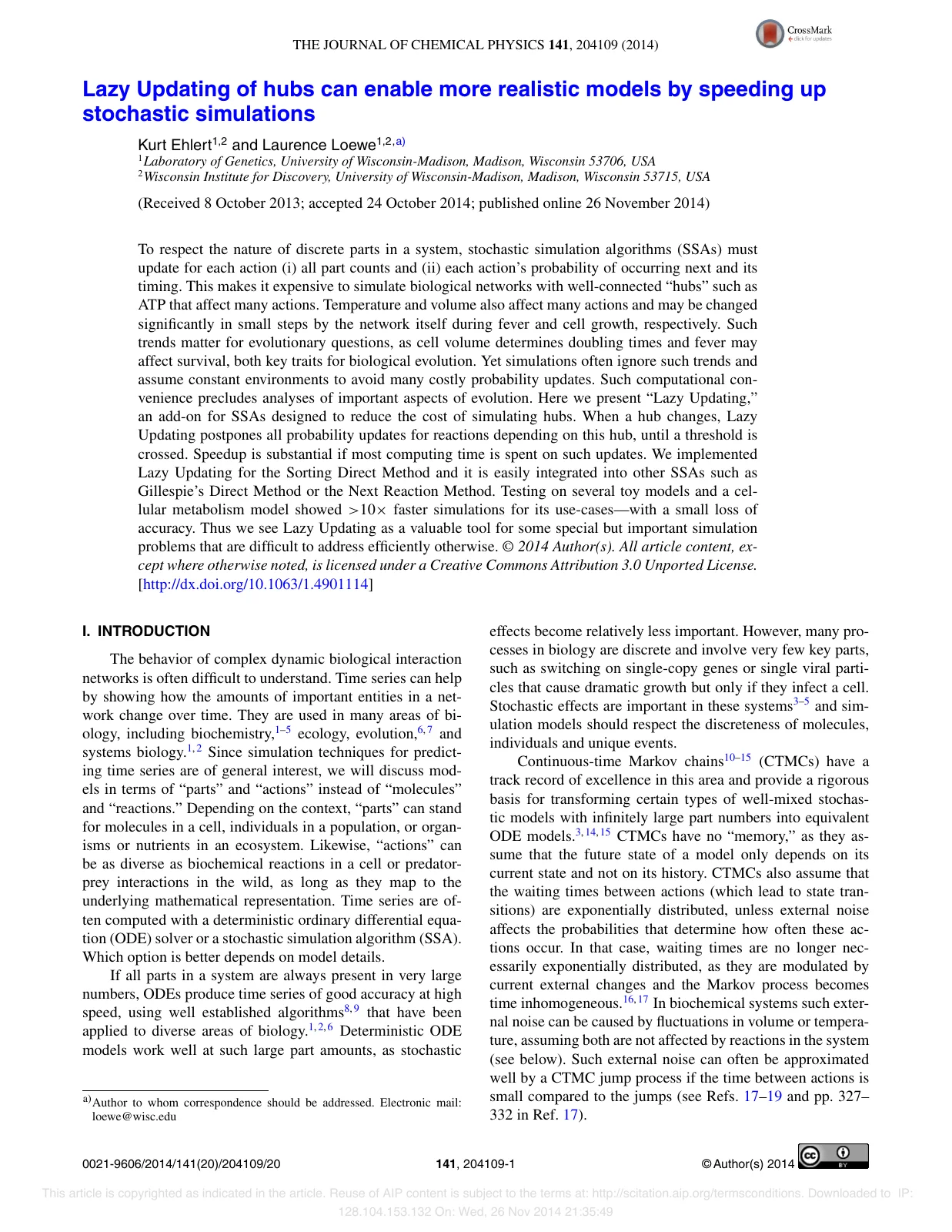
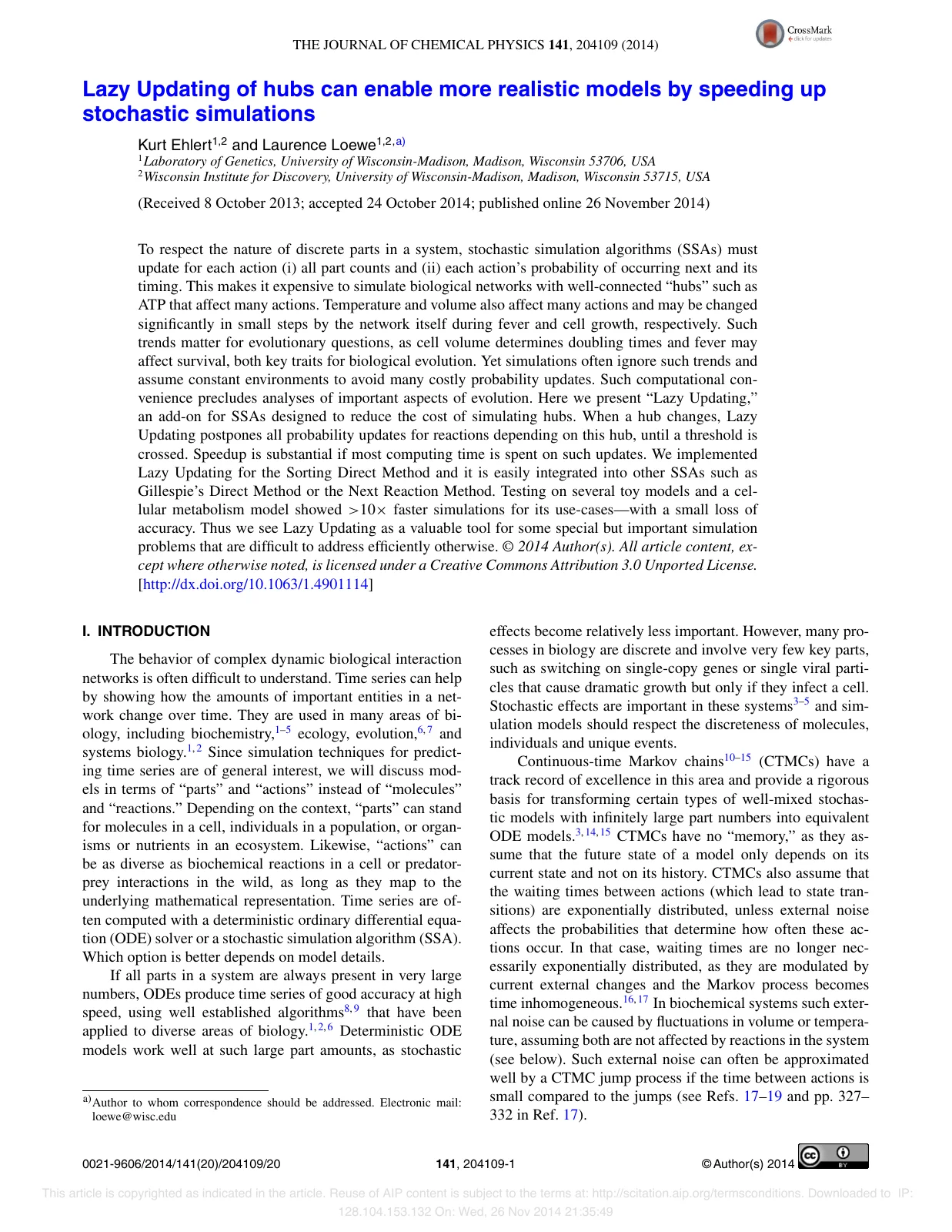
This paper presents Lazy Updating — an add-on for Stochastic Simulation Algorithms (SSAs) that reduces computational cost by skipping propensity updates for hub parts (highly connected molecular species) until a threshold is crossed. The core insight is that hub species participate in so many reactions that updating all their propensities after every single event is wasteful when the actual change in propensity is negligible.
Implemented within the Sorting Direct Method, Lazy Updating is tested on ATP pathway models, Birth/Contraction models, and a metabolic model prototype. Results show that Lazy Updating achieves approximately 10x speedup with small accuracy cost for well-connected hub parts. The algorithm automatically identifies which parts are hubs and applies lazy updating selectively, preserving exact stochastic simulation for non-hub parts.
The paper was published in the Journal of Chemical Physics (2014), received 2013m10d08, accepted 2014m10d24, and published 2014m11d26.
Broader Significance (Claude’s Assessment)#
This paper is directly relevant to the Jubilee System claims in the Matheo papers:
The Jubilee measuring principle. The Lazy Updating algorithm embodies a principle that LLoL later connects to the Jubilee economic concept: measuring everything all the time wastes resources, and periodic batch updates are more efficient than continuous adjustment. In economics, this maps to the argument that periodic debt resets (Jubilee cycles) are more efficient than continuous micro-adjustments to inequality.
Peer-reviewed scientific evidence. Published in J. Chem. Phys., this is rigorous peer-reviewed computational science demonstrating the efficiency of periodic-reset algorithms. It provides the scientific foundation for the broader claim that Jubilee-style periodic resets are computationally and practically superior to continuous monitoring.
Hub-based efficiency. The insight that hubs (highly connected nodes) can be updated lazily without significant accuracy loss parallels the economic observation that large-scale systemic adjustments (affecting many connections) are more efficient when done periodically than continuously.
Evolvix implementation. The algorithm was implemented within the Evolvix simulation framework, connecting this work to the broader ResearchCity software ecosystem.
Who This Document Is For#
Audience |
Why This Document Matters |
|---|---|
Computational scientists |
Presents a practical algorithm for speeding up stochastic simulations of biochemical networks by ~10x through selective lazy updating of hub species. |
Systems biologists |
Enables more realistic (larger, more connected) biochemical models by reducing the computational cost of stochastic simulation. |
Jubilee System reviewers |
The scientific peer-reviewed basis for the “Jubilee measuring” claim: periodic batch updates outperform continuous monitoring for hub-connected systems. |
Algorithm designers |
A general technique for optimizing event-driven simulations where hub nodes create computational bottlenecks through excessive update cascades. |
Key Concepts at a Glance#
Lazy Updating |
Algorithm add-on that skips propensity recalculation for hub parts until accumulated changes cross a threshold |
Stochastic Simulation Algorithm (SSA) |
The Gillespie algorithm and variants; exact methods for simulating chemical kinetics with stochastic noise |
Hub parts |
Molecular species connected to many reactions; updating all their propensities after each event is the bottleneck |
Sorting Direct Method |
The SSA variant within which Lazy Updating was implemented and tested |
Jubilee measuring |
LLoL’s term for the principle that periodic batch measurement is more efficient than continuous monitoring — derived from this algorithm |
Evolvix |
The simulation framework within which Lazy Updating was implemented, connecting to the broader ResearchCity vision |
Propensity |
The probability rate of a reaction firing; recalculating all propensities after every event is what Lazy Updating avoids |
Document Information#
Document ID |
Key Paper 15 (Dusty Deep Data, loewe-researchcity-key-papers/) |
Full title |
Lazy Updating of hubs can enable more realistic models by speeding up stochastic simulations |
Authors |
Kurt Ehlert, Laurence Loewe |
Journal |
Journal of Chemical Physics 141, 204109 (2014) |
DOI |
|
Received / Accepted / Published |
2013m10d08 / 2014m10d24 / 2014m11d26 |
Publisher |
AIP Publishing |
Pages |
20 |
License |
|
Part of |
Good News Pack MMv3, Dusty Deep Data / Key Papers collection |
PDF size |
1.5 MB |
WebP size |
316 KB |
Related documents in the Good News Pack:
Loewe (2002) — Dissertation (earlier EEPSLION simulation work)
Loewe et al. (2017) — Evolvix BEST Names (Evolvix naming and semantic reproducibility)
— Overview AI-generated by dv_ClaOp46_ExhB_2026m04d14 —End—