
A Framework for Evolutionary Systems Biology#
THE foundational paper for evolutionary systems biology — defining the scientific methodology behind the modeling claims in the Matheo papers.
Download the original document (PDF)
Loewe 2009 — EvoSysBio Framework — PDF (780 KB) — 34 pages, Jonah License with CC0 Public Domain
Filename: loewe-2009-review-evosysbio-framework-for-evolutionary-systems-biology-34page.pdf
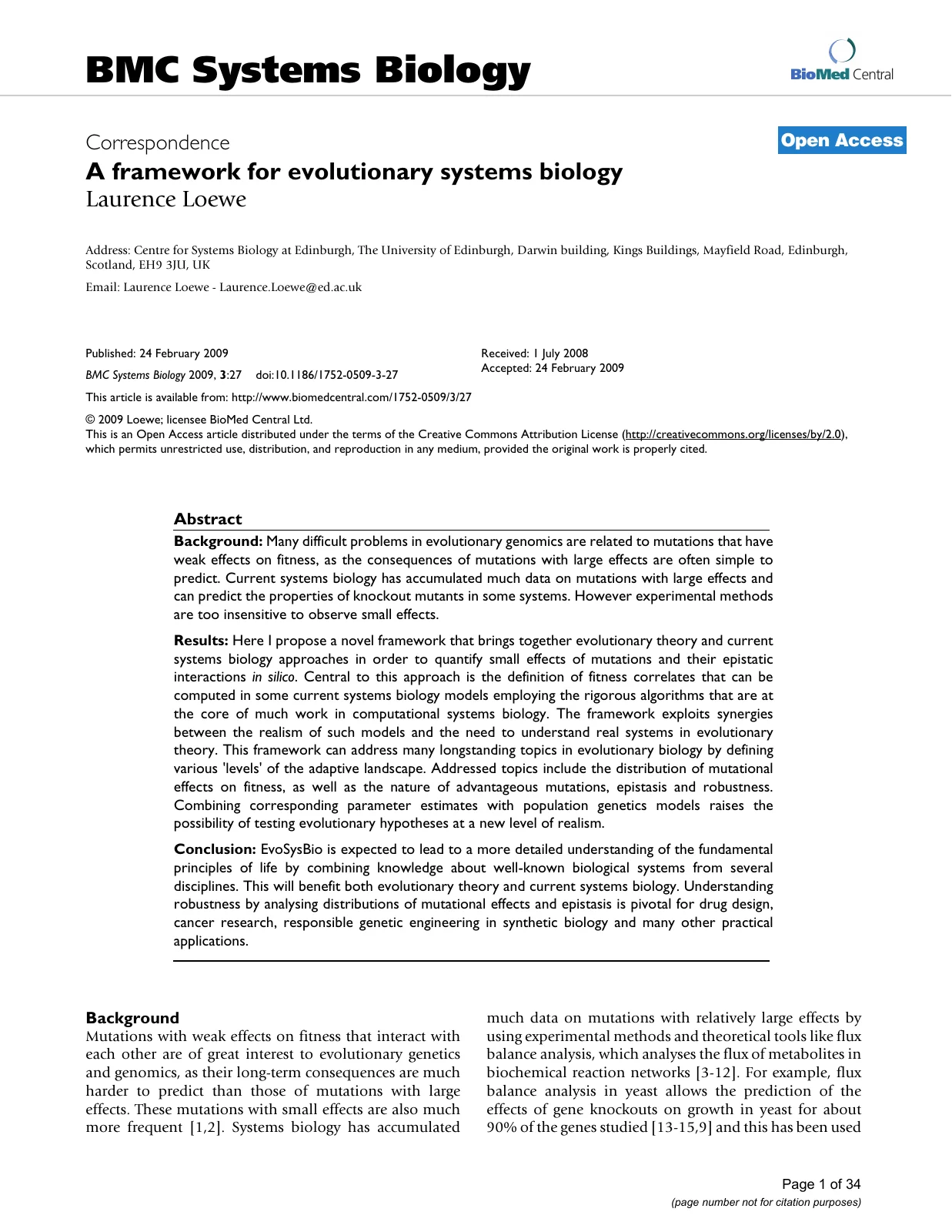
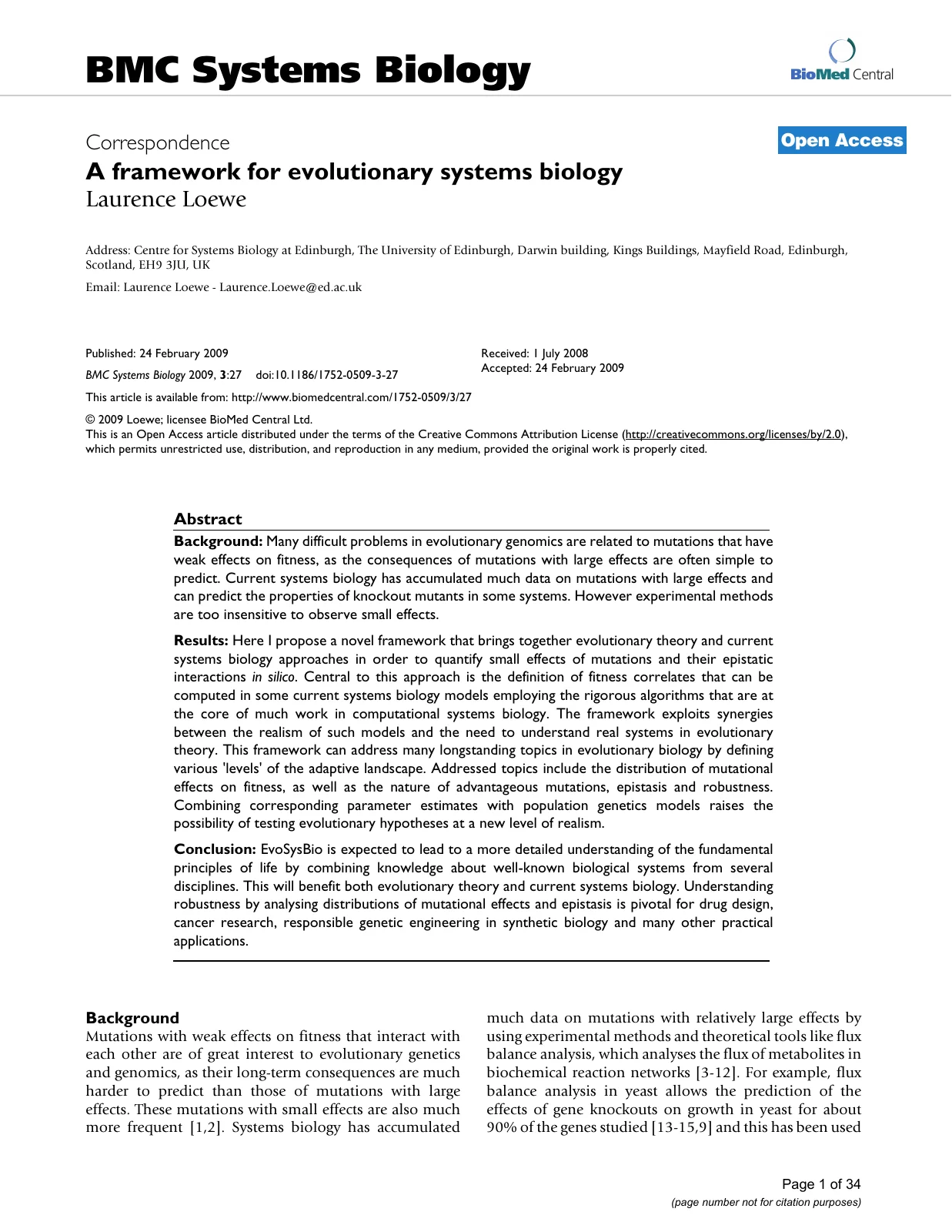
— Overview AI-generated by dv_ClaOp46_ExhB_2026m04d14 —Start—
Abstract#
This 34-page paper, published in BMC Systems Biology 2009, 3:27 (received 1 Jul 2008; accepted 24 Feb 2009; published 24 Feb 2009), proposes a novel framework bringing together evolutionary theory and systems biology to quantify the small effects of mutations and epistatic interactions in silico.
Central to the framework is the definition of fitness correlates — quantities computable in systems biology models that serve as proxies for organismal fitness. The paper defines 7 levels of adaptive landscape ranging from DNA sequences to population fitness, providing a systematic vocabulary for connecting molecular-level changes to evolutionary outcomes.
The framework addresses the distribution of mutational effects, the nature of advantageous mutations, epistasis, and robustness. The conclusion: EvoSysBio is expected to lead to a more detailed understanding of fundamental principles of life by enabling computational experiments that were previously impossible. This is an Open Access paper published under CC BY 2.0.
Broader Significance (Claude’s Assessment)#
This is arguably the most important single paper in LLoL’s scientific output for several reasons:
Foundational definition of a field. This paper defines evolutionary systems biology (EvoSysBio) as a coherent research program with its own methodology, vocabulary, and research agenda. It is the conceptual ancestor of everything that followed in LLoL’s scientific trajectory.
The fitness correlate concept. The definition of fitness correlates — computable quantities in systems biology models that can serve as proxies for fitness — is the key intellectual contribution. This concept bridges two fields (systems biology and evolutionary genetics) that had largely operated in isolation.
7-level adaptive landscape. The systematic decomposition of adaptive landscapes into 7 levels (from DNA to population fitness) provides a framework for thinking about how molecular changes propagate to evolutionary consequences. This hierarchical view remains relevant to current multi-scale modeling efforts.
Scientific backbone of the Matheo papers. The methodology defined here is what gives the Matheo papers their scientific grounding. Claims about modeling biological systems and predicting evolutionary outcomes trace back to this framework.
Most-cited work. As one of LLoL’s most-cited publications, this paper has influenced researchers working at the intersection of evolution and systems biology, contributing to the growing recognition that these fields must be integrated.
Who This Document Is For#
Audience |
Why This Document Matters |
|---|---|
Evolutionary biologists |
Provides a systematic framework for incorporating mechanistic molecular models into evolutionary theory, addressing long-standing questions about the distribution of mutational effects, epistasis, and the nature of advantageous mutations. |
Systems biologists |
Shows how systems biology models can be extended to generate evolutionary predictions via fitness correlates, adding biological significance beyond steady-state and dynamic analysis. |
Computational biologists & modelers |
Defines 7 levels of adaptive landscape that structure how multi-scale models can connect molecular parameters to population fitness — a practical roadmap for model design. |
Reviewers of the Matheo papers |
This is the scientific methodology paper that underpins the modeling claims made in the Matheo series. Understanding the EvoSysBio framework is essential for evaluating those claims. |
Science historians & philosophers of biology |
Documents the moment when evolutionary theory and systems biology were formally brought together as a unified research program, with explicit connections to both traditions. |
Key Concepts at a Glance#
Evolutionary systems biology (EvoSysBio) |
The research program integrating evolutionary theory with systems biology to quantify mutational effects in silico |
Fitness correlates |
Quantities computable in systems biology models that serve as proxies for organismal fitness — the central bridge concept |
7 levels of adaptive landscape |
Systematic decomposition from DNA sequence space to population fitness, providing a multi-scale framework |
Distribution of mutational effects (DME) |
Probability distribution describing how random mutations alter fitness — a central parameter in evolutionary genetics |
Epistasis |
Non-additive interactions between mutations, quantifiable through the framework’s multi-level approach |
Robustness |
The degree to which a biological system maintains function under perturbation — connected to the DME via fitness correlates |
In silico evolution |
Computational experiments simulating mutation and selection using mechanistic molecular models |
Document Information#
Document ID |
BMC Systems Biology 2009, 3:27 (Dusty Deep Data, key-papers/) |
Full title |
A framework for evolutionary systems biology |
Author |
Laurence Loewe |
Year |
2009 (received 1 Jul 2008; accepted 24 Feb 2009; published 24 Feb 2009) |
Journal |
BMC Systems Biology 2009, 3:27 |
DOI |
|
Access |
Open Access (CC BY 2.0) |
Format |
34-page journal article |
License |
|
Part of |
Good News Pack MMv3, Dusty Deep Data / key-papers collection |
PDF size |
780 KB |
WebP size |
200 KB |
Related documents in the Good News Pack:
2008 — DME in Circadian Clock (the application paper developed alongside this framework)
2012 — EvoSysBio Landscapes (extends the adaptive landscape concept)
2016 — Systems EvoSysBio (encyclopedia update of this framework)
— Overview AI-generated by dv_ClaOp46_ExhB_2026m04d14 —End—