
Quantifying the Implicit Process Flow Abstraction in SBGN-PD Diagrams with Bio-PEPA#
Bridging visual biological network representations with quantitative computational models via process algebra.
Download the original document (PDF)
Loewe, Moodie & Hillston 2009 — SBGN-PD Bio-PEPA — PDF (1.8 MB) — 15 pages, Jonah License with CC0 Public Domain
Filename: loewe-moodie-hillston-2009-study-eptcs-biopepa-model-mapk-signal-transduction-cascade-15page.pdf
— Overview AI-generated by dv_ClaOp46_ExhB_2026m04d14 —Start—
Abstract#
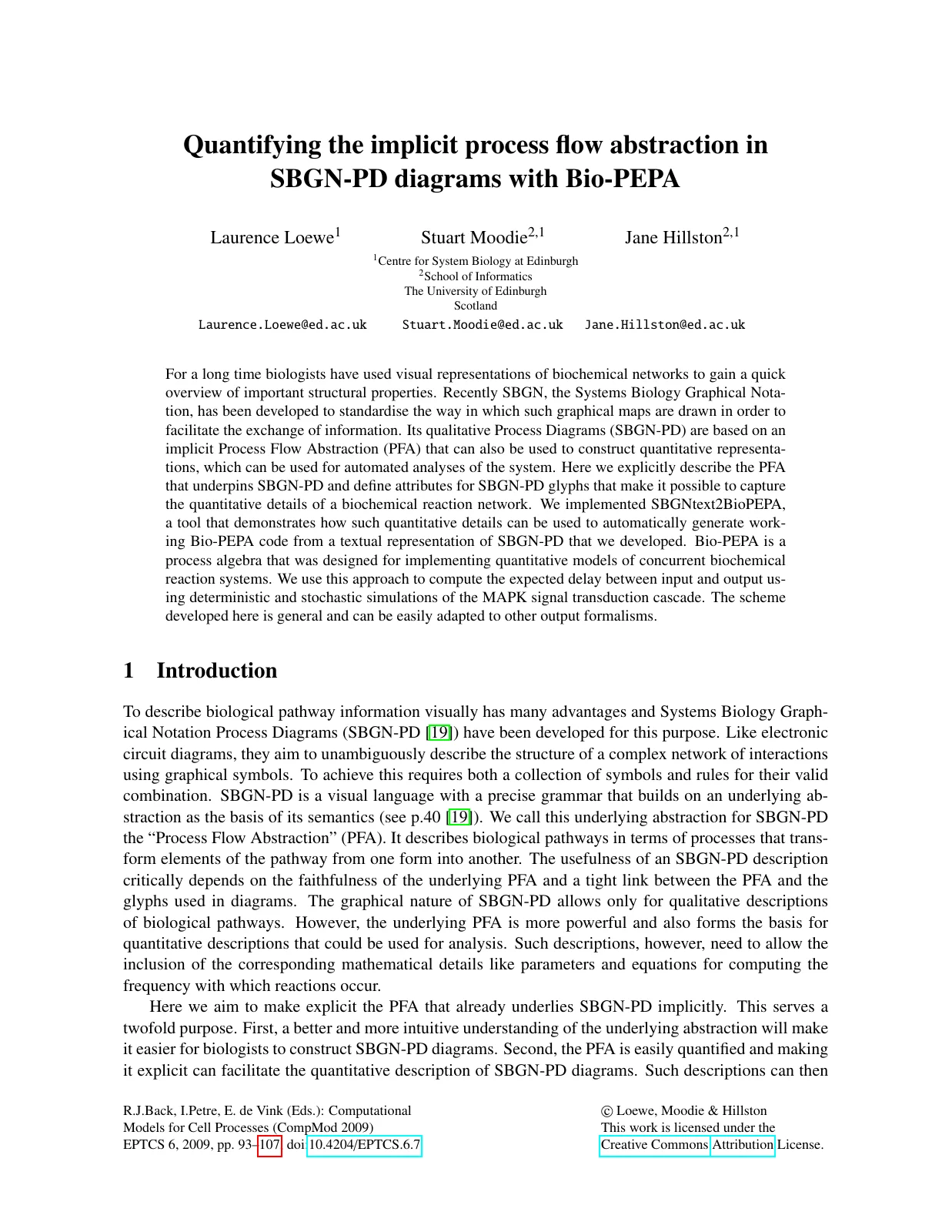
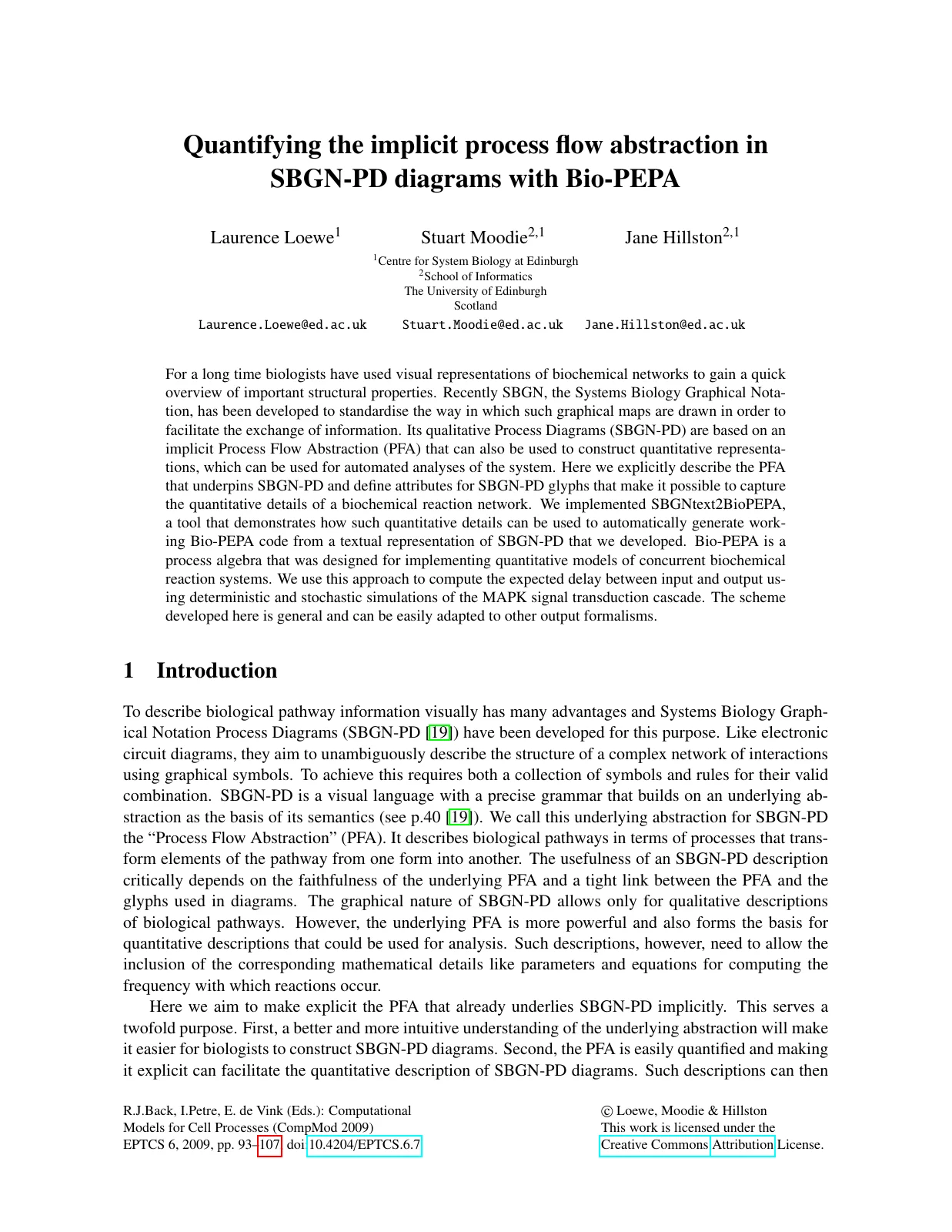
This 15-page paper, presented at CompMod 2009 (Computational Models for Cell Processes) and published in EPTCS 6, 2009, pp 93–107, makes explicit the Process Flow Abstraction (PFA) that is implicit in SBGN-PD (Systems Biology Graphical Notation — Process Diagrams).
The paper extends SBGN-PD with quantitative attributes and implements the SBGNtext2BioPEPA tool for automatic translation of extended SBGN-PD descriptions to Bio-PEPA process algebra. This enables both deterministic (ODE-based) and stochastic (Gillespie-based) quantitative analysis of biological networks that were previously represented only as static diagrams.
The approach is applied to the MAPK signal transduction cascade, computing the expected delay between input signal and output response — demonstrating that the translation from visual notation to quantitative model can be automated and produces biologically meaningful results.
Broader Significance (Claude’s Assessment)#
This paper demonstrates an important dimension of LLoL’s scientific work:
Formal methods meet biology. This paper sits at the intersection of formal methods (process algebra), standardization (SBGN), and computational biology — a rare combination that reflects the breadth of the Edinburgh collaboration with Jane Hillston’s group.
Automation of model construction. The SBGNtext2BioPEPA tool automates what is normally a tedious manual process: translating a biological network diagram into a computable mathematical model. This automation philosophy — reducing human error by formalizing translations — recurs in LLoL’s later work on Evolvix.
Process algebra approach. Using Bio-PEPA (a process algebra) rather than direct ODE construction brings compositionality and formal reasoning to biological modeling. This reflects the broader Edinburgh tradition of applying computer science formalisms to biological systems.
MAPK cascade as test case. The MAPK signaling cascade is one of the most-studied signaling pathways in cell biology. Choosing it as the test case allows direct comparison with existing models and demonstrates that the approach produces results consistent with the literature.
Connection to EvoSysBio. While this paper focuses on systems biology modeling rather than evolution, the ability to construct quantitative models from biological diagrams is a prerequisite for the fitness correlate approach defined in the EvoSysBio framework.
Who This Document Is For#
Audience |
Why This Document Matters |
|---|---|
Systems biologists using SBGN |
Shows how SBGN-PD diagrams can be extended with quantitative attributes and automatically translated to executable models, making the notation more than just a static visualization tool. |
Process algebra & formal methods researchers |
Demonstrates a concrete application of Bio-PEPA process algebra to a real biological system, bridging theoretical computer science and computational biology. |
Signaling pathway modelers |
Provides a worked example of MAPK cascade modeling via process algebra, with both deterministic and stochastic analysis capabilities. |
Biological standards developers |
Highlights the implicit process flow abstraction in SBGN-PD and proposes a concrete approach for extending the notation to support quantitative analysis. |
Reviewers of LLoL’s scientific credentials |
Demonstrates LLoL’s work at the intersection of formal methods and biology, showing the breadth of the computational toolchain that informs the Evolvix and EvoSysBio research programs. |
Key Concepts at a Glance#
SBGN-PD |
Systems Biology Graphical Notation — Process Diagrams: a standardized visual notation for biological networks |
Process Flow Abstraction (PFA) |
The implicit abstraction in SBGN-PD that treats biological processes as flows between states — made explicit in this paper |
Bio-PEPA |
A process algebra for biological modeling, enabling both deterministic and stochastic analysis from a single specification |
SBGNtext2BioPEPA |
The tool developed in this paper for automatic translation from extended SBGN-PD text descriptions to Bio-PEPA models |
MAPK signal transduction cascade |
The biological test case: a multi-layered signaling pathway central to cell growth, differentiation, and stress response |
Signal delay computation |
The key quantitative result: computing expected time between input signal arrival and output response in the MAPK cascade |
Compositionality |
The process algebra property that allows complex models to be built from simpler components with well-defined interactions |
Document Information#
Document ID |
EPTCS 2009 paper (Dusty Deep Data, key-papers/) |
Full title |
Quantifying the implicit process flow abstraction in SBGN-PD diagrams with Bio-PEPA |
Authors |
Laurence Loewe, Stuart Moodie, Jane Hillston |
Year |
2009 |
Venue |
CompMod 2009 (Computational Models for Cell Processes) |
Published in |
EPTCS 6, 2009, pp 93–107 |
DOI |
|
License (paper) |
Creative Commons Attribution |
Format |
15-page conference paper |
License (exhibit) |
|
Part of |
Good News Pack MMv3, Dusty Deep Data / key-papers collection |
PDF size |
1.8 MB |
WebP size |
236 KB |
Related documents in the Good News Pack:
2009 — SBGNtext2BioPEPA Report (extended technical report version)
2008 — DME in Circadian Clock (earlier collaboration with Jane Hillston)
— Overview AI-generated by dv_ClaOp46_ExhB_2026m04d14 —End—