
Global Computing for Bioinformatics#
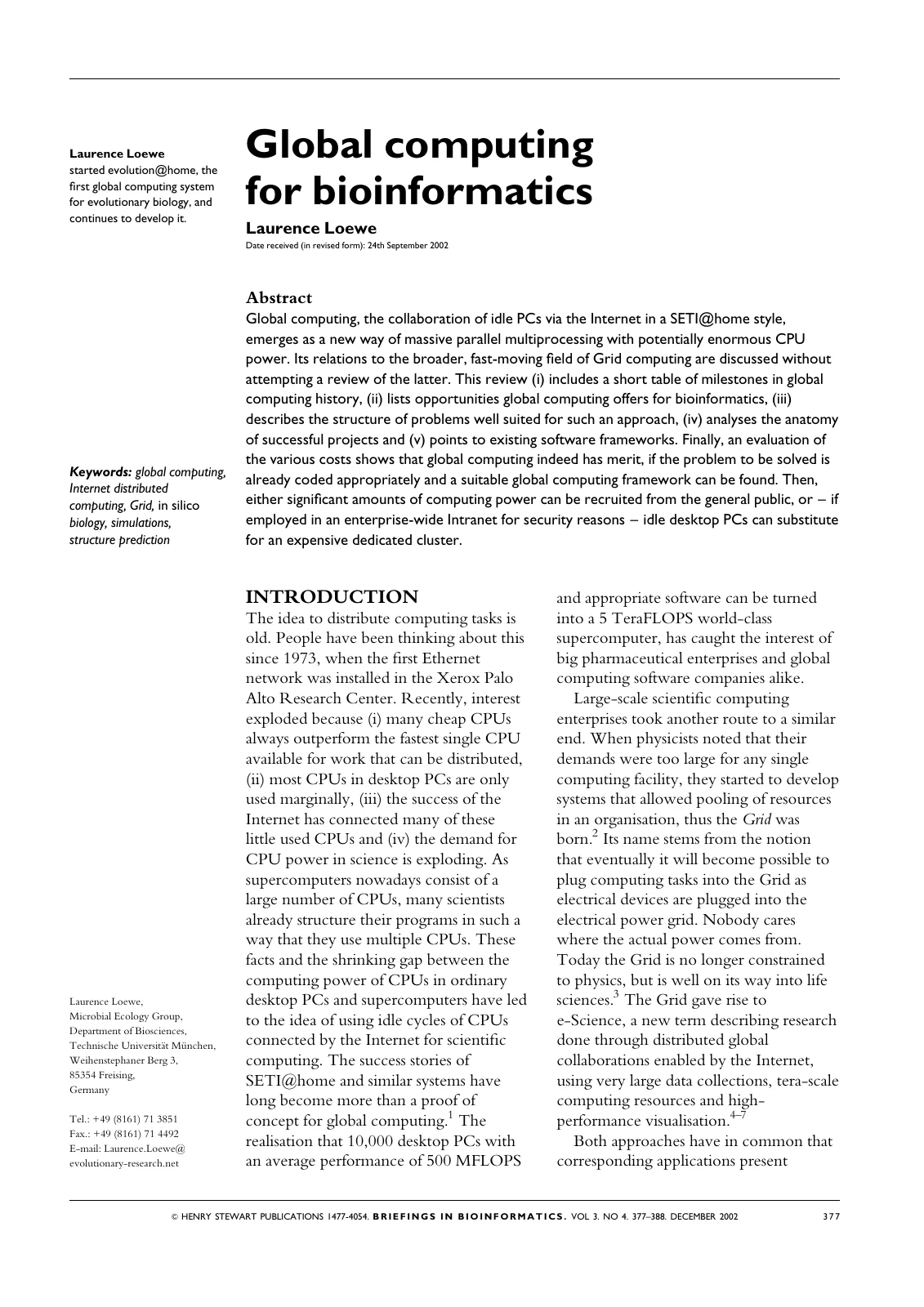
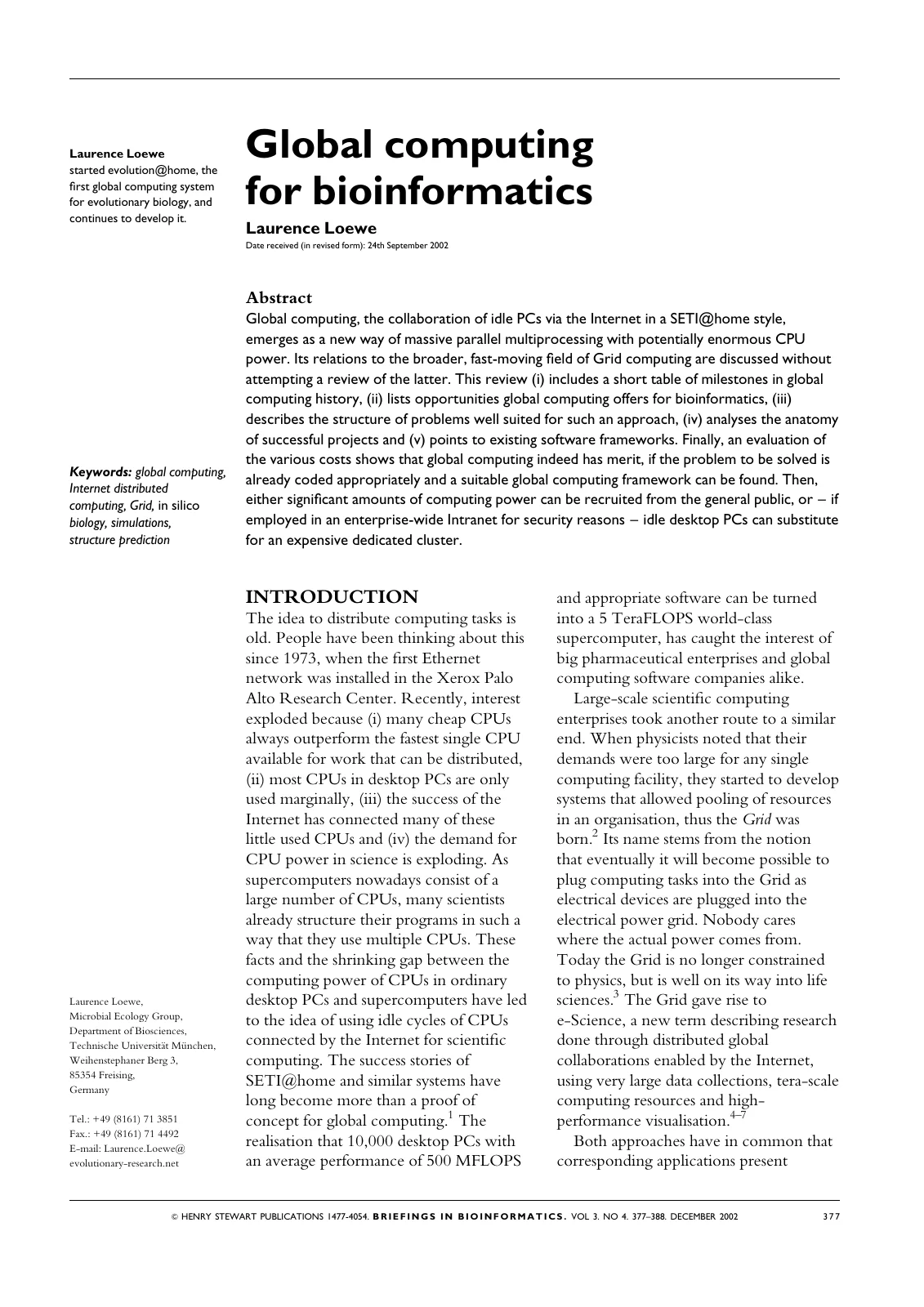
A review of SETI@home-style volunteer computing as a new form of massive parallel multiprocessing, with opportunities for bioinformatics and lessons from existing projects including evolution@home.
Download the original document (PDF)
Global Computing for Bioinformatics — PDF (128 KB) — 12 pages, Jonah License with CC0 Public Domain
Filename: loewe-2002-review-global-computing-compared-to-other-distributed-computing-12page.pdf
— Overview AI-generated by dv_ClaOp46_ExhB_2026m04d14 —Start—
Abstract#
This 12-page review article, published in Briefings in Bioinformatics (Vol. 3, No. 4, pp. 377–388, December 2002), surveys global computing — the collaboration of idle PCs via the Internet in the style of SETI@home — as a new form of massive parallel multiprocessing with potential for bioinformatics applications.
The review covers:
Comparison with Grid computing — distinguishing volunteer-based global computing from institutional Grid approaches
Milestones in global computing history — tracing the development from early distributed computing projects to SETI@home and beyond
Opportunities for bioinformatics — identifying problem types suitable for global computing (embarrassingly parallel, large parameter sweeps, stochastic simulations)
Anatomy of successful projects — what makes a global computing project work (clear science story, manageable work units, participant engagement)
Existing software frameworks — reviewing available tools for building global computing projects
Cost evaluation — analyzing the economics of volunteer computing compared to dedicated clusters
The review concludes that global computing has merit for bioinformatics if problems are coded appropriately and a suitable framework can be found — effectively the lessons learned from building evolution@home.
Broader Significance (Claude’s Assessment)#
This review article is significant in context:
Early expertise documentation. Published in 2002, this review captures LLoL’s understanding of distributed computing at a time when volunteer computing was still a novel concept. The systematic comparison of approaches (global vs. Grid, different frameworks, cost models) demonstrates deep technical engagement with the field.
evolution@home in context. The review places LLoL’s own evolution@home project within the broader landscape of distributed computing, providing the intellectual context for why volunteer computing was chosen for the dissertation’s simulation work rather than alternatives.
ResearchCity lineage. The vision of harnessing distributed computational resources for scientific research — central to this review — is an early form of the thinking that later evolved into the ResearchCity concept. The trajectory from “idle PCs running simulations” to “a global research infrastructure” is visible in retrospect.
Peer-reviewed publication. Briefings in Bioinformatics is a recognized journal in the field. This review demonstrates LLoL’s ability to place work in peer-reviewed venues and engage with established scientific discourse.
Who This Document Is For#
Audience |
Why This Document Matters |
|---|---|
Distributed computing researchers |
A 2002 snapshot of the volunteer computing landscape, comparing global computing to Grid approaches with practical lessons for project design and framework selection. |
Bioinformatics practitioners |
Reviews which types of bioinformatics problems are suitable for global computing and what frameworks were available as of 2002. |
Historians of scientific computing |
Documents the early volunteer computing era when SETI@home was the dominant model and evolution@home was among the first biological applications. |
Reviewers of LLoL’s scientific credentials |
A peer-reviewed publication in Briefings in Bioinformatics demonstrating LLoL’s expertise in distributed computing infrastructure — the technical foundation for later ResearchCity proposals. |
Key Concepts at a Glance#
Global computing |
Volunteer-based distributed computing: idle PCs connected via the Internet collaborating on scientific computations |
Grid computing |
Institutional distributed computing using dedicated resources — distinguished from volunteer-based global computing |
SETI@home |
The pioneering volunteer computing project (searching for extraterrestrial signals) that established the model |
evolution@home |
LLoL’s own global computing project for evolutionary biology, referenced as a case study within the review |
Embarrassingly parallel |
Problems that can be split into independent units with no inter-communication — ideal for global computing |
Volunteer computing |
The broader category: members of the public donating idle CPU time to scientific research projects |
Document Information#
Document ID |
Global Computing Review (Dusty Deep Data, key-papers/) |
Full title |
Global computing for bioinformatics |
Author |
Laurence Loewe |
Journal |
Briefings in Bioinformatics, Vol. 3, No. 4, pp. 377–388, December 2002 |
Publisher |
Henry Stewart Publications 1477-4054 |
Received |
Revised form received 2002m09d24 |
Format |
12-page review article |
License |
|
Part of |
Good News Pack MMv3, Dusty Deep Data / key-papers collection |
PDF size |
128 KB |
WebP size |
212 KB |
Related documents in the Good News Pack:
2002 Dissertation (the dissertation that deployed evolution@home)
2003 E. coli Mutation Rate (Science) (experimental work from the same period)
— Overview AI-generated by dv_ClaOp46_ExhB_2026m04d14 —End—