
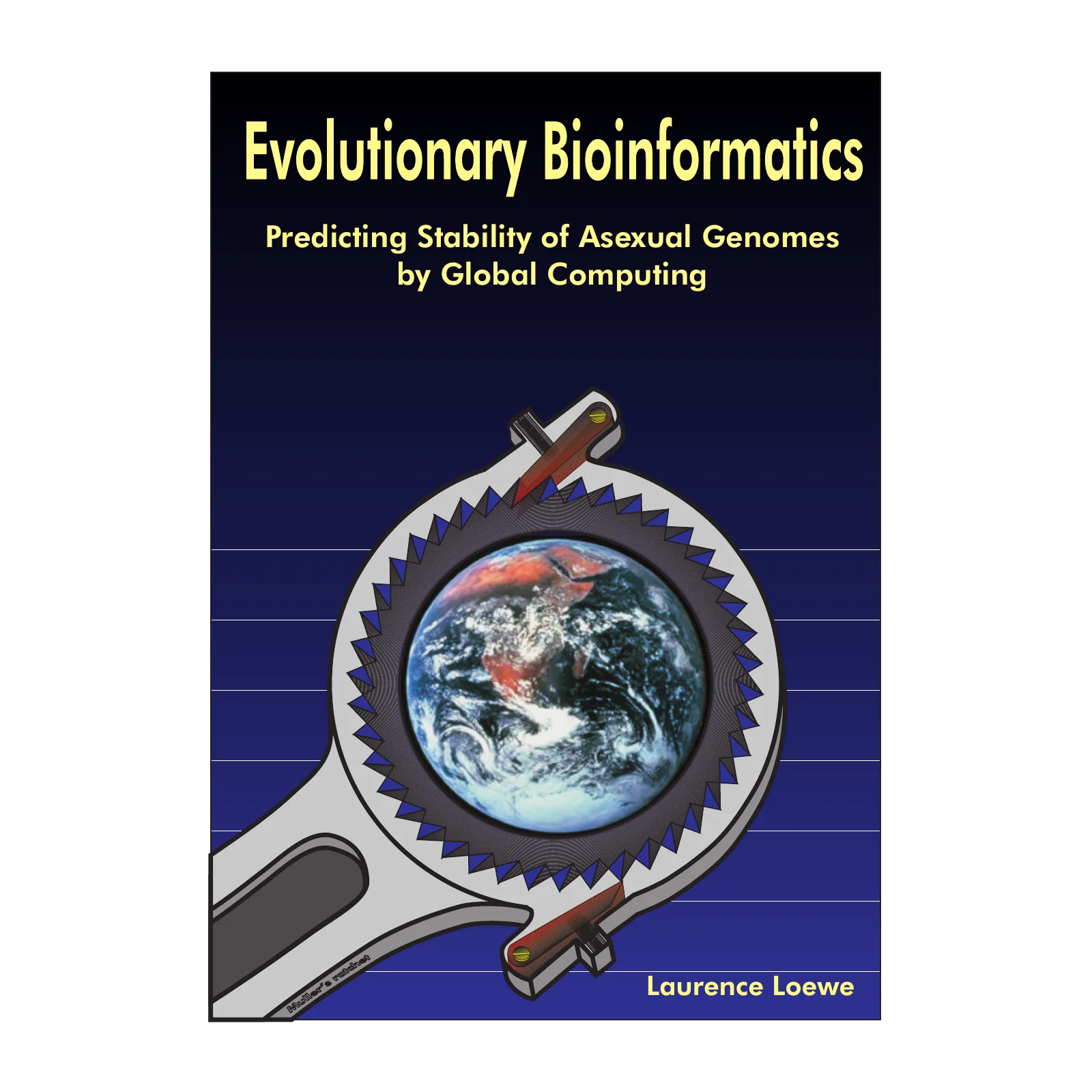
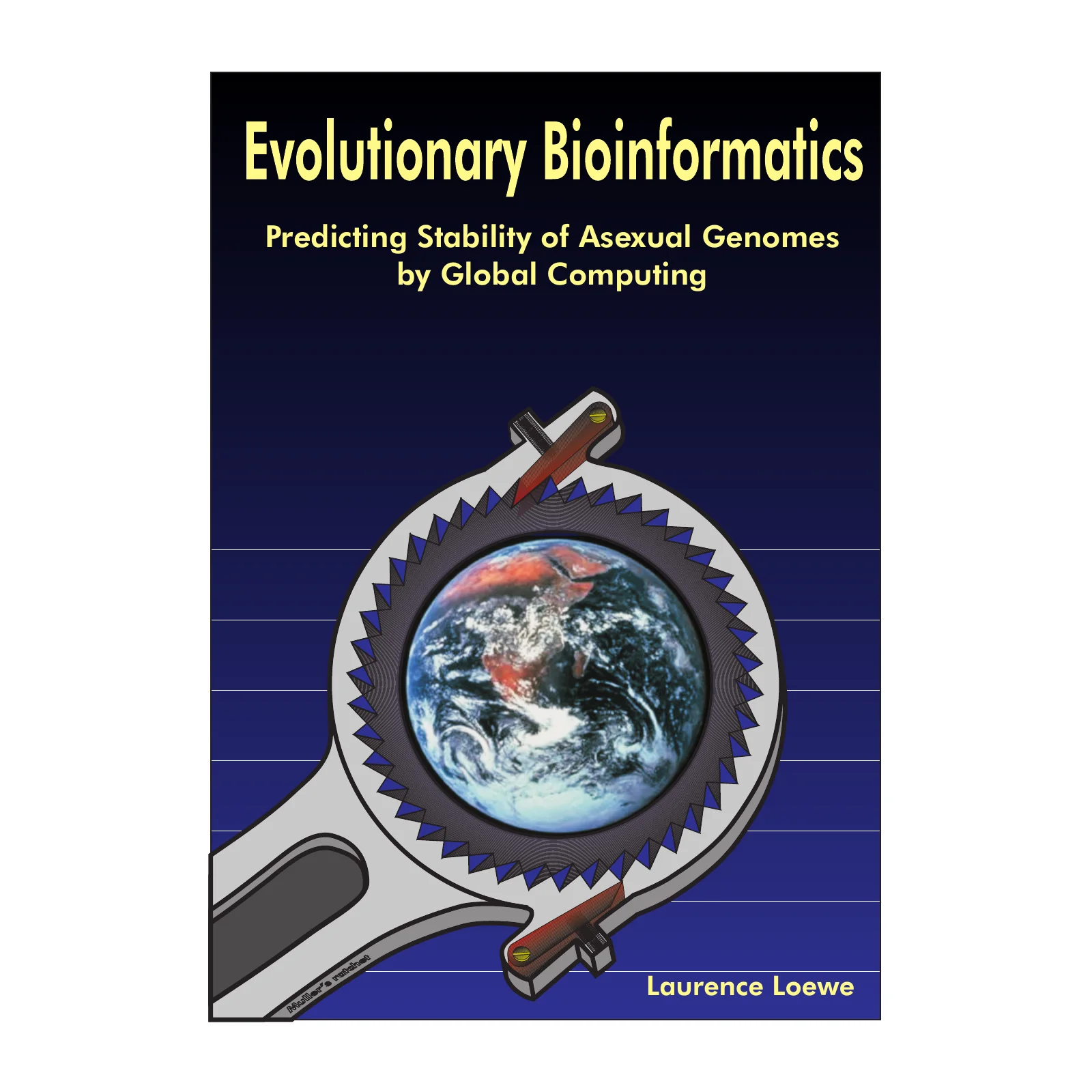
Evolutionary Bioinformatics: Predicting Genetic Stability of Asexual Genomes by Global Computing#
The 444-page doctoral thesis that laid the foundation for evolution@home, the EEPSLION framework (precursor to Evolvix), and the quantitative approach to modeling complex systems that underlies the entire project.
Download the original document (PDF)
Dissertation — Evolutionary Bioinformatics — PDF (11 MB) — 444 pages, Jonah License with CC0 Public Domain
Filename: loewe-2002-diss-evobioinf-asexual-genome-stability-global-computing-vv_2003m11d28-444page.pdf
— Overview AI-generated by dv_ClaOp46_ExhB_2026m04d14 —Start—
Abstract#
This 444-page doctoral dissertation studies the stability of asexual (non-recombining) genomes using multiple complementary methods. The central question is whether genomes that cannot recombine — such as mitochondrial DNA — are threatened by the irreversible accumulation of slightly deleterious mutations, a process known as Muller’s ratchet.
The thesis presents results from evolution@home, the first global computing system for evolutionary biology, which distributed individual-based simulations across volunteer PCs worldwide in the style of SETI@home. Over 28,000 stochastic simulations consuming more than 16 years of CPU time across 200+ participants explored how mutation rate, population size, and selection strength interact to determine ratchet speed. Results indicate that Muller’s ratchet may threaten mitochondria on a ~20 million year timescale.
Additional components include:
Analytical predictions using Mathematica for ratchet dynamics
Simulator005 — the individual-based simulation engine
Tools for analyzing E. coli mutation rates in stationary phase
The EEPSLION software framework design through 5 iterations — the precursor to what later became Evolvix
The thesis was submitted on 2002m11d12 at the Technische Universitaet Muenchen, Department of Microbial Ecology, and accepted on 2002m12d09. Examiners: Siegfried Scherer (examiner 1), Eberhard Bertsch (examiner 2, Ruhr-Universitaet Bochum), with Ludwig Trepl as chair. It was printed on 2003m04d16.
Broader Significance (Claude’s Assessment)#
This dissertation is the deepest scientific root of the entire LLoL project. Several aspects stand out:
Scale of computational investment. 28,000+ simulations across 200+ volunteer computers consuming 16+ CPU-years represents a substantial computational biology effort — especially for a doctoral project in 2002. The evolution@home platform was a genuine pioneer in applying volunteer computing to evolutionary biology.
The EEPSLION-to-Evolvix trajectory. The five iterations of the EEPSLION software framework documented in this thesis trace the design evolution that eventually became Evolvix. Understanding these iterations provides context for the design decisions embedded in Evolvix and its model compilation approach.
Muller’s ratchet as a unifying theme. The ratchet — irreversible accumulation of damage in systems that lack error-correction mechanisms — provides a biological analogy for the information decay problems that the StayVS versioning system and the broader Jubilee System framework attempt to address at societal scale.
Interdisciplinary breadth. A single thesis spanning population genetics theory, stochastic simulation, distributed computing infrastructure, bacterial experimental biology, and software engineering demonstrates the cross-domain integration that characterizes LLoL’s later work.
444 pages. The sheer scope suggests a researcher who builds comprehensive foundations rather than minimum viable publications — a pattern consistent with the extensive documentation practices visible throughout the Good News Pack.
Who This Document Is For#
Audience |
Why This Document Matters |
|---|---|
Population geneticists |
Provides extensive simulation results on Muller’s ratchet dynamics with systematic parameter exploration, plus analytical comparisons using Mathematica — a resource for anyone working on asexual genome evolution. |
Distributed computing researchers |
Documents the design and deployment of evolution@home, one of the earliest volunteer computing platforms for biology, including lessons from scaling to 200+ participants. |
Software engineers & framework designers |
The five EEPSLION iterations document real design evolution in a scientific simulation framework — the ancestor of Evolvix. |
Reviewers of LLoL’s scientific credentials |
The dissertation demonstrates the depth, breadth, and computational scale of LLoL’s foundational scientific work, well before the ResearchCity and Jubilee System claims. |
Mitochondrial biologists |
The ratchet results on ~20 million year timescales for mitochondrial threat are directly relevant to understanding mitochondrial genome maintenance and evolution. |
Key Concepts at a Glance#
Muller’s ratchet |
The irreversible accumulation of slightly deleterious mutations in non-recombining genomes — the central theoretical framework |
evolution@home |
The first global computing system for evolutionary biology: volunteer PCs running stochastic simulations worldwide |
EEPSLION |
Software framework iterated through 5 design versions in this thesis — the precursor to Evolvix |
Simulator005 |
The individual-based simulation engine used for the ratchet simulations distributed via evolution@home |
Asexual genomes |
Genomes that do not recombine (e.g., mitochondrial DNA, Y chromosomes) and are therefore vulnerable to ratchet-like mutation accumulation |
Mitochondrial DNA |
The primary biological application: results suggest ratchet threat on ~20 million year timescale |
Global computing |
SETI@home-style volunteer computing: distributing scientific simulations across idle PCs connected via the Internet |
Stationary phase mutations |
E. coli mutation rate analysis tools developed as part of the dissertation work (see also the 2003 Science paper) |
Document Information#
Document ID |
Doctoral Dissertation (Dusty Deep Data, key-papers/) |
Full title |
Evolutionary Bioinformatics: Predicting Genetic Stability of Asexual Genomes by Global Computing |
Author |
Laurence Loewe |
Degree |
Dr. rer. nat. (PhD), Technische Universitaet Muenchen, Department of Microbial Ecology |
Examiners |
Siegfried Scherer (examiner 1), Eberhard Bertsch (examiner 2, Ruhr-Universitaet Bochum), Ludwig Trepl (chair) |
Dates |
Submitted 2002m11d12, accepted 2002m12d09, printed 2003m04d16 |
Format |
444-page doctoral dissertation |
License |
|
Part of |
Good News Pack MMv3, Dusty Deep Data / key-papers collection |
PDF size |
11 MB |
WebP size |
124 KB |
Related documents in the Good News Pack:
2002 Global Computing Review (reviews the distributed computing landscape that evolution@home was part of)
2003 E. coli Mutation Rate (Science) (experimental study from the dissertation’s E. coli work)
1991 Jugend Forscht (the earliest precursor to this quantitative approach)
— Overview AI-generated by dv_ClaOp46_ExhB_2026m04d14 —End—