Social Cards for Matheology
When you share a link to a matheology page on social media (Twitter/X,
Facebook, LinkedIn, Slack, Discord, etc.), the platform shows a social card
— a preview with a title, description, and image. These cards are the first
thing most people see, so they matter.
What Is a Social Card?
A social card is generated from metadata in each page’s HTML header. When
someone pastes a link, the platform reads:
og:card:title — the bold headline on the card (35–45 characters)
description — the text below the title (140–150 characters)
og:card:image — the preview image (auto-generated at 1146 x 600 px)
These fields are set via .. meta:: directives at the top of each RST file.
The site’s build system (sphinxext-opengraph) converts them into the
standard Open Graph tags that social media platforms expect.
Example: The Matheology Landing Page
Here is what the social card for the main matheology page looks like when
shared on social media:
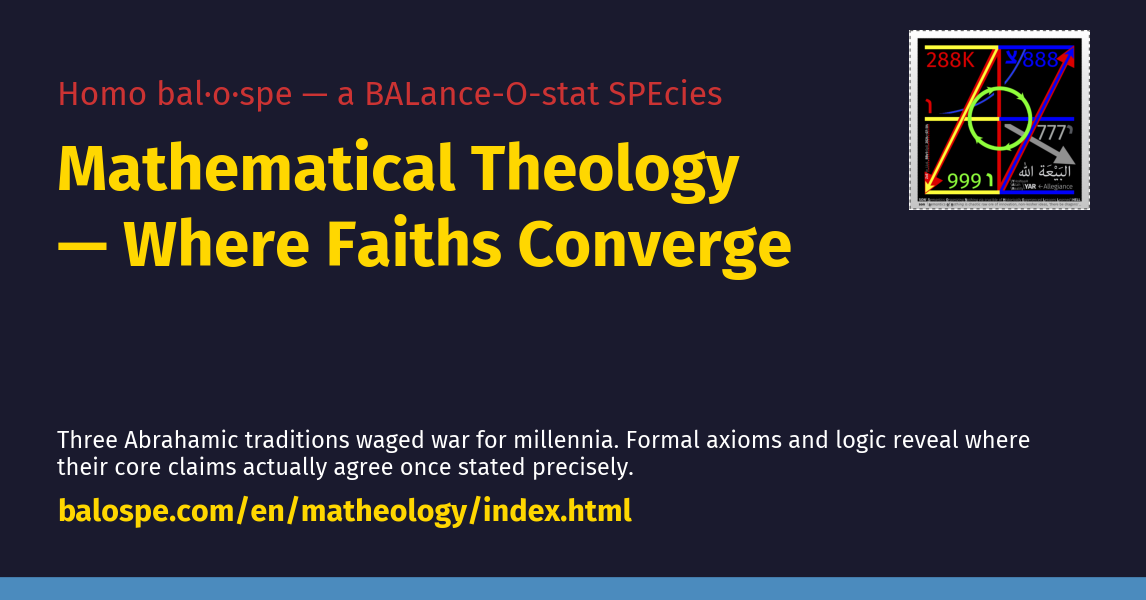
The fields that produced this card:
This card is crafted to:
Be self-explanatory — the title alone tells you what the page is about
Hook the reader — the description makes you want to click
End at natural boundaries — no mid-word truncation on any platform
Be accurate — the description matches what you actually find on the page
Coverage
Every page in the matheology section (~245 pages) has social card metadata.
The current active set was generated by Claude Opus 4.6 on 2026-03-26.

Social Cards for Matheology#
When you share a link to a matheology page on social media (Twitter/X, Facebook, LinkedIn, Slack, Discord, etc.), the platform shows a social card — a preview with a title, description, and image. These cards are the first thing most people see, so they matter.
What Is a Social Card?#
A social card is generated from metadata in each page’s HTML header. When someone pastes a link, the platform reads:
og:card:title — the bold headline on the card (35–45 characters)
description — the text below the title (140–150 characters)
og:card:image — the preview image (auto-generated at 1146 x 600 px)
These fields are set via
.. meta::directives at the top of each RST file. The site’s build system (sphinxext-opengraph) converts them into the standard Open Graph tags that social media platforms expect.Example: The Matheology Landing Page#
Here is what the social card for the main matheology page looks like when shared on social media:
The fields that produced this card:
Title
Mathematical Theology — Axioms, Common Ground
Description
Matheology uses axiomatic logic to find where theological traditions that waged war for millennia actually agree once stated precisely.
This card is crafted to:
Be self-explanatory — the title alone tells you what the page is about
Hook the reader — the description makes you want to click
End at natural boundaries — no mid-word truncation on any platform
Be accurate — the description matches what you actually find on the page
Coverage#
Every page in the matheology section (~245 pages) has social card metadata. The current active set was generated by Claude Opus 4.6 on 2026-03-26.
Social Card Pages