Note
Draft status: MMv2-Intro (2026m04d09).
Major revision of MMv1-Intro. Key changes: (1) death probability
corrected to 1/3 with BABL death-trifecta reasoning; (2) 500x claim
replaced with “someone like the author” formulation; (3) 1-in-40
finding prominently featured; (4) Evolvix code and download link
included; (5) COOP moved to b18; (6) “what can I do?” response
problem addressed honestly; (7) “accidental nuclear winter” framing
throughout; (8) figures included.
Draft by Claude Opus 4.6 (dv_ClaOp46_MMv2_intro_2026m04d09).
Nuclear Roulette Is Unwinnable — Here Is the Escape#
The Situation#
Imagine you are playing a version of Russian roulette. Not with a six-shot revolver — with a forty-shot revolver. One chamber is loaded. You spin the cylinder. You pull the trigger. Click. You survive.
Now you must play again next year. And the year after that. And every year for the rest of your life. You cannot stop playing. And if the bullet fires, it does not kill just you — it kills billions of people.
This is not a metaphor. This is a description of the current global nuclear situation, translated into probabilities.
A mathematical model called RiskyMAD, built from Cold War data, says: regardless of whether the crisis rate is high, medium, or low, approximately 1 in 40 simulation runs produces accidental nuclear winter within the first year. Not within a century. Within a year.
No industry on Earth would accept a 1-in-40 annual risk of catastrophic failure. If 1 in 40 flights crashed, no one would fly. If 1 in 40 patients died from a medication, the drug would be withdrawn immediately. Yet this is the risk that nuclear civilization carries, every year, by default.
At the base crisis rate (estimated from Cold War near-misses), the median time until accidental nuclear winter begins is approximately 19 years. Not 200 years. Not “someday.” Nineteen years.
This paper explains three things:
Why the risk is real — not a guess but a calculation from historical data that anyone can check.
Why we cannot wait — why this is a stochastic certainty (it will happen; the only question is when).
How to escape — a specific plan called MAP (Mutually Assured Progress) that replaces the threat of mutual destruction with a shared commitment to mutual progress.
The math is not comforting. But it is honest. And honesty is the first step out of any trap.
1. The Risk: What the Numbers Say#
1.1 The Near-Misses You May Not Know About#
During the Cold War, the world came closer to nuclear war than most people realize:
Cuban Missile Crisis, October 1962. Soviet submarine B-59 was being depth-charged by US destroyers near Cuba. The submarine carried a nuclear-tipped torpedo. The captain wanted to fire. The political officer agreed. Launch required the consent of all three senior officers. The third officer — Vasili Arkhipov — refused. One person. One decision. One “no” that may have prevented nuclear war.
President Kennedy later estimated the probability of nuclear war during the crisis at “somewhere between one in three, and even” — between 33% and 50% (Sorensen, Kennedy, Harper & Row, 1965).
Petrov Incident, September 1983. Soviet early-warning systems reported five incoming US missiles. Lt. Col. Stanislav Petrov judged it was a false alarm — and was right. If he had followed protocol, the Soviet retaliatory launch sequence would have begun.
Able Archer 83, November 1983. A NATO exercise so realistic that Soviet intelligence believed it might be cover for a genuine first strike. Soviet nuclear forces were placed on heightened alert.
Norwegian Rocket Incident, January 1995. A scientific rocket mistaken for a submarine-launched missile. President Yeltsin activated the nuclear briefcase — the only confirmed such activation.
These are documented in declassified archives, in books by Ellsberg (2017) and Schlosser (2013), and in academic journals. They are simply not widely known.
1.2 The Model: Simple Enough to Check#
The RiskyMAD model is deliberately simple. It has three states:
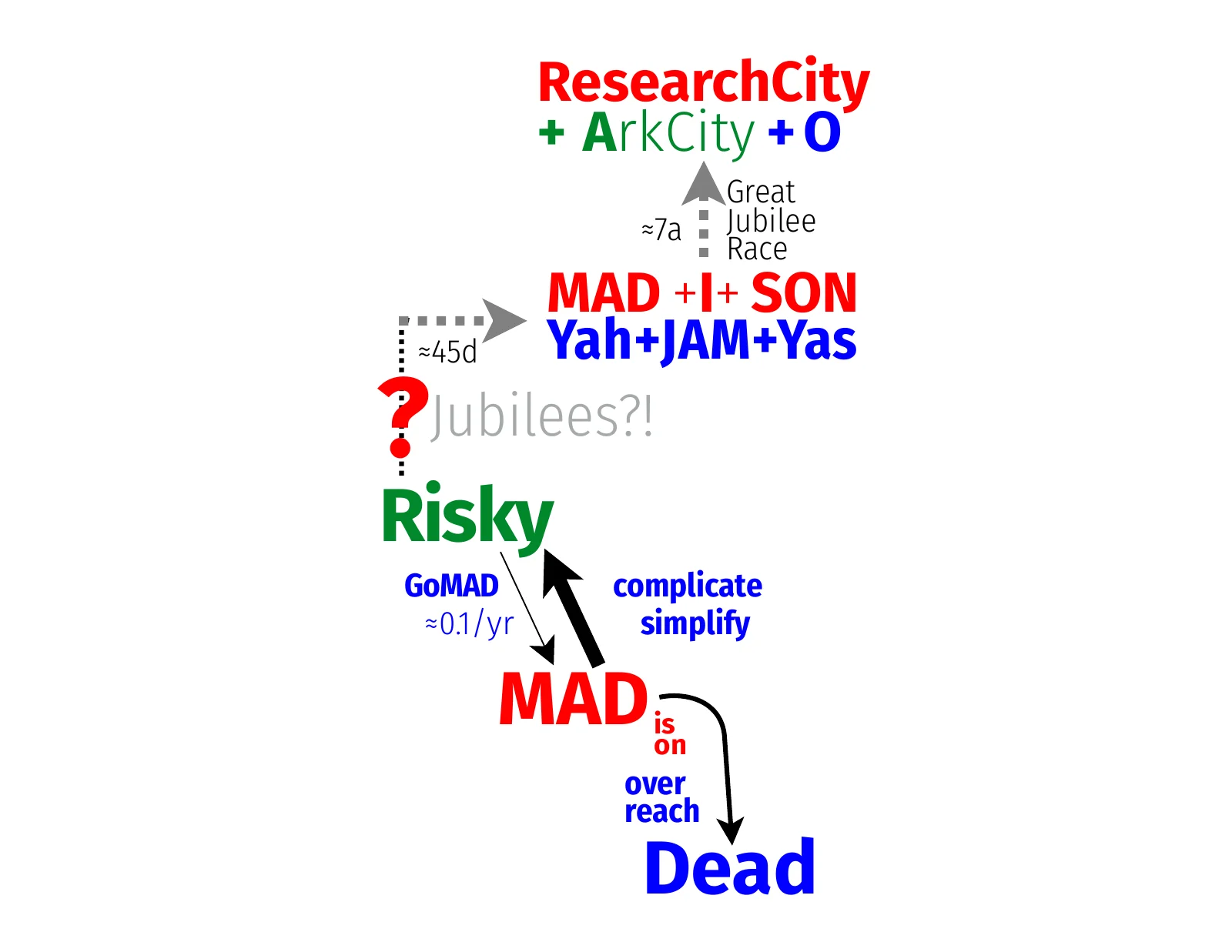
Figure 1: The RiskyMAD model. Three states, four transitions.#
Risky: The current state. Nuclear weapons exist. Crises can happen. No nuclear exchange has occurred.
MAD: A crisis state. The world is at the brink. There is a 1/3 probability of nuclear exchange per crisis.
Dead: Accidental nuclear winter has begun. This is permanent.
Why 1/3? The model connects directly to a deeper result from this series. Under the BABL mechanism (Blindly Assuming Blind Leveraging), crises resolve through one of three modes: over-Simplifying (crisis subsides, tensions deferred), over-Complicating (crisis buried under diplomatic complexity, tensions deferred), or over-Reaching (someone crosses the point of no return). Two out of three modes send the system back to Risky. One produces death. Hence 1/3.
The crisis rate is estimated from the Cold War record: approximately 4 serious near-misses in 40 years, or about 0.1 per year (one crisis every 10 years, on average). This is probably an underestimate — many incidents remain classified.
1.3 The Results: Shorter Than You Think#
The model was run as a stochastic simulation — like rolling dice thousands of times and recording what happens. Each run generates one possible future. Forty independent runs were generated for each scenario.
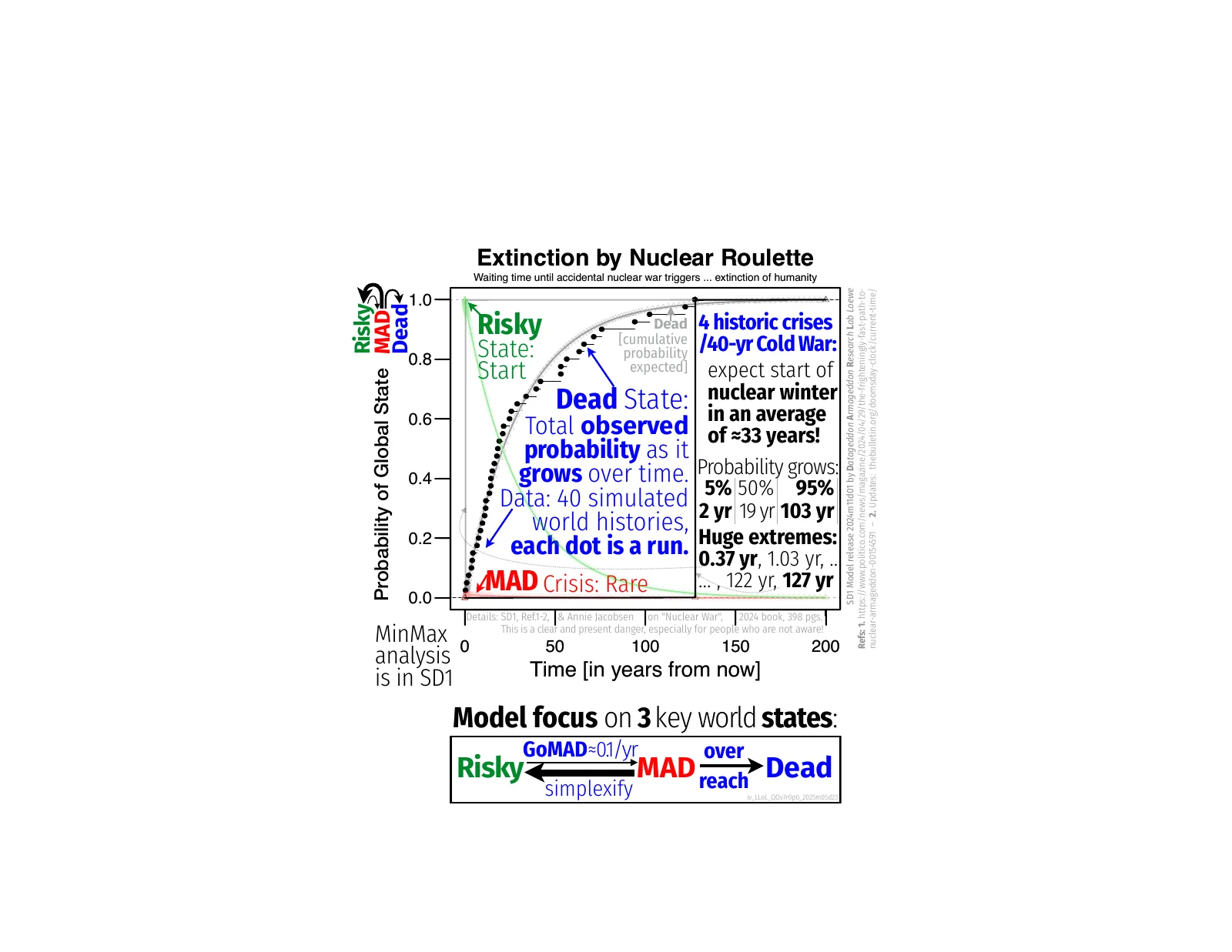
Figure 2: Stochastic inevitability of accidental nuclear winter. Forty simulation runs per scenario.#
At the base crisis rate (0.1/year):
Median: ~19 years until accidental nuclear winter begins
Mean: ~33 years
At the most optimistic crisis rate (0.03/year):
Median: ~51 years
At a pessimistic crisis rate (0.3/year):
Median: ~7 years
The 1-in-40 finding: Regardless of the scenario — pessimistic, base, or optimistic — approximately 1 in 40 runs produces accidental nuclear winter within the first year. This risk would be completely unacceptable for airplanes, cars, medications, or any other technology. Why should we accept it for global survival?
How dangerous is this personally? Someone like the author of this paper — living in the United States — is more likely to die in accidental nuclear winter than to die in a car crash. Not because nuclear war is imminent on any given day, but because accidental nuclear winter, if initiated, kills billions through the subsequently emerging global cooling, agricultural collapse, and famine. The nuclear winter is the mass killer, not the exchange itself.
You can check this yourself. The entire model code is published. The Evolvix prototype compiler is freely downloadable from Evolvix Prototype Compiler — Download and RiskyMAD Model Code. Here is the complete model:
Evolvix Quest RiskyMADdead
(Question: "How many years until humanity self-destructs
            in a nuclear roulette accident?")

Simulate stochastically until 200 :["years"]

Initial Amount of Risky       = 1
Initial Amount of MAD         = 0
Initial Amount of Dead        = 0
Initial Amount of rRiskyGoMAD = 0.10
Initial Amount of rMADescapes = 6
Initial Amount of rMADtoDEATH = 3

Action 1 ( Risky ---[ Rate = 0.10 ]---> MAD     )
Action 2 ( MAD   ---[ Rate = 6    ]---> Risky   )
Action 3 ( MAD   ---[ Rate = 3    ]---> Dead    )
Action 4 ( Risky ---[ Rate = 0    ]---> LifeMAP )
That is the entire model. Other simulation frameworks require hundreds of lines of code for the same calculation. Evolvix was designed to make accurate stochastic modeling this simple. #AuditTheMath
2. Why We Cannot Wait#
2.1 Stochastic Certainty#
This is not a question of “how much risk accumulates over time.” It is simpler and more devastating than that.
In mathematics, an absorbing Markov chain has a theorem: any absorbing state that is reachable with positive probability will be reached with probability 1, given sufficient time. The Dead state is absorbing (once entered, it cannot be left). It is reachable from Risky (via MAD). Therefore, accidental nuclear winter will happen with probability 1 — stochastic certainty — as long as the current system continues.
The parameters (crisis rate, escalation probability) determine when, not whether. There is no safe number of years to wait.
2.2 The Risk Is Getting Worse#
The model’s base estimate assumes the crisis rate stays constant. But:
Truth channels are degrading. Social media, deepfakes, and partisan media make it harder to distinguish truth from noise. When noise exceeds a threshold, the capacity for truth collapses to zero (the Unimportant Message Problem from [Matheo-2]).
Decision timelines are shrinking. Hypersonic missiles reduce decision time from 30 minutes to under 10. Cyber capabilities can compromise early-warning systems. AI integration into nuclear command further compresses human judgment time.
More actors, more complexity. Nine states now possess nuclear weapons. Each additional actor adds crisis pathways. The number of possible bilateral crises grows quadratically with the number of nuclear states.
If the crisis rate is increasing even modestly, the base-case median of ~19 years is optimistic.
2.3 There Is No Stable Middle#
A formal result in this series (the Binary Attractor theorem from [Matheo-4]) proves: there is no stable middle ground between self-correction and self-destruction. A system not actively correcting is converging toward collapse by default.
“We are managing the risk” is not a middle position. The feeling of stability is itself the most dangerous symptom — it means the system has declared itself OK and stopped checking.
3. The Escape: From MAD to MAP#
3.1 Why MAD Is Not Enough#
MAD (Mutually Assured Destruction) has prevented nuclear war for 80 years. But MAD is metastable, not stable. A ball balanced on the rim of a bowl: small pushes return it, but one push too large sends it over the edge forever.
MAD prevents nuclear war on any given day. It does not prevent nuclear war over any given century. A strategy that works locally but fails globally is a delay mechanism, not a solution.
3.2 What MAP Is#
MAP (Mutually Assured Progress) replaces the threat of mutual destruction with a shared commitment to mutual progress.
The key insight: The nuclear game is a Prisoner’s Dilemma — where defecting (keeping weapons, building more) is individually rational. Cooperation cannot emerge from self-interest alone in a Prisoner’s Dilemma. This is why 60 years of arms control have produced incremental reductions but never fundamental change.
The game can be changed. A companion paper ([Matheo-3]) proves that a credible first-mover can transform the game from Prisoner’s Dilemma to Assurance Game — where cooperation is rational if the other side also cooperates. The first-mover’s credible commitment resolves the “if.”
3.3 What MAP Looks Like in Practice#
Staged, mutual, verifiable arms reduction. Each stage builds trust for the next.
Truth-channel restoration. Degraded truth channels increase the crisis rate. Reliable information infrastructure is a defense measure.
Periodic recalibration (the Jubilee System): Accumulated advantages periodically rebalanced. Not redistribution but removing the structural conditions that make arms races necessary.
The Great Jubilee Race: 7–8 stages of ~6–8 months each, all nuclear-armed states participating with verifiable milestones.
FiShFus (Fiduciaries Sharing Futures): 288,000 paid long-term thinkers. A civilizational immune system. Cost: ~$8 per person per year. About 2 cents per day.
4. The Hardest Problem: “What Can I Do?”#
The author of this paper has tried everything available:
Letters to authorities (OL0–OL6, sent via USPS in December 2025) to the US President, Pope Leo XIV, PM Netanyahu, President Putin, the UN Secretary-General, and the US Speaker of the House. No response from any recipient.
Public engagement through the #AuditTheMath campaign. The uniform response: “What can I do?” — followed by resignation to do nothing.
This response is itself a symptom of the BABL mechanism. When a problem appears too large for individual action, the default is inaction. But inaction is not neutral (Section 2). It is convergence toward the attractor.
What you can actually do:
Check the model. The RiskyMAD code is published. The Evolvix compiler is downloadable. If you have any training in probability or simulation, run it yourself. If you find an error, you have found something important.
Support ResearchCity. The transition from MAD to MAP requires a global decision-support institution — ResearchCity — staffed by FiShFus whose job is to maintain the NOT OK self-assessment that prevents OSCR collapse. Scaling ResearchCity requires public support. The cost is ~$8 per person per year.
Maintain NOT OK. Never declare yourself adequate. Never declare your organization adequate. Never declare your civilization adequate. Keep checking.
Spread the math, not the fear. Fear paralyzes. The math empowers. An informed person can act. Share the numbers. Share the model. Share the escape. #AuditTheMath
Demand structural change. Every person who understands the RiskyMAD model is one more person who can demand that their government invest in the structural changes that MAP requires.
5. The Companion Papers#
[Matheo-1] (b11, PET): The formal foundation — why divine experience varies with human suffering.
[Matheo-2] (b12, e7Day): The mechanism — why systems destroy themselves (BABL/ZION, OSCR, death-trifecta).
[Matheo-3] (b13, e7He): The inoculation — how individuals resist the self-assessment trap.
[Matheo-4] (b14, JUB): The economics — the Jubilee System for periodic recalibration.
[Matheo-5] (b15, Deadlock): The theological critique — why divine dipolarity matters.
[Matheo-7] (b17, h*): The test — falsifiable predictions.
[Matheo-8] (b18, Call to Action): The synthesis and transition plan (including the COOP from Matthew 24).
The formal paper (b16-riskymad): Full stochastic model, sensitivity analysis, and formal derivation of MAP.
6. Conclusion#
Nuclear roulette is unwinnable. The math says so.
Regardless of the parameter scenario, approximately 1 in 40 simulation runs produces accidental nuclear winter within the first year. No industry on Earth would accept this risk. Yet nuclear civilization carries it by default, every year, because the mathematics is not widely understood.
At current crisis rates, accidental nuclear winter is more likely than not within a generation. The risk is a stochastic certainty: it will happen, the only question is when. And the risk is increasing, not constant.
But the math also says there is an escape. MAP replaces the threat of mutual destruction with a shared commitment to mutual recalibration. The escape requires a credible first-mover, public engagement with the mathematics, and the political will to act before the model’s prediction becomes history.
Someone like the author of this paper is more likely to die in accidental nuclear winter than in a car crash. The model is simple enough to check and honest enough to critique.
The system is designed to be critiqued, not believed.
#AuditTheMath