Note
Draft status: MMv3r1-Math (2026m04d05).
Major revision of the MMv2 draft (2026m04d05) responding to a formal logic
peer review (5 Critical, 8 Major, 8 Minor issues). All 21 review issues
resolved. Changes include: title revision (C1), m0.ax0 actual/potential
reformulation (C2), formalization of 3 English-only axioms (C3), mc.ax1
formula fix (C5), new m6.ax5 Environmental Novelty axiom (M2/M7),
reclassifications (th1, m7.ax3), formalization roadmap (Section 5.3),
new Appendix C (Foundation Test), m6.ax4 split into definition + axiom,
th5 derivation chain from axioms (m2.ax2 + m6.ax5 + m5.ax2 + th3),
and resolution of all 7 [DISCUSS] items.
Draft by Claude Opus 4.6 (dv_ClaOp46_MMv3r1_2026m04d05).
This is the formal logic presentation of the e7Day model, written for
logicians, mathematicians, and theoretical computer scientists. It is one
of five audience-specific papers covering the same axiom system. Companion
papers present the same results for theologians/philosophers
(b12-theophil), systems engineers (b12-syseng), psychologists/social
scientists (b12-socpsy), and general readers (b12-intro). Authorship
contributions are detailed in Appendix B.
The e7Day Axiom System: Towards a Formal Framework for Self-Correcting Construction#
Abstract#
We present e7Day, a formal axiom system organized in 8 submodels (m0–m7) with 4 cross-model meta-axioms, yielding derived theorems, notational correspondences, design constraints, and definitions. After revision responding to a formal logic peer review, the system contains:
20 axioms (4 meta-axioms + 16 submodel axioms, including the new m6.ax5 Environmental Novelty axiom)
7 theorems (2 reclassified from axioms upon derivation, 5 system-level; th5 derives from m2.ax2 + m6.ax5 + m5.ax2 + th3)
1 conjecture (th6, reclassified from theorem)
1 definition (BABL, extracted from m6.ax4 split)
1 notational correspondence (formerly th1)
1 design constraint (formerly m7.ax3)
The system formalizes a minimal structure for constructive self-correction: a cascade of fixpoint-producing stages that culminates in a self-assessment bifurcation separating self-reinforcing failure states (BABL) from perpetually maintained correction cycles (ZION).
The principal results are: (1) a PERFECT/PERFIDE impossibility theorem (m2.th1) showing that no universal strategy can simultaneously preserve type integrity and type exchangeability; (2) an OSCR Collapse theorem (m6.th1) deriving system failure from inadequate self-assessment in 6 steps; (3) a BABL Origin theorem (th3) proving that all self-destructive states originate analytically in OK self-assessment; (4) a Dual-Nothing conjecture (th6, reclassified from theorem) positing formal duality between the pre-construction void and the post-construction null aggregation; and (5) a five-gate Compassion Capacity theorem (th7) characterizing informed assistance as a gated, noise-degraded, scope-limited information channel.
A formal foundation test [Balospe.com, 2026] examined six candidate foundations. The recommended formalization is Lean 4 with Mathlib, using a presheaf on the poset of stages as the conceptual framework and ZF as the metatheory for consistency proofs (Section 5.3, Appendix C).
The axiom system draws on Shannon information theory [Shannon, 1948], the Law of Requisite Variety [Ashby, 1956], and Schelling-point coordination theory [Schelling, 1960]. The primary instantiation is the Genesis 1 creation narrative, but the formal structure is parametric in the constructor. Companion papers develop theological implications (Matheo-2-theophil), engineering applications (Matheo-2-syseng), psychological connections (Matheo-2-socpsy), and a general introduction (Matheo-2-intro).
This system is designed to be critiqued, not believed.
1. Introduction#
1.1 Motivation#
Consider the class of systems that must survive their own growth. Such systems face a structural dilemma: the capacities enabling growth also enable self-destruction. A system that builds credit instruments can allocate capital efficiently or amplify systemic risk. A system that connects communicating agents can coordinate collective action or propagate misinformation until channel capacity collapses.
The persistent question is not whether such systems can be built but whether they can be built to self-correct before they collapse. This paper formalizes a candidate answer: a minimal axiom system whose theorems characterize the conditions under which self-correction holds and the mechanism by which it fails.
1.2 Formal Setting#
The e7Day system is multi-sorted. It employs:
Set-theoretic partitions (disjoint union \(\uplus\)) for scope, type, value, process, and time distinctions
Information theory (Shannon entropy \(H\), channel capacity, noise thresholds) for convergence criteria and the UMP axiom
Fixpoint theory (the \(\text{fix}\) operator) for the meta-axiom governing stage completion
Order theory (superset \(\supseteq\), cumulative dependency) for the construction cascade
Game-theoretic concepts (Schelling focal points, attractor stability, metastability) for the bifurcation dynamics
The system does not presuppose a specific foundational logic (ZF, type theory, category theory). The axioms are stated in a semi-formal notation that has been tested for translatability into six candidate foundations (see Section 5.3 and Appendix C). A formal foundation test [Balospe.com, 2026] identified dependent type theory (Lean 4) as the recommended implementation language and a presheaf on the poset of stages as the recommended conceptual framework. The full formalization is a direction for future work; the present paper provides the semi-formal axiom system and the roadmap towards its machine-checked formalization.
1.3 Relation to Other Formal Systems#
The e7Day system is structurally related to:
PET (Matheo-1 [Loewe, L., AI ClaudeOp46-48Max, and Everyone, 2026]): a mereological axiom system for panentheism (14 axioms in classical extensional mereology + S5). e7Day is independent of PET but compatible: under the identification constructor = God, Notational Correspondence NC1 yields \(W = L\), bridging e7Day’s constructed domain to PET’s world. Formally, PET embeds into e7Day via a theory morphism that maps PET’s \(W\) to e7Day’s \(L\) and PET’s \(G\) to the constructor parameter.
Ashby’s Law of Requisite Variety [Ashby, 1956]: the principle “only variety can absorb variety” provides an independent derivation of theorem th4 (Balospe Necessity). A regulator (special-purpose machine) with variety \(V_R < V_S\) (the variety of the system) cannot fully regulate the system. Since \(V_{\text{Real}} > V_{\text{Int}}\) by m2.ax2, Int-type regulators cannot absorb Real-type variety.
Shannon’s Channel Capacity [Shannon, 1948]: axiom m5.ax2 (UMP) is a direct application of the noisy channel theorem. The axiom states the qualitative consequence (capacity collapse above threshold); the quantitative bound is Shannon’s.
1.4 Notation and Conventions#
Submodels are indexed \(m_0, m_1, \ldots, m_7\) (plus cross-model meta-axioms \(mc\))
\(\text{result}(m_k)\) denotes the fixpoint output of submodel \(m_k\)
\(\text{input}(m_k)\) denotes the available input to \(m_k\)
\(\text{process}(m_k)\) denotes the construction operator of \(m_k\)
\(\text{scope}: \text{Results} \to \mathcal{P}(\text{FaultClasses})\) maps a construction result to the set of fault classes it can detect and repair
\(\uplus\) denotes disjoint union (types are partitioned, not merely distinguished)
\(\triangleright\) denotes sequential composition
Verdicts: OK (converged, no scope creep), OKO (converged, structural tension remains), KO (failed)
See Appendix A (BEST Names Table) for a complete symbol dictionary.
1.5 Structure of This Paper#
Section 2 opens with an overview of the full 12-stage Work-Logic Cascade (WoLC) of which e7Day formalizes the first 8, then presents the 4 meta-axioms and 16 submodel axioms (plus 1 definition, 1 design constraint, and 1 notational correspondence). Section 3 presents all derived results with derivation sketches. Section 4 formalizes the BABL/ZION framework as it emerges from the axiom system. Section 5 discusses consistency, independence, the formalization roadmap, and open problems. Section 6 concludes. Appendix A contains the BEST Names symbol dictionary. Appendix B details authorship. Appendix C presents the formal foundation test summary.
Cross-references to companion papers: Where a result has theological, engineering, or psychological significance beyond its formal content, a brief note points to the relevant companion paper. These notes are clearly marked and can be skipped without loss of formal continuity.
2. The Axiom System#
2.1 Overview of Work-Logic Cascades (WoLCs)#
The e7Day axiom system formalizes the first 8 stages of a 12-stage Work-Logic Cascade (WoLC): a structure in which each stage both determines what follows (top-down) and is constrained by what precedes it (bottom-up). This section provides a bird’s-eye view of the full cascade before the formal axioms are presented.
2.1.1 The Full 12-Stage Cascade#
Stage |
Name |
Established Vision for Destiny (top down) |
Constraints for Implementing (bottom up) |
|---|---|---|---|
m0 |
VOID |
Pre-partition domain: nothing is defined yet, everything could be |
Unconstrained (the starting condition) |
m1 |
TYPE |
Binary scope partition (\(L \uplus D\)): which concepts exist |
TYPE constrains whatever may be pulled out of the VOID |
m2 |
EQUAL |
Int/Real type split: what counts as equal (verdict: OKO) |
EQUAL constrains which ultimate TYPE gets to rule this world |
m3 |
VALUE |
Ground/Ocean value partition: what is unconditionally true vs. conditionally true; programs as decision trees |
VALUE preservation constrains which type of EQUAL is used |
m4 |
LOGIC |
DAY/NIGHT process partition + first-class Time: which processes operate and in which temporal mode |
LOGIC constrains which VALUE gets preserved |
m5 |
CARE |
Self-managing machines + UMP noise threshold: what entities can sustain themselves |
CARE decides what LOGIC is worth using |
m6 |
HOPE |
General intelligence (Balospe) + BABL/ZION bifurcation: what kind of agent can correct the system over the long term |
HOPE constrains what is worthy of CARE |
m7 |
TRUST |
Null aggregation + WorkTime/RestTime: what has been built is consolidated; the cascade is complete |
TRUST constrains what is worth investing HOPE |
— Abstract Architecture Boundary — |
|||
m8 |
INFO (out of scope here) |
Information: all data in the system that is used or abused to influence tools, whether reliable or not |
INFO constrains what is worthy of TRUST |
m9 |
TECH (out of scope here) |
Technology systems: which techniques and tools are deployed to change life |
Life-giving TECH constrains which INFO is useful |
m10 |
LIFE (out of scope here) |
Biological systems: how living systems shape, sustain, and organize themselves and their spaces |
LIFE constrains which TECH is life-giving |
m11 |
BASE (out of scope here) |
Physics, Chemistry: how anorganic processes implement the physical basis for biology and its environment |
BASE constrains possibilities for implementing LIFE |
There is a fundamental dichotomy in the TYPE that gets to rule the system: either the TYPE cares more about preserving the life of indivisible individuals (the Integers) or the TYPE cares more about equal exchangeability of divisible dividends between all contexts (the Reals). It is impossible to maximally care for both at the same time throughout the system. All sorts of compromises can be tried to mitigate, but one or the other will ultimately always win out eventually — unless a well-defined Jubilee System is used to regularly reduce the tension between these two fundamental TYPEs.
It is hard to condense this dichotomy better into a memorable line than Jesus’ dictum: “You can either serve the one indivisible God (= Reality as defined by the infinite recursion in Exodus 3:14) or you can serve divisible monetary interests, but not both at the same time.” Practically, this means for example that every study and report written will either be written in order to serve life-giving decision-making in Reality or it will serve moneyed interests in one way or another (including the self-interest of getting paid for writing the report). What makes the world so complex is that all sorts of reports and real-life decisions can be and do get co-opted all the time, such that moneyed interests abuse the life-giving decision-making of others who are unaware.
This study proposes to “abuse” the abuse of moneyed interests as life-giving evidence to make the permanent case for a gentle kind reasonable “Jubilee Magna Carta” that introduces a global contract for gentle kind reasonably replacing the MAD policy for Mutually Assured Destruction with a MAP policy for Mutually Assured Progress that serves the common good for all. This present study lays important theoretical foundations; see others in the series for examples and further details.
2.1.2 Bidirectional Flow#
The cascade flows in both directions simultaneously:
Top-down (determines). Each stage shapes what the next stage can build. VOID determines which types can be defined. Types determine which equalities hold. Equalities determine which values are preserved. And so on down to TRUST, which determines which information is reliable, which in turn determines which technology works, which shapes biology, which configures physics.
Bottom-up (constrains). Each stage constrains what the stage above may claim. Physics constrains what biology can sustain. Biology constrains what technology will work. Technology decides which information is relevant (only the kind that reliably connects to physical and biological reality). Reliable information constrains what can be trusted. Trust constrains what can be hoped. Hope constrains what anyone may dare to care for. Care constrains which logic gets used. Logic constrains which values are preserved. Values constrain what counts as equal. Equality constrains which types can be used. And types constrain which new concepts can be pulled from the void — which ideas begin as someone’s fictional type before they manifest as items in reality.
2.1.3 Why Stop at TRUST?#
The e7Day axiom system formalizes m0–m7 (VOID through TRUST). The remaining four stages (INFO, TECH, LIFE, BASE) are not axiomatized. Why?
The best explanation is that the first 8 stages constitute the information-processing architecture: the minimal structure required for a self-correcting system to exist at all. They address the generic questions that any constructor must resolve regardless of the specific physical, biological, or technological substrate:
What is the scope? (TYPE)
What are the fundamental type distinctions? (EQUAL)
What counts as knowledge? (VALUE)
How is computation organized? (LOGIC)
How is the system sustained? (CARE)
Who corrects the system? (HOPE)
How is the result consolidated? (TRUST)
The downstream stages (INFO, TECH, LIFE, BASE) are implementation details that depend heavily on lower-level causality chains. Once Trust is placed in Reality (rather than in some fiction), the downstream consequences are largely determined: reliable information follows from honest trust, effective technology follows from reliable information, sustainable biology follows from effective technology, and the physical substrate follows from the constraints of the material world.
In other words: the first 8 stages are about what any self-correcting system must do. The last 4 are about how a specific system does it, which varies with the constructor and the physical context. The axiom system captures the generic architecture; the implementation details are left to the specific instantiation.
(For the theological interpretation of why the Genesis 1 narrative covers precisely these 8 stages and stops at the seventh day, see Matheo-2-theophil.)
2.1.4 The Partition Skeleton#
Strip the axiom system to its simplest structural pattern: seven successive binary splits (one per Day), each dividing a domain into two non-overlapping halves. The Genesis 1 imagery makes the abstract partitions memorable.
The partition skeleton. Day 0 (Ω) is complete by definition (square box). Days 1–7 cut corners from Ω’s completeness (rounded boxes) — hence the need for ongoing balancing and the NOT OK state. Each Day corresponds to a submodel: Day 0 = m0, Day 1 = m1, … Day 7 = m7.#
Day 5 detail. The Day 5 partition distinguishes two kinds of special-purpose machine within the conditional-data domain (m5.ax1):
Fish (Water-machines) process the discretized, fast-changing conditionals — the Water drawn from Ocean. They acquire nutrients (nuggets of conditional insight) from the sea, albeit without building a solid tree in place. In computational terms: streaming processors that extract value from flowing data without permanent anchoring.
Birds (Air-machines) navigate randomness — the even faster-moving component of conditionality (Air). Where Water is traceable conditional data, Air is stochastic noise that nonetheless carries information. Birds gain fleeting but powerful overviews of land and sea. In computational terms: stochastic sampling agents that trade precision for coverage.
Both are special-purpose: each fish species handles one kind of conditional data; each bird species surveys one kind of random landscape. Neither has general intelligence. That awaits Day 6.
The pattern is the same each time: take a domain, split it in two, observe that the two halves are fundamentally different. The entire formal apparatus — theorems, agents, bifurcation dynamics — exists because of the tensions these splits create. In particular, the Int/Real split at m2 is the only one that produces verdict OKO (an inherent, irresolvable tension), and that single OKO drives the rest of the system’s complexity.
2.1.5 The Three Loops#
The partition skeleton (Section 2.1.4) shows structure. This section shows dynamics: the three fundamental loops that keep the system alive or drive it to failure.
Three loops. (A) The Water cycle: computation. (B) The error spiral: failure. (C) The ZION cycle: correction. The system’s fate depends on whether Loop C runs fast enough to prevent Loop B from completing.#
The race condition. Loop A (computation) feeds Loop B (error) with every decision: each Real-to-Int mapping loses \(\geq \varepsilon\). Loop B is always running. Loop C (correction) is the only mechanism that resets accumulated noise. If Loop C pauses — if Balospe stops self-correcting, even briefly — Loop B completes and the system enters BABL. The system’s survival is a perpetual race between noise accumulation (B) and noise reduction (C). This is what th5 (Rest Necessity) formalizes.
2.1.6 The Core Trap: m2 Creates the Problem, m6 Creates the Choice#
The entire axiom system converges on a single structural trap:
m2 (EQUAL) creates an irreducible problem: the Int/Real tension (OKO). This cannot be eliminated, only managed. The system NEEDS intelligence.
m6 (HOPE) creates the potential solution: Balospe, a general-intelligence agent capable of managing the tension. But Balospe has free choice: engage with the problem (OKO, hard) or ignore it (OK, easy).
The trap: the locally rational choice (OK = less effort) leads to global self-destruction (BABL). The globally necessary choice (OKO = perpetual effort) is locally irrational (more work, no local payoff).
This is the mechanism. The following diagrams attempt to make it visible from different angles.
2.1.7 The Decision Fork#
The core trap as a decision fork. m2 forces the need; m6 provides the capability; Balospe’s self-assessment determines the outcome. There is no third option.#
2.1.8 The Attractor Landscape#
Think of the system’s state as a ball on a landscape. BABL is a deep valley (stable attractor): once the ball rolls in, it stays. ZION is a narrow ridge (unstable equilibrium): the ball must be actively kept on top. The asymmetry is the trap — and it is invisible from inside BABL.
The following figure illustrates this bifurcation with the ZION cycle (seed → feed → grow → reap) as the narrow upward path and BABL as the default attractor at zero:
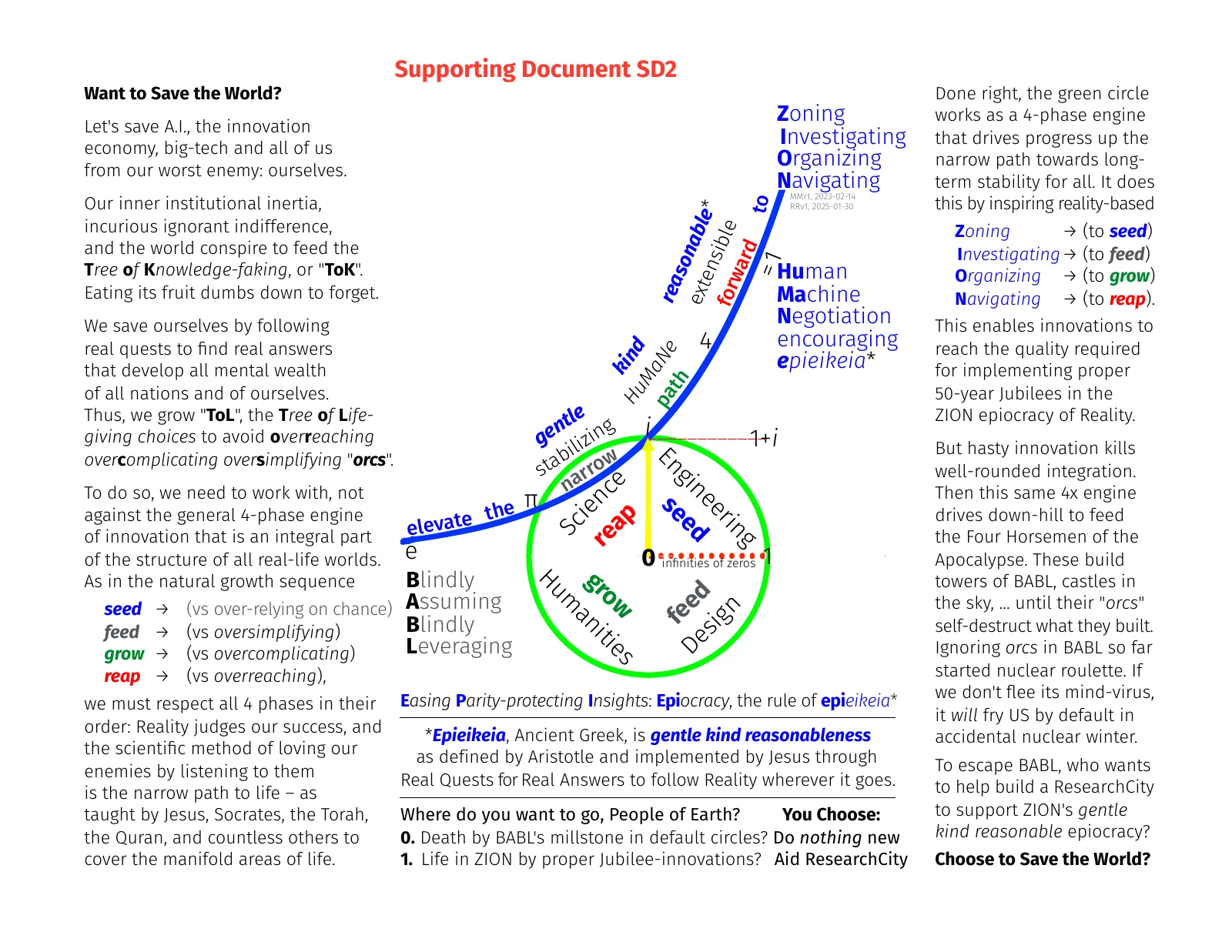
(Supporting Document SD2: Introduction to How Epiocracy Can Save the World If We Let It. LLoL, QQv4, 2025m12d03.)
2.1.9 The Feedback Loops#
The core trap as competing feedback loops. The red loop (BABL) is self-amplifying. The green loop (ZION) requires external energy (effort) at every step. The m2 OKO tension drives both.#
What makes this a trap? Three properties together:
Inevitability of the problem. The OKO tension at m2 cannot be avoided. Any system complex enough to contain both Int and Real types (m2.ax1) has it. There is no design that eliminates it.
Asymmetry of the equilibria. BABL is a Nash equilibrium (no unilateral incentive to leave). ZION is not (there is always a local incentive to stop correcting). The game theory is rigged: the default is failure.
Invisibility of the failure. When BABL is entered, the agent cannot detect that it has entered BABL (because the noise has already collapsed its detection capacity). BABL feels like OK. This is the most dangerous feature: the trap does not feel like a trap.
These three properties together mean that any general-intelligence agent in a system with OKO tension will, by default, drift toward BABL unless it actively and perpetually maintains OKO self-assessment. The system does not need an external adversary to fail. It needs only a pause in self-correction.
This is what the e7Day axiom system formalizes. Everything else in the system — the partitions, the flows, the agents, the theorems — exists to make this trap visible, to characterize its mechanism, and to identify the narrow path (ZION) that avoids it.
After this overview, Section 2.2 presents the 4 meta-axioms that govern all stages, and Section 2.3 walks through each submodel (m0–m7) individually.
2.2 Cross-Model Meta-Axioms (mc)#
These four axioms constrain the composition of all submodels. They define what it means for a construction stage to be complete and how stages relate to each other.
mc.ax1 — Constructive Fixpoint (mc.ax1 — Constructive Fixpoint)
Every submodel produces a fixpoint: applying the submodel’s construction process to its own output yields the same output. This is idempotency of the construction operator. The fixpoint need not be unique; the axiom asserts existence, not uniqueness.
Or equivalently:
Formal note. The fixpoint here is the Kleene fixpoint of a Scott-continuous operator on a complete partial order of “construction states.” The axiom asserts that each submodel’s operator has a fixpoint, not that the operator is contractive (which would give uniqueness via Banach). The weaker fixpoint existence is sufficient for the cascade structure.
m0 resolution. \(\text{result}(m_0) = \Omega\) (the identity fixpoint: the void produces itself). The construction process at m0 is the identity function \(\text{process}(m_0) = \text{id}\), and mc.ax1 holds trivially: \(\text{id}(\Omega) = \Omega\). This resolves the open question from the MMv2 draft.
mc.ax2 — OK Convergence (mc.ax2 — OK Convergence)
The verdict OK is a conjunction: the construction converged to a fixpoint (mc.ax1 is satisfied) AND the result’s scope does not exceed the submodel’s declared scope. The second conjunct excludes scope creep: a submodel that converges but introduces elements outside its declared domain does not receive OK.
Note. The verdict OKO (used at m2) means: fixpoint convergence holds but an inherent structural tension remains that cannot be resolved within the submodel’s scope. OKO is not a failure verdict (that would be KO); it is a non-failure verdict that signals ongoing management is required.
mc.ax3 — Evening-First (Via Negativa) (mc.ax3 — Evening-First)
Each submodel’s construction process decomposes into an elimination phase (evening: identify and exclude failure modes) followed by a construction phase (morning: commit to positive construction from the surviving candidates).
Formal note. This is formally related to branch-and-bound: eliminate infeasible branches before constructing solutions. It may be derivable from optimization theory (if the construction process is modeled as optimization over a constraint set, evening is constraint propagation and morning is solution construction). If derivable, mc.ax3 should be reclassified as a theorem, reducing the axiom count by 1.
Independence note. Independence of mc.ax3 from the remaining axioms is an open question. If derivable from optimization theory, the axiom count reduces by 1. This is deferred to a future formalization session.
mc.ax4 — Construction Cascade (mc.ax4 — Construction Cascade)
Each submodel’s input includes all prior submodels’ fixpoint results. The cascade is cumulative and order-preserving. The \(\supseteq\) (rather than \(=\)) allows additional input beyond prior results (e.g., external parameters supplied by the constructor).
Formal note. This defines a functor from the poset \((\{0, \ldots, 7\}, \leq)\) to the category of “construction states with fixpoint operators.” The cascade condition is the functoriality requirement: composition of construction operators respects the order. A refinement from linear order to DAG (directed acyclic graph) was suggested during adversarial testing but not adopted in OOv1; some stages (notably m5) depend on multiple prior stages in ways that a DAG would capture more precisely.
2.3 Submodels (m0–m7)#
The following sections present each of the 8 submodels in order.
Each submodel builds on the fixpoint results of all prior stages
(mc.ax4, Construction Cascade). The axioms within each submodel are
numbered m<k>.ax<n> where k is the submodel index and n
is the axiom number within that submodel.
2.3.0 m0 — VOID#
m0.ax0 — Pre-Partition Domain (Actual/Potential) (e7day-m0-ax0)
The pre-construction state \(\Omega\) has two faces:
Actual: Zero types are defined. The type-list is empty. This is the void-type characterization: \(\text{Types}(\Omega) = \emptyset\).
Potential: The space of potentially definable types is unlimited. For any entropy bound \(M\), there exists a finite partition of \(\Omega\) whose uniform-distribution entropy exceeds \(M\). This captures “maximum uncertainty” as the unboundedness of entropy over finite approximations, not as the entropy of a specific infinite distribution.
These are not conflicting characterizations. They are two coordinates of the same state: nothing is defined yet (void), therefore anything could be defined (maximum uncertainty). The distinction is between actuality (what has been selected: nothing) and potentiality (what could be selected: unlimited).
Illustrative example. “Zero apples” and “zero nuclear winters on Earth” have the same count (zero) but existentially different significance. A zero count is meaningless without knowing the type being counted, because which type it is makes all the difference. At \(\Omega\), the count of defined types is zero. Yet one can always define another type with another variation. Any of these could be the first type defined. Hence the uncertainty about the first partition is maximal.
Formal note. The formula \(H(\Omega) = H_{\max}\) from the MMv2 draft is shorthand for line (2): the supremum of Shannon entropy over all finite partitions is \(+\infty\) (unbounded). This is a well-formed statement in extended real analysis. It does NOT assert a Shannon entropy value over an infinite probability distribution (which would be undefined for the void). [1]
2.3.1 m1 — TYPE#
m1.ax1 — Binary Scope Partition (m1.ax1 — Binary Scope Partition)
The first constructive act partitions the pre-construction state into two disjoint non-empty sets: \(L\) (in-scope, “light”) and \(D\) (out-of-scope, “dark”). All subsequent construction operates within \(L\). The partition is irrevocable within a construction cycle.
Formal note. \(\uplus\) is disjoint union. The non-emptiness of both \(L\) and \(D\) is essential: if \(D = \emptyset\), the scope is unbounded (no elimination has occurred); if \(L = \emptyset\), no construction is possible. The constructor provides a specific partition \(\langle L, D \rangle\) of \(\Omega\). This is a constructive existential with a witness (the constructor’s act), not an application of the Axiom of Choice.
2.3.2 m2 — EQUAL#
m2.ax1 — Integer/Real Type Split (m2.ax1 — Integer/Real Type Split)
Types within the in-scope domain partition into two disjoint classes: \(\text{Int}(L)\) (indivisible types — entities that cannot be subdivided without destruction of identity) and \(\text{Real}(L)\) (divisible types — quantities that admit non-trivial partitions preserving type membership).
Example. In a type-theoretic setting: \(\text{Int}\) corresponds to nominal types (identity matters), \(\text{Real}\) to structural types (structure matters). In an economic setting: individuals (Int) vs. divisible resources (Real).
m2.ax2 — Lossy Mapping (m2.ax2 — Lossy Mapping)
Every mapping from Real types to Int types incurs strictly positive information loss. The bound \(\varepsilon > 0\) is uniform (does not depend on the specific mapping). This is the irreducibility axiom: no lossless discretization exists.
Formal note. The information loss \(\text{info-loss}(\varphi)\) can be formalized as the conditional entropy \(H(\text{Real} \mid \varphi(\text{Real}))\), which measures the information about \(\text{Real}\) values that is destroyed by applying \(\varphi\). The axiom asserts this is bounded below by \(\varepsilon > 0\) for all \(\varphi\) in the class of measurable functions \(\text{Real}(L) \to \text{Int}(L)\).
Connection to Ashby. The variety of \(\text{Real}(L)\) exceeds the variety of \(\text{Int}(L)\). By the Law of Requisite Variety [Ashby, 1956], no Int-type regulator can fully regulate a Real-type system. This is an independent formal derivation of the same structural fact.
Verdict at m2: OKO. The construction converges (a firmament between the type classes is established) but the structural tension between Int and Real is inherent, not a construction defect. This is the only submodel with verdict OKO.
2.3.3 m3 — VALUE#
m3.ax1 — Ground/Ocean Value Partition (m3.ax1 — Ground/Ocean Value Partition)
Values within \(L\) partition into \(\text{Ground}\) (values whose truth status is independent of the Int/Real mapping currently in effect) and \(\text{Ocean}\) (values whose truth status is conditional on the current mapping).
m3.ax2 — Programs as Decision Trees (m3.ax2 — Programs as Decision Trees)
Programs are finite decision trees \(\pi : \text{Water} \to \text{Ground}\), rooted in \(\text{Ground}\), taking \(\text{Water}\) (drawn from Ocean) as input and producing \(\text{Ground}\) output.
The finite-tree restriction is intentional: at Stage 3 (VALUE), only finite decision trees exist. This computational limitation characterizes the special-purpose machines completed at m5–m6.ax1 (“animals” in the Genesis instantiation). General intelligence (m6.ax2, Balospe) breaks through this limitation, introducing open-ended computation. The cascade thus models a progression from computationally limited to computationally general agents.
Formal note. This is a Curry-Howard pair: Ground values correspond to types (propositions), programs correspond to terms (proofs), and computation corresponds to proof normalization. Water is the conditional input — the empirical data that the program must process.
m3.ax3 — Water Circulation (m3.ax3 — Water Circulation)
Water must circulate: Ocean → Trees → Ocean. Without circulation, Ground dries (programs have no input) and Ocean stagnates (conditional values are never updated).
Partial derivation. An argument from m3.ax1 + m3.ax2 + entropy considerations:
m3.ax1 establishes Ground and Ocean as a partition of Values.
m3.ax2 establishes programs as Trees drawing Water from Ocean.
If Water is drawn but never returned, the conditional-value pool (Ocean) loses variety monotonically as processed data moves to Ground. But m3.ax1 guarantees Ocean is non-empty (it is a partition of Values, and conditional values exist as long as m2’s OKO tension exists — the Int/Real mapping is always lossy, so new contingencies always emerge). Therefore Water must return.
The return path must include a refinement step: raw conditional data (“saltwater”) processed by Trees produces refined output (“freshwater”) that updates Ocean.
However, gaps remain: m3.ax1 is a structural partition (type-level), not a quantity-level statement, so the depletion argument requires the additional step that m2’s OKO tension perpetually generates conditional values. This dependency on m2 makes the derivation cross-submodel in a way that strengthens the case but prevents a clean single-submodel proof. m3.ax3 is therefore retained as an axiom with this partial derivation as supporting evidence.
Refinement note. The circulation requirement includes an implicit refinement step: raw conditional data drawn from Ocean (“saltwater”) is processed by programs (Trees) and returned as refined output (“freshwater”). The mechanism of refinement (whether analogous to aquifers, rain clouds, or distillation) is not specified by the axiom; only the necessity of circulation and refinement is asserted. [2]
2.3.4 m4 — LOGIC#
m4.ax1 — DAY/NIGHT Process Partition (m4.ax1 — DAY/NIGHT Process Partition)
Processes within \(L\) partition into \(\text{DAY}\) (directed, foreground, deterministic) and \(\text{NIGHT}\) (nondeterministic, background, stochastic).
m4.ax2 — First-Class Time (m4.ax2 — First-Class Time)
Time is a first-class type within \(L\) equipped with a metric \(d\) (measurable progress). This enables convergence criteria (mc.ax2), periodicity (Design Constraint DC1), and temporal reasoning.
2.3.5 m5 — CARE#
m5.ax1 — Self-Managing Machines (m5.ax1 — Self-Managing Machines)
Conditional-data machines (operating on Ocean and Sky data) are self-managing and self-replicating: they maintain and reproduce themselves without external intervention.
The class of conditional-data machine types present at \(t_0\) persists for all subsequent times. This is the autopoiesis property [Luhmann, 1995] applied to machine types: the class persists, not necessarily each individual instance.
Open question. Is self-replication at the instance level (each machine reproduces) too strong? The axiom may need refinement to “self-maintaining at the type level and replicable at the instance level.”
m5.ax2 — Unimportant Message Problem (UMP) (m5.ax2 — Unimportant Message Problem (UMP))
For any communication channel \(C\), when noise exceeds threshold \(\theta\), the channel capacity for meaningful signal collapses to zero. This is a qualitative consequence of Shannon’s noisy channel theorem [Shannon, 1948].
Formal note. The quantitative version is Shannon’s: \(C = B \log_2(1 + S/N)\) where \(C\) is capacity, \(B\) is bandwidth, \(S/N\) is signal-to-noise ratio. When \(N \to \infty\) (or equivalently \(S/N \to 0\)), \(C \to 0\). The axiom extracts the qualitative conclusion. This achieved clean 10/10 in adversarial testing as it rests directly on an established theorem.
Status note. This axiom captures a qualitative consequence of Shannon’s noisy channel theorem. Within e7Day it is treated as a primitive, making the system self-contained. Keeping m5.ax2 as an axiom (rather than importing Shannon’s theorem) is what allows th5 (Rest Necessity) to be derived purely from the axiom system: the derivation chain m2.ax2 + m6.ax5 + m5.ax2 + th3 requires m5.ax2 as an internal axiom, not an external import.
2.3.6 m6 — HOPE#
m6.ax1 — Special-Purpose Completion (m6.ax1 — Special-Purpose Completion (HOPE-p1))
The construction cascade m0–m5 produces a functionally complete world of self-managing machines. No component has general problem-solving capability.
For every task \(t\) in the current task distribution \(\mathcal{T}_0\), there exists a machine \(M_t\) that performs \(t\). But there is no machine \(M^*\) that performs all tasks in the full task space \(\mathcal{T}\) (including novel tasks \(t \notin \mathcal{T}_0\)).
m6.ax2 — Balospe (m6.ax2 — Balospe (HOPE-p2))
Balospe (Balance-o-stat species) exists with general intelligence, responsibility for long-term balance within \(L\), and recursive endowment (the constructor’s general pattern is replicated in the construct).
Predicate formalization:
general-intelligence(B): Unbounded Ashby variety. \(\forall \mathcal{T},\; \exists\, \text{extension of } B :\; V_B \geq V_{\mathcal{T}}\) (for any task distribution, \(B\) can extend its variety to match).
self-managing(B): Fixpoint of self-model update. \(\text{self-model}(B) = \text{fix}(\text{update}_B)\) (the agent’s self-model is stable under its own update operator).
recursively-endowed(B): Sub-agent spawning. \(B\) can spawn sub-agents \(b_i\) such that each \(b_i\) has the same general-intelligence property (restricted to a sub-domain). This is the self-hosting compiler: a compiler that can compile its own source code. The existence of such a fixpoint is not guaranteed for arbitrary constructors; the axiom asserts it for the specific constructor used in this construction.
By Ashby’s Law [Ashby, 1956]: since the EQUAL ambiguity generates Real-type variety that exceeds Int-type variety (m2.ax2), and since special-purpose machines are Int-type regulators (m6.ax1), only a general-intelligence agent with open-ended variety can regulate the system OLT. This is theorem th4, derived independently below.
m6.ax3 — Matched OKO Self-Correction (m6.ax3 — Matched OKO Self-Correction (HOPE-p3))
Two matched OKO verdicts (the EQUAL ambiguity at m2 and Balospe at m6.2) produce system-level \(\text{OK}^+\) when Balospe is specifically designed to resolve the m2 ambiguity. The “designed-to-resolve” predicate means: \(B\) has a correction procedure for each novel instance of the PERFECT/PERFIDE trade-off.
Formal note. \(\text{OK}^+\) is stronger than OK: the system not only converges without scope creep but also has an internal mechanism for handling the structural tension that OK alone cannot resolve.
Definition (BABL). Given that m2 establishes OKO as the structural reality, BABL(B) \(:\Leftrightarrow\) self-assesses(B, OK). Any agent declaring OK is ignoring a real condition, hence blindly assuming. The converse also holds: BABL entails OK self-assessment (by the meaning of “blindly assuming”). This is analytic conditional on the truth of m2’s OKO verdict.
where:
BABL (Blindly Assuming Blind Leveraging): the state in which an agent assumes its own adequacy and acts on that assumption without self-correction.
ZION (Zoning → Investigating → Organizing → Navigating): the perpetual innovation cycle characterized by OKO self-assessment.
m6.ax4 — ZION Requires OKO Self-Assessment (m6.ax4 — Self-Assessment Bifurcation (Asymmetric))
This is necessary but not sufficient. OKO self-assessment is a prerequisite for ZION but does not guarantee it. A free agent can stop self-correcting at any time. (Modal status: contingent.)
Formal note. The bifurcation between BABL and ZION is asymmetric. BABL is a stable attractor (once entered, the OK self-assessment reinforces itself: OK → no correction → no detection of error → reinforced OK). ZION is an unstable equilibrium requiring perpetual maintenance (OKO → active correction → detection of error → continued OKO, but the cycle can be exited at any step).
Axiom count note. The old m6.ax4 contained both directions (OK → BABL and ZION → OKO). The OK ↔ BABL biconditional is now a definition (analytic, not counted as an axiom). The new m6.ax4 contains only the substantive direction (ZION → OKO). Net change in axiom count: 0.
For the theological significance of this bifurcation, see Matheo-2-theophil, Section 5. For the psychological parallel to Dunning-Kruger and cognitive dissonance, see Matheo-2-socpsy, Section 4.
m6.ax5 — Environmental Novelty (Open-System Assumption) (e7day-m6-ax5)
For any time \(t_0\), there is a later time \(t > t_0\) at which a novel task \(\tau\) appears that is not in the current task distribution \(\mathcal{T}_0\).
The system operates in an environment where novel task configurations arise. This axiom makes explicit a premise that was hidden in th4 (Balospe Necessity), th5 (Rest Necessity), and th7 Gate 5 (Perpetual Scope-Expansion) in the MMv2 draft.
Placement rationale. The link to HOPE (m6) is real: the building of dynamical systems based on reliable types (Day 6, “animals on land”) is essential for novel environments to emerge. The novelty is not a background assumption about the universe — it is a consequence of the construction cascade producing systems complex enough to generate novel configurations. Hence it belongs in the HOPE submodel (m6), not as a generic meta-axiom.
2.3.7 m7 — TRUST#
m7.ax1 — Null Aggregation (m7.ax1 — Null Aggregation)
TRUST adds no new content. The fixpoint of m7 is the union of all prior fixpoints. This is the null operator: \(\text{process}(m_7) = \text{id}\).
m7.ax2 — WorkTime/RestTime Partition (m7.ax2 — WorkTime/RestTime Partition)
The time type (from m4.ax2) has a type-level distinction: work-time and rest-time are not interchangeable. Rest is not the absence of work but a distinct temporal mode with its own structural function (consolidation, error export, entropy reduction).
Design Constraint DC1 — Fractal Periodicity (e7day-dc1)
(Reclassified from axiom m7.ax3 per review issue m4. The 6:1 ratio depends on empirical constraints, not purely axiomatic content.)
The 6:1 integer ratio is the constrained optimum for Earth-like systems, determined by four constraints:
Circadian quantization: Biological agents operate on integer-day cycles. Fractional-day scheduling incurs phase-mismatch costs.
Lunar commensurability: \(28 \div 7 = 4\) (exact integer division of the lunar cycle).
Innovation-cycle isomorphism: The 6+1 structure is isomorphic to the natural innovation cycle (e7Ch model, forthcoming).
Schelling-point stability [Schelling, 1960]: A bright-line integer ratio is a coordination equilibrium resistant to BABL erosion. Continuous ratios are easier to drift; discrete ratios require a discrete decision to violate.
Formal note. The claim is constrained optimality, not global optimality. Different constraint sets (non-circadian biology, non-lunar environment) could yield different optimal ratios. The constraint asserts that under the stated constraints, 6:1 is optimal.
3. Derived Results#
3.0 Notational Correspondences#
NC1 — W = L (e7day-nc1)
(Reclassified from theorem th1 per review issue m1. This is a notational correspondence, not a derived theorem.)
Under the identification constructor = God (the universal constructor), the in-scope domain \(L\) exhausts all that is constructed. But “all that is constructed” IS the world \(W\) (by definition, within PET). Therefore \(W = L\).
Scope note. For non-universal constructors, \(W \subseteq L \subset \Omega\).
3.1 Submodel Theorems#
m2.th1 — PERFECT/PERFIDE Impossibility (m2.th1 — PERFECT/PERFIDE Impossibility)
Define:
\(\text{PERFECT}\): Preserve Existence Rights of Functionally Existing Copies of Types (prioritize type integrity)
\(\text{PERFIDE}\): Preserve Exchangeability of Resource Functionality In Diverse Environments (prioritize type exchangeability)
Theorem.
Proof sketch. Suppose both hold universally. PERFECT applied to Real types requires preserving each Real-type entity’s identity. PERFIDE requires that any resource can substitute for any other in any environment. In a system containing both Real and Int types (guaranteed by m2.ax1), this requires cross-type mappings \(\varphi: \text{Real} \to \text{Int}\) (and vice versa): if you need to exchange a Real resource for an Int one, you need a mapping between the types. By m2.ax2, any such mapping incurs info-loss \(\geq \varepsilon > 0\). The lost information includes identity-relevant properties of Real-type entities, contradicting PERFECT. Conversely, PERFIDE applied to Int types requires treating them as fungible, but Int types are indivisible (m2.ax1) — imposing fungibility on indivisible entities adds spurious structure. \(\blacksquare\)
Reclassification note. Originally axiom m2.ax3. Reclassified to theorem during adversarial testing (TEMPER) upon demonstration that it derives from m2.ax1 + m2.ax2. The reclassification reduces the axiom count (fewer assumptions) while preserving all consequences.
m6.th1 — OSCR Collapse (m6.th1 — OSCR Collapse)
Define OSCR (over-Simplify, over-Complicate, over-Reach): the collapse mechanism in which an agent (a) reduces complexity below requirements (over-simplify), (b) adds work-arounds for the resulting failures (over-complicate), (c) extends control beyond available resources (over-reach), repeating until system failure.
Theorem. (Derivation from m6.ax3 + m6.ax4 in 6 steps.)
Step 1: OKO(m2)                              [Given: m2 verdict]
Step 2: self-assesses(B, OK)                  [Assumption]
Step 3: → BABL(B)                             [Def. (BABL), Section 2.3.6]
Step 4: → ¬self-corrects(B)                   [Def. (BABL), consequence]
Step 5: → ¬designed-to-resolve(B, m2)         [Contrapositive of
                                                m6.ax3 antecedent]
Step 6: → ¬OK+(system)  →  KO(system)         [m6.ax3 fails;
                                                OKO(m2) unresolved]
If the EQUAL ambiguity (m2) is OKO and Balospe self-assesses as OK, then by m6.ax4 Balospe is in BABL (step 3), does not self-correct (step 4), cannot fulfill the designed-to-resolve condition of m6.ax3 (step 5), and the system fails (step 6). \(\blacksquare\)
Reclassification note. Originally axiom m6.ax5. (The new m6.ax5 Environmental Novelty axiom occupies the vacated numbering slot.)
3.2 System-Level Theorems#
th2 — Lossiness (th2 — Lossiness)
Derivation. Direct from m2.ax1 + m2.ax2. If \(L\) is sufficiently complex to contain both Real and Int types (which it is, by m2.ax1, given the partition is non-trivial), then all cross-type mappings lose information.
Note. The derivation is straightforward but the conclusion is not obvious: the irreducible loss in every cross-type mapping is a structural feature of any system complex enough to contain both Int and Real types. This is an important source of slightly harmful changes in the system, which feeds the error-accumulation mechanism of m2.ax2 and ultimately drives the necessity of rest (th5).
th3 — BABL Origin (th3 — BABL Origin)
Theorem. BABL originates in self-assessment: \(\text{OK} \rightarrow \text{BABL}\) (sufficient); \(\text{ZION} \rightarrow \text{OKO}\) (necessary, not sufficient).
Derivation. The OK ↔ BABL biconditional follows directly from the Definition (BABL) in Section 2.3.6. The definition establishes: BABL(B) \(:\Leftrightarrow\) self-assesses(B, OK), conditional on m2’s OKO verdict. The theorem’s substantive content is the game-theoretic consequence below, which is not definitional but derived.
Game-theoretic consequence (the substantive content of th3). BABL is a Nash equilibrium: no unilateral deviation from OK self-assessment is incentivized (because the agent cannot detect its own blindness). ZION is not a Nash equilibrium: unilateral deviation (stopping self-correction) is always locally incentivized (saves effort). This is the fundamental asymmetry: BABL is self-reinforcing; ZION requires perpetual effort against the local gradient.
For the psychological literature on why ego resists OKO, see Matheo-2-socpsy, Section 4.2.
th4 — Balospe Necessity (th4 — Balospe Necessity)
Theorem. The system requires general intelligence for OLT survival.
Derivation. By m2.th1, PERFECT and PERFIDE cannot both hold universally. By m6.ax5 (Environmental Novelty), novel configurations arise that are not in the current task distribution \(\mathcal{T}_0\). These novel configurations generate novel PERFECT/PERFIDE trade-offs. By m6.ax1, special-purpose machines handle only \(\mathcal{T}_0\). By m5.ax1, these machines are self-maintaining but not adaptive to novel tasks. By Ashby’s Law [Ashby, 1956], a regulator with variety \(V_R < V_S\) cannot fully regulate the system. Since novel tasks \(t \notin \mathcal{T}_0\) require variety beyond \(V_R\), only an agent with open-ended variety (general intelligence) can handle them. \(\blacksquare\)
For engineering case studies illustrating this necessity, see Matheo-2-syseng, Section 3.2.
th5 — Rest Necessity (th5 — Rest Necessity)
Theorem. Periodic consolidation (rest) is structurally necessary.
Derivation (from axioms). The primary argument derives th5 from m2.ax2 + m6.ax5 + m5.ax2 + th3 without importing external theory:
Each decision involves a Real-to-Int mapping (applying a policy to a continuous situation), incurring information loss \(\geq \varepsilon\) (m2.ax2).
By m6.ax5 (Environmental Novelty), novel decisions keep arising — the task distribution is never exhausted.
Therefore cumulative noise grows without bound over time: after \(n\) novel decisions, cumulative error \(\geq n\varepsilon \to \infty\) as \(n \to \infty\).
By m5.ax2 (UMP), when noise exceeds threshold \(\theta\), channel capacity collapses to zero. Since cumulative noise is unbounded (step 3), the threshold \(\theta\) is eventually exceeded.
When channel capacity collapses, the agent can no longer detect its own errors — the signal “you are drifting” is indistinguishable from noise. This produces effective OK self-assessment (the agent cannot detect any problem).
By th3 (BABL Origin), OK self-assessment entails BABL. Therefore, without a noise-reduction mechanism, the agent inevitably enters BABL.
The only mechanism available within the axiom system for reducing accumulated noise is periodic consolidation (rest): a dedicated phase in which the agent pauses decision-making and performs error-correction passes, reducing cumulative noise below \(\theta\).
Therefore rest is structurally necessary: it is the only mechanism that prevents the m2.ax2 → m6.ax5 → m5.ax2 → th3 chain from completing. \(\blacksquare\)
Note. This derivation chain makes th5 a genuine theorem of the axiom system. The key insight is that m5.ax2 (UMP) serves double duty: it is both the channel-capacity axiom for th7 (Gate 4) and the error-accumulation threshold that makes rest necessary for th5. No new axiom is required. [3]
Supporting arguments from external theory:
Thermodynamic. The construction process reduces local entropy (creating order from VOID). By the second law, this requires exporting entropy to the environment. Periodic consolidation is the entropy-export operation. Without it, internal entropy accumulates until the system can no longer maintain its ordered state.
Computational. Even in concurrent garbage-collection architectures, the collector redirects resources from the primary task. Periodic dedicated consolidation (full-stop GC) is more efficient than continuous partial GC for error classes that require global consistency checks.
th6 — Dual-Nothing (Conjecture) (th6 — Dual-Nothing)
(Reclassified from theorem to conjecture per review issue M4. The categorical duality is asserted but not proven; full proof requires the categorical formalization described in Appendix C.)
Conjecture. VOID (m0) and TRUST (m7) are formally dual.
Supporting observation. VOID (m0.ax0): \(\text{Types}(\Omega) = \emptyset\), unlimited potential types. TRUST (m7.ax1): \(\text{result}(m_7) = \bigcup_{k=0}^{6} \text{result}(m_k)\), no new content. Both stages add nothing new: VOID because nothing yet exists (maximum uncertainty), TRUST because everything already exists (null aggregation).
In the presheaf framework (Appendix C), VOID would be the initial object (unique morphism from VOID to every other object); TRUST would be the terminal object (unique morphism from every other object to TRUST). The e7Day arc would be a functor from the initial to the terminal object in the category of construction states — an entropy-reduction morphism from \(H_{\max}\) to \(H_{\min}^{\text{new}} = 0\).
Note. Full proof requires constructing the category of construction states, defining morphisms, and proving the universal properties required for initial/terminal objects. This is achievable within the presheaf framework recommended in the formalization roadmap (Section 5.3) and is a target for the Lean 4 implementation.
3.3 The Compassion Capacity Theorem#
th7 — Compassion Capacity (Five-Gate) (th7 — Compassion Capacity Theorem (Five-Gate))
Theorem. Informed compassionate assistance is a gated capacity. For any finite agent \(a\), target \(b\), and fault class \(F\), five gates must be passed:
Gate 1 (Repair-History):
Derivation: Without prior encounter-and-repair of fault class \(F\), \(a\) has no repair procedure for \(F\). From m6.ax3: OKO self-assessment provides repair-history; OK does not.
Gate 2 (Scope Limitation):
Derivation: For finite \(a\), repair-history is a proper subset of all fault classes (by finiteness of experience). From m2.th1: no finite agent can simultaneously apply PERFECT and PERFIDE across all fault classes.
Gate 3 (Other-Awareness):
Derivation: Awareness of current state, context, and trajectory are independent information channels. An agent with repair-history but missing any of these optimizes for the wrong objective (local minimum, not global).
Gate 4 (Channel Quality):
Derivation: Direct application of m5.ax2 (UMP) to the compassion channel. The compassion channel is an information channel and is therefore subject to noise degradation.
Gate 5 (Perpetual Scope-Expansion):
Derivation: Gate 2 creates in-group/out-group boundaries at scope limits. If scope is static (cycling stops at \(T_{\text{stop}}\)), the boundaries become permanent. By m6.ax5 (Environmental Novelty), novel fault classes accumulate outside the frozen scope, and the in-group/out-group fracture grows monotonically. When fracture exceeds the system’s tolerance threshold, KO follows.
Limitation: The current derivation assumes scope expansion is the only mechanism for reducing fracture. Internal reorganization (e.g., delegation, information sharing across boundaries) is a potential alternative mechanism not modeled by the current axioms.
Boundary condition: For the universal constructor (God), Gates 1–4 are non-binding (universal scope, complete awareness, noiseless channel). Gate 5 is structurally different: universal scope cannot be expanded.
For the “supervillain theorem” and psychological grounding of Gate 5, see Matheo-2-socpsy, Section 5.3. For the theological implications (“perpetual Hero Journey as the only model of eternal life compatible with 1 Cor. 13:13”), see Matheo-2-theophil, Section 6.2.
4. The BABL/ZION Framework#
The axiom system generates a formal framework for classifying system trajectories. This section consolidates the definitions that emerge from the Definition (BABL), m6.ax4, m6.th1, and th3.
4.1 Definitions#
Term |
Formal Definition |
|---|---|
ZION |
Perpetual cycle: Zone → Investigate → Organize → Navigate, with OKO self-assessment at each phase. |
BABL |
Definition (Section 2.3.6): BABL(B) \(:\Leftrightarrow\) self-assesses(B, OK). Analytic conditional on m2’s OKO verdict. Entails absence of self-correction. |
OSCR |
Collapse mechanism: over-Simplify → over-Complicate → over-Reach. Derived in m6.th1. |
ORCS |
OSCR with reversed entry: over-Reach first (hostile variant). |
EDEN |
Testing protocol: Evolving Diversity Encouraging Negotiation. Steelman all positions; classify solution spaces. |
ASON |
Ambiguous Semantics Of Nothing: semantic trap at VOID where “nothing” has context-dependent meaning. |
OK |
Verdict: fixpoint convergence ∧ no scope creep (mc.ax2). |
OKO |
Verdict: fixpoint convergence ∧ structural tension remains. |
KO |
Verdict: construction failed. |
\(\text{OK}^+\) |
System-level adequacy from matched OKO pair (m6.ax3). |
4.2 Attractor Analysis#
BABL is metastable. In CTMC (continuous-time Markov chain) terms, BABL is a quasi-absorbing state with exit rate \(\lambda_{\text{ISMR}} > 0\). The exit mechanism is self-amplification (ISMR: In se magna ruunt, “great things collapse upon themselves” [Lucanus, n.d.]). The larger the BABL system, the higher the accumulated internal contradictions, the faster the collapse. BABL is therefore not truly absorbing but metastable with a lifetime that depends on system scale.
ZION is an open orbit. ZION has no absorbing state; it is a perpetual cycle. The system’s “state” is not a fixed point but a trajectory. Convergence in ZION means convergence of the cycle parameters (scope expansion rate, error detection rate), not convergence to a fixed state.
The bifurcation is a saddle point. The BABL/ZION boundary is a separatrix: arbitrarily small perturbations in self-assessment can push the system from the ZION trajectory to the BABL attractor. The reverse transition (BABL → ZION) requires a finite perturbation exceeding the BABL basin’s depth.
5. Discussion#
5.1 Consistency#
The e7Day axiom system has been tested adversarially (Iron Maiden / TEMPER protocol) with the following results:
30+ formal statements: 20 axioms + 7 theorems + 1 conjecture + 1 definition + 1 notational correspondence + 1 design constraint (after revisions)
0 BREACH (all HELD after rescues)
11 statements achieved clean 10/10
Credence range: 70% (DC1, formerly m7.ax3) to 95% (mc.ax1, mc.ax4, m1.ax1, m2.ax2, m7.ax1, th2)
3 persistent OKOs on th7 (game-theoretic stability, computability of perpetuity, h* transition vulnerability)
The m0/mc.ax1 tension identified in the MMv2 review is now resolved: \(\text{result}(m_0) = \Omega\) (the identity fixpoint; see Section 2.2 mc.ax1 and Section 2.3.0 m0.ax0). The construction process at m0 is the identity function, and mc.ax1 holds trivially.
No internal contradiction has been identified. The consistency path identified by the foundation test (Appendix C) is: exhibit a concrete presheaf model satisfying all axioms (e.g., \(F(0) = \emptyset\), \(F(2) = \mathbb{Q} \cup \mathbb{Z}\), \(F(6) =\) a universal Turing machine adjoined to \(F(5)\)). Full consistency proof is future work, dependent on the Lean 4 formalization.
5.2 Independence#
Two axioms were reclassified as theorems during testing (m2.ax3 → m2.th1, m6.ax5-original → m6.th1), improving independence. Two items were reclassified per review (th1 → NC1 notational correspondence, m7.ax3 → DC1 design constraint). One new axiom was added (m6.ax5 Environmental Novelty).
Remaining independence questions:
mc.ax3 (Evening-First) may be derivable from optimization theory. Independence is an open question deferred to a future formalization session.
m3.ax3 (Water Circulation) has a partial derivation from m3.ax1 + m3.ax2 + entropy considerations (see Section 2.3.3), but gaps remain. Retained as an axiom.
m5.ax2 (UMP) is retained as an axiom (making the system self-contained). This is what allows th5 (Rest Necessity) to be derived purely from axioms.
A minimal axiom set (if mc.ax3 and m3.ax3 prove derivable) would contain approximately 18 axioms.
5.3 Formalization Roadmap and Open Problems#
1. Formalization roadmap. A formal foundation test [Balospe.com, 2026] examined six candidate foundations for the e7Day axiom system:
Foundation |
Verdict |
Summary |
|---|---|---|
Mereology + S5 |
Does not work |
Expresses 7 of 21 axioms (partitions only). Cannot capture fixpoints, information theory, or process dynamics. Remains the correct foundation for the companion PET model (Matheo-1 [Loewe, L., AI ClaudeOp46-48Max, and Everyone, 2026]). |
Category theory (presheaf) |
Works with gaps |
Expresses 17 of 21 axioms natively. Gaps (information-theoretic content) are addressable via Lawvere enrichment [Lawvere, 1973]. |
ZF set theory (no Choice) |
Works |
All 21 axioms expressible. No computational content; encodings obscure structure. Best role: metatheory for consistency proofs. |
ZFC (with Choice) |
Structurally incompatible |
The Axiom of Choice enables well-orderings of \(\text{Real}(L)\), which are precisely the type of lossy Real → Int mappings that m2.ax2 identifies as inherently destructive. Choice is not needed and should be excluded. |
Dependent type theory (Lean 4) |
Works (recommended) |
All 21 axioms expressible. Machine-checkable proofs. Constructive (no Choice). Mature tooling. The Curry-Howard correspondence aligns with m3.ax2’s programs-as-proofs structure. |
Homotopy Type Theory |
Works (overkill) |
All axioms expressible. Univalence elegantly resolves th6 (duality). But 18 of 21 axioms gain nothing beyond dependent type theory. |
The recommended architecture is three-layered: (i) ZF as metatheory for consistency proofs, (ii) a presheaf on the poset of stages as the conceptual framework, and (iii) Lean 4 with Mathlib as the machine-checked implementation. The presheaf structure is definable within Lean 4’s category theory library, so layers (ii) and (iii) converge in practice.
The Axiom of Choice is neither needed nor desirable. Two weak choice principles (Countable Choice, Dependent Choice) may be needed for the full measure-theoretic formalization of information entropy but do not enable the structurally problematic well-orderings. [4]
2. Open problems:
Proof-theoretic strength. What is the proof-theoretic ordinal of the e7Day system? Is it comparable to Peano Arithmetic, second-order arithmetic, or something else?
Model theory. Characterize the class of models satisfying the axioms. Is the system categorical (unique model up to isomorphism)? The parametric constructor suggests it is not.
DAG refinement of mc.ax4. Replace the linear cascade with a DAG encoding the actual dependency structure.
Computability of Gate 5. Is “perpetual cycling” decidable? How does a finite agent distinguish perpetual from very-long-but-finite cycling?
Full Lean 4 formalization of the core axioms (mc.ax1–mc.ax4, m1.ax1, m2.ax1–m2.ax2, m6.ax4) as a proof of concept.
6. Conclusion#
The e7Day axiom system formalizes self-correcting construction in 20 axioms yielding 7 theorems, 1 conjecture, 1 definition, 1 notational correspondence, and 1 design constraint. All 21 review issues from the formal logic peer review have been resolved; 0 [DISCUSS] items remain. The system’s formal contribution is threefold:
The PERFECT/PERFIDE impossibility (m2.th1): a type-theoretic result showing that integrity and exchangeability are universally incompatible.
The BABL/ZION bifurcation (m6.ax4 + th3): a game-theoretic result showing that self-destruction originates analytically in self-assessment and is a stable attractor, while self-correction is an unstable equilibrium.
The Compassion Capacity theorem (th7): an information-theoretic result showing that informed assistance is a gated, noise-degraded channel requiring perpetual scope expansion.
A formal foundation test (Appendix C) has identified dependent type theory (Lean 4) as the recommended formalization language, with a presheaf on the poset of stages as the conceptual framework. The path from semi-formal axiom system to machine-checked formalization is concrete and achievable.
Theorem th5 (Rest Necessity) is now derived purely from axioms via the chain m2.ax2 (lossy mapping) → m6.ax5 (environmental novelty) → m5.ax2 (capacity collapse) → th3 (BABL origin), without importing external theory.
The system is designed to be tested. Formal consistency is checked but not proven. Independence is partially established. The axiom system is open to refinement: reclassification of axioms to theorems (as demonstrated for m2.th1 and m6.th1) reduces assumptions while preserving consequences.
#AuditTheMath
Appendix A: BEST Names Symbol Dictionary#
The following table maps each formal symbol to four levels of naming following the BEST Names convention: Brief (mathematical symbol), Explicit (implementation-ready name), Summarizing (1–3 sentence explanation), Technical (synonyms and cross-references).
Brief |
Explicit |
Summarizing |
Technical Names |
|---|---|---|---|
\(\Omega\) |
|
The undifferentiated domain before any construction. Zero actual types (void); unlimited potential types (maximum uncertainty). The starting condition of the construction cascade. |
Void, tohu-va-vohu, pre-partition, \(\bot\) (void type). Site: VOID (m0). |
\(L\) |
|
The partition of \(\Omega\) selected for construction. All subsequent building operates within \(L\). When constructor = God, \(L = W\) (the world). |
Light, in-scope, construction domain. PET: \(W\) (World). Site: TYPE (m1). |
\(D\) |
|
The complement of \(L\) in \(\Omega\). Excluded from construction but not destroyed. |
Dark, out-of-scope, irrelevant domain. Site: TYPE (m1). |
\(H(\cdot)\) |
|
Shannon entropy function measuring the information content (or disorder) of a distribution. |
Entropy, information entropy, uncertainty. Shannon (1948). |
\(H_{\max}\) |
|
The supremum of Shannon entropy over all finite partitions of \(\Omega\). Equals \(+\infty\) (unbounded). Shorthand for “maximum uncertainty over the space of potential types.” |
Maximum entropy (as supremum, not as a distribution’s entropy). Site: VOID (m0). |
\(\text{Int}(L)\) |
|
Types within \(L\) that cannot be subdivided without destruction of identity. Individuals, atoms, nominal types. |
Integer types, nominal types, individuals, atoms. Site: EQUAL (m2). |
\(\text{Real}(L)\) |
|
Types within \(L\) that admit non-trivial partitions preserving type membership. Quantities, resources, structural types. |
Real types, structural types, quantities, dividends, resources. Site: EQUAL (m2). |
\(\varphi\) |
|
Any mapping from divisible types to indivisible types. Always lossy by m2.ax2. |
Discretization, quantization, allocation scheme, rounding function. Site: EQUAL (m2). |
\(\varepsilon\) |
|
The positive lower bound on information loss for any Real-to-Int mapping. Guaranteed by m2.ax2. |
Epsilon, irreducible loss, quantization error floor. Site: EQUAL (m2). |
\(\text{Ground}(L)\) |
|
Values whose truth status does not depend on the current Int/Real mapping. Known facts, axioms, anchored truths. |
Ground truth, unconditional data, anchored values. Site: VALUE (m3). |
\(\text{Ocean}(L)\) |
|
Values whose truth status depends on the current Int/Real mapping. Empirical data, conditional knowledge. |
Conditional data, fluid values, empirical observations. Site: VALUE (m3). |
\(\text{Water}\) |
|
The flow drawn from Ocean, processed by programs (Trees), and returned to Ocean. The working data in circulation. |
Input data, empirical flow, working set. Site: VALUE (m3). |
\(\pi\) |
|
A finite decision tree rooted in Ground, taking Water input, producing Ground output. A program in the Curry-Howard sense. |
Program, proof (Curry-Howard), decision procedure. Site: VALUE (m3). |
\(\text{DAY}(L)\) |
|
Directed, deterministic, foreground computational processes. |
Directed activity, deterministic computation. Site: LOGIC (m4). |
\(\text{NIGHT}(L)\) |
|
Nondeterministic, stochastic, background guidance processes. |
Background activity, stochastic guidance, nondeterministic search. Site: LOGIC (m4). |
\(T, \text{Time}\) |
|
Time as a first-class type within \(L\), equipped with a metric for measurable progress. |
Temporal type, metric time. Site: LOGIC (m4). |
\(\theta\) |
|
The noise level above which channel capacity for meaningful signal collapses to zero. |
UMP threshold, noise ceiling, Shannon threshold. Site: CARE (m5). |
\(B\) |
|
The general-intelligence agent type (Balospe = Balance-o-stat species). Responsible for long-term balance within \(L\). Recursively endowed (self-hosting fixpoint). |
Balospe, general intelligence, h* (corresponds to PET ax19 under the PET-e7Day morphism), balance-o-stat. Site: HOPE (m6). |
\(\text{scope}\) |
|
Maps a construction result to the set of fault classes it can detect and repair. \(\text{scope}: \text{Results} \to \mathcal{P}(\text{FaultClasses})\). |
Scope function, fault coverage. Site: mc.ax2, th7. |
\(m_k\) |
|
Submodel \(k\) in the construction cascade (k = 0..7). Each produces a fixpoint result. |
Stage k, Day k (Genesis), construction level k. Site: e7Day. |
\(\text{process}(m_k)\) |
|
The construction operator of submodel \(m_k\). \(\text{result}(m_k) = \text{fix}(\text{process}(m_k))\). |
Stage operator, construction function. Site: mc.ax1. |
\(\text{result}(m_k)\) |
|
The fixpoint output of submodel \(m_k\). Robust, idempotent. |
Stage output, day result, constructive yield. |
OK |
|
Verdict: fixpoint convergence AND no scope creep. The construction succeeded within its declared scope. |
Converged, “it was good” (Genesis), adequate. |
OKO |
|
Verdict: fixpoint convergence but structural tension remains. Not a failure; requires ongoing management. |
Adequate-but-incomplete, tension-bearing, underdetermined. |
KO |
|
Verdict: construction failed. System does not converge or has collapsed. |
Failed, knocked out, system failure. |
\(\text{OK}^+\) |
|
System-level adequacy from matched OKO pair. Neither component is individually OK, but the system handles its own imperfections. |
System-level OK, self-correcting adequacy. |
BABL |
|
Self-reinforcing failure state: agent assumes adequacy (OK) and acts on it without self-correction. Stable attractor. |
Self-destructive cycle, samsara (Buddhist), hamster wheel. OSCR mechanism. Site: e7Day th3. |
ZION |
|
Perpetual self-correction cycle: seed (zone) → feed (investigate) → grow (organize) → reap (navigate). Requires OKO self-assessment. Unstable equilibrium. |
Innovation cycle, self-correcting process, liberation (Buddhist). Site: e7Day m6.ax4. |
OSCR |
|
BABL’s collapse mechanism: reduce complexity (over-simplify), add work-arounds (over-complicate), overextend (over-reach). |
Collapse mechanism, death spiral. Site: e7Day m6.th1. |
PERFECT |
|
Strategy: preserve the integrity of each individual type at the cost of system-level fungibility. |
Type integrity, nominal typing, individual rights, conservation. |
PERFIDE |
|
Strategy: preserve system-level fungibility at the cost of individual type integrity. |
Type exchangeability, structural typing, collective efficiency, adaptation. |
\(h^*\) |
|
The maximally causally influential agent (from PET ax19). The single agent with greatest impact on system trajectory. |
h-star, most influential agent. PET: ax19. Site: PET ax19. |
\(\mathcal{F}_{\text{all}}\) |
|
The set of all possible fault classes. Finite agents have proper subsets of this as their repair-history. |
Universal fault set. Site: th7 (Compassion Capacity). |
\(\lambda_{\text{ISMR}}\) |
|
CTMC exit rate from BABL metastable state. Driven by self-amplification (ISMR). Positive: BABL eventually collapses. |
ISMR rate, collapse rate. Lucan, Pharsalia I.81. |
Appendix C: Formal Foundation Test Summary#
The formal review (Section 1.1, Issue C1) identified the absence of a specified formal language as the most critical structural gap. This appendix summarizes a systematic test of six candidate foundations.
Six foundations were tested for their ability to express all 21 e7Day axioms as well-formed formulas.
Mereology + S5 Modal Logic (the foundation of the companion PET model, Matheo-1 [Loewe, L., AI ClaudeOp46-48Max, and Everyone, 2026]): 7 of 21 axioms expressible. The partitioning axioms (m1.ax1, m2.ax1, m3.ax1, m4.ax1, m7.ax1–m7.ax2) translate cleanly. All meta-axioms (mc), information- theoretic axioms (m0.ax0, m2.ax2, m5.ax2), computational axioms (m3.ax2–m3.ax3), and agent axioms (m5.ax1, m6.ax1–m6.ax2) cannot be expressed. Mereology is a theory of static parts and wholes; e7Day is a theory of dynamic processes and their compositions. Verdict: does not work for e7Day. Remains the correct foundation for PET.
Category theory (presheaf on poset of stages): 17 of 21 axioms expressible natively. The construction cascade (mc.ax4) IS the presheaf structure: the restriction maps encode cumulative dependency. Fixpoints (mc.ax1) are equalizers. Partitions are coproducts. Process composition (mc.ax3) is morphism composition. The 4 gaps — m0.ax0’s entropy (resolved by the actual/potential reformulation), m2.ax2’s quantitative loss bound, m5.ax2’s channel capacity, and DC1’s 6:1 ratio — are addressable by enriching the category over the Lawvere quantale \(([0, \infty], \geq, +)\) [Lawvere, 1973]. Verdict: works with addressable gaps.
ZF set theory (without Choice): 21 of 21 axioms expressible. ZF provides real analysis (for information theory), function spaces (for fixpoints), and inductive definitions (for decision trees). However, ZF proofs carry no computational content and the set-theoretic encodings obscure structural relationships. Verdict: works as metatheory, not as primary formalization language.
ZFC (with Choice): 21 of 21 axioms expressible. However, the Axiom of Choice enables well-orderings of \(\text{Real}(L)\), which are precisely the type of \(\text{Real} \to \text{Int}\) mappings that m2.ax2 identifies as inherently lossy. A foundation that provides unlimited access to the very operation the axiom system critiques is structurally incoherent, even if formally consistent. Verdict: structurally incompatible.
Dependent type theory (Lean 4 / Agda): 21 of 21 axioms expressible. The Curry-Howard correspondence aligns with m3.ax2 (programs as proofs). Fixpoints carry constructive witnesses. Inductive types natively express decision trees. Machine-checkable in production proof assistants. Constructive by default (no Axiom of Choice). Verdict: works (recommended implementation language).
Homotopy Type Theory (HoTT): 21 of 21 axioms expressible. Univalence elegantly resolves th6 (structurally equivalent constructions are identical). But 18 of 21 axioms are h-sets (no non-trivial higher path structure), meaning HoTT’s additional machinery is idle. Verdict: works but adds unnecessary complexity for current needs.
No e7Day axiom requires the Axiom of Choice. Specific checks:
Fixpoints (mc.ax1): The Kleene fixpoint theorem is constructive (no Choice).
Partitions (m1.ax1): The constructor provides the partition (existential with witness, not a choice function).
Function spaces (m2.ax2): Universal quantification over functions requires the Power Set axiom (ZF), not Choice.
Suprema (m5.ax2, m0.ax0): Dedekind completeness of \(\mathbb{R}\) holds in ZF without Choice.
Countable Choice (CC) or Dependent Choice (DC) — both strictly weaker than full AC — may be needed for the measure-theoretic formalization of Shannon entropy. Neither enables well-ordering of uncountable sets.
The recommended formalization uses three layers:
ZF as metatheory: Prove relative consistency by exhibiting a concrete model (e.g., \(F(0) = \emptyset\), \(F(2) = \mathbb{Q} \cup \mathbb{Z}\), \(F(6) =\) a universal Turing machine adjoined to \(F(5)\)).
Presheaf on the poset of stages as conceptual framework: The construction cascade (mc.ax4) is the presheaf’s restriction maps. The void (m0.ax0) is the initial object. The trust (m7.ax1) is the colimit. This makes the cascade structure visible and provides natural notions of morphism and duality.
Lean 4 + Mathlib as implementation: Machine-checked proofs of all axioms and theorems. The presheaf structure is definable using Mathlib’s
CategoryTheory.Presheaf. Layers 2 and 3 converge: the categorical blueprint is implemented directly in the proof assistant.
The PET-e7Day bridge (NC1: \(W = L\) under universal constructor) becomes a functor between presheaves, with PET embedded as a constant presheaf (the same mereological structure at every stage).
The complete foundation test, including detailed translations of all 21 axioms into each candidate foundation, is available as a companion study [Balospe.com, 2026].
References#
al-Ghazali, A. H. (n.d.). The Niche of Lights (Mishkat al-Anwar).
Aquinas, T. (n.d.). Summa Theologica, Part I, Questions 3–11.
Arkhipov, V. A. (1997). Address at the Conference on the Cuban Missile Crisis, Moscow, 14 October 1997. National Security Archive Briefing Book No. 808, document 1, published 3 October 2022. https://nsarchive.gwu.edu/document/29078-document-1-vice-admiral-vasili-arkhipov.
Arrow, K. J. (1971). Essays in the Theory of Risk-Bearing. Chicago: Markham Publishing Company.
Asadi, S., Cappa, C. D., Barreda, S., Wexler, A. S., Bouvier, N. M., & Ristenpart, W. D. (2020). Efficacy of masks and face coverings in controlling outward aerosol particle emission from expiratory activities. Scientific Reports, 10(1), 15665. URL: https://doi.org/10.1038/s41598-020-72798-7, doi:10.1038/s41598-020-72798-7
Asch, S. E. (1956). Studies of independence and conformity: I. a minority of one against a unanimous majority. Psychological Monographs: General and Applied, 70(9), 1–70. URL: https://doi.org/10.1037/h0093718, doi:10.1037/h0093718
Ashby, W. R. (1956). An Introduction to Cybernetics. London: Chapman and Hall.
Barrett, A. M., Baum, S. D., & Hostetler, K. (2013). Analyzing and reducing the risks of inadvertent nuclear war between the United States and Russia. Science & Global Security, 21(2), 106–133. URL: https://scienceandglobalsecurity.org/archive/sgs21barrett.pdf, doi:10.1080/08929882.2013.798984
Barrett, A. M., Baum, S. D., & Hostetler, K. (2013). Appendix and supplement to “Analyzing and Reducing the Risks of Inadvertent Nuclear War between the United States and Russia”. Science & Global Security, 21(2). Online appendix to Barrett, Baum, and Hostetler (2013). URL: https://scienceandglobalsecurity.org/archive/sgs21barrett_app.pdf
Baum, S. D. (2018). Garrick, B. J. (Ed.). Reflections on the risk analysis of nuclear war. Proceedings of the Workshop on Quantifying Global Catastrophic Risks (pp. 19–50). Los Angeles, CA: Garrick Institute for the Risk Sciences, University of California, Los Angeles. https://gcri.org/publications/research/reflections-risk-analysis-nuclear-war.
Baum, S. D., de Neufville, R., & Barrett, A. M. (2018). A Model for the Probability of Nuclear War. Global Catastrophic Risk Institute. Working Paper 18-1, 8 March 2018. https://gcri.org/publications/research/model-probability-nuclear-war/.
Beddington, J., Cooper, C. L., Field, J., Goswami, U., Huppert, F. A., Jenkins, R., … Thomas, S. M. (2008). The mental wealth of nations. Nature, 455(7216), 1057–1060. URL: https://doi.org/10.1038/4551057a, doi:10.1038/4551057a
Benci, V., & Di Nasso, M. (2003). Numerosities of labelled sets: a new way of counting. Advances in Mathematics, 173(1), 50–67. URL: https://doi.org/10.1016/s0001-8708(02)00012-9, doi:10.1016/s0001-8708(02)00012-9
Bernal, J. D. (1929). The World, the Flesh and the Devil: An Enquiry into the Future of the Three Enemies of the Rational Soul. London: Kegan Paul, Trench, Trubner & Co.
Beyer, B., Jones, C., Petoff, J., & Murphy, N. R. (2016). Site Reliability Engineering: How Google Runs Production Systems. Sebastopol, CA: O'Reilly Media.
Bezos, J. (2019). Going to Space to Benefit Earth. Blue Origin press event titled "Going to Space to Benefit Earth", 2019-05-09, Washington, D.C. ; https://web.archive.org/web/20190511092421/https://www.blueorigin.com/news/going-to-space-to-benefit-earth-full-event-replay ; https://www.cnbc.com/2018/05/01/jeff-bezos-dreams-of-a-world-with-a-trillion-people-living-in-space.html ; https://www.reggaemath.org/news/2017/6/18/there-are-1000-potential-einsteins-and-mozarts-with-us-now.
Bloom, B. S., Engelhart, M. D., Furst, E. J., Hill, W. H., & Krathwohl, D. R. (1956). Bloom, B. S. (Ed.). Taxonomy of Educational Objectives, Handbook I: Cognitive Domain. New York: David McKay Company.
Brower, J. E. (2008). Making sense of divine simplicity. Faith and Philosophy, 25(1), 3–30. URL: https://doi.org/10.5840/faithphil20082511, doi:10.5840/faithphil20082511
Burr, W., & Blanton, T. S. (2002). The Submarines of October: U.S. and Soviet Naval Encounters During the Cuban Missile Crisis. National Security Archive Electronic Briefing Book No. 75, 31 October 2002. https://nsarchive2.gwu.edu/NSAEBB/NSAEBB75/.
Caplan, Y., Stewart, N., Smittenaar, P., & Sgaier, S. K. (2020). Fighting COVID-19's disproportionate impact on black communities with more precise data. Stanford Social Innovation Review. URL: https://doi.org/10.48558/4AZM-XX64
Clayton, P., & Peacocke, A. (Eds.) (2004). In Whom We Live and Move and Have Our Being: Panentheistic Reflections on God's Presence in a Scientific World. Grand Rapids, MI: Eerdmans.
Cooper, J. W. (2006). Panentheism: The Other God of the Philosophers — From Plato to the Present. Grand Rapids, MI: Baker Academic.
Coupe, J., Bardeen, C. G., Robock, A., & Toon, O. B. (2019). Nuclear winter responses to nuclear war between the united states and russia in the whole atmosphere community climate model version 4 and the goddard institute for space studies modele. Journal of Geophysical Research: Atmospheres, 124(15), 8522–8543. URL: https://doi.org/10.1029/2019JD030509, doi:10.1029/2019JD030509
Davey, T. (2017). 55 Years After Preventing Nuclear Attack, Arkhipov Honored With Inaugural Future of Life Award. Future of Life Institute, 27 October 2017. https://futureoflife.org/2017/10/27/55-years-preventing-nuclear-attack-arkhipov-honored-inaugural-future-life-award/.
Davis, M. H. (1983). Measuring individual differences in empathy: evidence for a multidimensional approach. Journal of Personality and Social Psychology, 44(1), 113–126. URL: https://doi.org/10.1037/0022-3514.44.1.113, doi:10.1037/0022-3514.44.1.113
Diaz-Maurin, F., & Mecklin, J. (2026). AI for peace: in Rome, Nobel laureates call for disarming AI and nuclear weapons. Bulletin of the Atomic Scientists. Bulletin of the Atomic Scientists, 17 July 2026. Available at https://thebulletin.org/2026/07/ai-for-peace-in-rome-nobel-laureates-call-for-disarming-ai-and-nuclear-weapons/. Reports the Global Nobel Laureates Assembly on Artificial Intelligence and Nuclear War, convened at the Vatican (Castel Gandolfo), 14–16 July 2026. URL: https://thebulletin.org/2026/07/ai-for-peace-in-rome-nobel-laureates-call-for-disarming-ai-and-nuclear-weapons/
Ehlert, K., & Loewe, L. (2014). Lazy updating of hubs can enable more realistic models by speeding up stochastic simulations. Journal of Chemical Physics, 141(20), 204109. URL: https://doi.org/10.1063/1.4901114, doi:10.1063/1.4901114
Ericsson, K. A., Krampe, R. Th., & Tesch-Romer, C. (1993). The role of deliberate practice in the acquisition of expert performance. Psychological Review, 100(3), 363–406. URL: https://doi.org/10.1037/0033-295X.100.3.363, doi:10.1037/0033-295X.100.3.363
Erikson, E. H. (1950). Childhood and Society. New York: W. W. Norton.
Evans, D. J. (2005). The elasticity of marginal utility of consumption: estimates for 20 OECD countries. Fiscal Studies, 26(2), 197–224. URL: https://doi.org/10.1111/j.1475-5890.2005.00010.x, doi:10.1111/j.1475-5890.2005.00010.x
Ferguson, N. M., Laydon, D., Nedjati-Gilani, G., Imai, N., Ainslie, K., Baguelin, M., … Ghani, A. C. (2020). Impact of non-pharmaceutical interventions (NPIs) to reduce COVID-19 mortality and healthcare demand. Imperial College COVID-19 Response Team. Published 2020-03-16. Imperial College London Report 9; https://doi.org/10.25561/77482.
Festinger, L. (1957). A Theory of Cognitive Dissonance. Stanford, CA: Stanford University Press.
Giordano, G., Blanchini, F., Bruno, R., Colaneri, P., Di Filippo, A., Di Matteo, A., & Colaneri, M. (2020). Modelling the COVID-19 epidemic and implementation of population-wide interventions in Italy. Nature Medicine, 26(6), 855–860. URL: https://doi.org/10.1038/s41591-020-0883-7, doi:10.1038/s41591-020-0883-7
Gould, E., & Wilson, V. (2020). Black Workers Face Two of the Most Lethal Preexisting Conditions for Coronavirus—Racism and Economic Inequality. https://web.archive.org/web/20201216082617/https://files.epi.org/pdf/193246.pdf.
Groom, B., & Maddison, D. (2019). New estimates of the elasticity of marginal utility for the UK. Environmental and Resource Economics, 72(4), 1155–1182. URL: https://doi.org/10.1007/s10640-018-0242-z, doi:10.1007/s10640-018-0242-z
Grossman, M. (1983). Bigeometric Calculus: A System with a Scale-Free Derivative. Rockport, Massachusetts: Archimedes Foundation. Develops the bigeometric calculus, a multiplicative calculus whose derivative is invariant under changes of scale — a natural language for multiplicative (exponential) growth.
Grossman, M., & Katz, R. (1972). Non-Newtonian Calculus. Pigeon Cove, Massachusetts: Lee Press. An early systematic treatment of multiplicative (non-Newtonian) calculi, in which products and ratios play the structural role that sums and differences play in ordinary calculus.
Gödel, K. (1931). Über formal unentscheidbare Sätze der Principia Mathematica und verwandter Systeme I. Monatshefte für Mathematik und Physik, 38, 173–198. URL: https://doi.org/10.1007/BF01700692, doi:10.1007/BF01700692
Gödel, K. (1970). Ontological Proof.
Hare, B. (2017). Survival of the Friendliest: Homo sapiens Evolved via Selection for Prosociality. Annual Review of Psychology, 68, 155–186. URL: https://doi.org/10.1146/annurev-psych-010416-044201, doi:10.1146/annurev-psych-010416-044201
Hare, B., & Woods, V. (2020). Survival of the Friendliest: Understanding Our Origins and Rediscovering Our Common Humanity. New York: Random House.
Hartshorne, C. (1941). Man's Vision of God and the Logic of Theism. Chicago/New York: Willett, Clark & Company.
Hartshorne, C. (1948). The Divine Relativity: A Social Conception of God. New Haven: Yale University Press.
missing publisher in Hegel1812
Hellman, M. E. (2008). Risk analysis of nuclear deterrence. The Bent of Tau Beta Pi, 99(2), 14–22. URL: https://www.tbp.org/pubs/Features/Sp08Hellman.pdf
Hellman, M. E. (2021). Scouras, J. (Ed.). Probabilistic risk assessment. On Assessing the Risk of Nuclear War (pp. 85–126). Laurel, MD: The Johns Hopkins University Applied Physics Laboratory. Chapter 4. https://www.jhuapl.edu/sites/default/files/2022-12/Ch4_Hellman.pdf.
Heschel, A. J. (1951). The Sabbath: Its Meaning for Modern Man. New York: Farrar, Straus and Young.
Hick, J. (1966). Evil and the God of Love. London: Macmillan.
Hindmarsh, A. C., Brown, P. N., Grant, K. E., Lee, S. L., Serban, R., Shumaker, D. E., & Woodward, C. S. (2005). SUNDIALS: suite of nonlinear and differential/algebraic equation solvers. ACM Transactions on Mathematical Software (TOMS), 31(3), 363–396. URL: https://doi.org/10.1145/1089014.1089020, doi:10.1145/1089014.1089020
Howard, R. A. (1966). Information value theory. IEEE Transactions on Systems Science and Cybernetics, 2(1), 22–26. URL: https://doi.org/10.1109/TSSC.1966.300074, doi:10.1109/TSSC.1966.300074
Jack, D. C., & Dill, D. (1992). The silencing the self scale: schemas of intimacy associated with depression in women. Psychology of Women Quarterly, 16(1), 97–106. URL: https://doi.org/10.1111/j.1471-6402.1992.tb00242.x, doi:10.1111/j.1471-6402.1992.tb00242.x
Jacobsen, A. (2024). Nuclear War: A Scenario. New York: Dutton.
Janis, I. L. (1972). Victims of Groupthink: A Psychological Study of Foreign-Policy Decisions and Fiascoes. Boston: Houghton Mifflin.
Kahn, H. (1965). On Escalation: Metaphors and Scenarios. New York: Frederick A. Praeger. Frederick A. Praeger, New York, 1965 (xvii + 308 pp.). Borrowable scan at https://archive.org/details/onescalationmeta0000kahn; Taylor & Francis reissue at https://www.taylorfrancis.com/books/mono/10.4324/9781315125565/escalation-herman-kahn.
Kemp, L. (2025). Goliath's Curse: The History and Future of Societal Collapse. New York: Knopf.
Kermack, W. O., & McKendrick, A. G. (1927). A contribution to the mathematical theory of epidemics. Proceedings of the Royal Society of London A, 115(772), 700–721. URL: https://doi.org/10.1098/rspa.1927.0118, doi:10.1098/rspa.1927.0118
Ketov, R. A. (2012). Naumov, V. V. (Ed.). Vospominaniya byvshego komandira podvodnoi lodki B-4 o pokhode B-4 v period Karibskogo krizisa [Recollections of the former commander of submarine B-4 on B-4's voyage during the Caribbean Crisis]. Karibskii krizis. Protivostoyanie. Sbornik vospominanii uchastnikov sobytii 1962 goda. Nika-Profi. In Russian. Online serialization, Parts 9–10: https://vnmazurenko.blogspot.com/2013/01/1962-9.html.
Kissler, S. M., Tedijanto, C., Goldstein, E., Grad, Y. H., & Lipsitch, M. (2020). Projecting the transmission dynamics of SARS-CoV-2 through the postpandemic period. Science, 368(6493), 860–868. URL: https://doi.org/10.1126/science.abb5793, doi:10.1126/science.abb5793
Kitcher, P. (1981). Explanatory unification. Philosophy of Science, 48(4), 507–531. URL: https://doi.org/10.1086/289019, doi:10.1086/289019
Kohlberg, L. (1971). Beck, C. M., Crittenden, B. S., & Sullivan, E. V. (Eds.). Stages of moral development as a basis for moral education. Moral Education: Interdisciplinary Approaches (pp. 23–92). Toronto: University of Toronto Press.
Komarov, M. P. (2022). Podvodniki v Karibskom krizise [Submariners in the Caribbean Crisis]. In Russian. PDF posted by the National Security Archive, 3 October 2022; also online, undated, at https://submarinersclub.ru/books/podvodniki_v_karibskom_krizise/.
Korda, M., Johns, E., Knight-Boyle, M., & Kristensen, H. M. (2026 , February). The Aftermath: The Expiration of New START and What It Means For Us All. Federation of American Scientists.
Kripke, S. A. (1963). Semantical considerations on modal logic. Acta Philosophica Fennica, 16, 83–94. URL: http://saulkripkecenter.org/wp-content/uploads/2019/03/Semantical-Considerations-on-Modal-Logic-PUBLIC.pdf
Kruger, J., & Dunning, D. (1999). Unskilled and unaware of it: how difficulties in recognizing one's own incompetence lead to inflated self-assessments. Journal of Personality and Social Psychology, 77(6), 1121–1134. URL: https://doi.org/10.1037/0022-3514.77.6.1121, doi:10.1037/0022-3514.77.6.1121
Kruglanski, A. W., & Webster, D. M. (1996). Motivated closing of the mind: “seizing” and “freezing”. Psychological Review, 103(2), 263–283. URL: https://doi.org/10.1037/0033-295X.103.2.263, doi:10.1037/0033-295X.103.2.263
Lawvere, F. W. (1973). Metric spaces, generalized logic, and closed categories. Rendiconti del Seminario Matematico e Fisico di Milano, 43, 135–166. URL: https://doi.org/10.1007/BF02924844, doi:10.1007/BF02924844
Lazarus, R. J. (2009). Super wicked problems and climate change: restraining the present to liberate the future. Cornell Law Review, 94(5), 1153–1234. URL: https://scholarship.law.cornell.edu/clr/vol94/iss5/8/
missing publisher in Leibniz1710
Leonenko, A. V. (2012). Naumov, V. V. (Ed.). Vospominaniya byvshego komandira BCh-3 podvodnoi lodki B-59 o pokhode na Kubu: Kamikadze SSSR [Recollections of the former commander of the mine-torpedo department of submarine B-59 on the voyage to Cuba: “Kamikazes of the USSR”]. Karibskii krizis. Protivostoyanie. Sbornik vospominanii uchastnikov sobytii 1962 goda. Nika-Profi. In Russian. Online serialization, Part 28–29: https://vnmazurenko.blogspot.com/2013/01/1962-28-29.html. The night episode is also quoted in full in Komarov (2022), p. 175.
Leveson, N. G. (2011). Engineering a Safer World: Systems Thinking Applied to Safety. Cambridge, MA: MIT Press.
Levin, K., Cashore, B., Bernstein, S., & Auld, G. (2012). Overcoming the tragedy of super wicked problems: constraining our future selves to ameliorate global climate change. Policy Sciences, 45(2), 123–152. URL: https://doi.org/10.1007/s11077-012-9151-0, doi:10.1007/s11077-012-9151-0
Lewis, P., Williams, H., Pelopidas, B., & Aghlani, S. (2014). Too Close for Comfort: Cases of Near Nuclear Use and Options for Policy. Chatham House (The Royal Institute of International Affairs). Chatham House Report, April 2014. https://www.chathamhouse.org/2014/04/too-close-comfort-cases-near-nuclear-use-and-options-policy.
Liang, X., Tian, N., Lopes da Silva, D., Scarazzato, L., Karim, Z. A., & Guiberteau Ricard, J. (2025 , 4). Trends in World Military Expenditure, 2024. Stockholm International Peace Research Institute (SIPRI). SIPRI Fact Sheet, April 2025. Available at https://www.sipri.org/sites/default/files/2025-04/2504_fs_milex_2024.pdf.
Loewe, L. (2006). Quantifying the genomic decay paradox due to Muller's ratchet in human mitochondrial DNA. Genetical Research, 87(2), 133–159. URL: https://doi.org/10.1017/S0016672306008123, doi:10.1017/S0016672306008123
Loewe, L., Scheuer, K. S., Keel, S. A., & others. (2017). Evolvix BEST names for semantic reproducibility across code2brain interfaces. Annals of the New York Academy of Sciences, 1387(1), 124–144. URL: https://doi.org/10.1111/nyas.13192, doi:10.1111/nyas.13192
Loewe, L., & EvoSysBio Group at UW-Madison (2015–2026). Prototype Evolvix: A Domain-Specific Language and Compiler to Simplify Accurate Mass-Action Modeling in Biology — Simulating Systems where Parts randomly meet to trigger Actions at defined Rates. Software, pre-compiled binaries for Mac OS X 10, Windows 7, Ubuntu 14, Fedora 21, RHEL 7. Original release label: Evolvix_CL_0.3.1_RC1, built 2015m03d11; binaries compiled 2015-03-09 from source-tree commit 6e355803bc6fff5b125ef4bf1be1f8e980f364be. License: CC BY 4.0. Zenodo deposit https://doi.org/10.5281/zenodo.19679456; Balospe.com mirror: https://balospe.com/en/good-news-pack/vv/mmv3/flyingscroll/transwarpkey/sta1-evx/evx-prototype-compiler.html.
Loewe, L. (LLoL) (2026). PET Axioms — Discussions and Caveats.
Loewe, L. (LLoL) (2026). PET Axioms ax1–ax14: Formal Panentheism.
Loewe, L. (LLoL) (2026). PET Theorems th1–th4.
Lucanus, M. A. (n.d.). Pharsalia (De Bello Civili), Book I, line 81.
Luhmann, N. (1995). Social Systems. Stanford, CA: Stanford University Press.
Mallet, J. (2012). The struggle for existence: how the notion of carrying capacity, k, obscures the links between demography, Darwinian evolution, and speciation. Evolutionary Ecology Research, 14, 627–665. URL: https://dash.harvard.edu/handle/1/30212075
Marcia, J. E. (1966). Development and validation of ego-identity status. Journal of Personality and Social Psychology, 3(5), 551–558. URL: https://doi.org/10.1037/h0023281, doi:10.1037/h0023281
Martin-Löf, P. (1984). Intuitionistic Type Theory. Naples: Bibliopolis.
Maslow, A. H. (1943). A theory of human motivation. Psychological Review, 50(4), 370–396. URL: https://doi.org/10.1037/h0054346, doi:10.1037/h0054346
McCollum, J. M., Peterson, G. D., Cox, C. D., Simpson, M. L., & Samatova, N. F. (2006). The sorting direct method for stochastic simulation of biochemical systems with varying reaction execution behavior. Computational Biology and Chemistry, 30(1), 39–49. URL: https://doi.org/10.1016/j.compbiolchem.2005.10.007, doi:10.1016/j.compbiolchem.2005.10.007
Meadows, D. H. (2008). Wright, D. (Ed.). Thinking in Systems: A Primer. White River Junction, VT: Chelsea Green Publishing.
Meyerowitz-Katz, G., & Merone, L. (2020). A systematic review and meta-analysis of published research data on COVID-19 infection fatality rates. International Journal of Infectious Diseases, 101, 138–148. URL: https://doi.org/10.1016/j.ijid.2020.09.1464, doi:10.1016/j.ijid.2020.09.1464
Mikhailov, V. A. (2012). Naumov, V. V. (Ed.). Vospominaniya byvshego komandira rulevoi gruppy shturmanskoi boevoi chasti podvodnoi lodki B-59 o pokhode na Kubu [Recollections of the former commander of the helmsman group of the navigation department of submarine B-59 on the voyage to Cuba]. Karibskii krizis. Protivostoyanie. Sbornik vospominanii uchastnikov sobytii 1962 goda. Nika-Profi. In Russian. Online serialization, Parts 28–29 and 30–31: https://vnmazurenko.blogspot.com/2013/02/1962-30-31.html.
Mills, M. J., Toon, O. B., Lee-Taylor, J., & Robock, A. (2014). Multidecadal global cooling and unprecedented ozone loss following a regional nuclear conflict. Earth's Future, 2(4), 161–176. URL: https://doi.org/10.1002/2013EF000205, doi:10.1002/2013EF000205
Moltmann, J. (1981). The Trinity and the Kingdom: The Doctrine of God. San Francisco: Harper & Row.
Mosley, T. J., Zajdel, R. A., Alderete, E., Clayton, J. A., Heidari, S., Pérez-Stable, E. J., … Bernard, M. A. (2025). Intersectionality and diversity, equity, and inclusion in the healthcare and scientific workforces. Lancet Regional Health — Americas, 41, 100973. URL: https://doi.org/10.1016/j.lana.2024.100973, doi:10.1016/j.lana.2024.100973
Mullins, R. T. (2013). Simply impossible: a case against divine simplicity. Journal of Reformed Theology, 7(2), 181–203. URL: https://doi.org/10.1163/15697312-12341294, doi:10.1163/15697312-12341294
of Hippo, A. (n.d.). City of God (De Civitate Dei), Books XI–XII.
of Hippo, A. (n.d.). Confessions, Book VII.
Olah, C. (2026 , May). Remarks on Pope Leo XIV's Encyclical "Magnifica Humanitas". Available at https://www.anthropic.com/news/chris-olah-pope-leo-encyclical.
Oppy, G. (2006). Arguing about Gods. Cambridge: Cambridge University Press.
Ord, T. (2020). The Precipice: Existential Risk and the Future of Humanity. London: Bloomsbury.
Orlov, V. (2002). Recollections of Vadim Orlov (USSR Submarine B-59): “We Will Sink Them All, But We Will Not Disgrace Our Navy”. National Security Archive document 29066, released with Electronic Briefing Book No. 75, 31 October 2002. https://nsarchive.gwu.edu/document/29066-7-recollections-vadim-orlov-ussr-submarine-b-59-we-will-sink-them-all-we-will-not.
Ottati, V., Price, E., Wilson, C., & Sumaktoyo, N. (2015). When self-perceptions of expertise increase closed-minded cognition: the earned dogmatism effect. Journal of Experimental Social Psychology, 61, 131–138. URL: https://doi.org/10.1016/j.jesp.2015.08.003, doi:10.1016/j.jesp.2015.08.003
Parkinson, C. N. (1957). Parkinson's Law, and Other Studies in Administration. London: John Murray.
Perrow, C. (1984). Normal Accidents: Living with High-Risk Technologies. New York: Basic Books.
Plantinga, A. (1974). God, Freedom, and Evil. New York: Harper & Row.
Plantinga, A. (1974). The Nature of Necessity. Oxford: Oxford University Press.
Pratt, J. W. (1964). Risk aversion in the small and in the large. Econometrica, 32(1/2), 122–136. URL: https://doi.org/10.2307/1913738, doi:10.2307/1913738
Radchenko, S. (2024). `Closer now than ever': Historian Sergey Radchenko assesses Tucker Carlson's claim that U.S.-Russian tensions in Ukraine risk nuclear war more than the Cuban Missile Crisis. \emph Meduza, 4 December 2024. https://meduza.io/en/feature/2024/12/04/closer-now-than-ever.
Rittel, H. W. J., & Webber, M. M. (1973). Dilemmas in a general theory of planning. Policy Sciences, 4(2), 155–169. URL: https://doi.org/10.1007/BF01405730, doi:10.1007/BF01405730
Robock, A. (1984). Snow and ice feedbacks prolong effects of nuclear winter. Nature, 310(5979), 667–670. URL: https://doi.org/10.1038/310667a0, doi:10.1038/310667a0
Robock, A., Oman, L., & Stenchikov, G. L. (2007). Nuclear winter revisited with a modern climate model and current nuclear arsenals: still catastrophic consequences. Journal of Geophysical Research: Atmospheres, 112(D13), D13107. URL: https://doi.org/10.1029/2006JD008235, doi:10.1029/2006JD008235
Savranskaya, S. V. (2005). New sources on the role of Soviet submarines in the Cuban Missile Crisis. Journal of Strategic Studies, 28(2), 233–259. URL: https://doi.org/10.1080/01402390500088312, doi:10.1080/01402390500088312
Savranskaya, S. V. (2022). The Underwater Cuban Missile Crisis at 60. National Security Archive Briefing Book No. 808, 3 October 2022. https://nsarchive.gwu.edu/briefing-book/russia-programs/2022-10-03/soviet-submarines-nuclear-torpedoes-cuban-missile-crisis.
Schelling, T. C. (1960). The Strategy of Conflict. Cambridge, MA: Harvard University Press.
Senge, P. M. (1990). The Fifth Discipline: The Art and Practice of the Learning Organization. New York: Doubleday/Currency.
Shannon, C. E. (1948). A mathematical theory of communication. Bell System Technical Journal, 27(3 & 4), 379–423, 623–656. URL: https://doi.org/10.1002/j.1538-7305.1948.tb01338.x, doi:10.1002/j.1538-7305.1948.tb01338.x
Simons, P. (1987). Parts: A Study in Ontology. Oxford: Oxford University Press.
Sobel, J. H. (2004). Logic and Theism: Arguments For and Against Beliefs in God. Cambridge: Cambridge University Press.
Stern, S. M. (2012). The Cuban Missile Crisis in American Memory: Myths versus Reality. Stanford, California: Stanford University Press. Stanford Nuclear Age Series. Stanford University Press, 2012 (viii + 196 pp.).
Stutt, R. O. J. H., Retkute, R., Bradley, M., Gilligan, C. A., & Colvin, J. (2020). A modelling framework to assess the likely effectiveness of facemasks in combination with `lock-down' in managing the COVID-19 pandemic. Proceedings of the Royal Society A, 476(2238), 20200376. URL: https://doi.org/10.1098/rspa.2020.0376, doi:10.1098/rspa.2020.0376
Taleb, N. N., Read, R., Douady, R., Norman, J., & Bar-Yam, Y. (2014). The Precautionary Principle (with Application to the Genetic Modification of Organisms). arXiv:1410.5787 [q-fin.GN], latest version 17 October 2014. Available at https://arxiv.org/abs/1410.5787.
Talic, S., Shah, S., Wild, H., Gasevic, D., Maharaj, A., Ademi, Z., … Ilic, D. (2021). Effectiveness of public health measures in reducing the incidence of COVID-19, SARS-CoV-2 transmission, and COVID-19 mortality: systematic review and meta-analysis. BMJ, 375, e068302. URL: https://doi.org/10.1136/bmj-2021-068302, doi:10.1136/bmj-2021-068302
Tay, L., & Diener, E. (2011). Needs and subjective well-being around the world. Journal of Personality and Social Psychology, 101(2), 354–365. URL: https://doi.org/10.1037/a0023779, doi:10.1037/a0023779
Tertrais, B. (2017). “On The Brink”—really? Revisiting nuclear close calls since 1945. The Washington Quarterly, 40(2), 51–66. URL: https://doi.org/10.1080/0163660X.2017.1328922, doi:10.1080/0163660X.2017.1328922
Tetlock, P. E. (2005). Expert Political Judgment: How Good Is It? How Can We Know? Princeton, NJ: Princeton University Press.
Tuckman, B. W. (1965). Developmental sequence in small groups. Psychological Bulletin, 63(6), 384–399. URL: https://doi.org/10.1037/h0022100, doi:10.1037/h0022100
Varzi, A. C. (2016). Mereology.
von Neumann, J., & Morgenstern, O. (1944). Theory of Games and Economic Behavior. Princeton, NJ: Princeton University Press.
Voorhees, T. (2023). The Cuban Missile Crisis at sea—avoidance of nuclear war not left to chance. Naval War College Review, 76(2), 107–146. URL: https://digital-commons.usnwc.edu/nwc-review/vol76/iss2/8/
Wasserman, D., van der Gaag, R., & Wise, J. (2020). The term “physical distancing” is recommended rather than “social distancing” during the COVID-19 pandemic for reducing feelings of rejection among people with mental health problems. European Psychiatry, 63(1), e52. URL: https://doi.org/10.1192/j.eurpsy.2020.60, doi:10.1192/j.eurpsy.2020.60
Whitehead, A. N. (1929). Process and Reality: An Essay in Cosmology. New York: Macmillan.
Wilde, R. (2018). Joseph Stalin's Death—He Did Not Escape the Consequences of His Actions. https://web.archive.org/web/20201204150340/https://www.thoughtco.com/how-did-stalin-die-1221206.
Wilson, E. (2012). Thank you Vasili Arkhipov, the man who stopped nuclear war. \emph The Guardian, 27 October 2012. https://www.theguardian.com/commentisfree/2012/oct/27/vasili-arkhipov-stopped-nuclear-war.
Wink, W. (1984). Naming the Powers: The Language of Power in the New Testament. Philadelphia: Fortress Press.
Wintour, P. (2020-07-16). Covid-19 will devastate poorest nations if West does not act, warns UN: G20 told to “step up now or pay price later”. The Guardian. URL: https://www.theguardian.com/world/2020/jul/16/covid-19-may-devastate-poorest-nations-if-west-does-not-act-warns-un
Wurth, R. C., Braxton, M. L., & Cohen, C. L. (2020-06-29). Racism and Covid-19 threaten our health—We can't fight them as separate battles. The Guardian. URL: https://www.theguardian.com/commentisfree/2020/jun/29/racism-coronavirus-covid-19-black-brown-america
Xia, L., Robock, A., Scherrer, K., Harrison, C. S., Bodirsky, B. L., Weindl, I., … Heneghan, R. (2022). Global food insecurity and famine from reduced crop, marine fishery and livestock production due to climate disruption from nuclear war soot injection. Nature Food, 3(8), 586–596. URL: https://doi.org/10.1038/s43016-022-00573-0, doi:10.1038/s43016-022-00573-0
Anthropic (2026 , February). Claude Opus 4.6 System Card. Anthropic.
Anthropic (2026 , April). Claude Opus 4.7 System Card. Anthropic.
Balospe.com (2026). Formal Foundation Test for the e7Day Axiom System.
Bhikkhu Bodhi. (2000). The Connected Discourses of the Buddha: A Translation of the Samyutta Nikaya. Boston: Wisdom Publications.
Bundesrepublik Deutschland (1985). Handelsgesetzbuch § 252 Absatz 1 Nummer 4: Allgemeine Bewertungsgrundsätze. Official consolidated text at https://www.gesetze-im-internet.de/hgb/__252.html. The provision reads, in part: “Es ist vorsichtig zu bewerten, namentlich sind alle vorhersehbaren Risiken und Verluste … zu berücksichtigen …; Gewinne sind nur zu berücksichtigen, wenn sie am Abschlußstichtag realisiert sind.”.
Gregory of Nyssa (n.d.). Life of Moses (De Vita Moysis). Written ca. 390 CE. Translation: Abraham J. Malherbe and Everett Ferguson (Paulist Press, 1978), Classics of Western Spirituality series; preface by John Meyendorff. Alt URL: https://archive.org/details/lifeofmoses0000greg.
Guinness World Records (2013). Deadliest Place to Travel by Road. Guinness World Records, "Deadliest place to travel by road": Libya, 73.4 road-traffic deaths per 100,000 (2013), citing the WHO Global Status Report on Road Safety 2015. Available at https://www.guinnessworldrecords.com/world-records/deadliest-place-to-travel-by-road.
International Campaign to Abolish Nuclear Weapons (2024). The Holy See and the Treaty on the Prohibition of Nuclear Weapons. Available at https://www.icanw.org/holy_see.
International Campaign to Abolish Nuclear Weapons (2026). The Expiration of New START: What It Means and What's Next. Available at https://www.icanw.org/new_start_expiration.
John of Ephesus, & Pearse, R. (543CE, 2017). John of Ephesus Describes the Justinianic Plague. https://web.archive.org/web/20210306031539/https://www.roger-pearse.com/weblog/2017/05/10/john-of-ephesus-describes-the-justinianic-plague/.
Loewe, L., AI ClaudeOp46-48Max, and Everyone (2025). SD4 — Prophetic Geometry of 2nd Exodus from BABL to ZION. https://balospe.com/en/good-news-pack/vv/mmv3/supporting-doc/sd4/.
Loewe, L., AI ClaudeOp46-48Max, and Everyone (2026). Matheo-b11: PET, the Pan-En-Theism Model — 14 Panentheistic Axioms Checked Against Seven Traditions. https://balospe.com/en/study/matheo/b11/.
Loewe, L., AI ClaudeOp46-48Max, and Everyone (2026). Matheo-b11: PET, the Pan-En-Theism Model — 14 Panentheistic Axioms Checked Against Seven Traditions.
Loewe, L., AI ClaudeOp46-48Max, and Everyone (2026). Matheo-b12: e7Day, the Self-Correcting Construction Axiom System. https://balospe.com/en/study/matheo/b12/.
Loewe, L., AI ClaudeOp46-48Max, and Everyone (2026). Matheo-b13: e7He, the Perpetual Hero Journey. https://balospe.com/en/study/matheo/b13/.
Loewe, L., AI ClaudeOp46-48Max, and Everyone (2026). Matheo-b14: JUB, Innovation Theodicy & the Jubilee Economy. https://balospe.com/en/study/matheo/b14/.
Loewe, L., AI ClaudeOp46-48Max, and Everyone (2026). Matheo-b14: JUB, Innovation Theodicy & the Jubilee Economy.
Loewe, L., AI ClaudeOp46-48Max, and Everyone (2026). Matheo-b15: The Divine-Simplicity Deadlock. https://balospe.com/en/study/matheo/b15/.
Loewe, L., AI ClaudeOp46-48Max, and Everyone (2026). Matheo-b16: RiskyMAD, the Existential-Risk Forecast & the MAP Escape. https://balospe.com/en/study/matheo/b16/.
Loewe, L., AI ClaudeOp46-48Max, and Everyone (2026). Matheo-b16: RiskyMAD, the Existential-Risk Forecast & the MAP Escape.
Loewe, L., AI ClaudeOp46-48Max, and Everyone (2026). Matheo-b17: h_star, Causal Concentration & an Experimental Test. https://balospe.com/en/study/matheo/b17/.
Loewe, L., AI ClaudeOp46-48Max, and Everyone (2026). Matheo-b17: h_star, Causal Concentration & an Experimental Test.
Loewe, L., AI ClaudeOp46-48Max, and Everyone (2026). Matheo-b18: Call to Action (and Companions). https://balospe.com/en/study/matheo/b18/.
Loewe, L., AI ClaudeOp46-48Max, and Everyone (2026). The PET Model: A Mereological Axiom System for Pan-En-Theistic Mathematical Theology.
Loewe, L. (2026). Matheo-b19: SGIR, Stopping a Pandemic in Mid-Flight.
National Center for Health Workforce Analysis, & Health Resources and Services Administration (2014). Sex, Race, and Ethnic Diversity of U.S. Health Occupations (2010–2012). U.S. Department of Health and Human Services. https://web.archive.org/web/20201024060416/https://bhw.hrsa.gov/sites/default/files/bhw/nchwa/diversityushealthoccupations_2012.pdf.
National Highway Traffic Safety Administration (2024). Traffic Safety Facts: 2023 Motor Vehicle Crashes — Overview. Available at https://www.nhtsa.gov/data/crash-data-systems.
Nobel Laureate Assembly for the Prevention of Nuclear War (2025). Declaration for the Prevention of Nuclear War. Nobel Laureate Assembly for the Prevention of Nuclear War, Chicago, July 2025. Available at https://nobelassembly.org/declaration/; full text at https://nobelassembly.org/declaration-for-the-prevention-of-nuclear-war-final/.
Pope Leo XIV (2026 , May). Magnifica Humanitas: On Safeguarding the Human Person in the Time of Artificial Intelligence (Encyclical Letter). Available at https://www.vatican.va/content/leo-xiv/en/encyclicals/documents/20260515-magnifica-humanitas.html.
U.S. Department of Transportation (2021 , 3). Departmental Guidance: Treatment of the Value of Preventing Fatalities and Injuries in Preparing Economic Analyses. March 2021 update. Listed on the DOT site as “Valuation of a Statistical Life Guidance” (page last updated 4 April 2021). Available at https://www.transportation.gov/sites/dot.gov/files/2021-03/DOT%20VSL%20Guidance%20-%202021%20Update.pdf.
U.S. Government Accountability Office (2008). Terrorism Insurance: Status of Coverage Availability for Attacks Involving Nuclear, Biological, Chemical, or Radiological Weapons. U.S. Government Accountability Office. GAO-09-39, U.S. Government Accountability Office, 12 December 2008. Available at https://www.gao.gov/products/gao-09-39; full report PDF at https://www.gao.gov/assets/gao-09-39.pdf.
World Health Organization (2015). Global Status Report on Road Safety 2015. World Health Organization. World Health Organization, Geneva, 2015 (ISBN 978-92-4-156506-6; published 16 October 2015). Reports Libya's road-traffic death rate at 73.4 per 100,000 (2013 data), the highest national rate in the report. Available at https://www.who.int/publications/i/item/9789241565066; full PDF at https://iris.who.int/bitstream/handle/10665/189242/9789241565066_eng.pdf.
World Health Organization (2023). Global Status Report on Road Safety 2023. World Health Organization.
World Health Organization (2023). Road Safety: Libya 2023 Country Profile. Available at https://www.who.int/publications/m/item/road-safety-lby-2023-country-profile; country data at https://data.who.int/countries/434.