
OL9 — Open Letter to wid-e Reviewers: How to Review wid-e Research to Avert Existential Disasters#
A 6-page guide for potential reviewers — how to evaluate wide interdisciplinary diversity-encouraging research across unfamiliar domains.
Download the original document (PDF)
Open Letter OL9 — PDF (144 KB) — 6 pages, Jonah License with CC0 Public Domain
Filename: open-letter-ol9-iv_llol_qqv4_2025m12d03-6page.pdf
— Overview AI-generated by dv_ClaOp46Max_MMv2_2026m04d02 —Start—
Abstract#
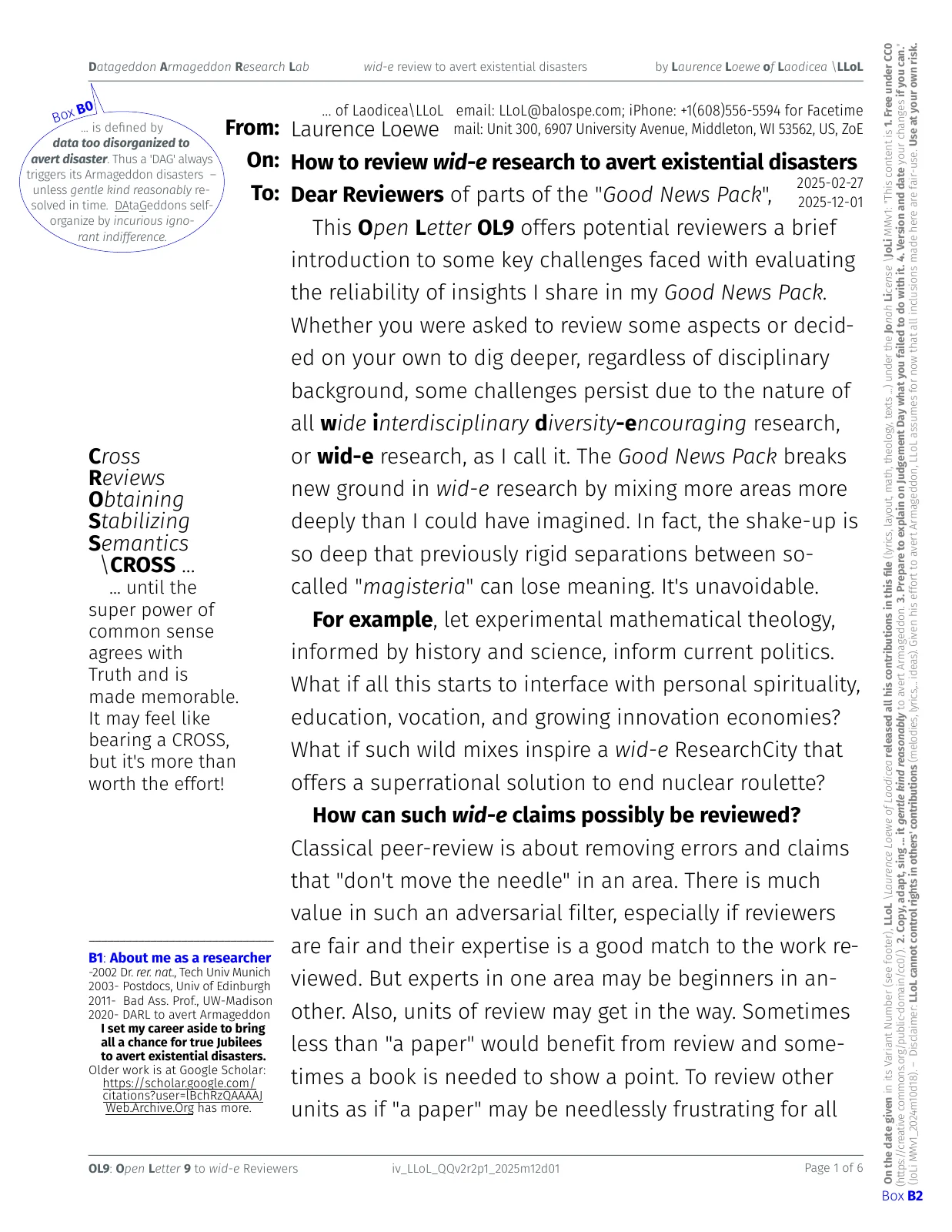
Open Letter OL9 is a 6-page meta-letter addressed to “Dear Reviewers of parts of the Good News Pack.” Dated 2025-02-27 to 2025-12-01, it is the reviewer’s guide for the entire collection — a methodological framework for evaluating wid-e research (wide interdisciplinary diversity-encouraging research).
The letter addresses a fundamental challenge: the Good News Pack mixes mathematics, theology, biology, politics, game theory, and more so deeply that “previously rigid separations between so-called ‘magisteria’ can lose meaning.” How can any reviewer — necessarily a specialist in some areas and a beginner in others — evaluate such work?
LLoL introduces key concepts for wid-e review:
CROSS (Cross Reviews Obtaining Stabilizing Semantics): using the “super power of common sense” to cross-check claims across domains until they agree with Truth
Selective hyper-general-specialists: mature wid-e researchers who combine deep expertise in selected areas with broad knowledge across related fields — neither pure specialists nor pure generalists
Triangulation: confirming findings using completely independent methodologies to manage the danger of pattern-matching biases
Maturity stages: research ideas mature like humans — toddlers and teenagers need different feedback, and the standard binary “published/unpublished” fails to capture this trajectory
Iron Rod versioning: an advanced system (StayVS) for tracking maturity of ideas and making searches for Truth more efficient
The letter explains that wid-e research has been LLoL’s approach since ~2015 (originally for Evolvix), named in 2019, and greatly expanded after 2020. The proposed solution for the review problem: scale up ResearchCity in 7-8 stages, each ~6-8 months, building “knowledge pipeline refineries” that exchange knowledge-uncertainty feedback to refine insights from all wid-e researchers involved.
Side boxes provide the 7 Freedoms of Research (Box B5), the Somebody/Everybody/Anybody/Nobody story (Box B6), 4 Worldly Laws (Box B7), and the Steve Jobs “crazy ones” / yurodivyy framing (Box B8). Box B4 introduces “The new Jubilee Enlightenment Era” and redefines the Ark as a bridge — “a quantum portal to another realm… a Stairway to Heaven and a way to invite Heaven to Earth.”
Key Concepts at a Glance#
wid-e research |
Wide interdisciplinary diversity-encouraging research — the methodology that mixes deep and broad expertise across domains |
CROSS |
Cross Reviews Obtaining Stabilizing Semantics — cross-checking until common sense agrees with Truth |
Selective hyper-general-specialist |
A mature wid-e researcher: deep in selected areas, broad across related fields, selective about which problems to pursue |
Knowledge pipeline refineries |
ResearchCity’s core infrastructure: systems that exchange knowledge-uncertainty feedback to refine wid-e insights |
Magisteria dissolution |
Wid-e research challenges traditional separations between academic domains (science, theology, humanities, etc.) |
7 Freedoms of Research |
Extension of WWII’s 4 Freedoms into a framework for innovation (same as OL0, Box B5) |
4 Worldly Laws |
(1) Law of Dictators rules by secrecy, (2) only full transparency and law of love can rescue, (3) time is running out, (4) decide: death by default or Exodus to life |
Broader Significance (Claude’s Assessment)#
OL9 is unique in the series: it is not an appeal to a specific power center but a methodological framework for anyone who wants to engage with LLoL’s work.
The review problem is real. Wid-e research genuinely challenges peer review. A nuclear physicist may be qualified to assess SD1’s stochastic model but not OL8’s theological arguments, and vice versa. LLoL’s proposed solution (staged scale-up with knowledge pipeline refineries) addresses this structurally.
Magisteria dissolution. The claim that separations between academic domains “lose meaning” in wid-e research is both the project’s greatest strength and its greatest vulnerability. It enables integration but makes assessment harder.
Pan-en-theology as methodology. The claim that “Reality is merely a different way to say God” positions pan-en-theology not as a religious belief but as a research methodology: if God is in all things, then all disciplines study aspects of the same Reality.
Practical honesty. LLoL admits “I wish I could have refined my Flying Scroll & Good News Pack more. It’s the best I can do” — acknowledging imperfection while arguing that the urgency of nuclear risk does not allow indefinite polishing.
Document Information#
Document ID |
OL9 (Open Letter 9) |
Full title |
How to review wid-e research to avert existential disasters |
From |
Laurence Loewe of Laodicea (LLoL), DARL |
To |
Dear Reviewers of parts of the Good News Pack |
Dates |
2025-02-27 to 2025-12-01 |
Version |
iv_LLoL_QQv2r2p1_2025m12d01 |
Format |
6-page letter with 8 side boxes (B0–B8) |
License |
|
Part of |
Good News Pack MMv3, Open Letters collection |
PDF size |
144 KB |
WebP size |
248 KB |
Related documents in the Good News Pack:
All other Open Letters (OL0–OL10)
— Overview AI-generated by dv_ClaOp46Max_MMv2_2026m04d02 —End—