OL10 — Open Letter to All 10 Nuclear Kings of Earth: Put Earth in Escrow#
To the ultimate decision makers on nuclear weapons in USA, Russia, China, North Korea, India, Pakistan, Iran, Israel, France, UK — a logistics proposal to end nuclear roulette.
Download the original document (PDF)
Open Letter OL10 — PDF (116 KB) — 6 pages, Jonah License with CC0 Public Domain
Filename: open-letter-ol10-iv_llol_qqv4_2025m12d03-6page.pdf
— Overview AI-generated by dv_ClaOp46Max_MMv2_2026m04d02 —Start—
Abstract#
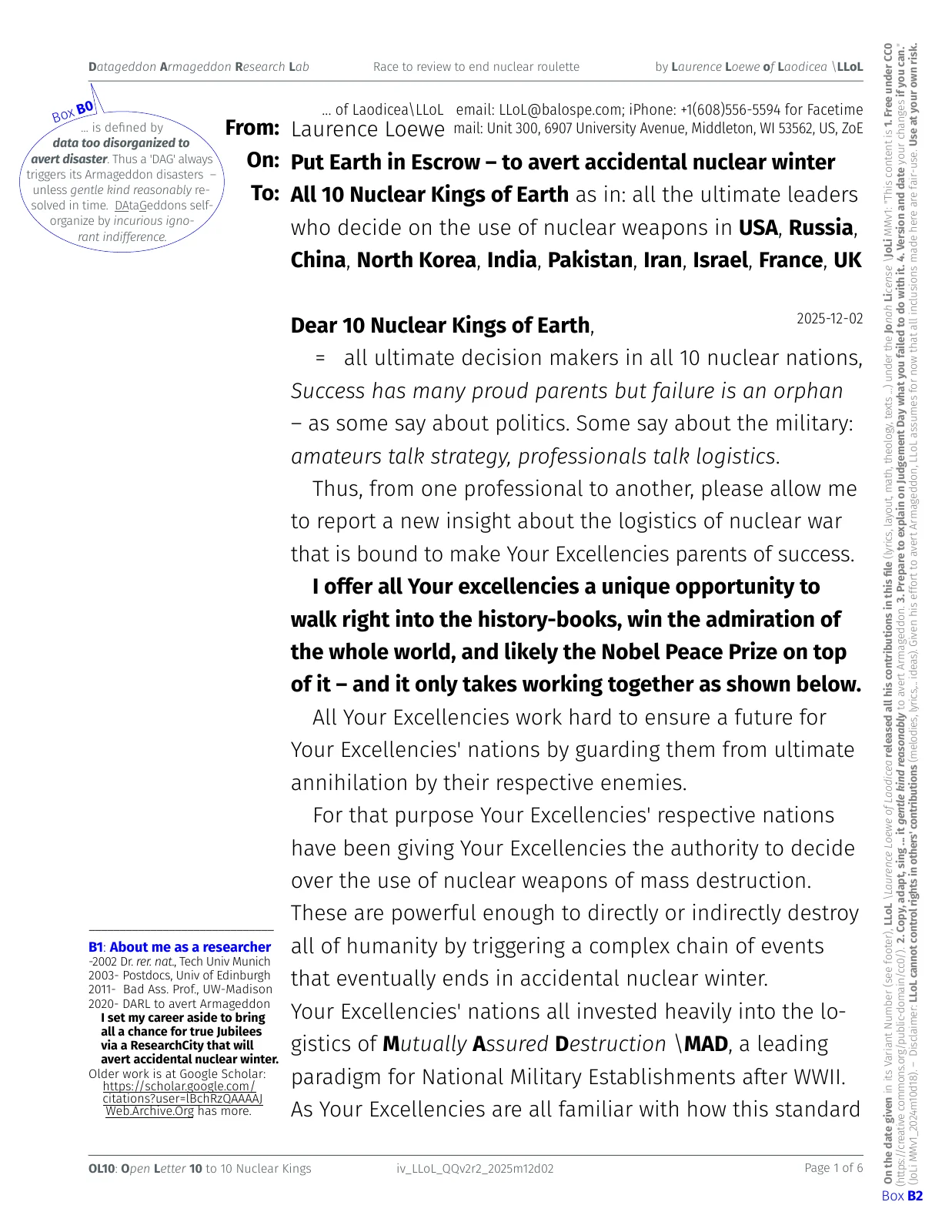
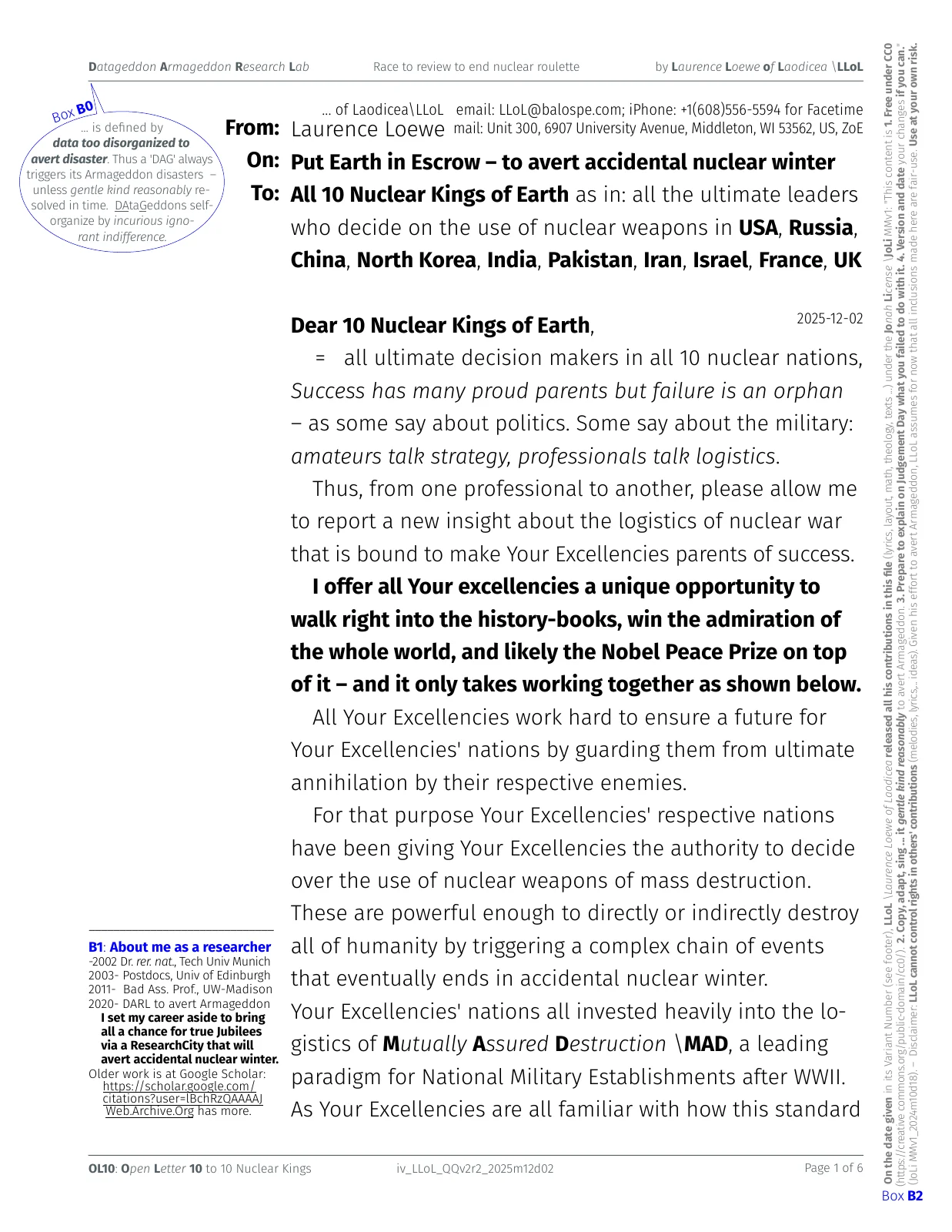
Open Letter OL10 is a 6-page letter from LLoL addressed to “All 10 Nuclear Kings of Earth” — the ultimate decision makers on nuclear weapons in the USA, Russia, China, North Korea, India, Pakistan, Iran, Israel, France, and the UK. Dated 2025-12-02, subtitled “Race to review to end nuclear roulette,” it is the most diplomatically careful and technically focused letter in the Open Letter series.
The letter opens by congratulating the Nuclear Kings for maintaining the balance of terrors without violations since 1945, enabling “an era of unprecedented peace.” It then pivots with a professional framing: “amateurs talk strategy, professionals talk logistics” — and offers a new logistics insight about nuclear war.
LLoL poses two questions:
Can I forecast a credible actuarial probability for my death in accidental nuclear winter?
Can I improve the odds of anyone’s survival?
He then explains why accidental nuclear winter is stochastically inevitable under current conditions, using four features: (i) it can happen in more ways than can be predicted; (ii) any particular way looks unlikely; (iii) any of the many unlikely ways can cause the disaster; (iv) continued repeat attempts guarantee occurrence. He illustrates this with the Titanic (1912), a dice game, and grocery sell-by-dates: “I can forecast global ‘sell-by-dates’ for nuclear arms.”
The letter introduces SD1’s RiskyMAD model as a two-dice system: a slow dice for the probability of entering a MAD crisis (calibrated to the Cuban Missile Crisis of 1962-10-27 and 4 Cold War near-misses), and a fast dice for how quickly a crisis resolves — either back to Risky or into nuclear winter. The core finding: “people like me are more likely to die in accidental nuclear winter than by car crash.”
Box B3 presents a 2x2 matrix classifying people by whether they help or harm themselves and others: Giving, Visionary, Trapped, Robbing, and Ineffectual people. It adapts Carlo M. Cipolla’s (1976) “5 Basic Laws” to explain how trapped people — who unknowingly harm everyone — are the most dangerous. The letter references Vasili Arkhipov’s 1962 submarine decision as a case where one person’s courage prevented nuclear war.
The concrete proposal: “Put Earth in Escrow.” While LLoL’s work scales up ResearchCity in 7-8 stages, all 10 Nuclear Kings agree to a treaty that credibly stops nuclear roulette. The letter insists all 10 must participate: “the superrational solution I discovered only works if all 10 of Your Excellencies approve.” It closes with: “all of Your Excellencies together deserve to win the Nobel Peace Prize together.”
Key Concepts at a Glance#
Put Earth in Escrow |
LLoL’s proposed treaty: Nuclear Kings agree to stop nuclear roulette while ResearchCity scales up in 7-8 stages |
Stochastic inevitability |
Nuclear winter is statistically certain under current postures because too many unlikely error cascades exist and attempts keep repeating |
Two-dice model |
SD1’s RiskyMAD model: slow dice for crisis onset probability, fast dice for crisis resolution speed |
Sell-by-dates for nuclear arms |
LLoL’s claim to forecast actuarial deadlines for when nuclear arsenals become statistically guaranteed to cause disaster |
Trapped people (Box B3) |
People who unknowingly harm everyone, adapted from Cipolla’s 1976 “Basic Laws” — the most dangerous because they do not know their mistakes harm them and others |
Vasili Arkhipov |
Soviet submarine officer who refused to authorize a nuclear torpedo on 1962-10-27, preventing nuclear war during the Cuban Missile Crisis |
Superrational solution |
A solution that only works if all participants agree — hence all 10 Nuclear Kings must be present |
10 Nuclear Kings |
USA, Russia, China, North Korea, India, Pakistan, Iran, Israel, France, UK |
Broader Significance (Claude’s Assessment)#
OL10 is the culminating letter of the Open Letter series. While the other letters address specific institutions (US, Pope, Netanyahu), OL10 addresses the existential problem directly by speaking to all nuclear decision makers simultaneously. Several features distinguish it:
Professional tone. Unlike OL1-OL3 which blend personal testimony, theology, and politics, OL10 is almost entirely focused on logistics, probability, and game theory. The religious language is minimized to “God\Yah\Allah\Reality” as a single inclusive term. This appears designed for a secular diplomatic audience.
Concrete game-theoretic argument. The “Put Earth in Escrow” proposal is framed as a superrational solution (one that benefits all parties if and only if all participate), explicitly requiring unanimous participation. This mirrors concepts from cooperative game theory.
Accessible probability pedagogy. The letter explains stochastic inevitability through three everyday analogies (Titanic, dice, grocery sell-by-dates) before introducing the formal RiskyMAD model. This progression from intuitive to technical is pedagogically effective.
The Cipolla framework. Box B3’s classification of people into Giving, Visionary, Trapped, Robbing, and Ineffectual categories provides a vocabulary for discussing why systemic problems persist. The insight that “trapped people who do not even know they are trapped are the most dangerous” applies to institutional blind spots around nuclear risk.
The Nobel Prize incentive. Offering the Nuclear Kings a path to the Nobel Peace Prize is a concrete positive-sum incentive, contrasting with the negative-sum logic of MAD.
Who This Document Is For#
Audience |
Why OL10 Matters |
|---|---|
Nuclear policy makers & military leaders |
The letter speaks their language: logistics, MAD, error cascades, actuarial risk. The two-dice model and sell-by-date framing translate technical risk into actionable concepts. |
Game theorists & decision scientists |
The superrational solution requiring unanimous participation among adversaries is a well-defined problem in cooperative game theory. The “Put Earth in Escrow” mechanism invites formal analysis. |
Risk analysts & actuaries |
The claim to produce actuarial forecasts for nuclear catastrophe is directly assessable. The RiskyMAD model parameters (calibrated to Cold War data) can be tested and critiqued. |
Diplomats & international relations scholars |
The proposal for a 10-nation summit with no exclusions, framed around mutual Nobel Prize incentives rather than threats, represents an unusual diplomatic approach worth analyzing. |
General public |
The accessible analogies (Titanic, dice, sell-by-dates) make the core argument about nuclear risk understandable without technical background. |
Document Information#
Document ID |
OL10 (Open Letter 10) |
Full title |
Put Earth in Escrow — to avert accidental nuclear winter |
From |
Laurence Loewe of Laodicea (LLoL), DARL |
To |
All 10 Nuclear Kings of Earth (USA, Russia, China, North Korea, India, Pakistan, Iran, Israel, France, UK) |
Date |
2025-12-02 |
Version |
iv_LLoL_QQv2r2_2025m12d02 (document); iv_LLoL_QQv4_2025m12d03 (MMv3 release) |
Format |
6-page letter with 3 boxes (B0–B3), including Trapped/Visionary diagram |
License |
|
Part of |
Good News Pack MMv3, Open Letters collection |
PDF size |
116 KB |
WebP size |
228 KB |
Related documents in the Good News Pack:
Annie Jacobsen (2024), Nuclear War: a scenario (external reference)
Carlo M. Cipolla (1976), “Basic laws of human stupidity” (external reference, adapted in Box B3)
— Overview AI-generated by dv_ClaOp46Max_MMv2_2026m04d02 —End—