FUN Challenge — Language Simplicity Is the Ultimate Challenge#
A single-page card (2019) arguing that growing a language is like growing a plant — language simplicity is the ultimate challenge for designing data languages that are stable, extensible, and user-friendly.
Download the original document (PDF)
FUN Challenge — Language Simplicity — PDF (92 KB) — 1 page, Jonah License with CC0 Public Domain
Filename: fun-challenge-vision-lang-simplicity-is-ultimate-challenge-iv_llol_oov1r5p8_2019m03d25-card.pdf
Also in this folder: STb12-FUN AIMS Ket, FUN Depth vs Width
— Overview AI-generated by dv_ClaOp46Max_ExhJ_2026m04d16 —Start—
Abstract#
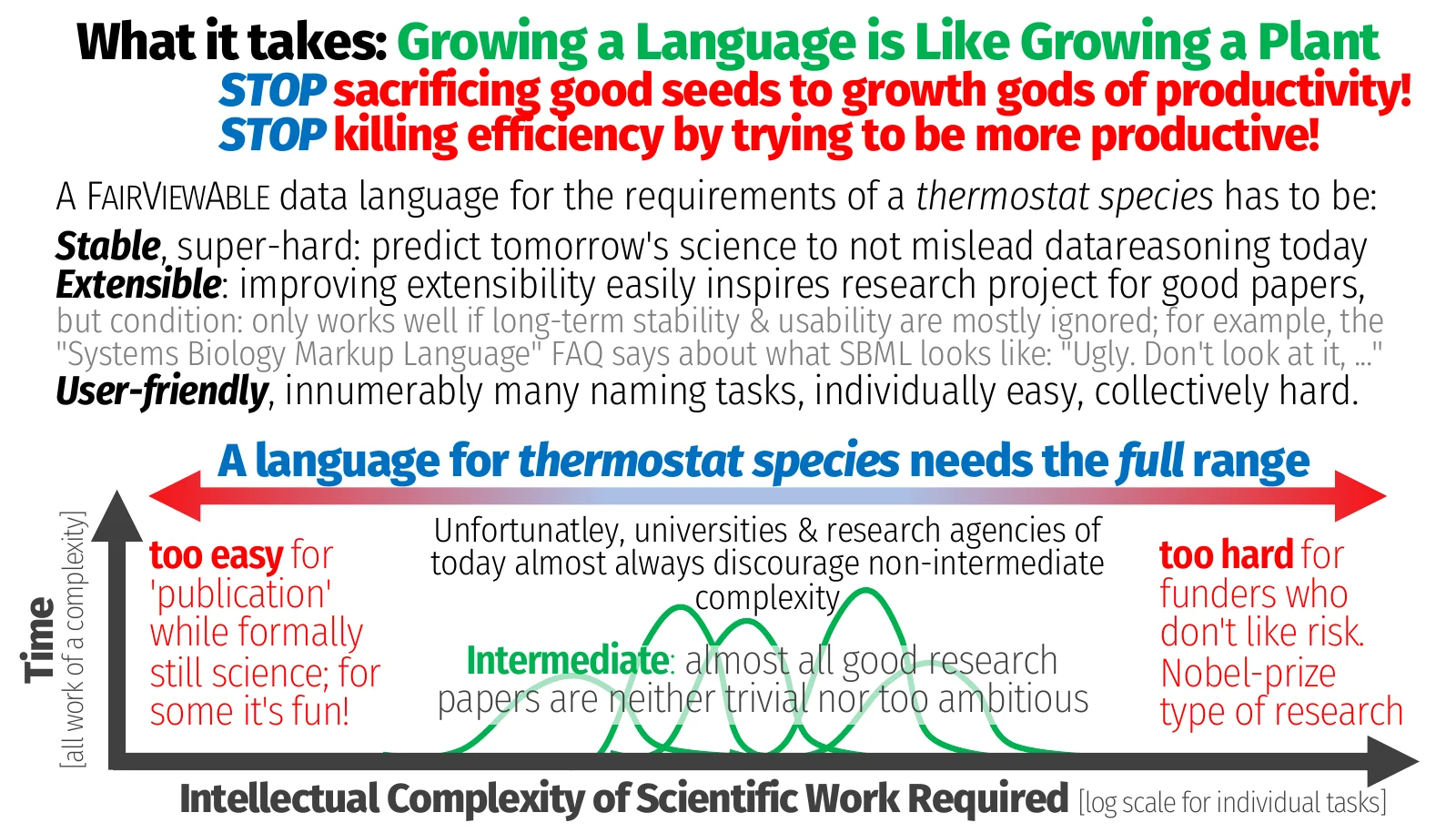
This single-page vision card presents the philosophy behind Evolvix language design: “Growing a Language is Like Growing a Plant.” It calls for stopping two destructive practices: “STOP sacrificing good seeds to growth gods of productivity!” and “STOP killing efficiency by trying to be more productive!”
The card defines a thermostat species — a data language that must satisfy three requirements simultaneously:
Stable — super-hard; predict tomorrow’s science to not mislead and avoid dataresourcing today
Extensible — improving extensibility easily inspires research and supports good papers, but only works well if long-term stability is not ignored
User-friendly — innumerably many naming tasks, individually easy, collectively hard
The central graph plots Intellectual Complexity of Scientific Work Required (horizontal axis, log scale) against Time (vertical axis), showing three regimes:
“Too easy” for publication (still science, but too simple for journals)
“Intermediate” — almost all good research papers fall here, but universities “almost always discourage non-intermediate complexity”
“Too hard” for funders who don’t like risk or Nobel-prize type research
The card argues that a language for a thermostat species needs the full range of complexity levels, not just the intermediate sweet spot that current academia rewards.
Key Concepts at a Glance#
Thermostat species |
A data language designed to regulate the “temperature” of information — stable, extensible, and user-friendly |
Growing a language |
Language design as a living, organic process (like growing a plant) rather than a one-time engineering project |
Simplicity as challenge |
True simplicity requires mastering the full complexity range, then reducing it to what users need — the hardest design task |
Three-complexity regime |
Too easy / Intermediate / Too hard — current academia rewards only the middle, neglecting both the foundational and the visionary |
Broader Significance (Claude’s Assessment)#
This 2019 vision card directly connects STb12-FUN’s educational mission to STa1-EVX’s language design work, showing how the two capstone stadia (first and last) are intimately linked. The thermostat metaphor is precise: just as a thermostat must regulate temperature across a wide range while being simple to use, a data language must handle wide complexity while remaining accessible. The critique of academic incentive structures (rewarding only intermediate complexity) reinforces the argument from the depth-vs-width figure: current institutions are structurally unable to produce the kind of work that wid-e research requires. The organic growth metaphor (plant, not machine) connects to the Jubilee System’s emphasis on natural cycles over industrial optimization.
Document Information#
Document ID |
FUN Challenge — Language Simplicity |
Author |
Laurence Loewe of Laodicea (LLoL) |
Date |
2019m03d25 |
Version |
iv_LLoL_OOv1r5p8_2019m03d25 |
Format |
Single-page vision card |
PDF size |
92 KB |
License |
|
Part of |
Good News Pack MMv3, Flying Scroll / Transwarp Key / STb12-FUN |
Related documents:
— Overview AI-generated by dv_ClaOp46Max_ExhJ_2026m04d16 —End—