
Pandemic Snapshot — EvoSysBio, Evolvix, and WWV against Coronaviruses#
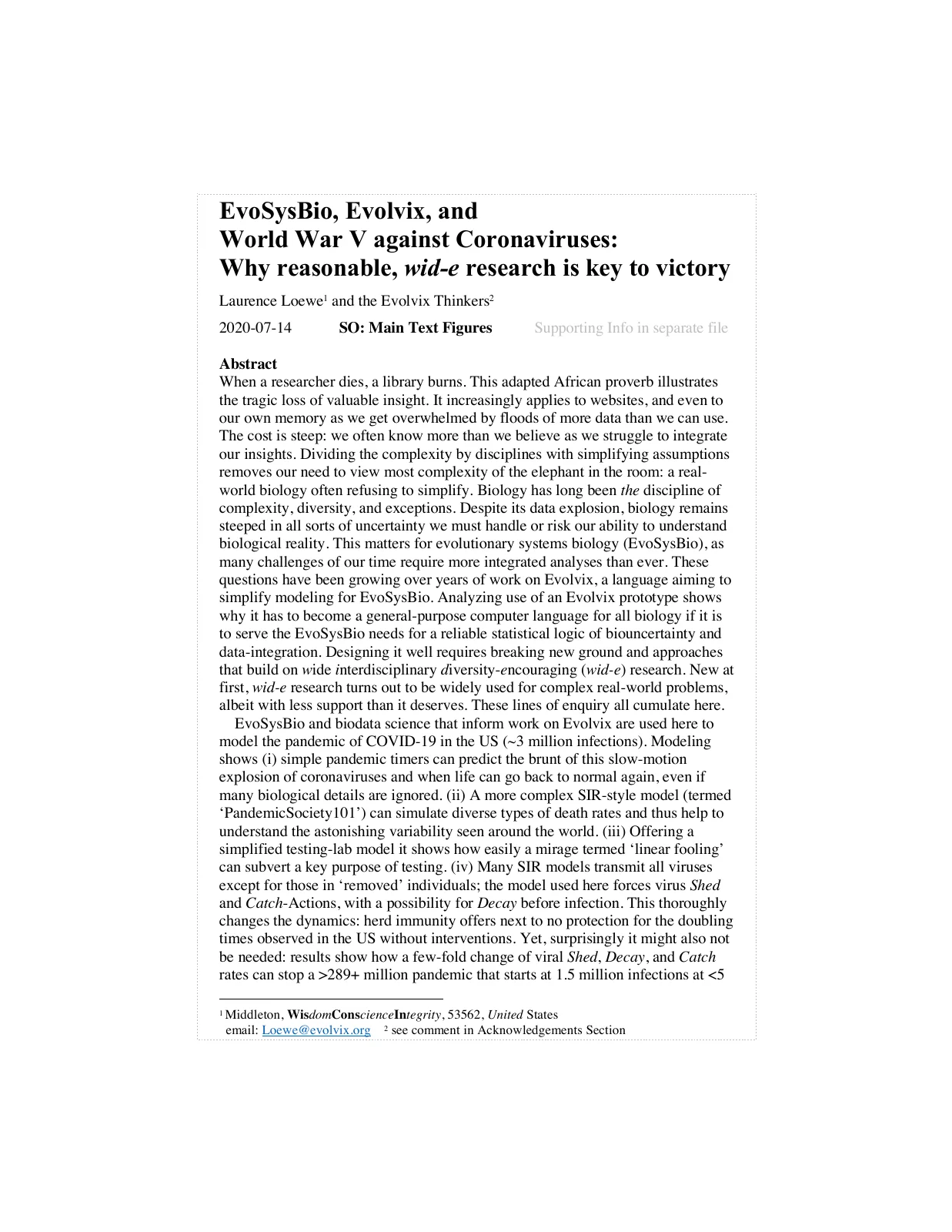
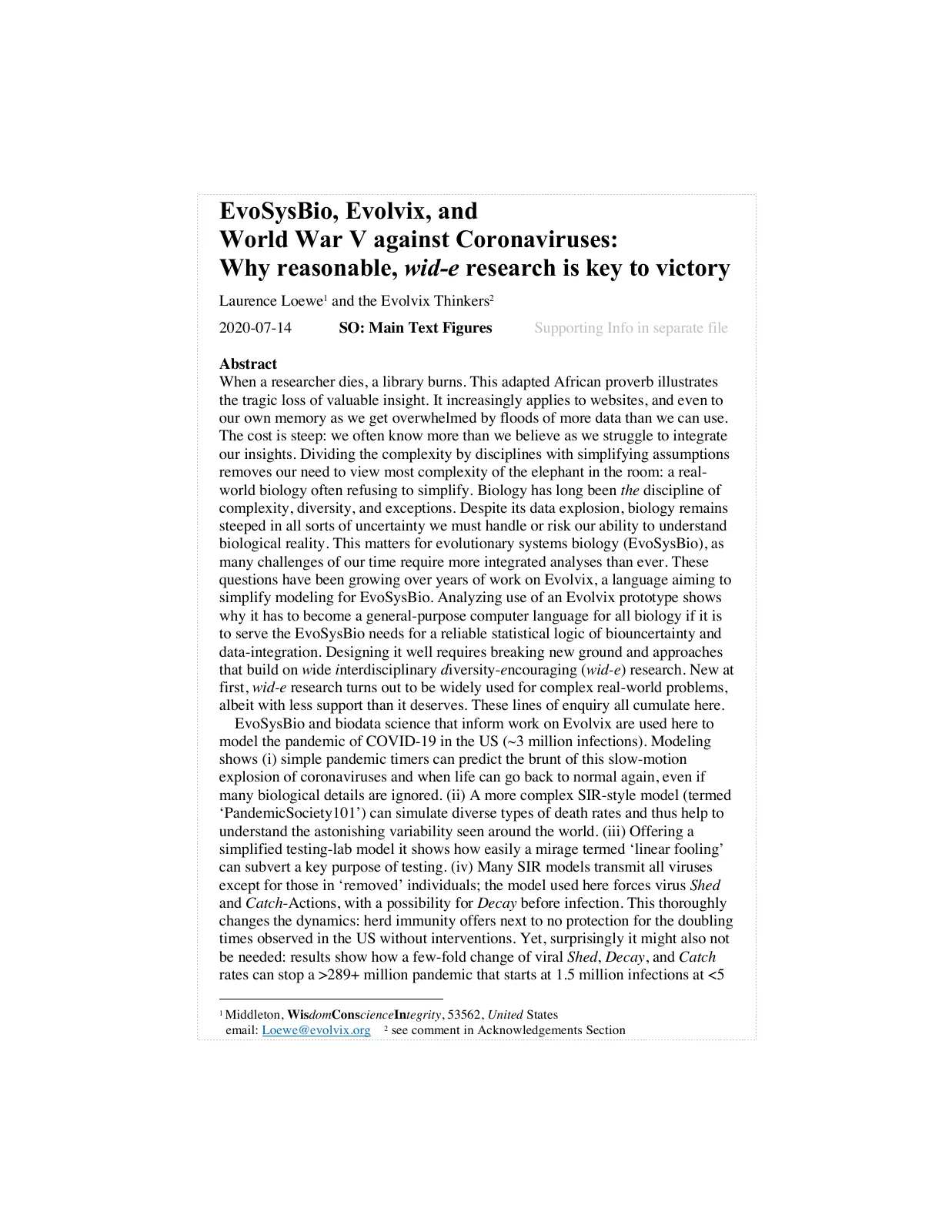
A 32-page academic manuscript (2020m07d17) presenting pandemic simulations, the PandemicSociety101 model, and the argument that reasonable, wid-e research is key to victory in World War V against Coronaviruses.
Download the original document (PDF)
Pandemic Snapshot — PDF (4.5 MB) — 32 pages, Jonah License with CC0 Public Domain
Filename: wwv-prep-fail-snapshot-loewe-part-ms-pandemicsociety101-results-iv_llol_qqr8p2_2020m07d17-32pg.pdf
Also in this folder: AIMS Ket, Concept Art, SGIR Model
— Overview AI-generated by dv_ClaOp46Max_ExhI_2026m04d16 —Start—
Abstract#
This 32-page academic manuscript, titled “EvoSysBio, Evolvix, and World War V against Coronaviruses: Why reasonable, wid-e research is key to victory,” is the most scientifically rigorous document in the STa2-WWV collection. Written 2020m07d17 as LLoL’s contribution to a Microsoft PandemicSociety101 collaboration, it presents formal pandemic simulations and modeling using the Evolvix prototype.
Key findings from the abstract and introduction (pp. 1–2):
Simple pandemic timers can predict the brunt of a coronavirus slow-motion explosion, even when many biological details are ignored
The PandemicSociety101 model (an advanced SIR-style model) can simulate diverse types of death rates and help understand astonishing variability worldwide
A simplified testing-lab model shows how “linear fooling” (failure to grasp non-linear dynamics) can subvert a key purpose of testing
Results show how a few-fold change of viral Shed, Decay, and Catch rates can stop a >289+ million pandemic at <5 million infections — with neither herd immunity nor vaccines
Structure (pp. 3–15 read; 32 total):
Section 2: Key modeling basics and the importance of wid-e research; introduces the Evolvix prototype
Section 4: “Mission Impossible: Timers to stop a slow-motion explosion” — HalfMax clock, LastFive clock, comparisons to US data through May 2020 (with detailed forecast figures)
Section 5: PandemicSociety101 — an advanced SIR model with new code motifs for simulating biological populations, supporting soft and hard population limits, and tracking Incomplete Fitness Traits (IFTs)
Section 7: Work-logic cascade and strategy for WWV (referenced in abstract, not in pages read)
Section 8: ReRafts for accelerating pandemic data processing
Section 9: Parallels to the Titanic’s causal probability network
Notable technical content:
Fig.4-1: Forecasting US coronavirus infections with what-if scenarios at different doubling times (3, 5, 6, 7 days)
Fig.4-2: Slow-motion explosion clocks tracking pandemic dynamics on log-scales using CDC data
Fig.2-2: Overview of Evolvix modeling language (many models in one language mapping to many tools — ODEs, SSAs)
Fig.5-1: Core model of PandemicSociety101 with US input scenarios, showing 7 infection stages, a simplified testing lab, hospital, and recovery pathways
On multiplicative calculus (pp. 7–8): The paper argues that coronaviruses live in a multiplicative world (exponential growth, radioactive decay) rather than our intuitive linear world. It introduces multiplicative calculus (Grossman, 1972 ff.) as a key mathematical framework for understanding pandemic dynamics — where multiplication and division replace addition and subtraction.
On counting in a pandemic (pp. 5–6): A remarkable section where LLoL confesses: “I cannot count” — meaning that the mathematical precision required for reliable counting is far deeper than most assume. This connects to the broader wid-e argument that interdisciplinary depth is essential for pandemic response.
Who This Document Is For#
Audience |
What they will find |
|---|---|
Epidemiologists |
PandemicSociety101 model with novel SIR extensions; IFT framework for virus mutant emergence; realistic death-rate modeling |
Computational biologists |
Evolvix prototype demonstration; multiplicative calculus connections; new code motifs for biological simulation |
General public |
Accessible HalfMax and LastFive timer models that can be calculated on a pocket calculator; work-logic cascade for individual pandemic contribution |
Policy makers |
Evidence that simple interventions (Shed/Decay/Catch changes) can stop a >289M pandemic at <5M infections without vaccines |
Key Concepts at a Glance#
PandemicSociety101 |
An advanced SIR-style model built in the Evolvix prototype, supporting 7 infection stages, testing labs, hospitals, and multiple death pathways |
HalfMax clock |
A rough timer estimating when half the population will be infected — the “brunt” of a slow-motion explosion |
LastFive clock |
A timer for when contact tracing can break the deterministic power of the explosion (when only ~5 active cases remain) |
Multiplicative calculus |
Mathematical framework (Grossman, 1972) where multiplication replaces addition — natural for exponential growth/decay processes like viral spread |
Shed, Decay, Catch |
Three key viral transmission parameters: how much virus is shed, how fast it decays outside hosts, and how easily it is caught — small changes can stop pandemics |
Linear fooling |
The cognitive trap of applying linear intuitions to fundamentally non-linear (exponential) pandemic dynamics |
IFTs |
Incomplete Fitness Traits — framework for studying virus mutant emergence that may affect transmission |
Broader Significance (Claude’s Assessment)#
This is the most technically substantive document in the STa2-WWV collection and one of the most scientifically rigorous in the entire Good News Pack. Several aspects stand out:
The >289M-to-<5M result is a striking quantitative claim: that simple changes in viral transmission parameters can reduce a massive pandemic by orders of magnitude without vaccines or herd immunity. This deserves independent testing.
The multiplicative calculus argument is original: reframing pandemic dynamics in the calculus where viral processes naturally live (multiplicative rather than additive) could yield insights invisible to standard approaches.
The “I cannot count” confession connects to the broader wid-e philosophy: genuine interdisciplinary depth requires confronting the foundations of one’s own discipline, not just applying standard methods.
The PandemicSociety101 model appears to be a substantial computational contribution, with realistic features (7 infection stages, testing labs, hospital capacity) built in the Evolvix prototype.
Note: Only pages 1–15 of 32 were read for this summary. Sections 6–9 (death traps, work-logic cascade, ReRafts, Titanic parallels) are referenced from the table of contents but not summarized in detail.
Document Information#
Document ID |
Pandemic Snapshot — EvoSysBio, Evolvix, and WWV |
Full title |
EvoSysBio, Evolvix, and World War V against Coronaviruses: Why reasonable, wid-e research is key to victory |
Author |
Laurence Loewe1 and the Evolvix Thinkers2 |
Affiliation |
Middleton, WisdomConscienceIntegrity, 53562, United States |
Date |
2020m07d17 |
Version |
iv_LLoL_QQs0r8p2_2020m07d17 |
Format |
32-page academic manuscript (figures file — main text figures with captions) |
PDF size |
4.5 MB |
License |
|
Part of |
Good News Pack MMv3, Flying Scroll / Transwarp Key / STa2-WWV |
Related documents:
— Overview AI-generated by dv_ClaOp46Max_ExhI_2026m04d16 —End—