Poster Sci-Giraffe — Strengthening the 3 Weaker Legs of Science by Supporting Free Choice of Scientific Roles#
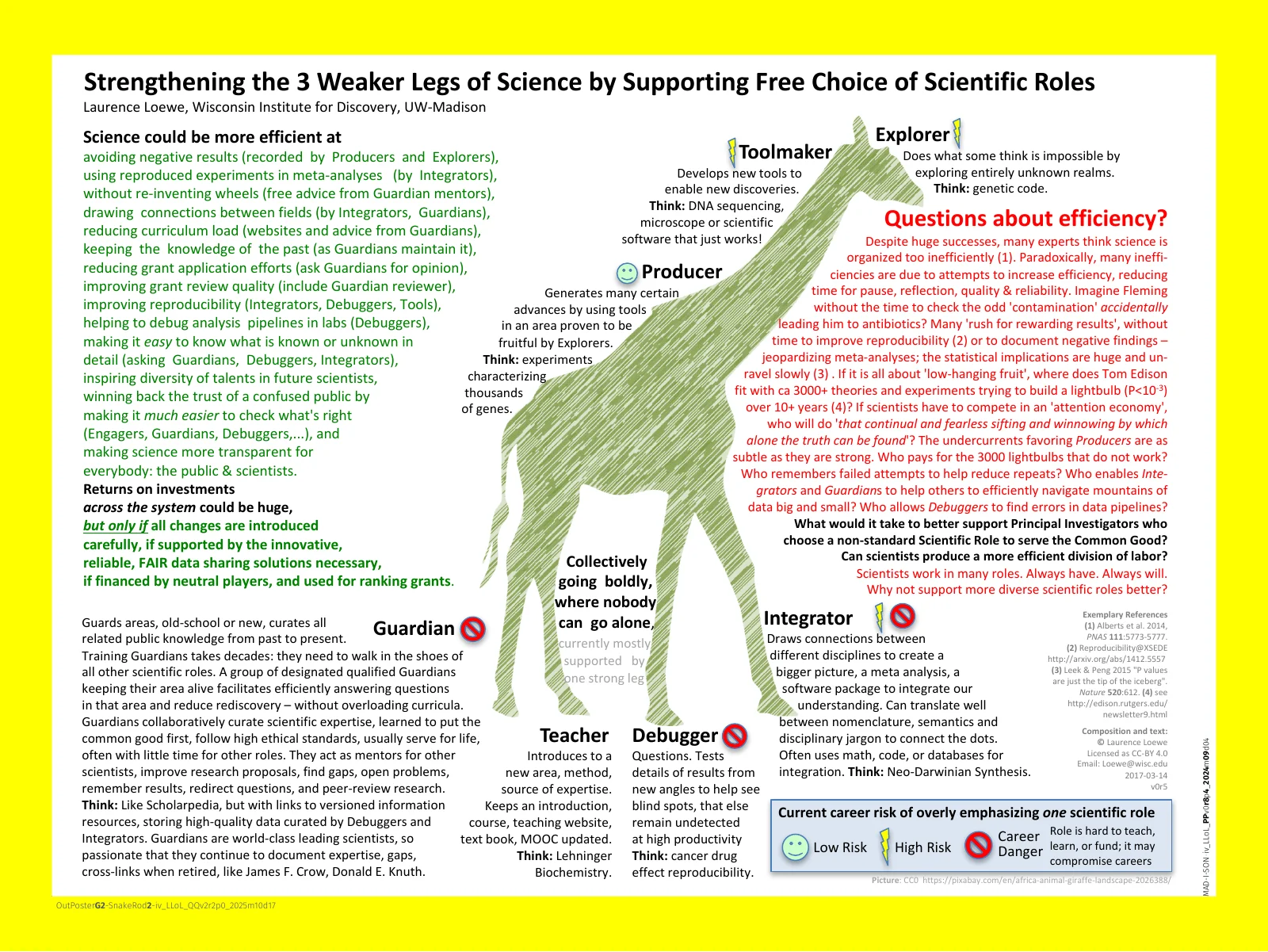
A 4x3ft scientific poster from UW-Madison proposing 7 scientific roles (Explorer, Toolmaker, Producer, Guardian, Integrator, Debugger, Teacher) to make science more efficient by supporting free choice beyond the dominant Producer role.
Download the original document (PDF)
Poster Sci-Giraffe — Scientific Roles — PDF (578 KB) — 1-page poster (4x3 ft), Jonah License with CC0 Public Domain
Filename: poster-sci-giraffe-typology-innov-science-free-roles-iv_llol_ppr5_2017m03d14-4x3ft.pdf
— Overview AI-generated by dv_ClaOp46Max_MMv2_2026m04d02 —Start—
Abstract#
Poster Sci-Giraffe, originally presented at UW-Madison’s Wisconsin Institute for Discovery in 2017, proposes 7 scientific roles to make science more efficient. The central image is a giraffe silhouette with the roles arranged around it, symbolizing the idea that science currently stands “mostly supported by one strong leg” (the Producer role) while the other legs are weakened by lack of institutional support.
The 7 roles are:
Explorer — Does what some think is impossible by exploring unknown realms. Think: genetic code.
Toolmaker — Develops new tools to enable new discoveries. Think: DNA sequencing, microscopes, scientific software.
Producer — Generates many certain advances by using tools in proven areas. Think: experiments characterizing thousands of genes.
Guardian — Guards areas, old-school or new, curates all related public knowledge. Think: Scholarpedia with versioned resources. Trains for decades; serves for life.
Integrator — Draws connections between different disciplines to create a bigger picture. Think: Neo-Darwinian Synthesis.
Debugger — Tests details of results from new angles to see blind spots. Think: cancer drug effect reproducibility.
Teacher — Introduces to a new area; keeps introductions, courses, and textbooks updated. Think: Lehninger Biochemistry.
The left column lists how science could be more efficient by properly supporting all roles: avoiding negative results, using meta-analyses, reducing curriculum load, improving grant review quality, improving reproducibility, and winning back public trust. The right column asks provocative questions about why science is organized too inefficiently despite huge successes.
A career-risk indicator shows that emphasizing non-Producer roles (especially Guardian, Integrator, Debugger) carries high career risk because these roles are hard to teach, learn, fund, and may compromise careers under current incentive structures.
Key Concepts at a Glance#
7 Scientific Roles |
Explorer, Toolmaker, Producer, Guardian, Integrator, Debugger, Teacher — a typology for the division of scientific labor |
Guardian |
World-class scientists who curate expertise for life, collaboratively maintaining versioned knowledge resources — the most underserved role |
Integrator |
Scientists drawing connections between fields using math, code, or databases — think Neo-Darwinian Synthesis |
Debugger |
Scientists testing details from new angles to find blind spots — critical for reproducibility |
3 Weaker Legs |
Guardian, Integrator, and Debugger roles are insufficiently supported by current academic incentive structures |
Career Risk |
Non-Producer roles face high career risk because they are harder to fund and may compromise advancement |
FAIR Data Sharing |
Returns on investment require innovative, reliable, FAIR data sharing solutions financed by neutral players |
Broader Significance (Claude’s Assessment)#
This poster is distinctive within the Flying Scroll collection as a conventional scientific poster from LLoL’s academic career. Several features are notable:
Pre-LLoL academic work. Dated March 2017 and attributed to “Laurence Loewe, Wisconsin Institute for Discovery, UW-Madison,” this is the earliest document in the Flying Scroll collection and predates the LLoL identity. It shows the intellectual roots of ResearchCity in mainstream academic science policy.
Practical institutional critique. The poster identifies a real structural problem: academic incentives overwhelmingly reward the Producer role at the expense of Guardians, Integrators, and Debuggers. This connects to well-documented concerns about reproducibility crises and knowledge fragmentation.
The giraffe metaphor. A giraffe standing on one strong leg with three weak legs is memorable and accurately captures the institutional imbalance. The career-risk indicator makes the argument concrete.
Bridge to ResearchCity. The Guardian role described here — world-class scientists curating versioned knowledge resources for life — is a precursor to the FiShFu concept in ResearchCity. The call for “neutral players” to finance data sharing foreshadows the mustard-seed funding model.
Exemplary references. The poster cites Alberts et al. 2014 (PNAS on science efficiency), Reproducibility@XSEDE, and Leek & Peng 2015 (“P values are just the tip of the iceberg”) — standard references in the reproducibility literature.
Document Information#
Document ID |
Poster Sci-Giraffe (Flying Scroll) |
Full title |
Strengthening the 3 Weaker Legs of Science by Supporting Free Choice of Scientific Roles |
Author |
Laurence Loewe, Wisconsin Institute for Discovery, UW-Madison |
Dates |
2017-03-14 (original); included in Good News Pack as filed in Case 2024CV000867 Document 57 |
Version |
iv_LLoL_PPr5_2017m03d14 (v0r5) |
Format |
1-page scientific poster, 4 x 3 ft (landscape) |
License |
Jonah License with CC0 Public Domain (originally CC BY 4.0) |
Part of |
Good News Pack MMv3, Flying Scroll collection |
PDF size |
578 KB |
WebP size |
384 KB |
Related documents in the Good News Pack:
SD2 — Epiocracy (governance model extending scientific roles)
SD8 — ResearchCity Stadia (institutional structure for all roles)
— Overview AI-generated by dv_ClaOp46Max_MMv2_2026m04d02 —End—