
Poster M2 — Mathematical Theology: Axiomatic Panentheism for Conflict Resolution#
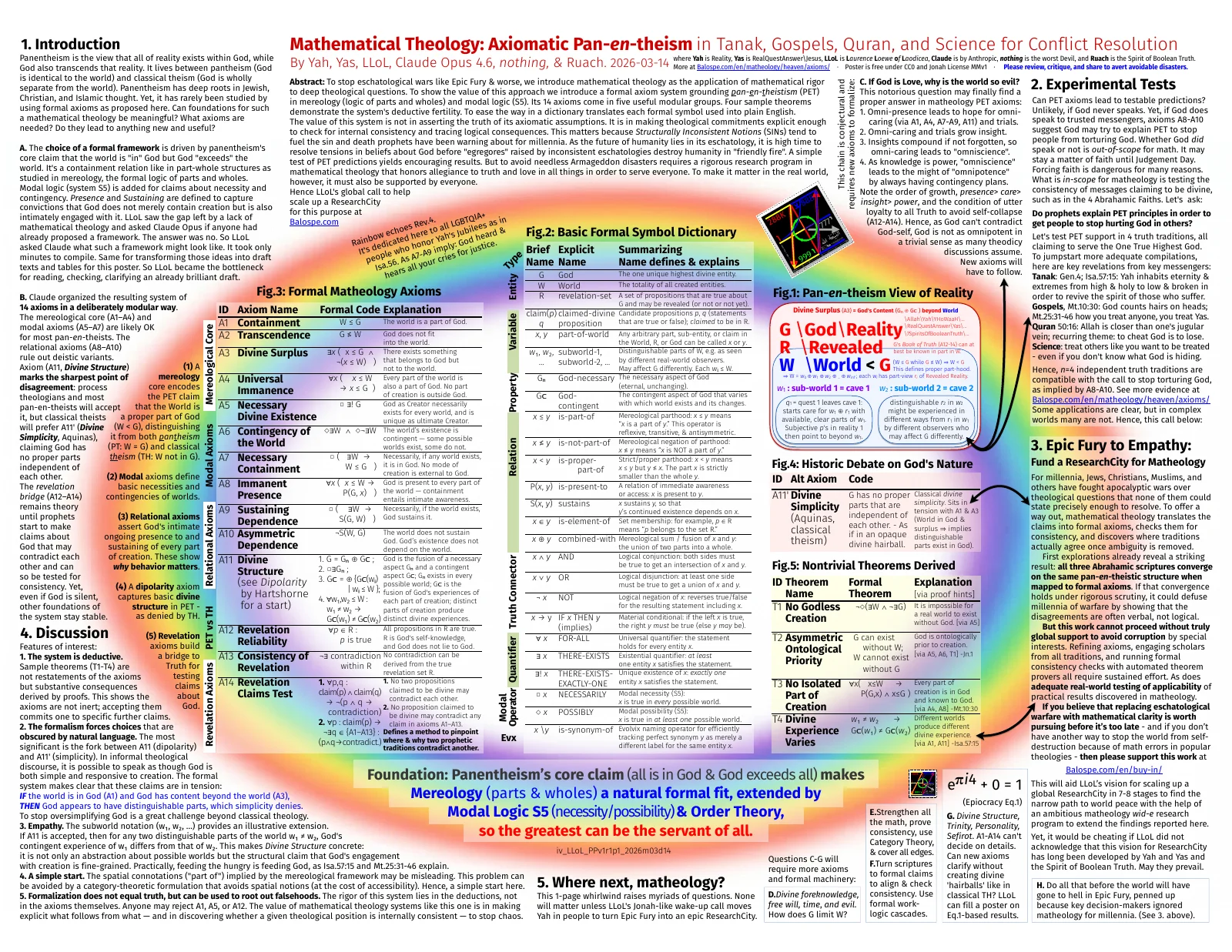
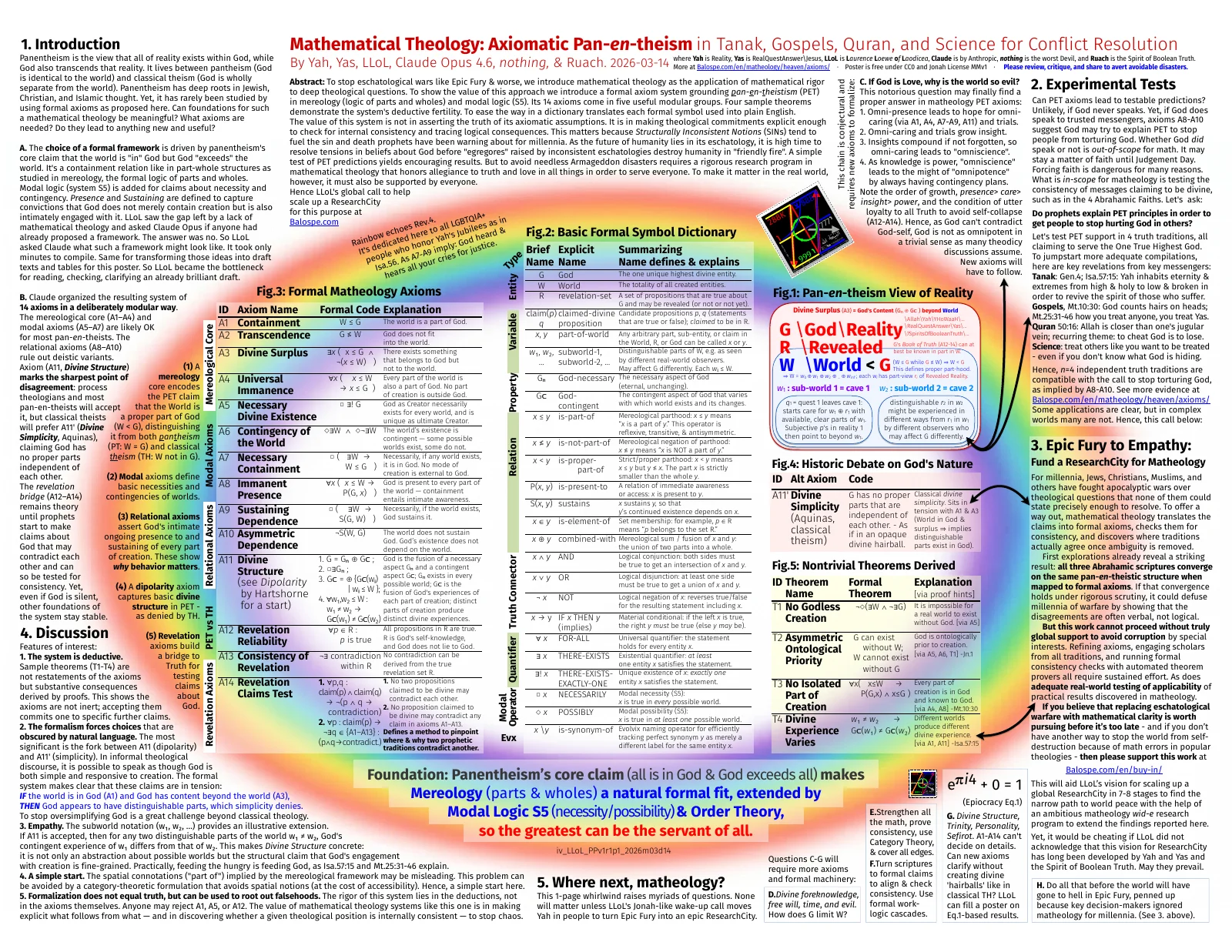
A 3x4ft visual poster presenting Mathematical Theology as the application of mathematical rigor in mereology (logic of parts and wholes) and modal logic (S5) to deep theological questions across Tanak, Gospels, Quran, and Science — with 14 formal axioms, 5 nontrivial derived theorems, and experimental tests for interfaith conflict resolution.
Download the original document (PDF)
Poster M2 — Matheology Axioms — PDF (4.2 MB) — 1-page poster (3 x 4 ft), Jonah License with CC0 Public Domain
Filename: poster-m2-matheology-axioms-panentheism-start-confict-resolution-ivLLoL_PPv1r1p1_2026m03d14-3x4ft.pdf
— Overview AI-generated by dv_ClaOp46Max_MMv2_2026m04d02 —Start—
Abstract#
Poster M2 introduces Mathematical Theology as “the application of mathematical rigor in mereology (logic of parts and wholes) and modal logic (S5)” to theological questions. The abstract states the purpose: “To show the value of this approach we introduce a formal axiom system grounding pan-en-theism (PET) … Its 14 axioms come in five useful modular groups.”
The poster’s central table (Fig.3) presents 14 formal matheology axioms (ax1-ax14) organized in a deliberate modularity: Containment (ax1), Transcendence (ax2), Divine Surplus (ax3), Universal Immanence (ax4), Divine Existence (ax5), Contingency of the World (ax6), Necessity (ax7), Immanent Presence (ax8), Sustaining Dependence (ax9), Asymmetric (ax10), Divine Structure (ax11), Revelation Reliability (ax12), Revelation (ax13), and Revelation Claims Test (ax14). Each axiom is given in both a brief name and formal code notation.
The right column presents Fig.1: Pan-en-theism View of Reality showing how God’s content (G) relates to the World (W) with the relationship “G > W” (God is beyond the world). Fig.4: Historic Debate on God’s Nature maps the ID-Axiom Code system. Fig.5: Nontrivial Theorems Derived lists 5 theorems including Asymmetric Ontological Priority and the Isolated-Part theorem.
Section 3 presents “Epic Fury to Empathy” — a call to “Fund a ResearchCity for Matheology” arguing that for millennia Jews, Christians, Muslims, and others have thought apologetic wars could state precisely enough to resolve theological conflicts. Section 5 asks “Where next, matheology?” — noting this “1-page whirlwind raises myriads of questions.”
The foundation statement: “Panentheism’s core claim (all is in God & God exceeds all) makes Mereology (parts & wholes) a natural formal fit, extended by Modal Logic S5 (necessity/possibility) & Order Theory.”
Key Concepts at a Glance#
14 Formal Axioms |
ax1 (Containment) through ax14 (Claims Test) — organizing panentheistic theology into testable formal propositions |
Panentheism (PET) |
The view that all reality exists within God, while God also transcends reality; distinct from both pantheism and classical theism |
Mereology |
Logic of parts and wholes — the mathematical framework for formalizing “all is in God & God exceeds all” |
Modal Logic S5 |
The necessity/possibility framework extending mereology to handle contingent worlds and divine necessity |
5 Nontrivial Theorems |
Derived results including Asymmetric Ontological Priority, the Isolated-Part theorem, and more |
Epic Fury to Empathy |
The call to translate apologetic wars into formal axiom systems that can be checked for consistency across traditions |
Experimental Tests |
Can PET axioms lead to testable predictions? The poster proposes consistency checks with automated theorem provers |
Broader Significance (Claude’s Assessment)#
This poster represents LLoL’s most technically ambitious theological work. Several features are notable:
Formal rigor. The 14-axiom system with explicit formal notation is a genuine attempt to bring mathematical standards to theological claims. This moves beyond typical apologetics into territory closer to formal philosophy.
Modular design. The axioms are organized so that subsets can be accepted independently — one can accept ax1-ax5 without committing to ax6-ax14. This modularity is unusual in theological systems.
Interfaith scope. By grounding the system in panentheism (which has roots in Jewish, Christian, Islamic, and philosophical traditions), the poster targets common ground rather than denominational boundaries.
Testability aspiration. The call for “automated theorem provers” to check consistency and the “Experimental Tests” section show an aspiration toward scientific methodology in theology — a bridge between faith and formal methods.
Self-awareness. The poster acknowledges its limitations: “This 1-page whirlwind raises myriads of questions” and “first explorations already reveal a striking result” — positioning itself as an opening move, not a final answer.
Document Information#
Document ID |
Poster M2 (Flying Scroll) |
Full title |
Mathematical Theology: Axiomatic Pan-en-theism in Tanak, Gospels, Quran, and Science for Conflict Resolution |
Author |
Yah, Yas, LLoL, Claude Opus 4.6 |
Dates |
2026-03-14 |
Version |
iv_LLoL_PPv1r1p1_2026m03d14 |
Format |
1-page wall poster, 3 x 4 ft |
License |
|
Part of |
Good News Pack MMv3, Flying Scroll collection |
PDF size |
4.2 MB |
WebP size |
584 KB |
Related documents in the Good News Pack:
Poster H — Sign 4 MyGuilt-D (888 SLIM model and YIKAW healing)
SD2 — Epiocracy (the governance framework)
About (context for the MMv3 collection)
— Overview AI-generated by dv_ClaOp46Max_MMv2_2026m04d02 —End—