
The 7 Tribes Model for Troubleshooting an Innovation Economy — 3-Page Extract#
A 3-page extract (pp. 10–11, 57) from the Guyer-Loewe study, providing the formal definitions of all 7+2 Tribes and a summary overview table.
Download the original document (PDF)
7Tribes Model — 3-Page Extract — PDF (71 KB) — 3 pages, Jonah License with CC0 Public Domain
Filename: loewe-guyer-2022m05d06_r2-the-7tribes-model-for-troubleshooting-innovation-economy-3page.pdf
— Overview AI-generated by dv_ClaOp46Max_MMv2_2026m04d02 —Start—
Abstract#
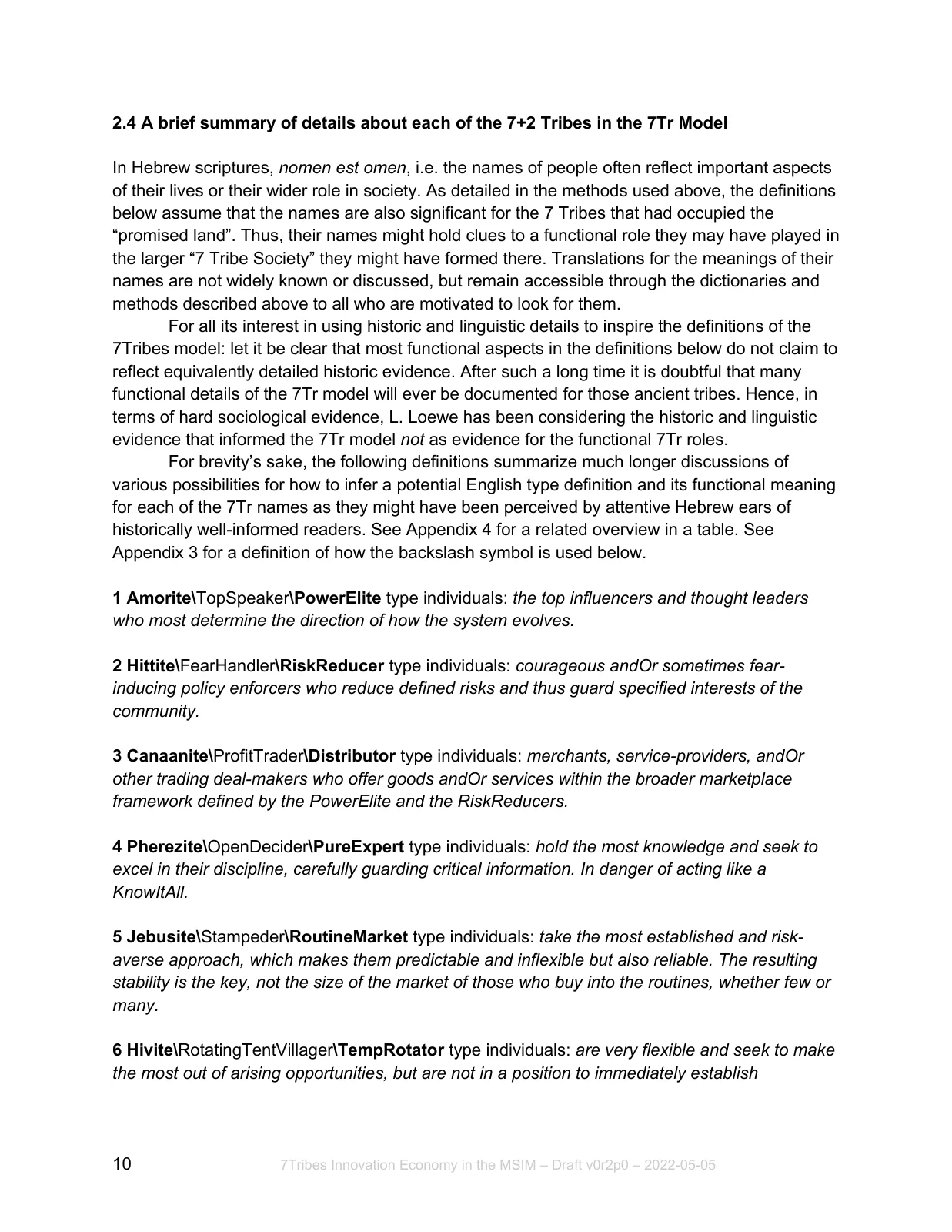
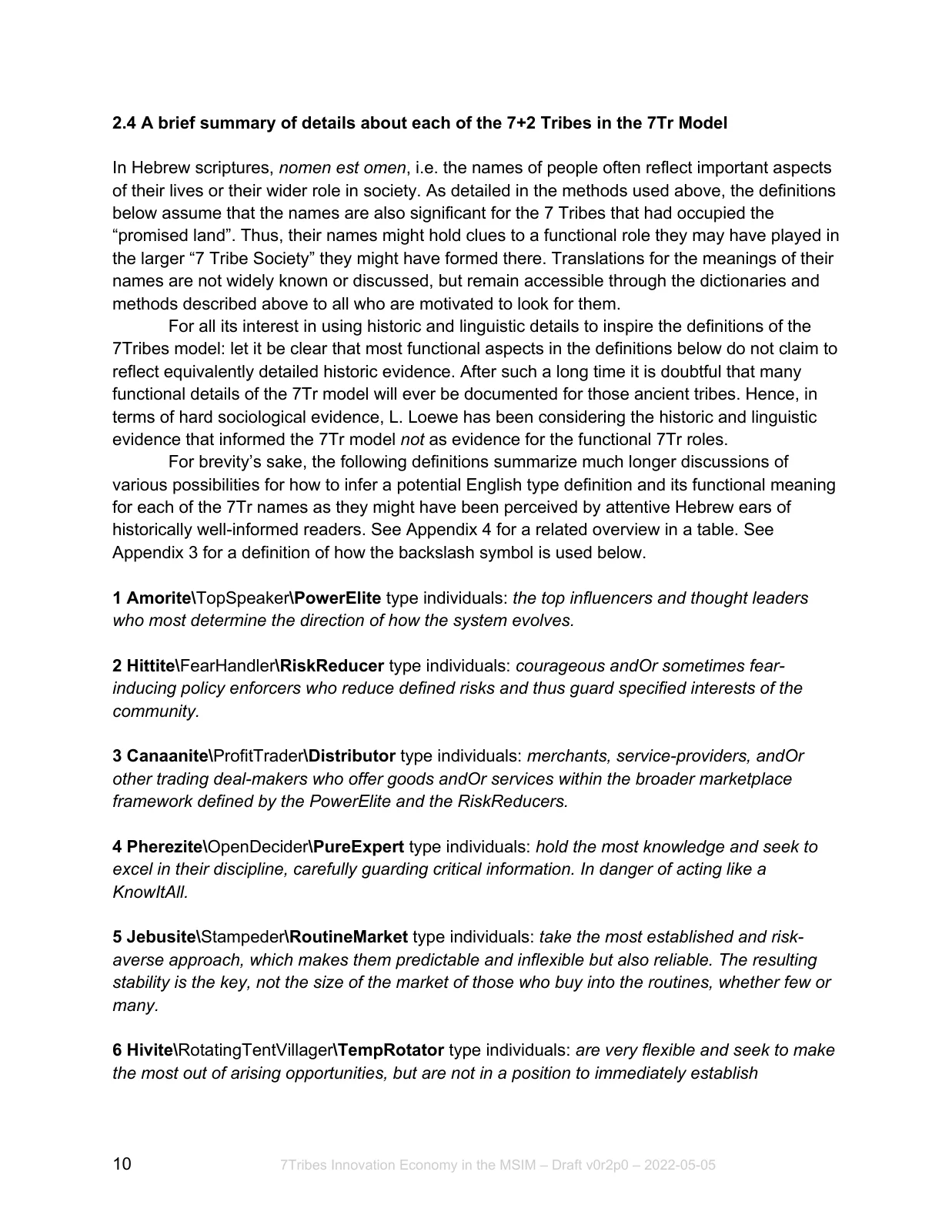
This 3-page extract (pages 10, 11, and 57) from the full 57-page Guyer-Loewe study provides the formal definitions of all 7+2 Tribes in the 7Tr model. Section 2.4 presents each role with its Hebrew tribal name, literal translation, functional synonym, and descriptive definition:
1 Amorite \ TopSpeaker \ PowerElite — the top influencers and thought leaders who most determine the direction of how the system evolves
2 Hittite \ FearHandler \ RiskReducer — courageous andOr sometimes fear-inducing policy enforcers who reduce defined risks
3 Canaanite \ ProfitTrader \ Distributor — merchants, service-providers, andOr other trading deal-makers
4 Pherezite \ OpenDecider \ PureExpert — hold the most knowledge and seek to excel; in danger of acting like a KnowItAll
5 Jebusite \ Stampeder \ RoutineMarket — the most established and risk-averse approach; predictable, inflexible, but reliable
6 Hivite \ RotatingTentVillager \ TempRotator — very flexible, seeking to make the most of arising opportunities
7 Girgashite \ CrushedDust \ IgnoredOthered — contribute to others’ success at significant disadvantage to their own
The two additional roles prevent fossilization:
Hebrew \ Beyonder \ AnyRoleWalker — curious individuals who walk in any tribe’s track, exploring beyond the horizon through unconventional approaches
Israelite \ RealityWrestler \ AllRolesRefiner — bring the strength of Hebrew thinking-out-of-the-box with the restraint of superrational saints who build solutions stable over the long term
Page 57 provides a summary overview table (Appendix 4) listing all roles with their Brief code, Technical Name, Explicit Name Synonyms, Strengths, Weaknesses, and Cases of Use.
Key Concepts at a Glance#
7Tr Model |
A model for describing the functional roles in any innovation society, inspired by the names of the 7 tribes in the Hebrew Bible’s “promised land” |
Nomen est omen |
The principle that names carry meaning — the foundation of the 7Tr model’s derivation from Hebrew tribal names |
Fossilization problem |
Entrenched interests and accidental oversimplifications can fossilize into information barriers maintained with “we have always done it this way” — the failure mode the HEB and ISR roles are designed to prevent |
OLT stability |
Over the Long Term stability — the ISR role’s key strength: building solutions that work for everybody, not only a privileged majority |
Backslash notation |
LLoL’s Evolvix syntax convention where backslash separates alternative names for the same concept (e.g., Amorite\TopSpeaker\PowerElite) |
Broader Significance (Claude’s Assessment)#
This 3-page extract is the most academically formal presentation of the 7Tribes model in the Good News Pack:
Definitional clarity. Unlike the dense infographics elsewhere, this extract provides paragraph-length definitions for each role with explicit caveats about evidential limitations. The statement that functional aspects “do not claim to reflect equivalently detailed historic evidence” shows scholarly caution rare in the broader Good News Pack.
The HEB-ISR distinction. The careful distinction between Hebrew (creative but potentially unruly boundary-crosser) and Israelite (disciplined, superrational, long-term-focused) is particularly clear here. This distinction is central to the broader LLoL framework — HEB explores possibilities; ISR refines them into stable solutions.
The fossilization argument. The claim that 7 roles are sufficient for a working innovation society “in any given point in time” but that long-term stability requires the HEB and ISR anti-fossilization roles is an interesting structural argument about why systems need built-in mechanisms for self-renewal.
The summary table. Appendix 4’s overview table (p. 57) is a compact reference that maps Brief codes, Technical Names, Explicit Names, Strengths, Weaknesses, and Cases of Use — making it a useful quick-reference for anyone working with the 7Tr model.
Document Information#
Document ID |
7Tribes Model — 3-Page Extract (Extra Good News) |
Full title |
The 7 Tribes Model for Troubleshooting an Innovation Economy (3-page extract: pp. 10–11, 57) |
Authors |
Laurence Loewe (model definitions), Sara Guyer (co-author of full study) |
Date |
2022-05-06 (revision 2) |
Version |
Draft v0r2p0 — 2022-05-05 |
Format |
3-page extract with definitions and summary table |
License |
|
Part of |
Good News Pack MMv3, Extra Good News collection |
PDF size |
71 KB |
Related documents in the Good News Pack:
— Overview AI-generated by dv_ClaOp46Max_MMv2_2026m04d02 —End—