
The Population Genetics of Mutations: Good, Bad and Indifferent#
A major review co-authored with William G. Hill for Brian Charlesworth’s Festschrift — positioning population genetics of mutations at the center of evolutionary theory.
Download the original document (PDF)
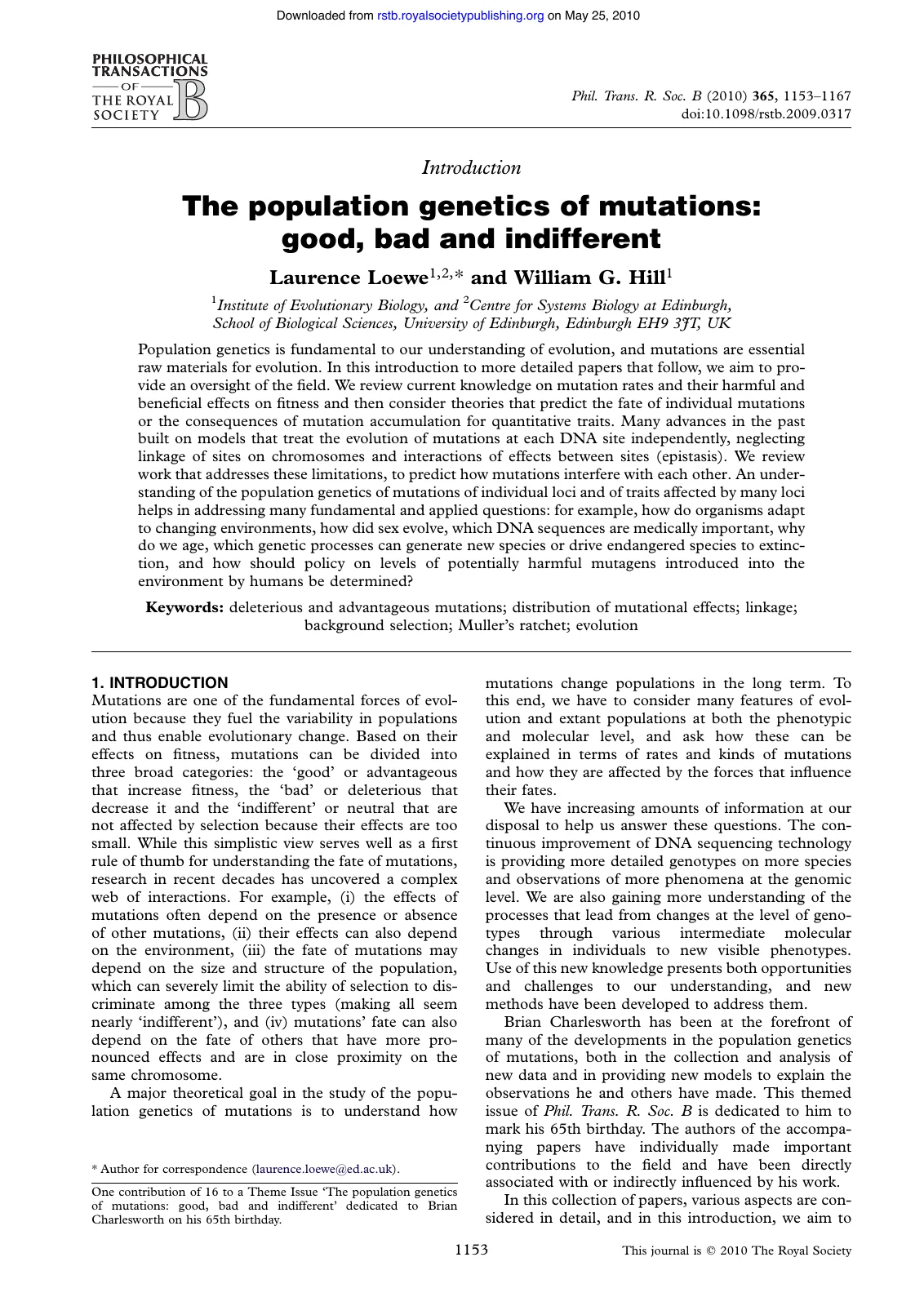
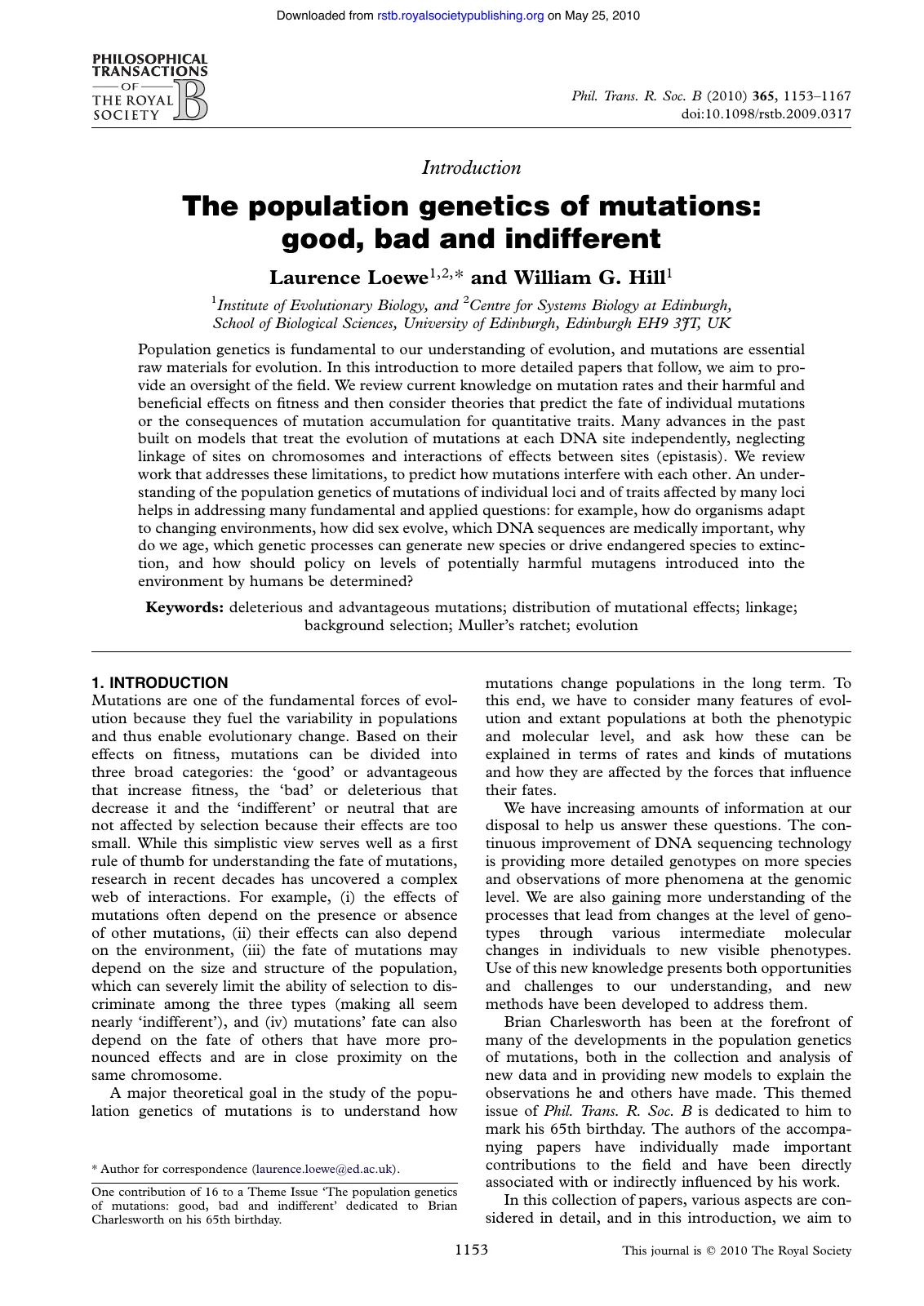
Loewe & Hill 2010 — Population Genetics of Mutations — PDF (228 KB) — 15 pages, Jonah License with CC0 Public Domain
Filename: loewe-hill-2010-review-population-genetics-of-mutations-intro-15page.pdf
— Overview AI-generated by dv_ClaOp46_ExhB_2026m04d14 —Start—
Abstract#
This 15-page review paper, published in Phil. Trans. R. Soc. B (2010) 365, 1153–1167 (published 25 May 2010), serves as the introduction to a themed issue of Philosophical Transactions of the Royal Society B dedicated to Brian Charlesworth’s 65th birthday.
The paper reviews current knowledge on mutation rates, the harmful and beneficial effects of mutations on fitness, and the consequences for quantitative traits. It covers the major categories of mutation types, their fitness effects (deleterious, neutral, and advantageous), and the key linkage theories that govern how mutations interact in finite populations: background selection, Muller’s ratchet, and genetic hitchhiking. The review synthesizes population genetics parameters and connects classical theory to modern genomic data, providing a comprehensive snapshot of the field as of 2010.
Broader Significance (Claude’s Assessment)#
This paper is significant for several reasons:
Co-authored with William G. Hill. William G. Hill is a pioneer in quantitative genetics and one of the most influential population geneticists of the late 20th century. Co-authoring a major review with Hill positions LLoL at the center of the quantitative genetics community and reflects the high regard in which LLoL’s expertise in mutation effects was held.
Festschrift for Brian Charlesworth. This paper introduces a themed issue honoring Brian Charlesworth, one of the most important evolutionary geneticists alive. Writing the introductory review for such a volume is a significant mark of standing in the field — building on LLoL’s earlier collaborations with Charlesworth on DME research.
Comprehensive DME review. The paper provides perhaps the most thorough review of the distribution of mutational effects available at the time, connecting it to mutation rate estimates, linkage theories, and quantitative genetics. This synthesis is the empirical and theoretical context within which the EvoSysBio framework operates.
Theoretical foundation for EvoSysBio. The population genetics parameters reviewed here — selection coefficients, mutation rates, dominance, epistasis — are precisely the quantities that the EvoSysBio framework aims to compute from mechanistic molecular models. This review paper documents the gap that EvoSysBio is designed to fill.
Good, bad and indifferent. The title itself captures a fundamental truth about mutations that is often oversimplified in popular science: mutations are not simply “good” or “bad” but span a continuous distribution, and their effects depend on genetic background, population size, and environmental context.
Who This Document Is For#
Audience |
Why This Document Matters |
|---|---|
Population geneticists |
A comprehensive review of mutation rates, fitness effects, and linkage theories as of 2010, co-authored by two leading figures in the field. Useful as both a reference and a snapshot of the field’s state of knowledge. |
Evolutionary biologists |
Synthesizes the empirical and theoretical foundations for understanding how mutations drive evolutionary change, from individual nucleotide changes to population-level consequences. |
Quantitative geneticists |
Connects mutation effects to quantitative trait variation, bridging the gap between molecular-level mutations and the phenotypic variation that breeders and medical geneticists observe. |
Reviewers of the Matheo papers |
The population genetics parameters reviewed here are the target quantities of the EvoSysBio framework. Understanding what is known (and unknown) about these parameters provides essential context for evaluating EvoSysBio claims. |
Science historians |
A Festschrift introduction that maps the intellectual landscape of population genetics as of 2010, with extensive citation of the field’s foundational contributions. |
Key Concepts at a Glance#
Distribution of mutational effects (DME) |
The probability distribution of fitness effects across random mutations — the central theme of the review |
Mutation rates |
Per-nucleotide and per-genome rates of spontaneous mutation, reviewed across organisms |
Selection coefficients |
The quantitative measure of a mutation’s effect on fitness, ranging from lethal to strongly beneficial |
Background selection |
Reduction of neutral diversity due to removal of linked deleterious mutations from the population |
Muller’s ratchet |
Irreversible accumulation of deleterious mutations in small asexual populations due to stochastic loss of the least-loaded class |
Genetic hitchhiking |
Increase in frequency of neutral alleles linked to a positively selected mutation sweeping through the population |
Codon bias |
Differential use of synonymous codons reflecting weak selection for translational efficiency |
Document Information#
Document ID |
Phil. Trans. R. Soc. B review (Dusty Deep Data, key-papers/) |
Full title |
The population genetics of mutations: good, bad and indifferent |
Authors |
Laurence Loewe, William G. Hill |
Year |
2010 (published 25 May 2010) |
Journal |
Phil. Trans. R. Soc. B (2010) 365, 1153–1167 |
DOI |
|
Context |
Introduction to themed issue for Brian Charlesworth’s 65th birthday |
Format |
15-page journal review article |
License |
|
Part of |
Good News Pack MMv3, Dusty Deep Data / key-papers collection |
PDF size |
228 KB |
WebP size |
288 KB |
Related documents in the Good News Pack:
2009 — EvoSysBio Framework (the framework that aims to compute the parameters reviewed here)
— Overview AI-generated by dv_ClaOp46_ExhB_2026m04d14 —End—