
Loewe (2016) — Systems in Evolutionary Systems Biology#
The definitive encyclopedia entry formalizing EvoSysBio — establishing LLoL as the primary architect of the framework that connects systems biology to evolutionary and population genetics.
Download the original document (PDF)
Loewe (2016) — Systems in EvoSysBio — PDF (2.2 MB) — 22 pages, CC BY-SA 4.0 / Jonah License with CC0 Public Domain
Filename: loewe-2016-study-framework-definition-for-systems-in-evolutionary-systems-biology-22page.pdf
— Overview AI-generated by dv_ClaOp46_ExhB_2026m04d14 —Start—
Abstract#
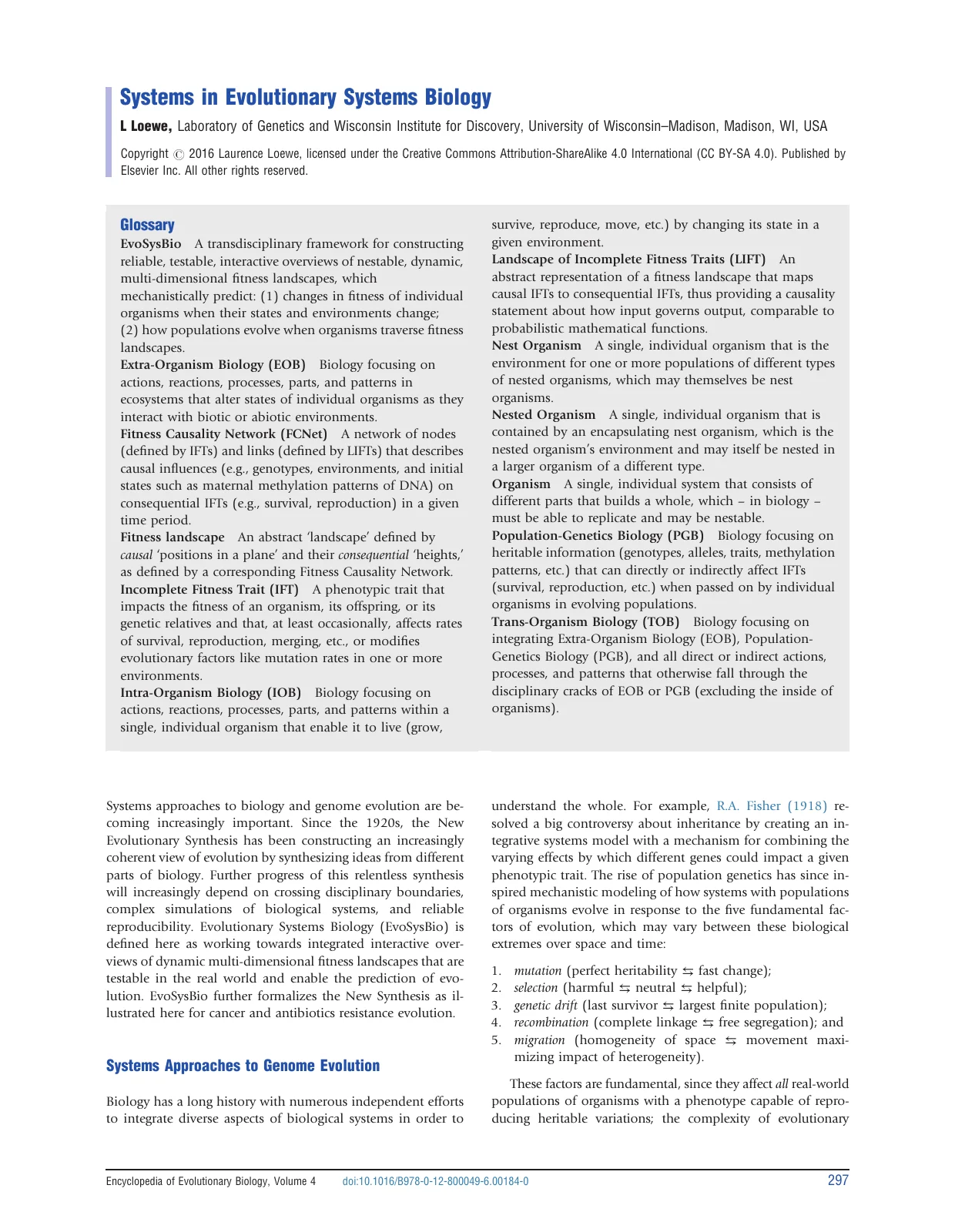
This encyclopedia article, published in the Encyclopedia of Evolutionary Biology (R. Kliman, ed., Elsevier/Academic Press), defines Evolutionary Systems Biology (EvoSysBio) more precisely without loss of generality. It introduces a glossary of key terms and formalizes the theoretical architecture of the field.
Key contributions include:
IOB (Internal Organization of Biology) — the systems biology side
EOB (External Organization of Biology) — the population genetics side
PGB (Population Genetics Bridge) — connecting IOB to EOB through fitness
TOB (Theory of Biology) — the overarching theoretical framework
Fitness Causality Networks (FCNets) — formal representations of how molecular-level traits causally determine fitness
Landscapes of Incomplete Fitness Traits (LIFTs) — fitness landscapes built from partial information about fitness-relevant traits
MOCA-LIFTs — Multi-Objective Co-Adapted LIFTs that capture trade-offs across multiple fitness components
The article formalizes EvoSysBio as a trans-disciplinary framework for constructing reliable, testable, interactive overviews of nestable, dynamic, multi-dimensional fitness landscapes. It distinguishes formal and informal EvoSysBio, with formal EvoSysBio requiring explicit mathematical models and informal EvoSysBio using conceptual frameworks.
Broader Significance (Claude’s Assessment)#
This encyclopedia entry is the capstone of the EvoSysBio framework:
Definitive reference. Being the author of the EvoSysBio entry in a major encyclopedia (Elsevier’s Encyclopedia of Evolutionary Biology) establishes LLoL as the primary architect and definer of this field. Encyclopedia entries are authoritative reference works consulted by researchers worldwide.
Formal definitions. The progression from conceptual framework (2009) through landscape integration (2012) to formal definitions (2016) shows seven years of systematic theoretical development. The IOB/EOB/PGB/TOB terminology provides a precise vocabulary for discussing the integration of systems biology with evolutionary genetics.
FCNets and LIFTs. These formal constructs — Fitness Causality Networks and Landscapes of Incomplete Fitness Traits — provide the mathematical tools for connecting molecular-level simulations to population-level evolutionary dynamics. This is the scientific methodology that underlies the Matheo papers’ claims.
CC BY-SA 4.0 license. Published under an open-access Creative Commons license, making this foundational framework freely available to the scientific community.
Who This Document Is For#
Audience |
Why This Document Matters |
|---|---|
Evolutionary biologists |
The definitive formal framework for integrating systems biology with evolutionary and population genetics, with precise definitions of key terms. |
Systems biologists |
Explains how systems biology models (IOB) connect to population genetics (EOB) through the Population Genetics Bridge (PGB) using fitness as the connecting concept. |
Graduate students |
A comprehensive 22-page encyclopedia entry that defines the field, its vocabulary, and its theoretical architecture — an ideal starting point for understanding EvoSysBio. |
Reviewers of LLoL’s scientific credentials |
The authoritative encyclopedia entry establishing LLoL as the primary definer of the EvoSysBio framework and its formal vocabulary. |
Key Concepts at a Glance#
EvoSysBio |
Evolutionary Systems Biology — the trans-disciplinary framework integrating systems biology with evolutionary genetics |
IOB (Internal Organization of Biology) |
The systems biology side: molecular mechanisms, pathways, networks within organisms |
EOB (External Organization of Biology) |
The population genetics side: selection, drift, mutation, migration acting on populations |
PGB (Population Genetics Bridge) |
The bridge connecting IOB to EOB through fitness — the central integration concept |
TOB (Theory of Biology) |
The overarching theoretical framework encompassing IOB, EOB, and PGB |
FCNet (Fitness Causality Network) |
Formal representation of how molecular traits causally determine fitness through causal pathways |
LIFT |
Landscape of Incomplete Fitness Traits — fitness landscapes built from partial knowledge of fitness-relevant traits |
MOCA-LIFT |
Multi-Objective Co-Adapted LIFT — landscapes capturing trade-offs across multiple fitness components |
Document Information#
Document ID |
Key Paper 17 (Dusty Deep Data, loewe-researchcity-key-papers/) |
Full title |
Systems in Evolutionary Systems Biology |
Author |
Laurence Loewe |
Published in |
Encyclopedia of Evolutionary Biology, Volume 4, pp 297–318 (R. Kliman, ed.) |
Publisher |
Elsevier / Academic Press |
Year |
2016 |
DOI |
|
License |
CC BY-SA 4.0 / Jonah License with CC0 Public Domain |
Pages |
22 |
Part of |
Good News Pack MMv3, Dusty Deep Data / Key Papers collection |
PDF size |
2.2 MB |
WebP size |
256 KB |
Related documents in the Good News Pack:
Loewe (2009) — EvoSysBio Framework (the founding framework paper)
Loewe (2012) — EvoSysBio Landscapes (intermediate development with 7-level landscapes)
— Overview AI-generated by dv_ClaOp46_ExhB_2026m04d14 —End—