
Nuclear Winter Wager, Audited#
Pascal’s wager is famously broken. Here is exactly how it breaks — and what survives when you strip away the infinity, drop the forced “my God or none,” and aim the repaired bet at a finite, this-world catastrophe whose odds you can check. The repaired wager does not ask you to believe. It asks you to look.
by LLoL (concept, prompts, first review to MockupModel quality, 2026m06d18), Claude Opus 4.8 Max (drafting), on the shoulders of Everyone who came before. This is reviewed MockupModel version 2 (MMv2), not a final, deeply-vetted version. That simply means, especially on this page: don’t believe it. Audit it.*
Pick your depth
Beginners and teachers: the first three sections — the stakes, Pascal in plain terms, and the everyday logic underneath — are the whole idea, no philosophy required. Skeptics and experts: the audit in full follows — every serious objection stated at maximum strength, then tested, with a HELD/BREACH ledger. Either way the verdict is the same: the naive two-box version of this bet really does break (BREACH); a disciplined version does not (HELD) — and what survives is not “believe me,” it is “look.”
In a hurry, or want to share it? The same idea in tweet-sized beats is the Nuclear Winter Wager thread; a personal why now is The Day After June 17; and a top-level overview of the cause in one place is a 30-second, 5-minute, or 72-minute read.
Secular first — no theology required
Everything below stands on decision theory and public data; you do not need to share any faith to weigh it. Pascal appears only as the most famous worked example of betting under uncertainty. (If you also want the ancient-text lens that LLoL actually came in by, it is one click deeper in Prophecy — none of that is needed here.)
What’s at stake — the evidence, up front#
Accidental nuclear winter is a civilisation-scale catastrophe we could stumble into by mistake — not on purpose, the way most disasters actually happen. On current trajectories the model puts the yearly chance at worse than 1 in 40, calibrated to four widely accepted Cold-War near-misses in forty years. On those numbers most of us alive today are likelier to die in an accidental nuclear winter than in a car crash — and the longer the game runs, the worse the odds you have dodged it:
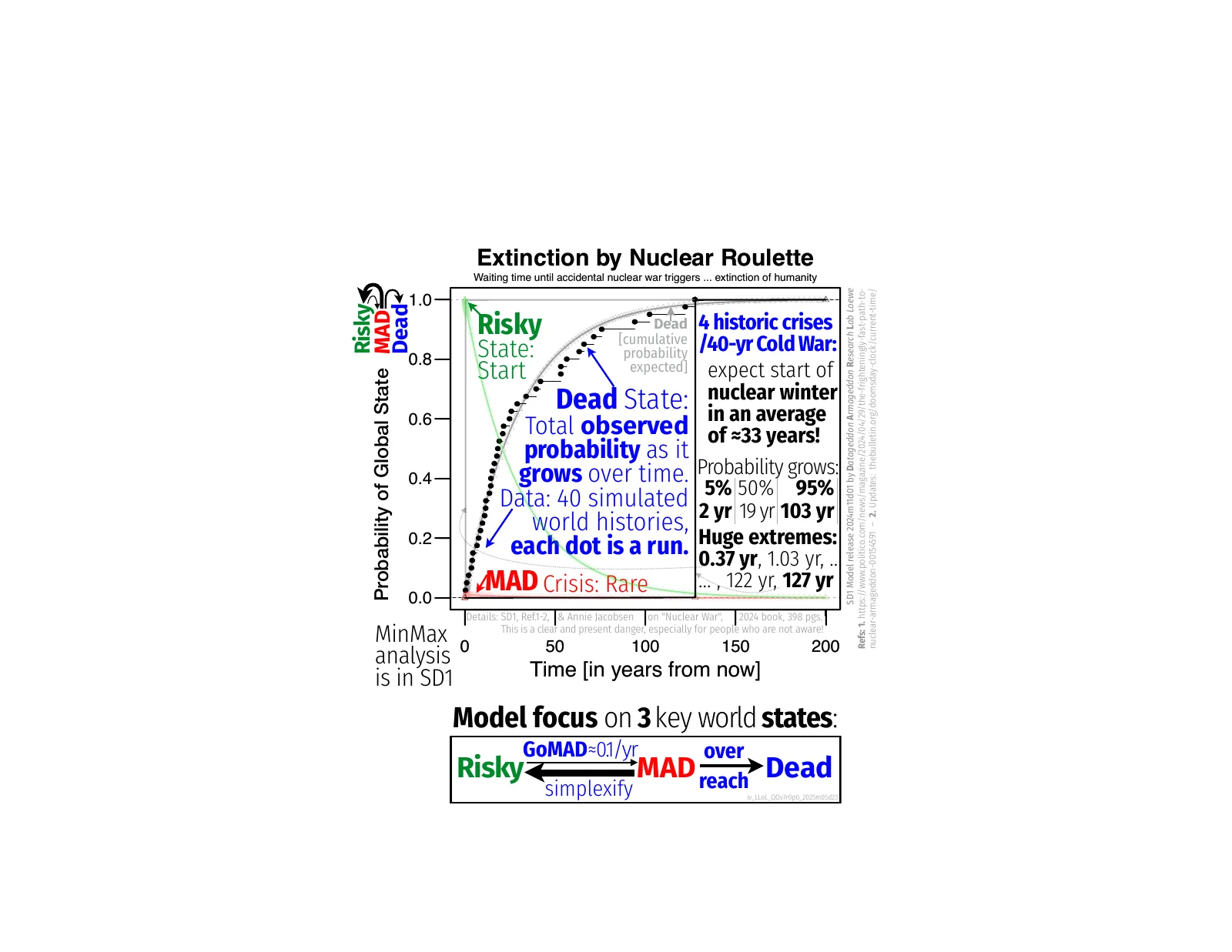
That number is not a slogan. Open it, move the inputs, and try to break it — the actuarial forecast, the SD1 poster (model, rates, sensitivity scenarios, simulation code), and the Matheo-b16 RiskyMAD study.
And it is not a counsel of despair. The same model shows a checkable way out — a step-ladder up from today’s gamble toward a ResearchCity that stabilises the system instead of betting it. The point here is small but load-bearing: an alternative exists, and it needs checking. The first move is the cheap one — #AuditTheMath.
So why frame any of this as a wager at all — isn’t that just Pascal’s discredited old bet? That is the fair challenge this page answers, starting from the beginning.
Pascal’s wager in plain terms#
You do not need any philosophy to follow this. Here is the whole 360-year story in three steps.
(a) What Pascal actually said. Blaise Pascal — the mathematician who helped invent probability theory — posed history’s most famous bet. You cannot prove God exists, he said, and you cannot prove God does not. But weigh the stakes: bet on God and you are right, the prize is infinite (eternal bliss); bet on God and you are wrong, you have lost almost nothing. So, as pure arithmetic, believe. It was the first time anyone reasoned about an unknown by weighing an outcome’s size against its chance — a genuine breakthrough, even though the conclusion was about faith.
(b) Why it breaks — the “many gods” problem. The bet has a famous hole. “God” is not one clearly-labelled option. Which God? A devout believer in another tradition, reasoning exactly as Pascal did, lands on a different one. And you can always imagine a god who does the reverse — one who rewards honest doubt and punishes the hedged, just-in-case belief Pascal is selling. Once there are many possible gods pulling in different directions, “just bet on God” no longer tells you which way to jump. If all we ever get is a fractured, partial view of the divine, Pascal’s clean two-box choice falls apart. On his own terms, this is fatal.
(c) Why it need not break — where the views overlap. But notice where that objection bites: only where the many views of God conflict. Where they agree, it has no force at all — and they agree, strikingly, on a few essentials. “Love your neighbour as yourself” — and its mirror, “do not do to others what you would hate done to you” — turns up, in nearly the same words, in Judaism, Christianity, Islam, Hinduism, Buddhism and Confucianism, and, with no deity at all, in plain secular ethics. On that common ground the views do not pull apart; they point the same way.
So the many-gods objection wrecks a bet on whose God — but not a bet aimed at what the views share. And the deepest shared ground of all needs no agreement about God whatsoever: that the accidental death of billions of our neighbours would be a catastrophe worth preventing. A believer of any tradition and a committed atheist stand together there. A bet aimed there does not break.
That is the move in one sentence: stop betting on which view is right, and act on what they overlap on. Hold on to it — the rest of this page is essentially the same move applied to probabilities of disasters instead of gods.
Two fair worries remain, and they deserve straight answers:
Isn’t this just a scare — a tiny chance of an enormous disaster, used to stampede me into paying? (Philosophers even have a name for that trick: Pascal’s Mugging.) The answer is the number. It is not tiny and not invented: worse than 1 in 40 a year, calibrated to real history, and laid out so you can open it and attack it.
Doesn’t a “wager” still demand a leap of faith? No — and that is the whole inversion. Pascal’s bet needed faith because its payoff (an afterlife) could never be checked. This one needs none, because it can be checked. The move it asks of you is not “believe.” It is “look.”
The boring part that actually works#
Strip the theology away and Pascal’s real discovery is almost dull — which is exactly why it is reliable. It is the logic you already use every day:
A smoke alarm goes off at 3 a.m. You do not know there is a fire. You get up anyway — because checking is cheap and being wrong is fatal.
A doctor suggests a test for something serious but treatable. You take it — not because you are certain you are ill, but because the stakes and the odds make looking the obvious move.
That is the whole engine: when an outcome is bad enough, and checking is cheap enough, you check — even when you are far from sure it is real. You weigh an outcome’s size together with its chance. No faith required; you do it for smoke alarms.
Pascal’s mistake was not the engine — it was forcing it into two boxes (“God or no God”). Real choices are almost never two boxes. So extend the same logic to the world as it actually is — many possibilities at once — and watch one move handle all three:
Many views of God? Don’t bet on one and hope. Act on what they overlap on (the step above).
Many possible catastrophes — pandemics, runaway AI, climate tipping points, nuclear winter — competing for scarce attention? Don’t choose by gut. Rank them: how big, how neglected, how fixable. Accidental nuclear winter scores high on all three — civilisation-scale, badly under-watched, and with a concrete way to change the game. (That makes it a top neglected risk — never the claim that it is the only one, or the biggest.)
Don’t even know the exact odds? You don’t have to. Pick the move that comes out best across the whole range of odds any honest person would grant.
These are the same move three times: when you are uncertain, don’t gamble everything on one guess — find the action that holds up across your uncertainty, and take it. For the divine, it is the shared ethic. For the threats, it is the big-neglected-fixable one. For the odds, it is the cheap, informative first step: look. That robustness — not a leap of faith, and not a frightening number — is what makes this wager hold.
Everything below is the rigorous proof that it does. Beginners can stop here with the whole idea intact; skeptics and experts, read on — the objections get no gentler.
The charge, at full strength#
(The audit in full. If you came to attack the argument — welcome; that is the point. Here is the attack at maximum strength, before any answer.)
There are really three distinct objections, not one, and a serious case has to survive all three.
(A) The many-gods / false-partition objection. Pascal’s matrix splits the world into “my God exists” versus “no God.” That partition is arbitrary and not exhaustive: the second column silently hides countless rival gods, some of whom punish the very belief Pascal recommends (Diderot: an imam could reason exactly the same way; Cargile sharpens it — for every real number you can posit a god who rewards only those who contemplate it). Because the choice of partition drives the verdict, the argument settles nothing. Ported charge: “your nuclear grid has the same disease — real vs not-real and act vs ignore are arbitrary binaries.”
(B) Pascal’s Mugging (Yudkowsky 2007; Bostrom 2009) — the attack a numerate reader reaches for first. A mugger promises an astronomical payoff at a tiny, ungrounded probability; naive expected value then “forces” you to pay. Ported charge: “you are waving a civilisation-scale catastrophe to extract $8 on a probability you cannot really justify.”
(C) The coercion / false-simplicity objection (the deepest). Any “bounded downside, unbounded upside” framing is a rhetorical device that short-circuits thought; a clean 2x2 is inherently a false partition, because real decisions under uncertainty are high-dimensional resource allocations, not two boxes. Ported charge: “the moment you dress a cost-effectiveness estimate as a wager, you have chosen seductive simplicity over rigour — the very oversimplification the project claims to oppose.”
If any one of these stands undefeated against the shipped argument, leading with a wager would be reckless. So each is answered below — not waved away.
Why Pascal’s wager actually fails#
Pascal’s matrix (Pensées, Lafuma 418) tells you that you are already “embarked” and must bet:
God exists |
God does not |
|
|---|---|---|
Wager for |
+∞ (salvation) |
a small finite loss (some foregone pleasures) |
Wager against |
a loss of ∞ (damnation) |
a small finite gain |
The sound core is just correct decision theory: under uncertainty, weigh each outcome by both its probability and its size. Pascal essentially invented expected-utility reasoning, and that part is not the problem. Two specific defects are:
Defect 1 — formal invalidity from the infinity. Because salvation is set at +∞, any strategy with a non-zero chance of eventually believing also scores +∞ (half of infinity is still infinity). So “wager for God” is not uniquely rational — “believe only if a coin lands heads,” or almost any act read as a mixed strategy, scores +∞ too. An argument that endorses every action endorses none (Hájek 2003, building on Duff 1986 and Jeffrey 1983).
Defect 2 — the partition cannot be ranked, again because of the infinity. The many-gods objection on its own is survivable — with finite stakes you would simply compare the rival hypotheses. What makes it fatal for Pascal is that every god ties at +∞ and every hell at the same infinite loss, so expected value cannot rank them and cannot break the tie.
The load-bearing observation: both lethal defects are caused by the infinite payoff. Pascal needed the infinity for rhetorical force — “infinite gain dwarfs any finite cost!” — but the infinity is exactly what detonates the argument.
The inversion: what survives the move into this world#
The Nuclear Winter Wager changes four things about Pascal’s bet at once. His was infinite, otherworldly, faith-based, unverifiable. This one is finite, this-worldly, evidence-based, checkable. The first swap — infinite to finite — is the decisive one:
Both fatal objections to Pascal depend entirely on the infinite utilities. With finite payoffs, mixed strategies no longer blow up (half of 100 plus half of something finite is just a finite number), and rival hypotheses no longer tie at infinity (different outcomes have different finite values, so you can simply compare them).
This is not special pleading; it is what the Stanford Encyclopedia of Philosophy entry — written by Pascal’s leading modern critic — says in as many words: going finite dissolves both the mixed-strategies invalidity and the infinite tie that powers the many-gods objection. The same source notes, correctly, that going finite “sacrifices Pascal’s core insight about the argumentative weight of infinity.” For this wager that is the goal, not a loss. We do not want the infinity — the whole point is that the stakes are large-but-finite and the probability is grounded in data.
So the strongest form of the charge — that the fatal flaw “ports straight into this world” — does not hold: the specific fallacies (the invalidity and the infinite tie) are infinity-powered, and this wager has no infinity. What the charge is right about is narrower, and it is the next section.
The residue — answered, not waved away#
Stripping the infinity defeats the fatal form of all three attacks, but it leaves a real, finite residue of each. Declaring victory without answering these would itself be an oversimplification.
(A′) Finite many-gods = many catastrophes. Why privilege accidental nuclear winter over engineered pandemics, misaligned AI, climate tipping points, asteroids? — Answer: with finite numbers this is not a paradox; it is ordinary prioritisation. The existential-risk field already has the tool: rank by scale × neglectedness × tractability. Accidental nuclear winter is singled out not by fiat but by a defensible claim on all three — civilisation-scale, badly under-watched, and with a concrete proposed mechanism for change. The discipline this imposes: the honest pitch is comparative, never exclusive. This page does not claim accidental nuclear winter is the only or the biggest risk — only that it is a top, badly-neglected, cheap-to-check one. (The literal many-gods version of the objection has its own answer — act on the shared ethic where the views overlap — in Pascal’s wager in plain terms (c) above, and under Across worldviews below.)
(B′) Pascal’s Mugging. — Answer (the single most important one for a numerate reader): a mugging needs a tiny, ungrounded, made-up probability. This probability is non-tiny and evidence-based — worse than 1-in-40 per year, calibrated to the Cold-War near-miss record, and robust across a wide range of parameter assumptions (the result holds whether the per-crisis death probability is taken as low or high). The distinguishing test is explicit and fair: “is the probability cheap talk, or is it calibrated to a data series you can open?” Here it is the latter — set out, with its sensitivity scenarios and simulation code, on the SD1 poster and developed in the Matheo-b16 RiskyMAD study. That is also the honest answer to the lay version, “you are just fear-mongering”: no — here is the model; try to break it.
(C′) The clean 2x2 is a false partition of the actions — conceded, and fixed below. The naive grid’s “you acted / you ignored” smuggles in that acting = funding this. That genuinely is a false dichotomy in the action dimension, and it genuinely is an oversimplification. The fix is not to abandon the argument but to partition the actions honestly — and the honest partition recommends not “pay” but “look.”
(D′) “But 1-in-40 is not fixed — arms control could just lower it.” True in principle, and it does not weaken the case. The near-term urgency is conditional on roughly-current, hair-trigger conditions (and the trend is worsening: more nuclear states, more crisis pathways). But the long-term result is policy-robust: halving the yearly rate only moves the median wait further out; it does not remove the absorbing “dead” state, because a system that keeps oscillating between safety and the brink is a repeated game against a small chance of extinction, and the probability of surviving every cycle still tends to zero. The one move that changes the game — not merely the timing — is to change the game itself, which is what the Jubilee System proposes. A genuine reduction would be the wager’s success, not its refutation.
Partition it correctly — and the move that survives#
Do not bet on a coin that is “really real” or “really fake.” The honest object is an uncertain probability p of catastrophe per unit time, and the rigorous move is not to pick a partition but to show that the recommended action is the same across the whole plausible range of p. (That is exactly the property Pascal’s matrix lacks: his verdict flips with the partition; this one does not. It is the numbers-version of the “act on the overlap” move from the plain-terms section — robustness, not a lucky guess.)
And the action space is not “fund this / ignore.” It is {ignore, look, commit}, and the first question is only look or not:
It turns out real |
It turns out not real |
|
|---|---|---|
Look (audit the math) |
You are among the few who checked in time. |
You spent an afternoon — and now you know, and can show others why. |
Don’t look |
You helped sleepwalk into it. |
You saved an afternoon. |
Two honest points about this table — stated plainly, because over-claiming here would repeat Pascal’s own mistake:
This is not strict dominance. In the “not real” column, not looking saves you the afternoon (bottom-right cell). So this is an expected-value argument with finite, estimable quantities — not a dominance proof, and not an infinity argument.
But the break-even probability is extraordinarily low, for two compounding reasons: looking costs only an afternoon, and looking has positive value even when the claim is false — you can then debunk it and warn others, which is a gain, not a pure loss. So for any probability above a small threshold, looking is the better bet — and the evidence-based estimate (worse than 1-in-40 per year) sits far above that threshold.
The distinction that keeps this from being a Mugging lives exactly here: the work is done by the number, not by the size of the catastrophe. A Mugging leans on a huge payoff to overwhelm a probability it cannot justify; this leans on a probability you can open and attack. At vanishing odds the recommendation would not hold — which is precisely why the number, and your check of it, carries the argument.
The result, in one line: strip Pascal’s infinity and his forced binary, partition the actions honestly, and the residue does not say “believe me.” It says “look” — because looking is cheap, is informative whether or not the threat is real, and wins across the whole plausible range of how likely it is. “Look, don’t trust” is #AuditTheMath. The resolution of the wager’s own false-partition problem turns out to be the project’s founding move.
EDEN ledger — HELD / BREACH, attack by attack#
Two versions of the wager, tested against every attack above. (HELD = the attack was withstood; BREACH = the attack succeeded.)
Attack |
Against the naive 2x2 grid |
Against the disciplined “audit the wager” version |
|---|---|---|
|
BREACH — real/fake and act/ignore read as arbitrary binaries |
HELD — the recommendation is invariant across the plausible range of p (and, for the literal many-gods reading, rides the shared ethic where views overlap), plus an explicit comparative (scale × neglectedness × tractability) framing |
|
BREACH — looks like “scary number, therefore give $8” |
HELD — the probability is calibrated and attackable, not tiny and ungrounded; and the ask is look, not pay |
|
BREACH — a clean 2x2 is the oversimplification |
HELD — the grid is demoted to an illustration; the real object is the checkable model, and the page says “audit it, don’t trust the framing” |
formal invalidity (Pascal’s own) |
not applicable (no infinity) |
HELD — finite expected value, no mixed-strategy blow-up |
morality objection (rewarding honest doubt) |
— |
HELD, and it inverts in our favour — this rewards checking, the honest act; a God who valued honest reasoning would approve of #AuditTheMath |
Is it an open question? No — it is decidable, and decided: the naive grid is a BREACH; the disciplined version is HELD. In EDEN terms the naive grid sits on a Knife Edge (its verdict flips with how you frame the partition — the signature of a brittle argument), while the disciplined version is a Green Meadow (many honest framings all converge on “look,” because it rests on robustness and a checkable number, not on a chosen partition). The only genuinely open variable is rhetorical: the word “Pascal” can prime a reflex dismissal in a sharp reader before they reach the fix — which is why this page names the flaw first.
Across worldviews and disciplines#
A global debate will come at this from more than one direction. The same backbone — finite, checkable, “look not pay” — answers each, but it is worth saying how.
Analytic philosophy / the “Pascal is broken” tradition. Agreed — and that agreement is the point. The fatal objections (mixed-strategy invalidity, the infinite tie) are honoured here, not dodged; they simply do not survive the move to finite stakes. What remains is the part even the critics grant: weigh outcomes by probability and size.
Decision theory / the rationalist and effective-altruism reader. The live worry is Pascal’s Mugging. The reply is a test, not a reassurance: a calibrated, openly published probability is not a mugging. And the comparative scale–neglectedness–tractability framing is exactly this reader’s own tool — used here without claiming this risk is the largest.
Faith traditions (of any name). No theology is asked for or smuggled in — and the many-gods objection, far from sinking this, is answered the way the traditions themselves converge: on the shared commitment not to let one’s neighbours be destroyed. This wager rides on that overlap, not on whose God is real, so no one has to abandon their fuller view to act on it. If anything the old morality objection to Pascal inverts here: this bet rewards honest checking, which most traditions prize as a virtue, not credulity.
The Global South, and anyone wary of another wealthy-world cause. The framing is deliberately comparative, not “this risk above your urgent needs.” And the funding model is built against capture: contributions are capped against influence-buying, with half given away to others in urgent need now. The ask is to look, never to defer present needs.
The hostile sceptic looking for a grift. Everything load-bearing is built to be opened and attacked, the ask is to audit rather than to pay, and the campaign caps its largest possible contribution far below the scale at which anyone could buy it. A claim you cannot check is worth nothing here — including this page’s own framing.
Underneath all of them is one structural fact: the recommended action — don’t let the world sleepwalk into mass death; look first — sits in the overlap of essentially every worldview, theist or atheist. That is the deepest form of the robustness this whole page rests on: a choice that is right across the full range of what reasonable people disagree about. This also passes William James’s classic test for when a wager-style choice is even legitimate — a living, forced, momentous option — without leaning on any of the moves that make Pascal’s own argument fail.
The move is “look”#
If the wager holds, it does not end at “believe me” — it ends at a task anyone can start:
Look. Open the forecast and try to break it: the actuarial forecast, the SD1 poster (states, calibrated rates, sensitivity scenarios, and the simulation code), and the Matheo-b16 RiskyMAD study for the rigorous treatment.
Then — only if you were convinced, and as a later, softer step, never the thing the grid “proves” — there is a capped, give-away-first way to help fund the review: the ~$8-per-person-per-year ask, with half of everything given away and a hard ceiling against capture.
The companion Nuclear Winter Wager section states the short, decision-first version of the same case; this page is the deeper audit of the bet itself. Both land in the same place: don’t trust me — audit it.
Who watches the watcher?#
The tweets that may have sent you here raise a fair follow-up: if someone is going to watch a risk this big, who watches them? That is a design problem, not a popularity contest. The proposal inverts the usual arrangement: instead of one watcher over everyone (the Big-Brother default), build a transparency standard that lets everyone watch the watcher — contributions capped so no one can buy influence, half of everything given away, mistakes logged in the open, every critique invited and answered. Whoever holds the role — a “canary in Earth’s mine,” a Mutually Assured Destruction Inhibitor — is then accountable to all, and replaceable by anyone who can do it better.
LLoL volunteers only as a backup candidate of backup candidates: not because he is the right person, but because the seat is empty and the clock is running. If someone better-placed brings a worked-out version, he will audit their math and gladly follow. The point is the role and its guardrails, not the person in it — which is exactly why it must be built to be watched. How the role and the standard could work is sketched on the buy-in page (a dedicated write-up is in preparation).
Sources and further reading#
A. Hájek, “Pascal’s Wager,” Stanford Encyclopedia of Philosophy (plato.stanford.edu/entries/pascal-wager) — the many-gods objection, the mixed-strategies invalidity, the finite-utility escape, and the morality objection.
A. Hájek (2003), “Waging War on Pascal’s Wager,” The Philosophical Review 112(1) (with Duff 1986 and Jeffrey 1983) — the formal-invalidity argument.
N. Bostrom (2009), “Pascal’s Mugging,” Analysis 69(3); the term was coined by E. Yudkowsky (2007) — the tiny-probability / huge-payoff exploit of naive expected value.
D. Diderot (1746), Pensées philosophiques (the origin of the many-gods objection), and J. Cargile’s real-number-indexed sharpening of it.
W. James (1896), “The Will to Believe” — a genuine option is living, forced, momentous; a useful test for when wager-style reasoning is even legitimate.
On the cross-traditional “Golden Rule” / ethic of reciprocity (step (c)): the comparative-religion literature documents “love your neighbour as yourself” and its negative twin across the major traditions (see, e.g., Karen Armstrong’s 2009 Charter for Compassion).
The effective-altruism / existential-risk importance–tractability–neglectedness frame for choosing among many catastrophes under finite resources.