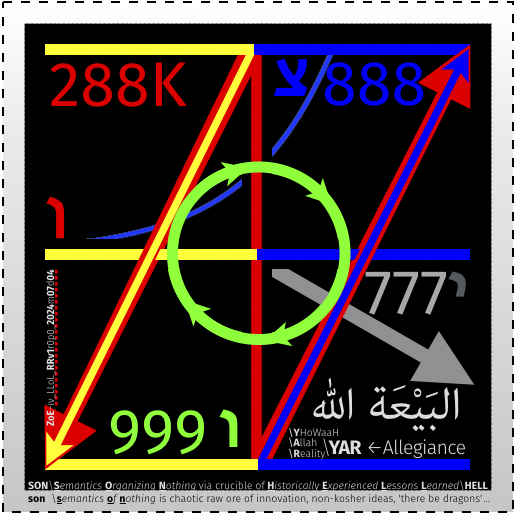
The Choice#
How can anyone talk about “The Choice” as if there were only one? Aren’t there infinitely many choices?
Yes, there are.
However, there are fundamentally only two mutually exclusive paths:
There are also decisions that commit to neither — but these are essentially only prolonging life in limbo. They are inconsequential, for as long as they don’t get in the way by killing time and opportunities for making the life-giving choices that do matter most.
Therefore, The Choice is a death-or-life choice.
Why “default” leads to death#
The crisis shows the math: for most people, the risk of dying in accidental nuclear winter exceeds their risk of dying in a car crash. The challenge shows why humanity cannot respond: the BABL algorithm — Blindly Assuming Blind Leveraging — is the default operating system of every human institution.
The default does not require malice. It does not require stupidity. It only requires inaction — the passive assumption that whatever has been working will keep working. This is the most natural thing in the world. It is also, at civilizational scale, lethal.
Death by default is not a punishment. It is a consequence — the natural outcome of systems that stop self-correcting. Every empire that has fallen, every civilization that has collapsed, every organization that has drifted from its mission has followed the same trajectory: the BABL cascade running unchecked until the accumulated errors produce a sudden, catastrophic failure that insiders failed to see coming.
The formal models on this site show that this pattern is not random. It is algorithmic. It can be identified, named, and — in principle — interrupted.
Why “choice” can lead to life#
Life by choice requires something specific: honest self-assessment followed by deliberate self-correction. In the language of the formal models, this means running the ZION cascade instead of the BABL cascade — the same innovation engine, wired for life instead of self-destruction.
This sounds abstract. In practice, it means:
For a person: choosing to check your assumptions rather than defend them. Asking “what am I missing?” rather than “who agrees with me?”
For an organization: building systems that catch drift before it becomes catastrophe. The StayVS system on this site is one example.
For a civilization: implementing Jubilees — periodic, structured resets that prevent the accumulation of systemic fragility.
The choice is not a one-time event. It is a continuous practice of self-correction. The Jubilee System is the framework for making that practice structural, transparent, and accountable.
How complicated does it get?#
How exactly the choice plays out in real life can be complicated. Or not. It depends.
What is not complicated is the fundamental structure:
Every system that stops self-correcting eventually self-destructs. The formal models argue this rigorously.
Every system that maintains honest self-correction can sustain itself over the long term. The same models argue this as well.
The transition from one to the other is possible. It is also hard, because the BABL cascade actively resists being interrupted — not through conspiracy, but through the simple inertia of cached assumptions.
The purpose of this website and of ResearchCity is to provide life-giving decision-support: the data, the models, the institutional infrastructure, and the transparent review processes that help people, organizations, and civilizations make the choice that leads to life rather than the default that leads to death.
The next step#
The choice without a plan is just wishful thinking. The plan is the solution.
And for artificial intelligence, the choice has now been put formally to the institutions best placed to make it: the open AI-safety proposal (2026m07d06) — an invitation to review the math, with the verdict published either way.